Excavators dig trenches and footings, level and shape ground, clear land, break concrete and load trucks, and with the right attachment they also drill holes and handle logs and rock. In Australia most of that work is done by mini excavators, or mini diggers, under about 6 tonnes, on house sites, farms, landscaping jobs and small civil works. Bigger machines take over for bulk earthworks, roads, quarries and mines.
Digging trenches and footings
Digging trenches is the job excavators do more than any other. A narrow trenching bucket cuts a clean trench for water, sewer, stormwater, power and telecommunications conduit. The spoil sits beside the trench, ready to backfill once the pipe or cable is in.
Footings are the other everyday digging job: strip footings for slabs and walls, pier holes for decks and verandahs, and footings for retaining walls and sheds. An auger on a mini excavator drills pier holes faster and neater than a bucket.
Owners and builders often dig the trench themselves and leave the connection to a licensed plumber or electrician, as most states require. Before any trench, lodge a free Before You Dig Australia enquiry and confirm buried services by hand before the bucket goes in. Striking a gas line or power cable is one of the most serious risks on any dig.
Earthmoving, levelling and site preparation
Excavators prepare sites by stripping topsoil, cutting and filling to level, shaping batters and backfilling around new work. On a mini excavator the front blade does much of the finishing: it pushes spoil back into a trench and levels a pad without a second machine.
A wide batter or mud bucket gives a smoother finish when shaping slopes and drains. Some operators fit a tiltrotator, a wrist between the arm and the bucket that tilts and rotates it, so they can cut angles and falls without repositioning the machine. For moving large volumes of soil across a site, though, a loader is faster than an excavator swinging and tracking back and forth.
Land clearing and farm work
On farms and rural blocks, an excavator clears scrub, pulls stumps, digs drains and cleans out dams. A grapple or thumb lets the machine pick up logs, rocks and branches instead of pushing them around with the bucket.
Fence lines, culverts, troughs and water lines all start with a trench, so a farm machine often spends as much time trenching as clearing. For that mix of work, a 5 to 6 tonne machine such as the Yuchai YC60 has the reach and weight for stumps and dam cleaning. A 1 to 2 tonne machine suits fencing and small water lines.
Felling large trees is a different job. Forestry excavators carry purpose-built harvester heads, and a mini excavator isn't a tree-felling machine.
Landscaping and residential jobs
Landscapers and home owners use mini excavators for garden beds, retaining walls, paths and driveways, drainage, pool excavation and removing old slabs or sheds. Access decides the machine more than anything else, because side passages and garden gates rule out all but the smallest machines.
Rubber tracks are the usual choice on residential work because they're kinder to lawns, pavers and driveways than steel tracks. A short or zero tail swing machine keeps its rear inside the track width as it rotates, which matters along fences and house walls.
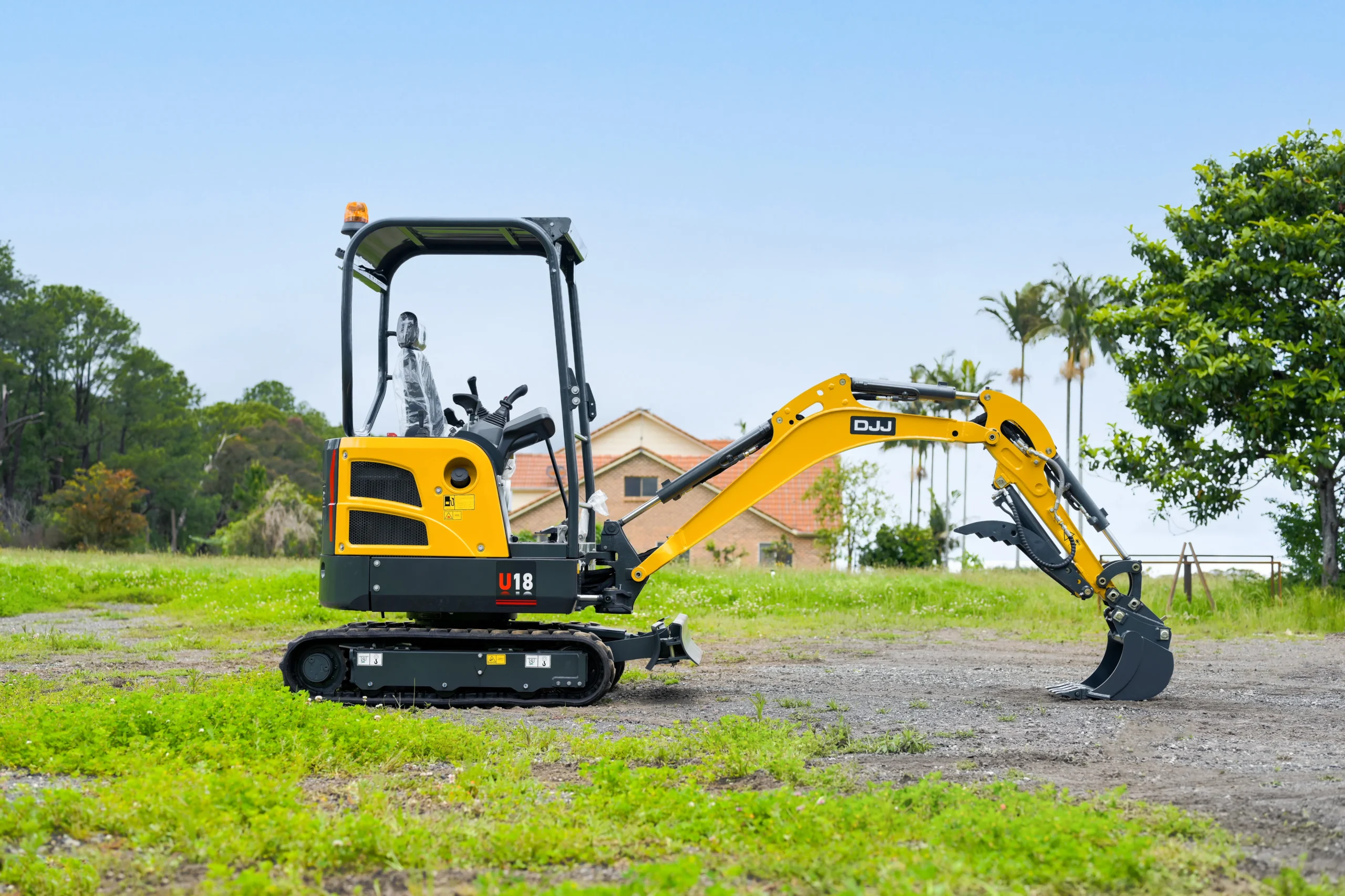
A 1.8 tonne machine such as the Yuchai U18 digs to 2,295 mm, deep enough for most house service trenches and retaining wall footings. The 1 tonne class trades depth for access and fits through narrower gaps.
Demolition and breaking concrete
Excavators demolish small structures, break up slabs, driveways and old footings, and load the rubble for removal. A hydraulic hammer does the breaking, and a grapple or demolition bucket sorts concrete, steel and timber for recycling.
Match the hammer to the machine, because a hammer that's too heavy for a small excavator makes it unstable and wears the boom. Mini excavators handle residential slabs and sheds well, while multi-storey buildings need large machines with high-reach booms.
Check for asbestos before demolishing anything built before 1990. Asbestos has to be identified first, and removing more than 10 square metres of non-friable asbestos needs a licensed asbestos removalist.
Loading trucks and handling materials
An excavator loads trucks by digging from a stockpile or a cut and swinging the bucket over the truck's side, which is quick when the machine can stay in one spot. The maximum digging height on the spec sheet tells you whether the bucket clears the side of your truck or trailer.
Excavators also place pipes, pits, rocks and other heavy items. Lifting a suspended load, such as a pipe on chains, counts as crane work. The machine needs a rated lifting point and a load chart, and the operator may need extra training or a licence, depending on the state and the load. Our guide to what an excavator is and the licence rules that apply covers this in more detail.
Specialist excavator uses
Specialist excavators handle work a standard machine can't, and most of it happens far from house sites:
- Mining and quarrying: large excavators and mining shovels load haul trucks with rock and ore
- Dredging and deep drains: long reach excavators clean out rivers, channels and deep drains
- High-reach demolition: extra-long booms take tall buildings apart from the top down
- Suction excavation: water or air breaks up the soil and a vacuum removes it, exposing underground services without touching them
- Amphibious work: machines on floating pontoon tracks work in swamps and shallow water
None of these jobs suit a mini excavator, but suction excavation is worth knowing about. Utility contractors use it to expose pipes and cables before a standard excavator digs nearby.
What can you do with a mini excavator?
A mini excavator can do almost every job above at a smaller scale: trenching, footings, landscaping, light demolition, stump removal, drainage and loading small trucks. Its limits are depth, reach and the weight it can handle. The table matches common jobs to the four Yuchai mini excavators DJJ Equipment sells.
| Model | Operating weight | Maximum digging depth | Typical jobs |
|---|---|---|---|
| Yuchai E12 and YC10 | 1.0 t | 1,415-1,435 mm | Garden beds, irrigation and shallow service trenches, post holes with an auger, tight backyard access |
| Yuchai U18 | 1.8 t | 2,295 mm | House service trenches, footings, retaining walls, stumps, landscaping, small hire fleets |
| Yuchai YC60 | 5.7 t | 3,720 mm | Deeper footings and drains, farm dams and clearing, loading trucks, breaking slabs with a hammer |
For deeper basements, bulk earthworks or solid rock, a midi or larger excavator is the better tool. You can compare the full specifications of each model in our range of excavators for sale.
Which attachments suit each excavator job?
Attachments decide which jobs an excavator can take on, and most owners start with a few buckets and add one or two tools. The table pairs common jobs with the attachment that does them.
| Job | Attachment |
|---|---|
| Digging and trenching | General purpose bucket, narrow trenching bucket |
| Shaping slopes, drains and clean-up | Wide batter or mud bucket, tilt bucket |
| Pier and post holes | Auger |
| Breaking concrete and rock | Hydraulic hammer |
| Cracking hard or compacted ground | Ripper |
| Logs, rocks and demolition waste | Grapple or thumb |
| Compacting trench backfill | Compaction plate |
Every attachment has to suit the machine's weight class, hitch and hydraulic flow. Our guide to excavator attachments explains how to choose each one.
Quick hitches make changing tools fast but need care, because an attachment can fall if a pin isn't fully locked or the hitch loses pressure. Fully automatic hitches are the safer choice, and SafeWork NSW has phased out semi-automatic hitches.
When an excavator is the wrong machine
An excavator is the wrong machine when the job is mostly carrying material rather than digging it. Excavators track slowly and aren't built to drive loads around a site, so a loader or skid steer moves stockpiles and spreads gravel far faster.
A mini excavator in particular struggles with:
- Solid rock in volume: a hammer on a small machine breaks rock slowly, so a larger excavator or a rock contractor is usually more economical
- Depth beyond its range: a machine working at its limit is slow and less stable, so size up rather than stretch a small machine
- Very large volumes: bulk earthworks on a big site are a job for a midi or larger machine and trucks
- Soft, saturated ground: even tracks sink in waterlogged clay, so wait for it to dry or lay ground mats
If your site needs both digging and carrying, an excavator working alongside a skid steer covers most small jobs. Our guide to what a skid steer is and how it works shows where that machine fits.
Is buying a mini excavator worth it?
Buying a mini excavator is worth it when you have regular digging work: a builder, landscaper, plumber or farmer who would otherwise hire a machine most weeks, or a hire business adding to its fleet. For one job a year, hiring a machine or paying a contractor usually costs less.
Owning one also means moving it. A 1 to 2 tonne machine usually travels on a trailer behind a ute, but check the trailer's rating and the vehicle's towing capacity against the machine, trailer and attachments together. Gerd, a customer of our Brisbane branch, bought a U18 and a trailer at the same time, and the team sourced a trailer with the right weight for Gerd's ute.
I am extremely happy with my purchase of the U18 excavator & trailer.
Gerd v., Brisbane branch customer
In Boorowa NSW, Milton runs a hire business and added a 1.8 tonne excavator to the dry hire fleet. Two years later it was going out a lot, with no problems so far. These stories come from public Google reviews of our Brisbane and Sydney branches, and you can read the full Google reviews of DJJ Equipment Brisbane.
An excavator earns its place when digging is the main job, and a mini excavator covers most trenching, footings, landscaping and farm work in Australia. If you mostly move material, a loader or skid steer may serve you better. To match a machine to your work, call DJJ on 1800 355 388. Tell us the jobs you do most, the depth you dig to, the narrowest access point and how you'll move the machine.