
To choose a large excavator, start with the trucks it will load and the material it will dig. Then check the dig depth and stick you need, the track shoes for your ground and the lift chart if it will lift. After that, plan how you will move it, because a large excavator needs a float and often a permit. Site entry rules at quarries and mines can decide the machine before the price does.
What counts as a large excavator
There is no official size class for a large excavator, and manufacturers draw the lines differently. Some call machines of 20-31 t medium and start their large range at about 37 t, while mining excavators run to hundreds of tonnes. In this guide, a large excavator means a crawler machine of roughly 30 t and up that works in civil construction, bulk earthworks and quarries.
| Rough class | Typical work | What decides the choice |
|---|---|---|
| About 30-50 t | Bulk earthworks, large pipelines, loading road trucks, quarry faces | Truck pass match, dig depth, transport |
| About 50-100 t | High-production quarries, mass excavation, mine pre-strip | Production rate, site entry standards, permits |
| Over 100 t | Mining shovels and face excavators | Mine fleet planning, outside the scope of this guide |
Almost every excavator above about 25 t runs on tracks, because wheeled excavators are mostly sold up to about 20-25 t. Reduced tail swing models exist up to roughly the 30-35 t class; above that, a conventional tail swing is the norm.
Match a large excavator's bucket to your trucks
The bucket-to-truck match is the most important sizing decision for a large excavator that loads trucks. Aim to fill each truck in three to five passes. Work out the bucket payload by dividing the truck's payload by the number of passes, then adjust for the material's density and how full the bucket really gets.
Fewer passes keep the trucks moving, but a bucket that is too big for the material slows the cycle and overloads the machine. A short swing angle between the face and the truck, ideally well under 90 degrees, saves more time than extra engine power. As a guide, 45-50 t machines take buckets of about 1.1-3.2 m³, with heavy rock buckets at the small end.
Dig depth, reach and stick length
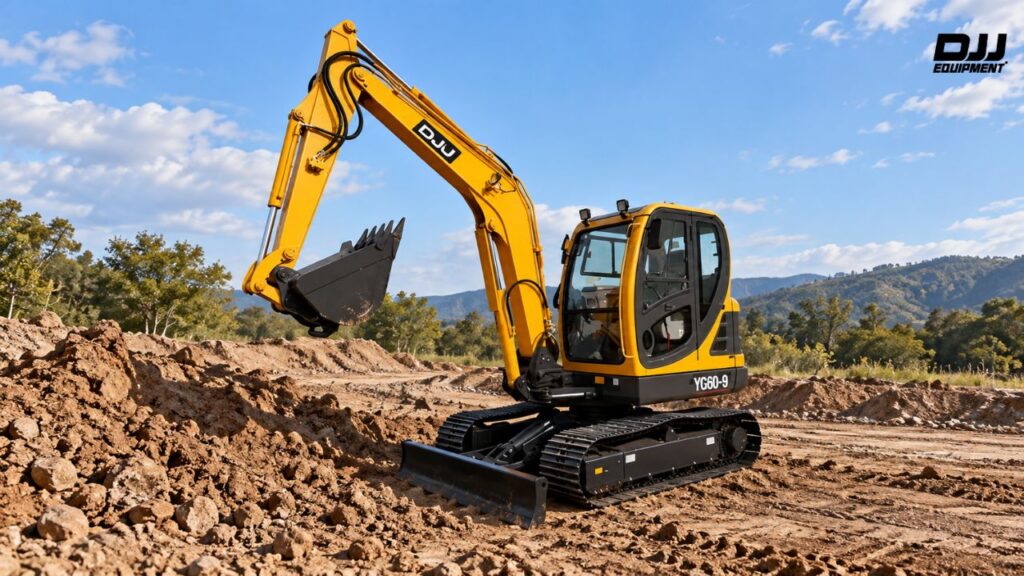
A large excavator's dig depth and reach depend as much on the stick as on the machine. With a standard boom and stick, 40-50 t excavators dig roughly 7.2-8.2 m deep. A long stick or long-reach front digs deeper and reaches further, but carries a smaller bucket and less breakout force.
Choose the stick for the job you do most. A shorter stick suits truck loading and rock, while a longer one suits deep trenches, batters and work over water. Check the working range diagram for the exact boom, stick and bucket combination you are buying.
Hydraulics and attachments on large excavators
Large excavators move a lot of oil: main pump flow on 45-50 t machines can exceed 700 L/min at pressures above 35 MPa. Auxiliary hydraulic circuits are only needed if you will run powered attachments such as hammers, shears or tilt couplers, so specify them when you order rather than retrofitting.
A quick coupler should meet AS 13031:2023, the current Australian Standard, and on a large machine it is part of the load path when lifting. The coupler also decides which excavator attachments you can swap on and off.
Undercarriage, track shoes and ground pressure
The undercarriage decides how a large excavator stands on your ground. An LC (long carriage) frame gives more stability when lifting or digging over the side. Wider track shoes spread the weight: on a typical 45-50 t machine, ground pressure falls from about 72 kPa on 700 mm shoes to about 57 kPa on 900 mm shoes.
Use wide shoes for soft ground and narrower shoes for rock and frequent travel, where wide shoes bend and wear faster. Ask how the undercarriage was set up on any used machine, because it is the most expensive part of an excavator to maintain.
Lifting with a large excavator
A large excavator that lifts and suspends loads needs a rated lifting point and a load chart in the cab. Under AS 10567, the rated capacity is the lower of 75% of the tipping load and 87% of the hydraulic lift capacity, and pick-and-carry is rated at 66%. The WorkSafe Victoria guidance on excavators used to lift loads sets out the checks, including never lifting a load of unknown weight.
No high risk work licence is needed to dig with an excavator of any size. Lifting is different: slinging that needs judgement calls for a dogging licence. In WA, using a slewing machine with a safe working load over 3 t as a crane has needed a C2 crane licence since 10 August 2025. A dogging licence plus the SLELIC301 unit is accepted instead under an exemption. Every large excavator sits above that 3 t threshold.
Moving a large excavator: floats and permits
A large excavator travels on a float, and the move often needs a permit. General heavy vehicle limits are 2.5 m wide and 4.3 m high. An excavator on a float is a Class 1 load-carrying vehicle. Moves that fit the national dimension and mass exemption notices can travel without a permit, depending on the state and its conditions.
Larger moves need an oversize permit through the NHVR, or through the state road authority in WA and the NT. When buying an excavator in WA, that means Main Roads WA, because WA runs its own heavy vehicle rules rather than the national NHVR scheme. Pilot and escort vehicle rules are set by each state: in Queensland, for example, a pilot or escort travels with a load wider than 3.5 m or longer than 25 m. Get transport quotes before you buy, especially for regional sites.
Quarry and mine site rules
Quarries and mines set their own entry standards for mobile plant, so check them before you choose a machine. In NSW, many sites still use the MDG 15 guideline for mobile plant as a checklist. It was best-practice guidance rather than law, and the regulator now lists it as expired. Queensland treats a quarry as a mine under the Mining and Quarrying Safety and Health Act 1999, regulated by Resources Safety and Health Queensland.
Protective structures matter on every site: look for a ROPS tested to AS ISO 3471:2020 and a FOPS tested to AS ISO 3449:2020. Australia has no national emission standard for new non-road diesel engines yet. Many large machines still carry engines with a diesel particulate filter and DEF, which need low-sulphur diesel and a DEF supply on site.
Buying a used large excavator
A used large excavator can carry many thousands of hours, so the records matter more than the paint. Compare the hours with the service history, check undercarriage wear and ask for oil analysis results. Samples are usually taken every 250 hours for the engine and 500 hours for other compartments, and at least three samples show a trend. Search the serial number on the PPSR for money owing before you pay.
Large excavator prices vary widely with age, hours and size.
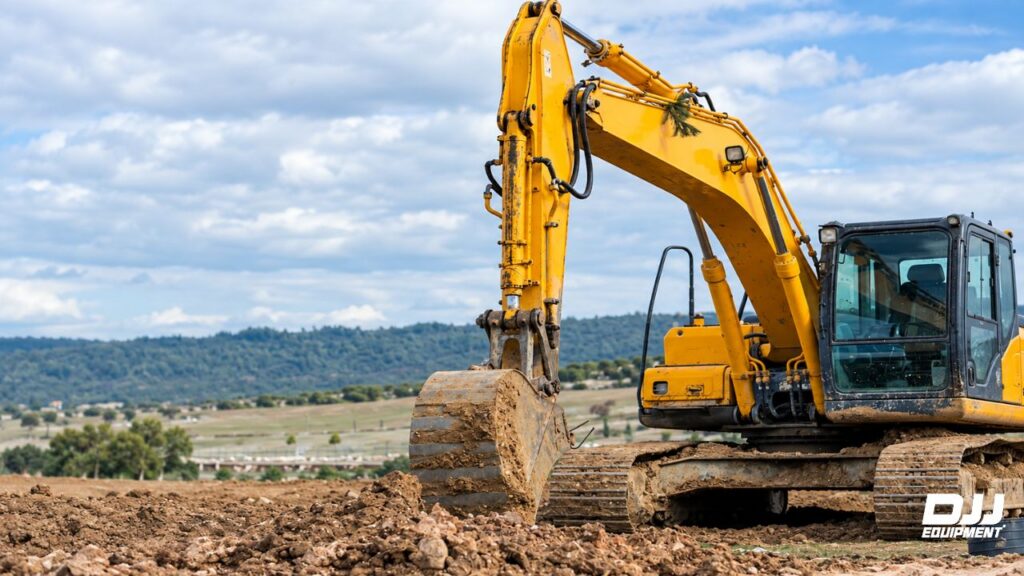
Owning a large excavator: depreciation and use
The ATO's effective life for a hydraulic excavator used in construction is 10 years. A machine of this size is far above the $20,000 instant asset write-off, so it is depreciated over time. Whether to buy, finance or hire comes down to how many hours a year the machine will work. A large excavator that sits idle between projects costs money every month, while one that works most days usually pays to own.
Large or small: choosing the right class
Many jobs that look like they need a large excavator are done faster and cheaper with a smaller machine that fits the site and travels on a trailer. DJJ Equipment doesn't sell large excavators, but it sells Yuchai mini excavators from 1 t to 5.7 t for farms, landscaping, house sites and small civil work. In that class, choosing an excavator comes down to dig depth, site access and how you move it.
Spare parts and servicing for the Yuchai range are handled through the branches at Silverwater, Meadowbrook and Bayswater.
If one of the Yuchai mini excavators up to 5.7 t could do your job, call 1800 355 388.