A forklift tips over when the combined centre of gravity of the truck and its load moves outside its stability triangle. You prevent it by choosing a truck and tyres that suit the ground, keeping every lift inside the load chart for the height you work at, maintaining the parts that keep the truck stable, and running the site so that licensed, trained operators wear their seatbelts and know the hazards. It matters: SafeWork NSW lists being crushed in a forklift tip-over as one of the three main ways workers are killed or seriously injured in forklift incidents in NSW.
Why forklifts tip over
A counterbalance forklift rests on three points: the two front wheels and the pivot at the centre of the rear axle. The triangle between them is the stability triangle. As long as the combined centre of gravity of the truck and the load stays inside it, the truck stays upright. Anything that pushes that centre of gravity towards an edge, such as a heavy or raised load, a sharp turn, a slope or a sudden stop, brings the truck closer to tipping.
A forklift can tip three ways, and each has its own common causes, taken from the hazards that Australian regulators list:
| Tip-over | What happens | Common causes |
|---|---|---|
| Sideways | The truck rolls over to one side | Turning too fast, turning with the load or forks raised, driving across a slope, uneven ground or potholes, an unevenly balanced load |
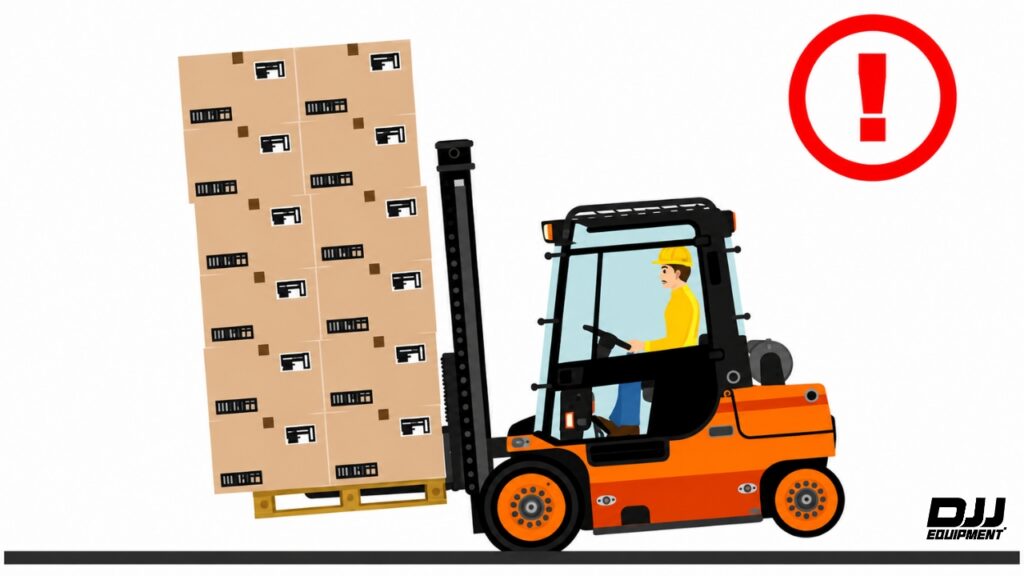
| Forward | The rear wheels lift and the truck pitches over its front wheels | Overloading, a load too far out on the forks, braking hard with a load, accelerating quickly in reverse, tilting a raised load forward, carrying a load facing down a slope |
| Backward | The truck tips back over its rear | Accelerating hard with a load raised high, a high load with the mast tilted fully back, climbing a ramp steeper than the manufacturer allows |
Two points surprise many people. First, an empty forklift is not safer. Queensland's forklift safety guide says most tip-over incidents involve unloaded forklifts, and Safe Work Australia explains why: without a load the centre of gravity sits near the narrow rear of the triangle, so an empty truck can tip with a simple sharp turn, even on a level surface. Second, the rear end swings fast. Safe Work Australia notes that a forklift's rear can swing at up to three times its forward speed, and rapid tail swing can tip the truck over.
Choose a forklift and tyres that suit the ground
Many tip-overs start with a truck working on ground it wasn't built for. Before you buy or hire, match the truck to the floor, the yard and every slope it will cross:
- Cushion tyres are pressed-on solid tyres for smooth, level indoor floors only
- Solid or pneumatic tyres suit sealed yards, loading areas and mixed indoor and outdoor work
- Rough terrain forklifts with large pneumatic tyres and high ground clearance suit gravel, dirt, building sites and unsealed yards
On rough or sloping ground, a warehouse forklift fitted with pneumatic tyres still has low clearance and a drive built for hard, level surfaces. Rough terrain forklifts are built for it, and the brochure gradeability shows the difference: Hangcha, a brand DJJ Equipment is a dealer for, rates its 2WD diesel rough terrain forklifts at 22 to 32% laden gradeability, the 4WD models at 46 to 60% and the high-voltage lithium models at 52 to 63%.
Gradeability is how steep a slope the truck can climb, not a safe slope to work on. The slope you can safely travel with a load is set by the manufacturer's instructions for that model, and Safe Work Australia says not to travel across a slope greater than the manufacturer recommends. Ask for that figure, and check the site for kerbs, gutters, dock edges, speed bumps and potholes. Queensland's guide singles out uneven ground with a height difference of more than 20 mm across the front wheels as a tip-over risk.
Stay inside the load chart at the height you lift
A forklift's rated capacity applies only at the load centre and lift height on its data plate. Lift higher, carry a longer load or tilt the mast forward, and the truck can safely carry less, because the raised load moves the centre of gravity up and forward.
The data plate of a Hangcha 3.5 tonne rough terrain forklift shows how quickly it falls. At a 600 mm load centre it allows 2,900 kg at a 3,250 mm lift with the mast vertical, 1,890 kg at the same height with the mast tilted forward, and 1,320 kg at 4,500 mm tilted forward. A load that's safe at the first height can tip the same truck at the third.
Attachments cut capacity again, because they add weight in front of the wheels and push the load further out. An attachment can be used only when it's listed on the data plate with the capacity of the truck and attachment together, which is the first check when choosing a forklift attachment.
Two habits help at the buying stage. Queensland's guide warns that the model number painted on the side of a forklift can be mistaken for its capacity, so read the plate, not the paintwork. It also suggests buying or hiring a forklift with slightly more capacity than you actually need, so your heaviest load at your highest lift sits comfortably inside the chart.
Maintenance that keeps a forklift stable
A forklift that left the factory stable can become unstable through wear. These are the parts that matter most for tipping:
- Tyres: Safe Work Australia notes that under-inflated tyres can reduce stability. Check pneumatic tyre pressures, and look for wear, cuts and chunking on every tyre type
- Mast chains: worn or unevenly adjusted chains let the carriage sit unevenly or drop
- Mast and carriage: excessive play in the mast rollers or channels lets a raised load sway
- Tilt cylinders: a mast that drifts forward under load is tilting the load out on its own
- Brakes and steering: a truck that pulls or stops unevenly is harder to keep steady with a load
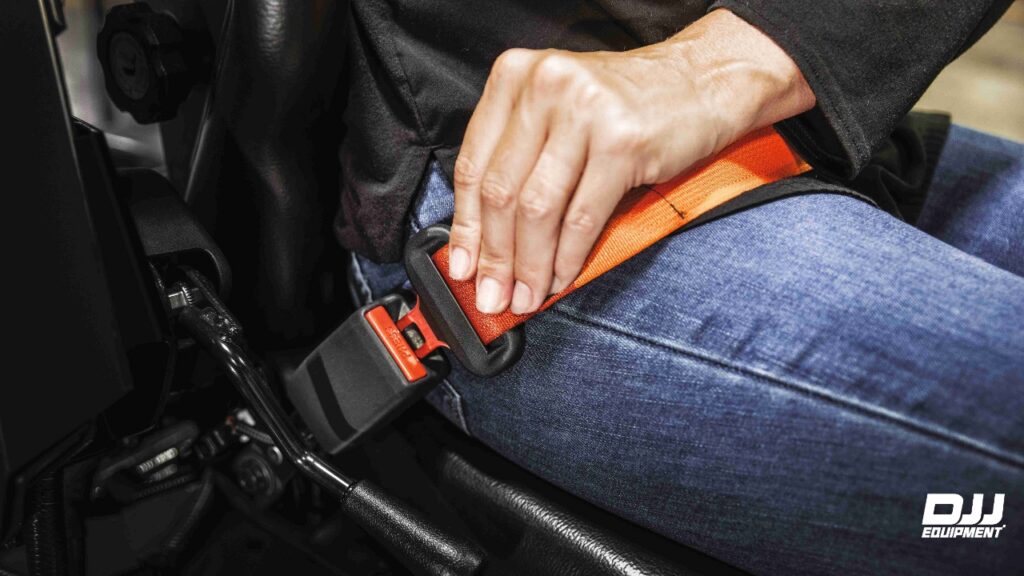
- Seatbelt and interlock: the restraint has to latch and release every time
- Load backrest, overhead guard and data plate: in place, undamaged and readable
Operators should run a pre-start check at the start of each shift and whenever they change trucks, using the manufacturer's checklist. A daily pre-start checklist covers these items with the rest of the truck.
Any fault that could affect safe operation means the forklift is tagged out and taken out of service until it's repaired. Keep a record of each check, so a fault that keeps coming back gets noticed and fixed properly.
Dust, water and heavy use wear safety parts faster than people expect. At Kimbriki Environmental Enterprises, dust affected the seat harness connection on a Hangcha high-voltage lithium rough terrain forklift, and DJJ fitted a dedicated harness connection socket at no charge. Regular forklift servicing and repairs find problems like this before they matter, and DJJ services all brands, with on-site service within 50 km of its Sydney, Brisbane and Perth branches during business hours.
What employers must do
Under Australian work health and safety law, the business that manages or controls a forklift must manage the risks of it overturning and of the operator being thrown out. In practice, regulators expect a business to:
- make sure every operator holds a High Risk Work Licence class LF for forklift trucks, or class LO for order pickers, and sight the licence
- give operators training and instruction for the trucks, attachments and site they work with, including pedestrian-operated trucks that don't need a licence
- plan site traffic: set speed limits, separate people from forklifts, and set safe systems for loading docks, ramps and trailers
- provide, maintain and enforce the use of operator protective devices such as the overhead guard and seatbelt
SafeWork NSW's forklift guidance also says to include seatbelt use in site rules and to consider a seatbelt interlock, which stops the truck operating until the belt is fastened. Queensland's guide adds that seatbelts can be retrofitted to older forklifts. When you buy or hire, check that the truck suits the surfaces, loads and tasks, and ask what safety features it has.
Seatbelts and what to do if a forklift tips
A seatbelt keeps the operator inside the overhead guard. SafeWork NSW says operators of sit-down counterbalance forklifts are more likely to be killed or seriously injured in a tip-over if they aren't wearing a seatbelt, and that the instinct to jump clear is often how operators end up crushed by the overhead guard. NSW recorded 1,538 forklift-related incidents from 2017 to 2022, and SafeWork NSW lists operators being ejected in tip-overs, for example because they weren't wearing a seatbelt, among the common contributing factors.
If a sit-down forklift starts to tip, Australian regulators give the same advice:
- don't jump
- stay seated with the seatbelt on
- brace your feet and hold on tight
- keep your arms and legs inside the overhead guard
- lean away from the side the truck is falling towards
Seatbelts should be worn wherever they're fitted. The only exception regulators allow is where a risk assessment shows wearing one isn't safe and other controls stop the operator being thrown out. For stand-on trucks and reach trucks, follow the manufacturer's manual and your training.
Want a forklift that suits your ground and your heaviest lift? Tell our team about your site, your loads and the height you lift to, and we'll check the right truck, tyres and load chart with you, whether you buy or hire. Call 1800 355 388 for sales and hire, or 1300 646 747 for servicing and repairs.