Forklifts are key tools in warehousing, logistics, manufacturing, and retail. When you need a new one, the big question is: should you hire or buy one? It's not just about price, you need to consider how often you'll use it, how busy your business is, and your cash flow. This blog explains the pros and cons of forklift hire and purchase to help you make the best choice.
Benefits of Forklift Hire
Drawbacks of Forklift Hire
Total Cost of Ownership (TCO) Example: Forklift Hire
Let's say you need a 2.5-ton electric counterbalance forklift:
- Usage period: 3 years
- Usage frequency: 160 hours/month (about 40 hours/week)
- Purchase price: AUD 35,000
- Forklift rental price: AUD 1,800/month (maintenance included)
- Maintenance cost if purchased: AUD 1,500/year
- Insurance & registration if purchased: AUD 500/year
- Resale value after 3 years: AUD 15,000
Short term (<12 months) → Forklift hire is cheaper, no need for a AUD 35k upfront payment, and maintenance is included. Long term (>2 years) → Buying costs less overall, especially for high-frequency use. Flexibility → Forklift rental works better for seasonal or project-based businesses; buying is better for steady, long-term needs.
Risks & Key Considerations for Forklift Rental
When hiring a forklift
- Check service response time (e.g. within 24 hours).
- Understand replacement equipment arrangements.
- Confirm insurance responsibilities (damage, third-party liability).
- Clarify overtime rates and extra fees to avoid disputes.
When buying a forklift
- Plan a regular maintenance schedule.
- Consider resale value in your ROI calculation.
- Choose a brand with good after-sales service and spare parts availability.
- Make sure the forklift spec suits future business changes.
Rent-to-Buy Option in Fork Hire
Some companies offer rent-to-buy deals to combine the flexibility of forklift rental with the long-term value of ownership. You hire the forklift first, and after a set period, you can buy it at a reduced price. If the machine isn't a good fit, you can return it without wasting a big investment.
At DJJ, we offer a well-structured rent-to-buy program, giving you the chance to become our long-term partner while enjoying Australia-wide delivery and reliable local after-sales service.
Forklift Hire Decision Recommendations
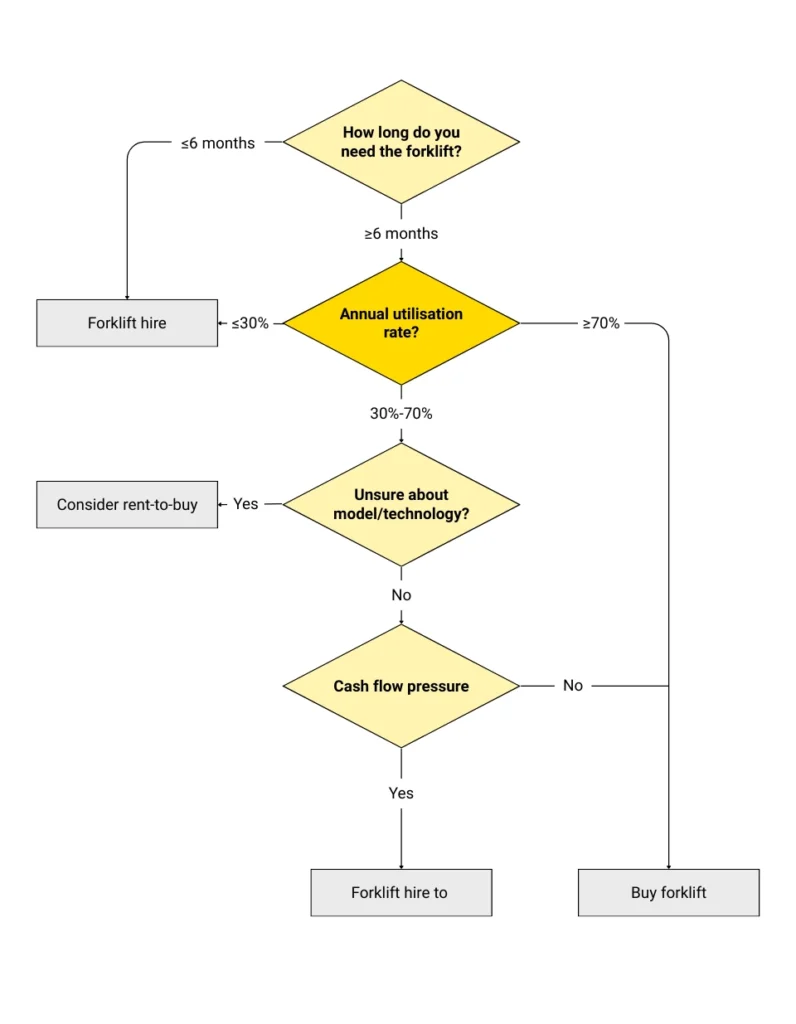
Here's a simple decision logic to help you quickly determine whether to buy or hire a forklift:
Annual Utilisation Rate for Forklift Hire
The annual utilisation rate measures how much the forklift is actually working compared to its total available hours.
Annual utilisation rate (%) = Actual annual operating hours ÷ Total available annual hours × 100%
Example:
- Total available hours = 8 hours/day × 5 days/week × 50 weeks/year = 2,000 hours
- If you use the forklift 1,600 hours/year → utilisation = 80%
Guidelines:
- ≥70% → Buying is more cost-effective
- 30-70% → Evaluate based on budget and workload stability
- <30% → Forklift hire is more cost-effective
Benefits of Buying a Forklift
Lower cost over the long term If you use a forklift frequently, buying costs less than renting over time.
Full operational control No rental restrictions, always available when you need it.
Asset value & tax benefits Forklifts can be listed as fixed assets, depreciated for tax purposes, and sometimes qualify for end-of-financial-year asset purchase tax incentives in Australia.
Customisation You can modify or add attachments, such as freezer-rated or explosion-proof features.
Drawbacks of Buying a Forklift
Higher upfront cost A big one-time payment can put pressure on cash flow.
Maintenance costs You'll be responsible for servicing, repairs, and spare parts.
Depreciation & obsolescence Forklifts lose value and may be outdated after a few years.
Forklift hire is ideal for businesses with seasonal demand or short-term projects, while buying suits stable, high-usage operations. By comparing your forklift rental costs against purchase costs, and factoring in your utilisation rate, you can make the smartest choice for your business. Contact us today!