No, you don't need a forklift licence to operate a walk-behind walkie stacker in Australia, because the WHS licensing definition of a forklift truck excludes pedestrian-operated trucks. The answer changes once the operator rides on the machine. A stacker you stand or sit on, with forks that can be raised 900 mm or more, generally needs an LF high risk work licence. Licensed or not, your business still has to train, instruct and supervise everyone who uses one.
Why a walk-behind walkie stacker needs no LF licence
A walk-behind walkie stacker needs no LF licence because the law defines a forklift truck narrowly, and a machine you walk behind falls outside that definition. The wording is the same in the WHS Regulations for NSW, Queensland and Western Australia. A machine counts as a forklift truck for licensing only if it passes all three of these tests:
- Mast and lifting carriage: it's a powered industrial truck with a mast and an elevating load carriage carrying fork arms or other arms.
- Lift height: those arms can be raised 900 mm or more above the ground.
- Not excluded: it isn't a pedestrian-operated truck or a pallet truck.
A walkie stacker passes the first two tests, since most lift well above 900 mm. It fails the third, so a walk-behind stacker that lifts to 5.5 m still sits outside the LF class. WorkSafe Queensland sets out the full definition, exclusions included, on its forklift truck licence page.
Safe Work Australia's general guide for industrial lift trucks lists pedestrian-operated trucks as one type of industrial lift truck. It also says forklift trucks are the only lift trucks that need a high risk work licence.
Is a walkie stacker a forklift?
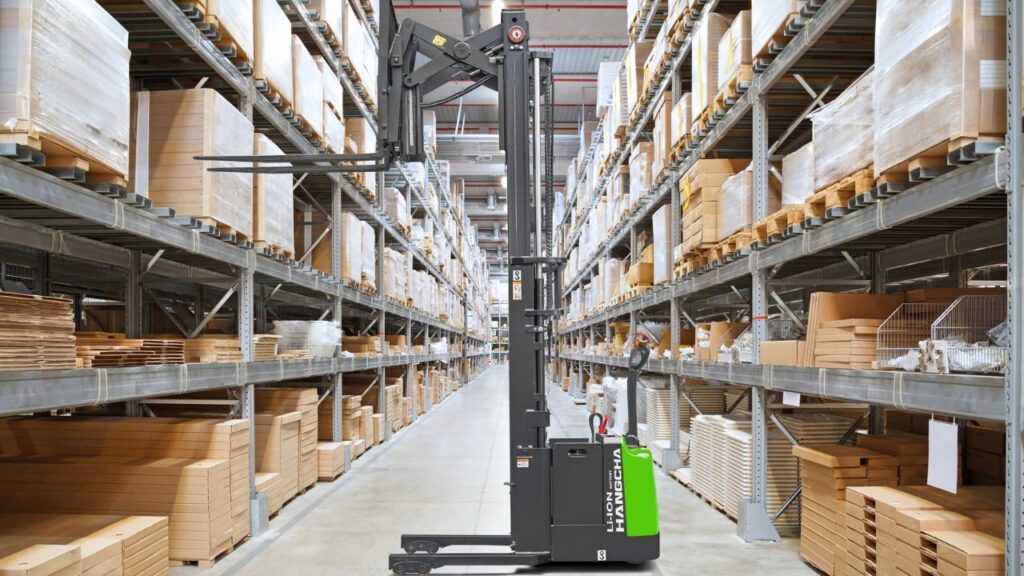
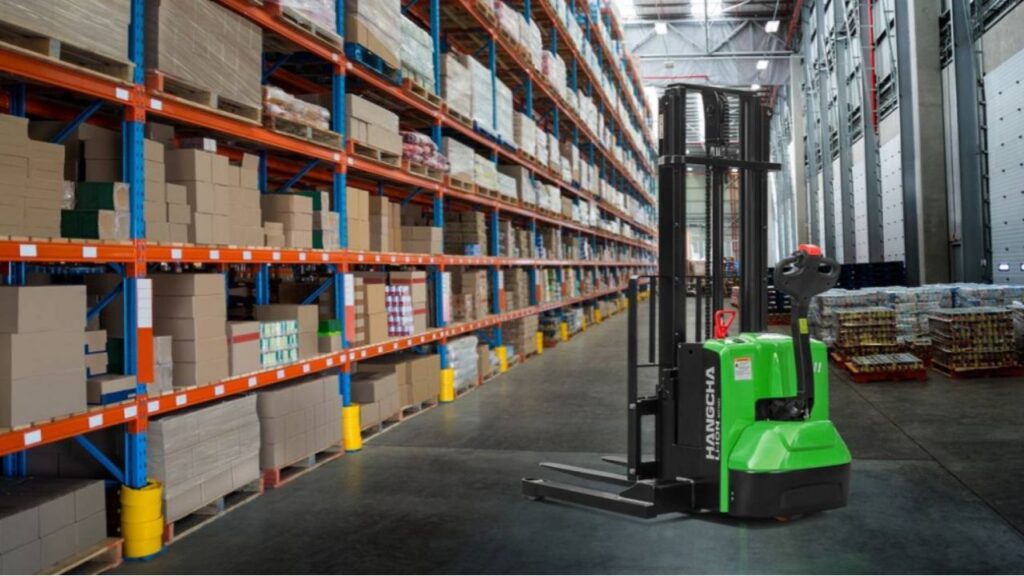
A walkie stacker is a forklift in the everyday sense, but not in the licensing sense while you walk behind it. It has a mast, forks and a battery-powered lift like a forklift. The difference is the operator, who steers it with a tiller arm at walking pace and stays on the ground. That's why the regulations treat it as a pedestrian-operated truck.
Ride-on and platform stackers: when the LF licence applies
A ride-on or platform stacker needs an LF licence when its forks can be raised 900 mm or more, because an operator standing or sitting on the machine is no longer a pedestrian. Once that exclusion drops away, the stacker is judged on the same tests as any forklift truck. Rider stackers built for racking usually lift well past 900 mm, so their operators generally need an LF licence.
Stackers with a fold-down platform are the grey area, and we haven't found regulator guidance that deals with them by name. Our advice: if operators stand on the platform to drive, treat the machine as a forklift truck. Confirm the model with your state regulator before anyone runs it without a licence.
The table sorts common warehouse machines by where the operator stands, which is what decides the licence in NSW, Queensland and WA.
| Machine | Operator position | Licence needed |
|---|---|---|
| Walk-behind walkie stacker, any lift height | Walks behind | No high risk work licence; training required |
| Walkie pallet truck or pallet jack | Walks behind | No high risk work licence; training required |
| Rider pallet truck that only lifts a pallet clear of the floor | Stands or sits | No high risk work licence (pallet truck); training required |
| Stand-on or platform stacker, forks lift 900 mm or more | Stands on a platform | LF |
| Seated rider stacker, forks lift 900 mm or more | Seated | LF |
| Man-up stacker or order picker, controls rise with the load | Rises with the load | LO |
| Counterbalance forklift or reach truck (for comparison) | Seated or standing | LF |
Lift height only matters once the operator rides. For a walk-behind machine, the answer is the same at 1.6 m or 6 m.
Man-up stackers and order pickers need an LO licence
A machine whose operator controls rise with the load needs an LO licence, not LF. WorkSafe Queensland calls these stock pickers, and they include turret trucks used in narrow-aisle warehouses. If your team picks stock from racking at height, the order pickers they ride on fall in this class.
Rider pallet trucks stay outside the forklift licence
Rider pallet trucks don't need a forklift licence in NSW, Queensland or WA, even though the operator rides on them. They only lift a pallet clear of the floor, and the definition excludes pallet trucks outright. Walkie pallet jacks are in the same position.
Does Victoria treat walkie stackers differently?
Not for walk-behind walkie stackers. Victoria's licensing rules sit in the OHS Regulations 2017 rather than the WHS Regulations, and WorkSafe Victoria's guidance also leaves pedestrian-operated industrial trucks out of the forklift definition. The difference is pallet trucks: Victoria excludes a pallet truck only if it can't, by design, raise its forks 900 mm or more. If you run a high-lift pallet truck in Victoria, confirm its status with WorkSafe Victoria.
What training walkie stacker operators still need
Walkie stacker operators still need training, information, instruction and supervision, because that duty sits with the business whether or not a licence applies. Section 19 of the WHS Act requires a business to provide the training and supervision needed to protect people from work risks. Regulation 39 adds that the training must be suitable and adequate for the work, its risks and the controls in place.
Safe Work Australia's lift truck guide expects operators to be trained on the type of truck and attachments they use, with that training given by a competent person. For a walkie stacker, training usually covers:
- the tiller controls, horn, emergency stop and reverse safety switch
- reading the capacity plate and what the rated load means at height
- pre-start checks using the manufacturer's checklist
- keeping clear of pedestrians and working in narrow aisles
- stacking and retrieving pallets from racking
- charging the battery safely
A VOC certificate is not a licence
Many training providers sell short walkie stacker courses and call the result a licence. What you get is a verification of competency (VOC) or a training certificate. It's useful evidence that someone has been trained, but no regulator issues it and it isn't a high risk work licence.
Supervision and training records
New operators need closer supervision until they've shown they can work safely on your site. Keep a record of who was trained, on which model, by whom and when. If you bring in a different stacker model, train operators on it before they use it.
Don't use a walkie stacker to lift people
A walkie stacker isn't designed to lift people, and riding the forks or a pallet puts a worker at risk of a serious fall. In October 2025 a factory worker in NSW was raised to about 3.5 metres on a walkie stacker to trim a tree. The stacker tipped and the worker fell, suffering serious injuries. The SafeWork NSW incident release points businesses to plant designed for work at height.
The WHS Regulations back this up. Plant used to lift people must be designed for the job, and where that isn't reasonably practicable, people must ride in a securely attached work box with fall protection and a safe way out. A stacker that needs no licence still carries real risk, and this is where it shows.
For jobs like changing lights or trimming branches, use equipment built to carry people, such as a scissor lift.
How to get an LF licence if your stacker needs one
You get an LF licence by training and being assessed through a registered training organisation (RTO), then applying to your state regulator. The steps are broadly the same in every state:
- Be at least 18 years old.
- Complete the forklift truck unit, TLILIC0003 Licence to operate a forklift truck, with an RTO. The order picking class (LO) uses TLILIC0004.
- Pass an assessment by an accredited assessor using the national assessment instrument.
- Apply to your regulator within 60 days of the assessment: SafeWork NSW, WorkSafe Queensland or WorkSafe WA, depending on where you work.
- Renew before it expires, because a high risk work licence lasts five years.
While you train, you can operate under the supervision of a licensed person. If you apply within the 60 days, you can generally keep working while the application is processed. A licence from one state is recognised in the others, and a business must see a worker's licence before letting them do licensed work.
Course fees, course length and licence fees vary between RTOs and states, so check current costs with the RTO and your regulator. Penalties apply to workers and businesses when licensed work is done without a licence.
Choosing a walk-behind or ride-on stacker around your licences
If nobody on your team holds an LF licence, a walk-behind stacker can go to work as soon as operators are trained on it. That suits short runs, shared use across a shift and sites where several people move the odd pallet. In the DJJ Equipment range of walkie stackers, walk-behind models such as the Hangcha XA Series lift up to 6 m.
A ride-on stacker makes more sense for long travel distances and steady stacking across a full shift, because the operator isn't walking all day. The trade-off is that every operator needs an LF licence, so it suits sites that already have licensed staff. The range also includes ride-on models such as the Hangcha X Series rider pallet stacker, which lifts up to 6 m and needs an LF-licensed operator. If you're unsure which side of the line a model falls on, ask the supplier for its operator position and lift height, then confirm with your regulator.
The same rules apply to hired machines. DJJ hire is dry hire, so the business hiring the stacker supplies operators who are trained on the model and licensed where the machine needs it. Our forklift hire team can tell you which stackers are available at each branch.
A walk-behind walkie stacker needs trained operators, not licensed ones, while a ride-on stacker lifting 900 mm or more needs an operator with an LF licence. Match the machine to the people who will drive it and the licence question mostly answers itself. To talk through stacker options for your site, call DJJ sales on 1800 355 388.