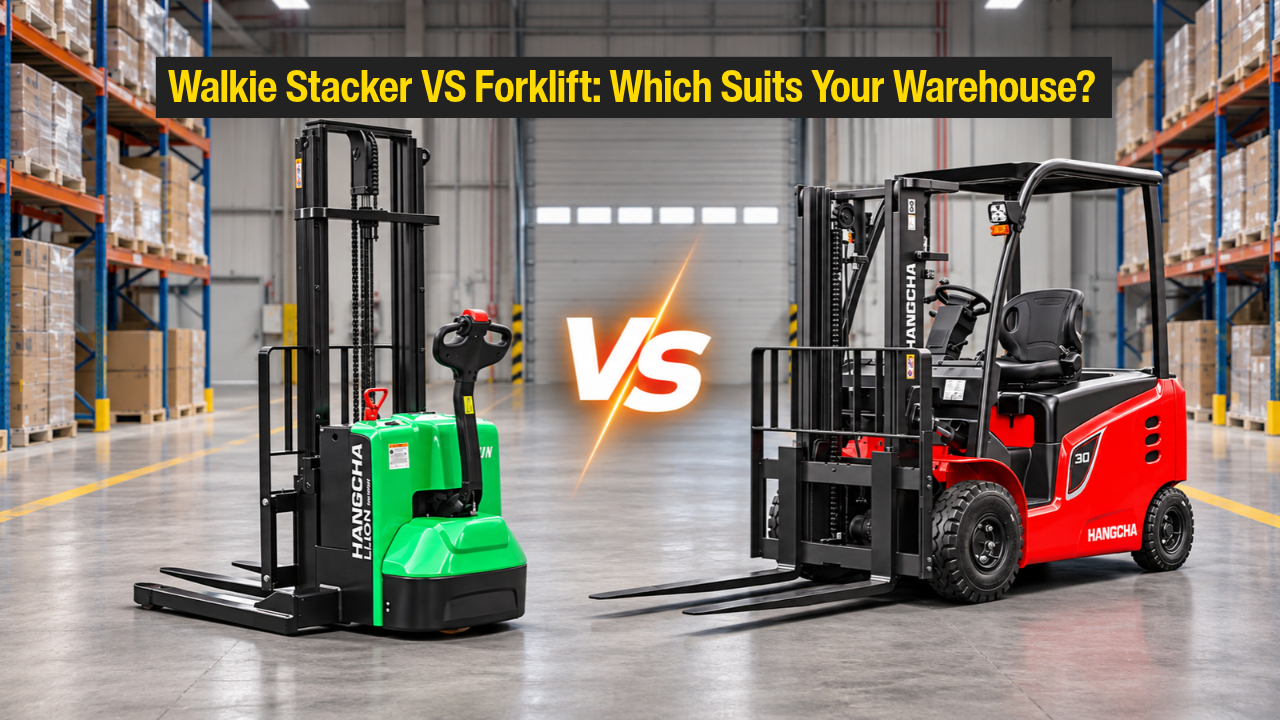
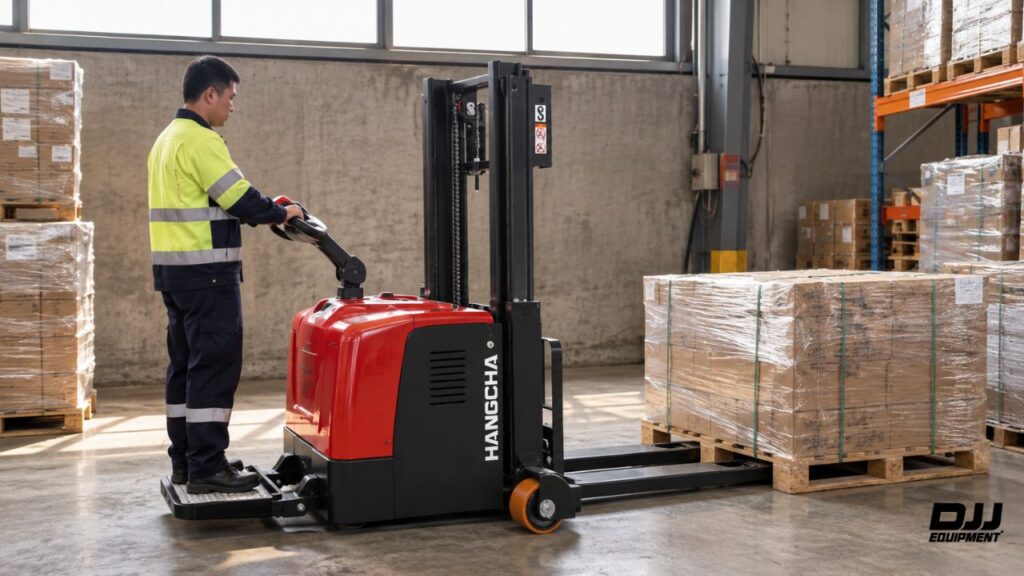
A walkie stacker is a battery-powered pallet stacker with a mast that you steer on foot using a tiller arm. It lifts pallets onto racking, up to about 6 m on larger models, which a pallet jack can't do. It's smaller and slower than a ride-on forklift and suits short runs on smooth floors. Walk-behind models need no forklift licence in Australia, but operators still need training.
How a walkie stacker works
A walkie stacker works like a small forklift that you walk behind. The tiller carries the throttle, lift and lower buttons, a horn and an emergency reverse switch, often called a belly switch. Let go of the tiller and the brake comes on.
Most walkie stackers carry the load on forks above two support legs. In Australia they are usually rated at a 600 mm load centre, about half the depth of a 1165 mm pallet. The Hangcha stackers DJJ Equipment sells all use 600 mm. Capacity drops as the forks go higher.
Walkie stacker vs forklift: what's the difference?
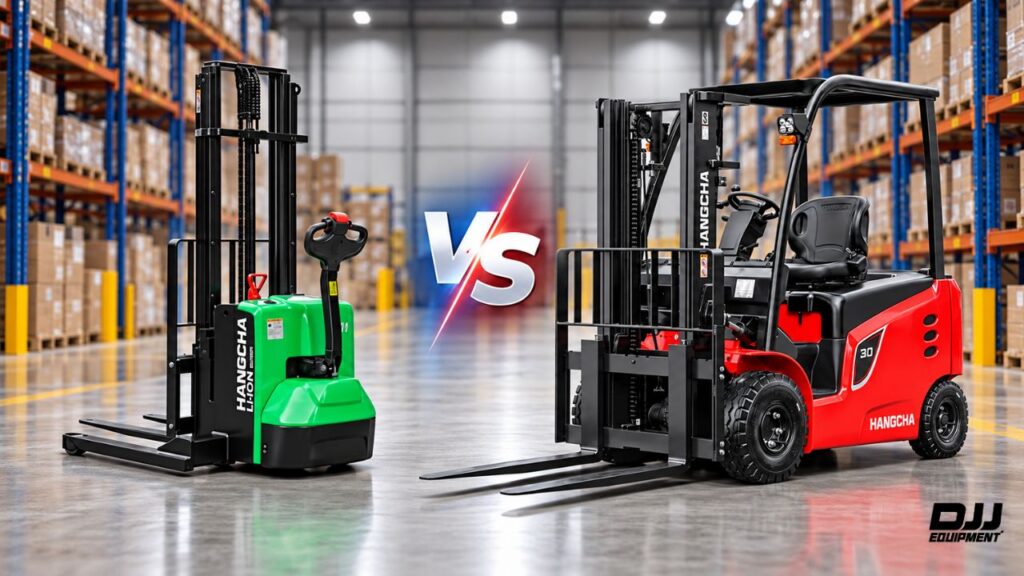
A walkie stacker and a forklift both lift pallets, but they suit different workloads, floors and operators. The table compares a walkie stacker with an electric counterbalance forklift.
| Walkie stacker | Electric counterbalance forklift | |
|---|---|---|
| Operator | Walks behind and steers with a tiller | Sits or stands on the truck |
| Licence | No LF licence for walk-behind models, training still required | LF high risk work licence |
| Rated load centre | 600 mm | Commonly 500 mm |
| Lift height | Up to 6 m | 3 m standard, up to about 7 m |
| Stacking aisle | About 2.0-2.3 m (walkie reach stacker from 2,337 mm) | About 4.0 m for a 2-2.5 t model |
| Floor | Smooth, level, hard floors, about 5-8% laden gradient | Docks, ramps and yards on many models |
| Travel speed | About 6 km/h, walking pace | Faster, with the operator riding |
| Purchase price | Usually lower | Usually higher |
If you move pallets now and then over short indoor runs, a walkie stacker costs less and needs about half the aisle. If you load trucks, cross a yard or move pallets all shift, choose a forklift. A powered pallet jack works at floor level, lifting only about 120-200 mm, so it moves pallets but can't stack them.
Types of walkie stackers
Walkie stackers come in several layouts, and your pallets and racking decide which one fits.
Legs-under-forks pallet stackers
Legs-under-forks stackers are the most common and the cheapest type. The support legs sit under the forks and roll into the pallet like a pallet jack, as on Hangcha's WS, X and XA series. The legs must fit into the pallet, which rules out some pallets.
Straddle stackers
Straddle stackers have legs that sit outside the pallet. The gap between the legs must be wider than the pallet, so more than 1165 mm for an Australian pallet. The legs also need room under the bottom rack beam. DJJ doesn't currently sell a dedicated straddle model.
Counterbalanced stackers
A counterbalanced stacker has no front legs and balances the load with weight at the back. It can lift closed-bottom pallets and odd loads from any side. The trade-off is a longer, heavier machine that needs more aisle. Hangcha's A Series counterbalanced stacker lifts to 5.5 m.
Walkie reach stackers
A walkie reach stacker pushes its forks forward on a pantograph, past its own legs, so it can pick closed-bottom pallets and place loads into racking. The Hangcha A Series walkie reach stacker carries 1.36 t, lifts to 5.5 m and works in aisles from 2,337 mm. Double-deep racking needs a specific reach distance, so check that first.
Initial-lift stackers
Initial-lift stackers have a second low lift on the support legs, so they can carry one pallet on the legs and another on the forks. Hangcha's X Series initial-lift stacker takes 1.2-1.6 t on the mast and up to 2,000 kg on the initial lift.
Platform and rider stackers
Platform and rider stackers let the operator ride on longer runs. The stand-on version of the X Series initial-lift stacker travels at 9 km/h laden, against 6 km/h for the walk-behind version. Riding on the machine can bring it under forklift licensing.
Semi-electric stackers lift on battery power but are pushed by hand. DJJ's stackers are fully powered for both drive and lift.
Where walkie stackers fit, and where they don't
Walkie stackers fit sites that move a modest number of pallets over short distances on smooth concrete. Think retail backrooms, small warehouses, workshops and stores with low to mid-height racking.
A walkie stacker isn't built for a gravel yard. Its small polyurethane wheels need a smooth, level, hard floor, and laden gradeability on Hangcha stackers is only about 5-8%. Dock ramps, rough slabs, unloading trucks from the ground and long runs are forklift work. For high racking in narrow aisles all shift, look at a high reach forklift instead.
Long runs at walking pace also tire operators, so a platform stacker or a forklift can pay off on bigger sites.
How high can a walkie stacker lift?
A walkie stacker lifts about 3-3.6 m on small models and 5.5-6 m on larger Hangcha models. Standard masts are lower: the XA Series comes with a 2,700 mm standard lift, with options up to 6 m.
The rated capacity applies at the load centre and lift height on the data plate, and it drops at the top of a tall mast. Check the load chart at your top beam height with your heaviest pallet.
Do you need a licence to operate a walkie stacker?
A walk-behind stacker doesn't need an LF high risk work licence in Australia, but your operators still need training. Under regulation 39 of the WHS Regulations, employers must give suitable and adequate training, information and instruction. Regulation 218 also requires the business to manage the risks of industrial lift trucks.
The exemption comes from the definition. A forklift truck for licensing is a powered truck with a mast whose forks can be raised 900 mm or more. That definition excludes pedestrian-operated trucks and pallet trucks. Victoria has the same exclusions, set out in WorkSafe Victoria's forklift health and safety guidance.
Ride-on stackers are different. A stacker you ride on, standing or seated, is no longer pedestrian-operated. If its forks lift 900 mm or more, it may need an LF licence. Confirm the model with your state or territory regulator, such as SafeWork NSW, WorkSafe Queensland or WorkSafe WA.
Train each operator on the model they'll use and keep records. Among the Australian Standard requirements for forklifts and other powered industrial trucks, AS 2359.2 covers operator training and authorisation.
Walkie stacker safety on the warehouse floor
Walkie stacker safety starts with keeping people and machines apart. SafeWork NSW names poor separation of pedestrians and forklifts as the main factor in people being killed or seriously injured by forklifts. The WHS Regulations require powered mobile plant not to collide with pedestrians, and a warning device where a collision is possible.
Day-to-day habits for operators:
- Walk to the side of the tiller, never in front of the machine.
- Wear safety boots.
- Travel with the forks lowered and lift only when stopped.
- Keep the emergency reverse switch working.
- Stay within the load chart and away from slopes and damaged floors.
Do a pre-start check every shift with the manufacturer's checklist: forks, mast and chains, hydraulic leaks, wheels, battery and charger lead, horn, brakes and the reverse switch. WHS law requires risks to be managed and plant maintained, but it doesn't prescribe this exact list.
How to choose a walkie stacker for your site
Choosing a walkie stacker comes down to your pallets, your aisles and racking, and how long the machine runs each day. Those specs also set the price, so it helps to know how much a walkie stacker costs before you compare quotes.
Check your pallets first
The Australian standard pallet is 1165 x 1165 mm (AS 4068). Pool pallets are double-decked, so a legs-under-forks stacker can only enter from the sides where its load wheels clear the bottom boards. Test the machine with your own pallets. For closed-bottom pallets or entry from any side, look at a straddle, counterbalanced or walkie reach stacker.
Measure aisles and racking
Measure the narrowest aisle where you turn into the racking, and compare it with the model's stacking aisle figure. That figure assumes a pallet size: the XA Series needs 2,260 mm with a 1000 x 1200 mm pallet.
Pick the battery for your shifts
Battery choice depends on how many hours the stacker works and whether you can charge at breaks. Many small stackers use sealed gel or AGM batteries that need no watering. Lithium (LiFePO4) batteries can be topped up at breaks, and charge time depends on the charger. On the Hangcha XA Series pallet stacker, the 24 V lithium pack is 150 Ah against 240-280 Ah for lead-acid, and lithium models weigh 160-175 kg less.
Amp-hours alone don't tell you the run time, so ask for the run time on your duty cycle. Lithium still needs its charger, cable and battery management system checked. For one short shift, a sealed lead-acid battery may be all you need.
If you stack pallets indoors over short runs on a smooth floor, a walk-behind stacker usually does the job for less than a forklift. DJJ sells Hangcha walkie stackers from Silverwater, Meadowbrook and Bayswater, with hire on selected models and minimum terms that depend on the machine and branch. Call 1800 355 388 with your load weight, lift height, pallet type and floor, and we'll suggest models to compare.