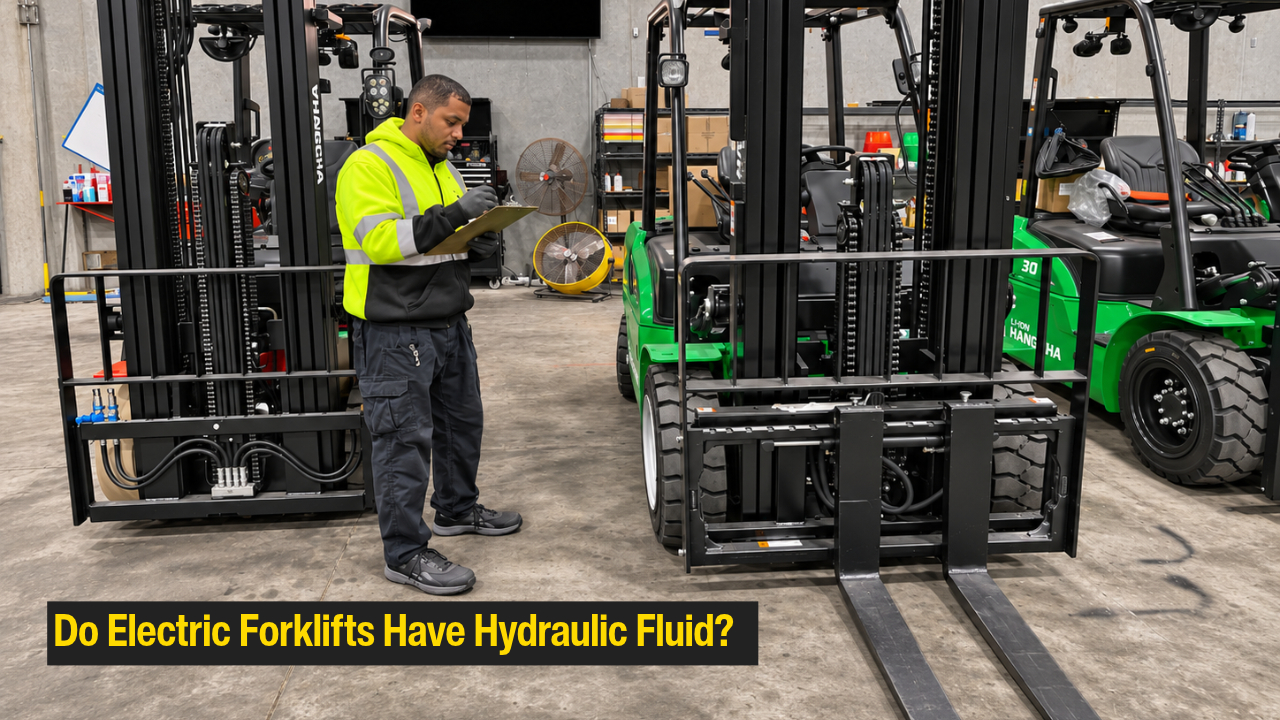

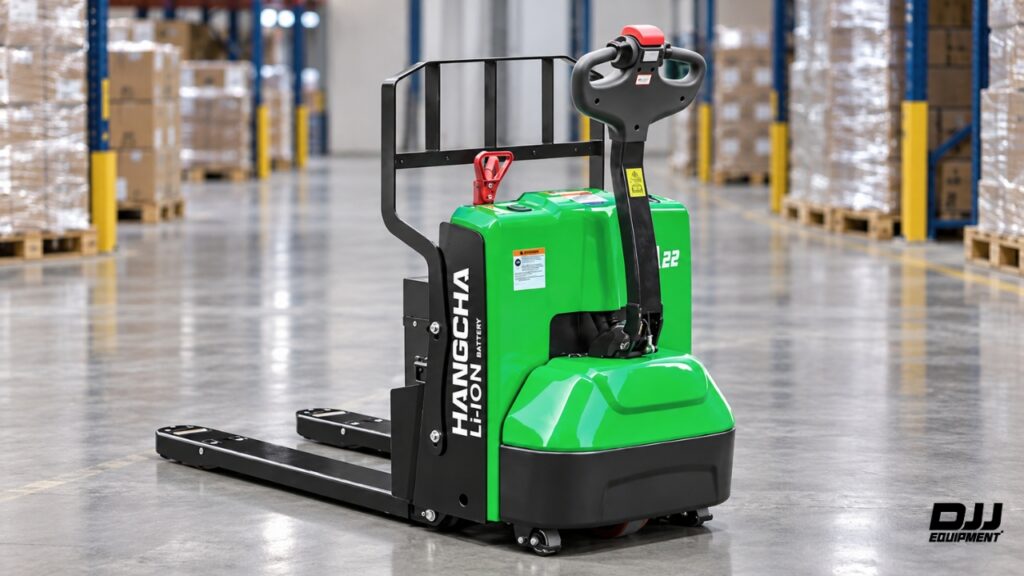
A pallet jack, also called a pallet truck, is a wheeled machine that slides two forks into a pallet and lifts it just clear of the floor so it can be moved. It only raises a load far enough to roll it, so it can't stack pallets or put them on racking. Pallet jacks come as manual models you pump by hand and electric models with a battery-powered motor. A standard pallet jack doesn't need a forklift licence in Australia, but operators still need training.
How a pallet jack works
A pallet jack lifts its whole fork frame with a small hydraulic cylinder. The forks ride on load wheels near the tips. When the cylinder raises the body, linkages inside the forks push those wheels down, so both forks rise together and lift the pallet a few centimetres.
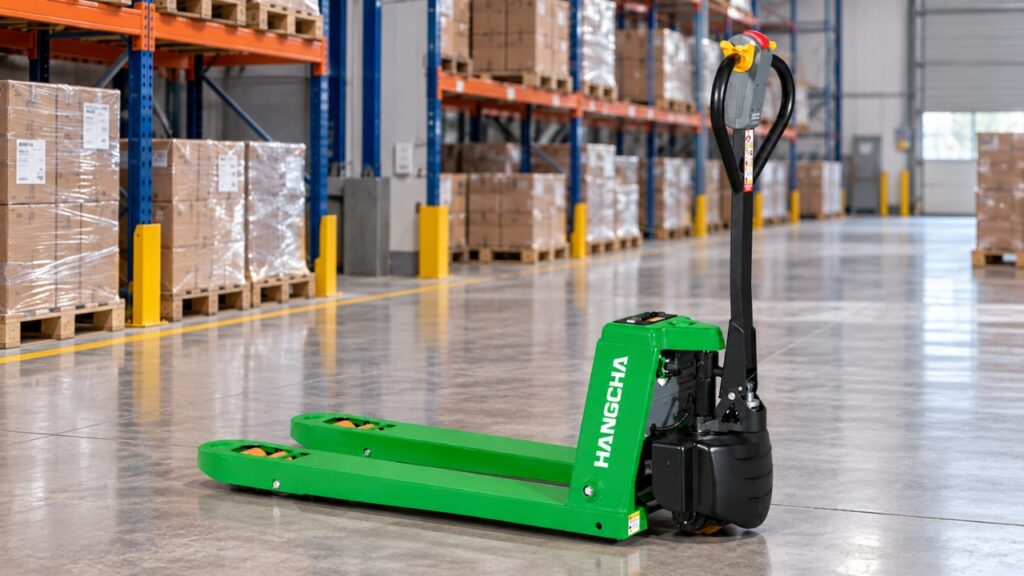
On a manual pallet jack, the operator pumps the handle to raise the forks and pushes or pulls the load, so the effort grows with weight, distance and slope. An electric pallet jack uses a battery to run a travel motor and the lift pump, with controls on the tiller head and a brake that applies when the operator lets go. Taking the effort out of heavy loads and long runs is the main reason to choose electric.
What is a pallet jack used for?
A pallet jack is used to move palletised goods over smooth, hard floors. Typical jobs include:
- Loading and unloading trucks at a dock
- Moving pallets between receiving, storage and dispatch
- Order assembly along picking aisles
- Feeding production lines and retail backrooms
It's the wrong machine for putting pallets onto racking, for gravel yards and for ramps steeper than its rated gradient.
Types of pallet jacks
Pallet jacks are grouped by how they're powered and whether the operator walks or rides. The Hangcha range DJJ Equipment sells is all electric, so the figures below come from those models.
Manual pallet jacks
A manual pallet jack has no motor or battery. It costs the least, needs no charging and suits light, occasional moves over short distances, such as a shop backroom. The trade-off is effort: a heavy pallet is hard to start, stop and steer by hand, and a manual jack is risky on any slope.
Electric walkie pallet jacks
An electric walkie pallet jack drives and lifts under power while the operator walks behind it. Walkie models in the Hangcha range carry 1.5-3.6 t and travel at 4-6 km/h laden. Compact models such as the WD Series weigh under 250 kg, which suits truck beds and tight stores.
Stand-on and rider pallet jacks
A rider pallet jack, sometimes called a riding pallet jack, has a platform or seat so the operator rides. Most riders in the Hangcha range travel at 7.5-10 km/h laden, which suits long dock runs and large floors. The Hangcha X Series pallet truck, for example, runs at 6 km/h laden as a pedestrian model and 9.5 km/h as a 2 t stand-on. Riders are longer, so they need more turning room.
Low-profile and scissor-lift pallet jacks
A low-profile pallet jack has thinner forks for pallets with a low entry height. The WS Series comes with a 65 mm lowered fork height, against 82 mm on the standard model. A scissor-lift pallet jack, such as the Hangcha XB Series, raises its platform 1.0-2.0 m so staff can load or pick without bending. It carries 500 kg on the 2 m model and 2,000 kg on the 1 m model. Weigh-scale and rough terrain pallet jacks also exist, but they sit outside DJJ's range.
Pallet jack capacity, lift height and fork size
Pallet jack capacity in the Hangcha electric range runs from 1.5 t to 3.63 t on standard trucks. Each rating applies at a set load centre, 600 mm on most models and 610 mm on the A Series 2.7-3.6 t trucks. An uneven load, or one beyond the load centre, reduces safe capacity, and the data plate is the authority.
- Lift height: 120-150 mm on most models and up to 197 mm on the WS Series. Enough to clear a dock plate, not to stack.
- Fork length: 1,150 mm is standard. Longer forks on the A Series riders, up to 3,658 mm, need more turning space.
- Fork width: 520-700 mm across both forks, depending on the model and option.
- Gradient: laden gradeability is 6-10% on the models that list it, so measure ramps and dock plates first.
Pallet jack fork length matters because the Australian standard pallet is 1165 x 1165 mm. A 1,150 mm fork reaches almost its full depth, so the load sits over the load wheels. Pool pallets are double-decked, so a pallet jack can usually enter from only the two sides where its load wheels clear the bottom boards. Test the truck with your own pallets before you buy.
Pallet jack vs walkie stacker vs forklift
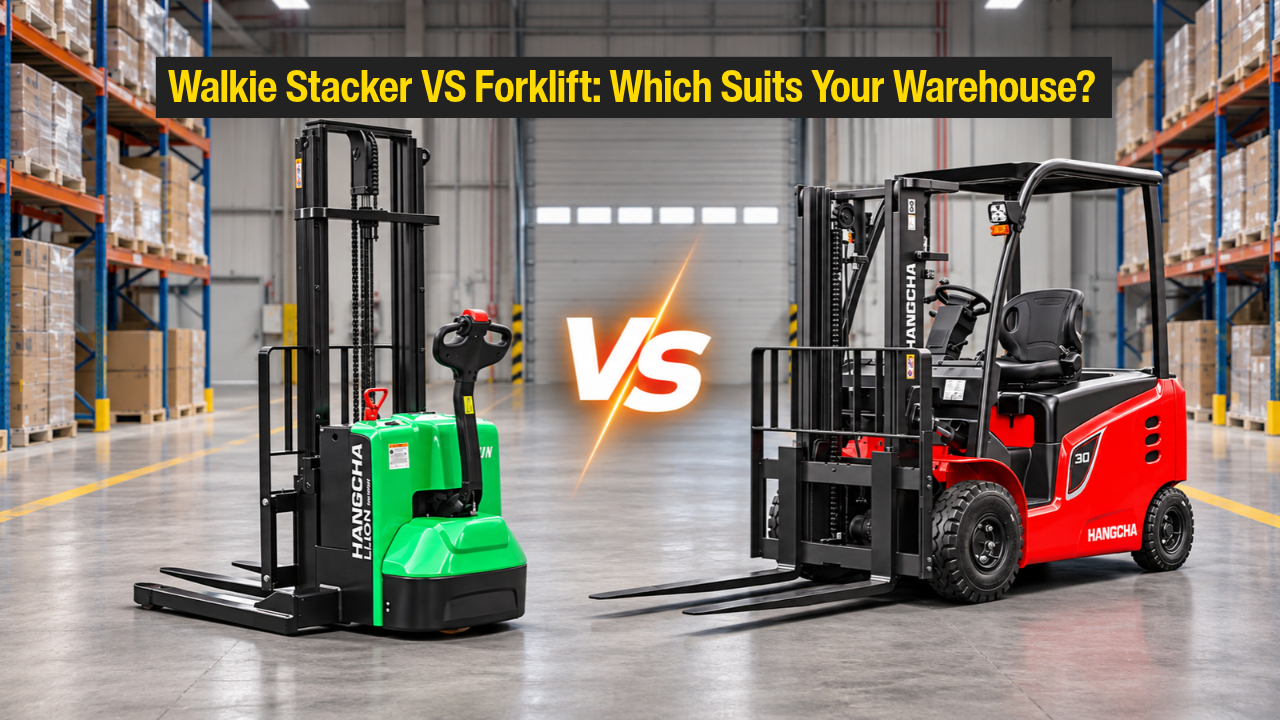
A pallet jack, a walkie stacker and a forklift all move pallets, but only the last two lift them to height. The table compares them on the points that usually decide the choice.
| Pallet jack | Walkie stacker | Forklift | |
|---|---|---|---|
| Main job | Moves pallets at floor level | Stacks pallets or puts them on racking | Lifts, stacks, loads trucks, crosses yards |
| Lift height | 120-197 mm (scissor models 1.0-2.0 m) | Up to 6 m | Set by the mast |
| Capacity in the Hangcha range | 0.5-3.63 t | 0.8-2 t | 0.6-48 t (electric models) |
| Operator | Walks or rides | Usually walks | Rides |
| Ground | Smooth, hard floors | Smooth, level floors | Indoor or outdoor, by model |
| Licence | No LF licence, training required | No LF licence for walk-behind models, training required | LF high risk work licence |
If you only move pallets across a floor or in and out of trucks, a pallet jack costs the least of the three and does the job. If pallets have to go up onto racking, look at walkie stackers for light loads and short runs, or a forklift once loads, heights or distances grow.
Do you need a licence to operate a pallet jack?
You don't need a forklift (LF) high risk work licence to operate a pallet jack in New South Wales, Queensland or Western Australia. The WHS Regulations define a forklift truck by a mast and forks that rise 900 mm or more, and they exclude pallet trucks and pedestrian-operated trucks. Your business must still give operators suitable training, information and instruction under regulation 39.
Victoria draws the line a little differently under WorkSafe Victoria's forklift rules. Pedestrian-operated trucks are excluded, and pallet trucks only when they can't, by design, raise their forks 900 mm or more. Standard electric pallet trucks lift 120-197 mm.
Scissor-lift models are the case to check. The XB Series raises its platform 1.0-2.0 m, above the 900 mm mark. Confirm the licence and training position for that model with your regulator, such as SafeWork NSW, WorkSafe Queensland or WorkSafe WA.
Pallet jack safety basics
Safe pallet jack use comes down to trained operators, a stable load and a planned route. Your site rules and the manufacturer's manual set the detail, but these points apply almost everywhere:
- Stay within the rated capacity, with the load stable across both forks
- Keep people clear of pallet routes, aisle ends and dock doors
- Use ramps only within the model's gradient limit, because capacity and control drop on slopes
- Never ride a walk-behind model or carry people on the forks
Lithium or lead-acid pallet jack?
A lithium pallet jack suits busy sites that top up the battery at breaks. A lead-acid pallet jack costs less to buy and suits single-shift work with full charge cycles. Lithium is also lighter: on the Hangcha XA Series 2 t pallet truck, the lithium battery weighs 70 kg against 195 kg for lead-acid. That matters inside trucks and on floors with a load limit.
Lithium still needs the correct charger and battery management. Lead-acid needs a charging area and, on flooded batteries, regular watering. For cold stores, the A Series 2 t and X Series pallet trucks have options rated to -30°C.
How to choose a pallet jack
Choosing a pallet jack starts with the heaviest pallet you move and how far you move it. Also check:
- Pallet type and entry sides
- Run length and moves per hour, which decide walkie or rider
- Ramps, dock plates and the tightest turning point on the route
- Shifts and charging access, which decide lithium or lead-acid
If you move a few pallets a week, a manual pallet jack may be all you need. For daily moves over short runs, a compact electric walkie takes the strain off your staff. If operators cover long distances all shift, a rider saves time and fatigue. If loads need to go higher, choose a scissor-lift model or a stacker.
A pallet jack is the right machine when the job is moving pallets across a floor, not lifting them. Hangcha electric pallet jacks for sale at DJJ run from 1.5 t to 3.63 t in walkie and rider layouts, plus the XB scissor-lift models. Tell our team at Silverwater, Meadowbrook or Bayswater your heaviest pallet, run length and shifts, or call 1800 355 388, and we'll suggest the models that fit.