The best all terrain forklift is the one whose laden gradeability, ground clearance and capacity at full height match the worst part of your site, not the one with the biggest number on the brochure. Within the same 2.5-3.5 tonne size, a Hangcha 2WD diesel model climbs 22-32% with a full load, while the 4WD version climbs 46-60%. The 2WD turns in 2,900 mm against 3,300 mm for the 4WD, so the tighter machine can be the better pick in a crowded yard.
DJJ Equipment sells five series of Hangcha rough terrain forklifts from 1.5 to 10 tonnes. The table matches each series to the site it suits best and the figure that decides it.
| Site | Best all terrain forklift | Figure that decides it |
|---|---|---|
| Narrow yards, nurseries and landscape supply yards | 1.5-1.8 t, 2WD or 4WD | 1,450 mm wide; turns in 2,800 mm as a 2WD |
| Firm gravel yards, brick, paver and timber yards | 2.5-3.5 t 2WD diesel | 2,900 mm turning radius; 22-32% laden gradeability |
| Building sites with mud, sand or steep haul roads | 2.5-3.5 t 4WD diesel | 46-60% laden gradeability; 240-290 mm ground clearance |
| Recycling and waste yards with power for charging | 2.5-3.5 t high-voltage lithium | 46.4 kWh battery; full charge in about 1.5 hours |
| Steel, precast concrete and large timber packs | 5-10 t, 2WD or 4WD | 600 mm load centre; 370-424 mm ground clearance |
Read the table from your worst ground, not your best. A yard that stays firm for most of the year but turns to mud each winter belongs in the 4WD row, because winter is when a 2WD gets stuck. Each row is a starting point, and the load chart decides the final model.
Why a 2WD all terrain forklift loses grip when it is empty
A 2WD all terrain forklift loses grip when it is empty because only the front wheels drive, and an empty forklift carries most of its weight over the rear axle. The counterweight that balances a full load sits above the rear steer wheels. With nothing on the forks, the front drive wheels press lightly on the ground and spin on mud, sand or wet clay. Put a load on the forks and the weight moves forward onto the drive axle, so grip comes back.
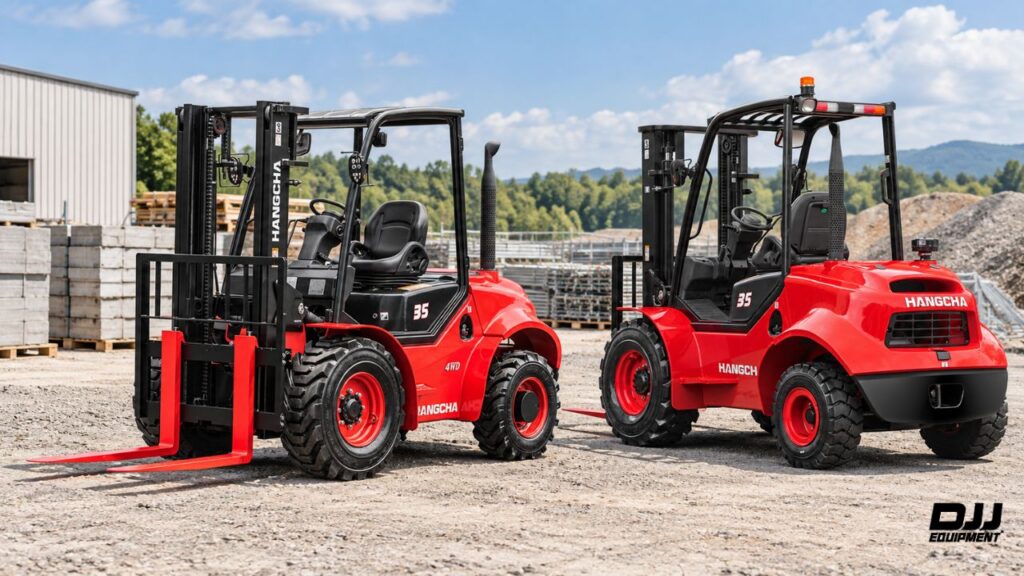
That is why a 2WD machine often bogs on the empty run back, not on the loaded trip out. A 4WD all terrain forklift also drives the rear wheels, which carry the weight when the forks are empty. The Hangcha 4WD rough terrain forklift 2.5-3.5 t switches between 2WD and 4WD and has a differential lock as standard. The diff lock turns both wheels on an axle together, so one wheel on slick ground cannot take all the drive.
The price of 4WD is turning space. The 4WD version needs a 3,300 mm turning radius, 400 mm more than the 2WD version at 2,900 mm. If your ground stays firm and dry most of the year, the 2WD is the better buy.
How to read all terrain forklift gradeability before you choose
The gradeability on an all terrain forklift spec sheet is a drivetrain test with a full load, not a slope you are allowed to work on. It shows whether the machine has the power and traction to climb, which makes it useful for comparing models. The safe slope for travelling, lifting and turning comes from the operator manual for your model.
The engine moves the figure as much as the drive does. On the Hangcha 2WD rough terrain forklift 2.5-3.5 t, the Kubota V2607 version climbs 29-32% laden, against 22-27% for the Yanmar and Xinchai versions. On the 5 t model, 4WD lifts laden gradeability from 39-42% to 45-55%. The 7 t 4WD reaches up to 68%, the highest in the range.
Gradeability is a percentage: the rise divided by the run. A 30% grade is about 17 degrees and a 60% grade about 31 degrees. Measure your steepest ramp or haul road the same way before you compare spec sheets.
How much an all terrain forklift lifts at height on rough ground
An all terrain forklift lifts far less at full height on rough ground than its rated capacity. The Hangcha high-voltage lithium rough terrain forklift is rated at 2,500-3,500 kg, yet its rough terrain rating under ISO 22915-13 at 6,000 mm is only 600-700 kg. An integral sideshifter takes off another 200 kg, and an external one 300 kg.
The cause is the centre of gravity. As the mast rises, the combined centre of gravity of the forklift and its load rises with it. On uneven ground the machine already leans, so a high load pushes that point towards the edge of the base the forklift balances on, and it tips sooner.
Rated capacity also assumes a set load centre: 500 mm on the 1.5-3.5 t models and 600 mm on the 5-10 t models. Every model has a 3,000 mm standard mast with options to 6,000 mm, except the 7 t and 10 t, which top out at 5,000 mm. Check your heaviest load at your highest stack against the load chart for the exact mast and attachment, and go up a size if the figure is close.
Which engine is best in an all terrain forklift, diesel or lithium?
For a diesel all terrain forklift in the 2.5-3.5 t size, the Kubota V2607 is the strongest option. It delivers 47.3 kW, meets EU Stage V and Tier 4f emissions limits, and gives the best laden gradeability on both the 2WD and 4WD models. Stage V matters when a contract or site sets an emissions standard.
The other engines on the 2.5-3.5 t models:
- Yanmar 4TNE98: 42.1 kW, Stage IIIA.
- Xinchai 4D32: 45 kW.
- Cummins QSF2.8: 36.5 kW, Stage IIIA, on the 4WD 2.5 t and 3 t only.
Heavier loads need more engine. On the Hangcha rough terrain forklift 5-10 t, the 5 t runs a Deutz TCD3.6 at 55.4 kW or a Cummins QSF3.8 at 86 kW, and the 7 t a Cummins at up to 90 kW.
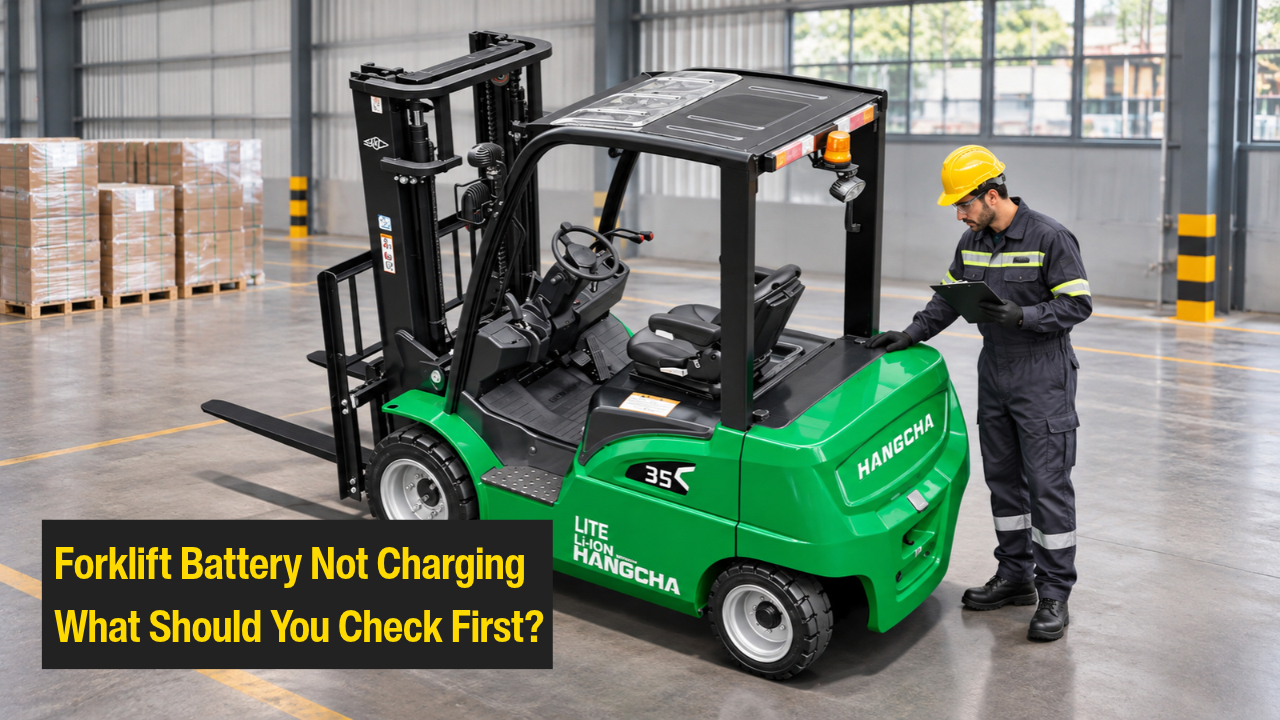
A lithium all terrain forklift suits sites with power for charging. The Hangcha lithium model runs on a 317V/150Ah CATL battery (46.4 kWh) that charges fully in about 1.5 hours. Its 4WD version has separate front and rear drive motors of 30 kW and 15 kW, and it travels at 24/26 km/h laden and unladen. Kimbriki Environmental Enterprises runs one at its waste and resource recovery site in Terrey Hills. Diesel still suits sites with no power for charging and long days away from a workshop.
Ground clearance, tyres and turning circle on an all terrain forklift
Higher ground clearance and bigger tyres carry an all terrain forklift over ruts and rubble, but they bring a wider turning circle. Across the Hangcha range, clearance runs from 235 mm under the mast on the 1.5-1.8 t to 424 mm on the 10 t. Turning radius runs from 2,800 mm to 5,740 mm.
Tyre size follows the drive. The Hangcha 1.5-1.8 t rough terrain forklift runs 27x10-12 rear tyres as a 2WD and 10.0/75-15.3 as a 4WD, which widens its turning radius from 2,800 to 3,200 mm. On the 2WD 2.5-3.5 t, the 2.5 t model sits on 12-16.5 front tyres, while the 3 t and 3.5 t move to 14-17.5. The 10 t is 2,550 mm wide on 17.5-25 front tyres.
In a tight yard, turning space matters as much as clearance. With 1000 x 1200 mm pallets carried crossways, the lithium 2WD needs a 4,635-4,650 mm aisle and the lithium 4WD 5,085-5,100 mm. Measure the tightest corner between your stacks before you choose 4WD. Solid tyres are an option on the lithium and 5-10 t models for yards where scrap metal puts pneumatic tyres at risk.
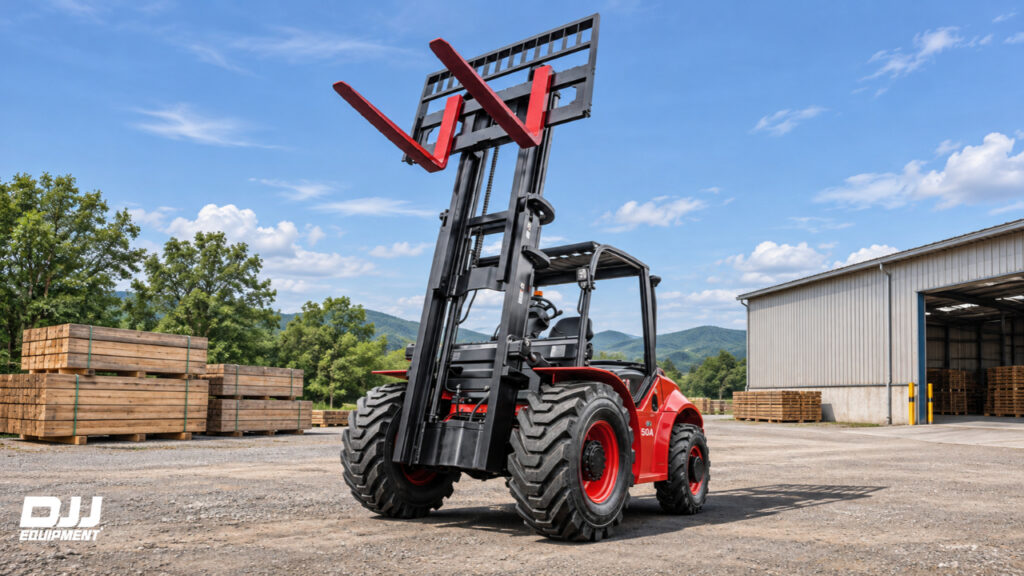
Who makes the best all terrain forklift for Australian sites?
No single brand makes the best all terrain forklift for every site. The best one for you comes with parts and technicians near your site, an engine local mechanics know, and a warranty you can read before you buy. Hangcha rough terrain forklifts run Kubota, Yanmar, Xinchai, Cummins or Deutz diesel engines, depending on the model.
Some buyers are wary of a Chinese-built forklift until they see the support behind it. The 1.5-1.8 t, 4WD 2.5-3.5 t, lithium and 5-10 t series each carry a 24 months / 2,000 hours warranty. DJJ keeps commonly required parts at its branches in Silverwater NSW, Meadowbrook QLD and Bayswater WA. Every forklift is inspected, function-tested and cleaned before handover.
Choose with three figures in hand: the grade of your steepest ramp, the weight you lift to full height, and the width of your tightest turn. Send them to DJJ with your ground conditions and daily hours, and our team will match a Hangcha model to buy or hire. Call 1800 355 388 or use the enquiry form on any product page.