To hire a forklift in NSW you need an operator with the right High Risk Work Licence: class LF for counterbalance forklifts, reach trucks and side loaders, or class LO when the machine is an order picker whose controls rise with the load. SafeWork NSW issues the licence and it is valid for five years. Your business must also check and record that licence, carry public liability insurance, and tell the hire company four things: the heaviest load, the highest lift, the ground and the hours of use. Walkie stackers and pallet trucks need training, not a licence.
Which forklift licence does a hire operator need in NSW?
The operator needs an LF licence, or an LO licence on order-picking forklifts, where the controls rise with the load, and the hire company does not provide one. DJJ Equipment hires forklifts dry, without an operator, so the person in the seat comes from your own team or a labour hire firm. SafeWork NSW puts counterbalance forklifts, reach trucks and side-loading forklifts under LF. The holder must be at least 18.
Some machines on a hire list need no licence at all. A pedestrian-operated truck sits outside the legal definition of a forklift truck, so there is no forklift licence for a walkie stacker, and a manual pallet truck needs only site-specific training. A telehandler needs a licence in NSW in two cases: with a hook and crane jib lifting more than 3 tonnes, or with a slewing function or work box and a boom longer than 11 metres.
A lapsed licence counts the same as none. Check each operator's expiry date against the end date of the hire, because a five-year licence can run out partway through a long term.
What must a NSW business check before anyone drives a hired forklift?
Your business must see each operator's licence, confirm it is current and covers the right class, and keep a register of those licences. SafeWork NSW puts this duty on the person conducting the business or undertaking, and DJJ's hire terms say the same thing in plainer words: the hirer obtains the licences needed and restricts use of the forklift to qualified staff. The reason is control. Your business decides who drives, where the forklift goes and what it lifts, so the duty sits with you even though DJJ owns the machine.
Forklifts are powered mobile plant under the Work Health and Safety Regulation 2025, and that brings five named risks to manage: overturning, objects falling on the operator, the operator being thrown out, collisions, and pressurised parts failing. The overhead guard and seatbelt must be fitted, maintained and used, and an unattended forklift must not be drivable by someone without authority. Under section 26A of the Work Health and Safety Act 2011, a business must follow the code of practice Managing the risks of plant in the workplace or use a method that is at least as safe, and the SafeWork NSW forklift rules name the AS 2359 series as the relevant Australian Standard.
What insurance and terms come with forklift hire?
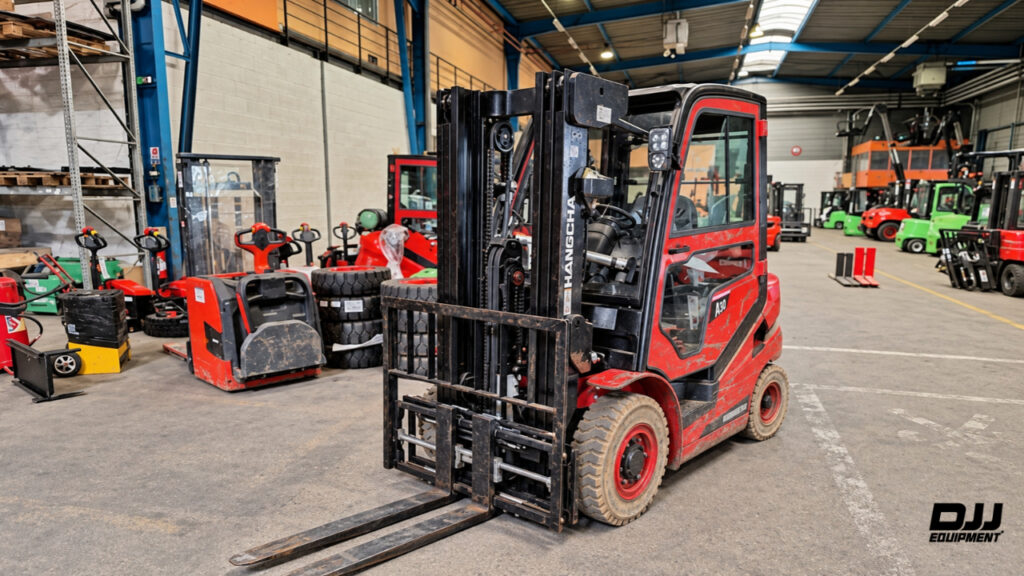
DJJ requires every hirer to carry public liability insurance covering the forklift, its use and operation, and injury, death and property damage. DJJ can ask for a certificate of that insurance. Damage to the forklift itself is a separate matter.
For an extra 10% of the weekly hire cost, the optional Equipment Waiver caps what you owe if the forklift is stolen, lost or damaged past repair. It is not insurance. It also does not apply when the operator is not suitably licensed, is affected by drugs or alcohol, damages the machine on purpose, or hits a bridge, awning, gutter, tree or other overhead object. The licence check in the last section therefore protects the waiver as well as the operator.
The term matters as much as the rate. Minimum terms vary with the machine and the branch, and the hirer is bound to the whole term: handing the forklift back early means paying out what is left. The rent includes a set number of hours on the hour meter, any hour over that is billed at an overtime rate, and rates go up with CPI every year.
During the hire your team supplies fuel, oil, grease and water, does the daily checks and recharges the batteries. DJJ does the servicing in its own business hours, 8am to 5pm on weekdays, so under forklift rental with maintenance included the servicing is DJJ's job and the daily checks stay with you.
What details does a forklift hire quote depend on?
A forklift hire quote depends on four details: what your biggest load weighs, how high it goes, the ground underneath and the hours the machine runs each day. DJJ's team asks for the same four before recommending any machine to buy or hire. Each one changes which forklift turns up, not only the price.
| Detail | Why it changes the forklift | Example from the DJJ range |
|---|---|---|
| Heaviest load and its size | Capacity is rated at a set load centre, and attachments reduce it | 2.5-3.5 t lithium rough terrain forklift: rated at a 500 mm load centre, 200 kg less with an integral sideshifter |
| Highest lift | Capacity falls as the forks go higher | A Series walkie reach stacker: 1,400 kg up to 3.5 m, 1,155 kg at 4.5 m, 1,000 kg at 5.5 m |
| Ground | Smooth concrete and gravel need different tyres, clearance and drive | Rough terrain forklifts from 1.5 to 10 tonnes; 225-290 mm ground clearance on the 2.5-3.5 t lithium model |
| Hours per day | Sets the battery or fuel plan and the hours allowed in the hire agreement | Hours over the agreed limit are charged at the overtime rate |
The table shows that one rated capacity can mean very different forklifts on the day. The walkie reach stacker carries 400 kg less at 5.5 m than at 3.5 m, so a quote based on the badge alone can put the wrong machine in your racking.
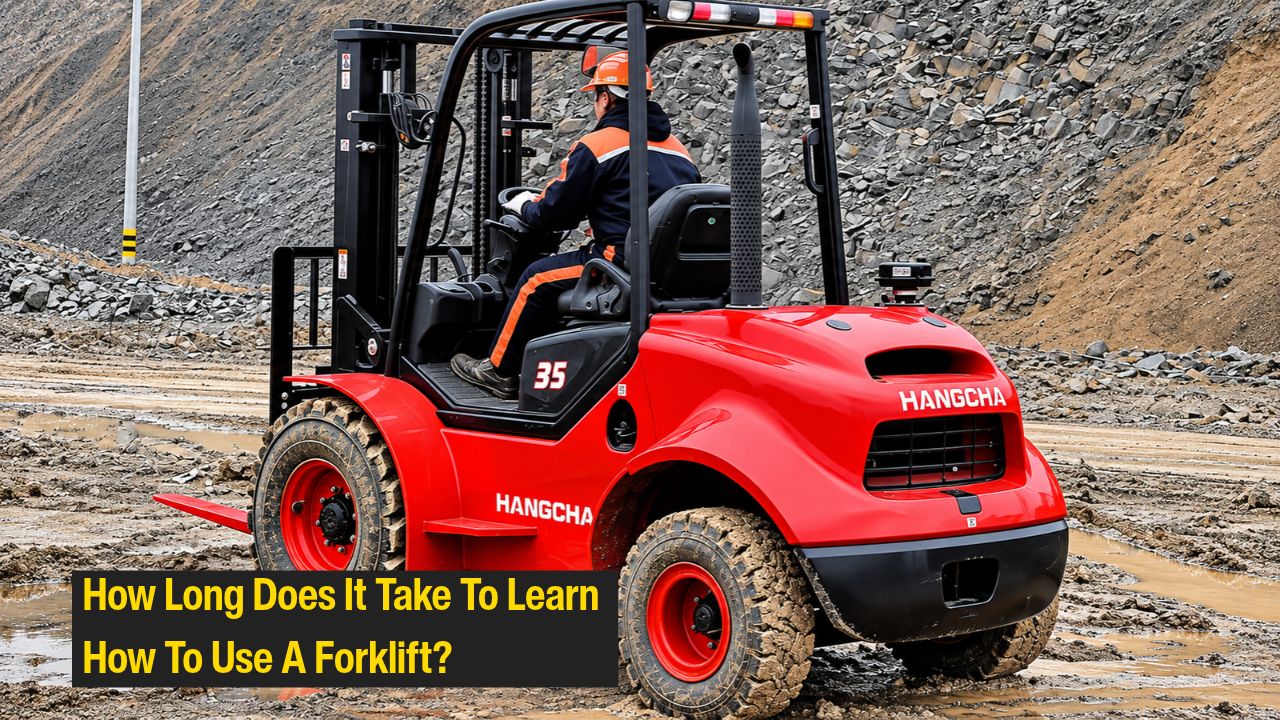
Ground decides the rest. A yard of gravel or unsealed dirt needs rough terrain forklifts with higher clearance, where a warehouse forklift on small solid tyres would bog or ground out.
How does a hired forklift get to a site in Sydney?
A hired forklift travels on a truck, so plan how it will reach your site before the hire starts. Send your suburb or postcode with the enquiry and ask DJJ's Sydney team about transport options for the machine and your site access.
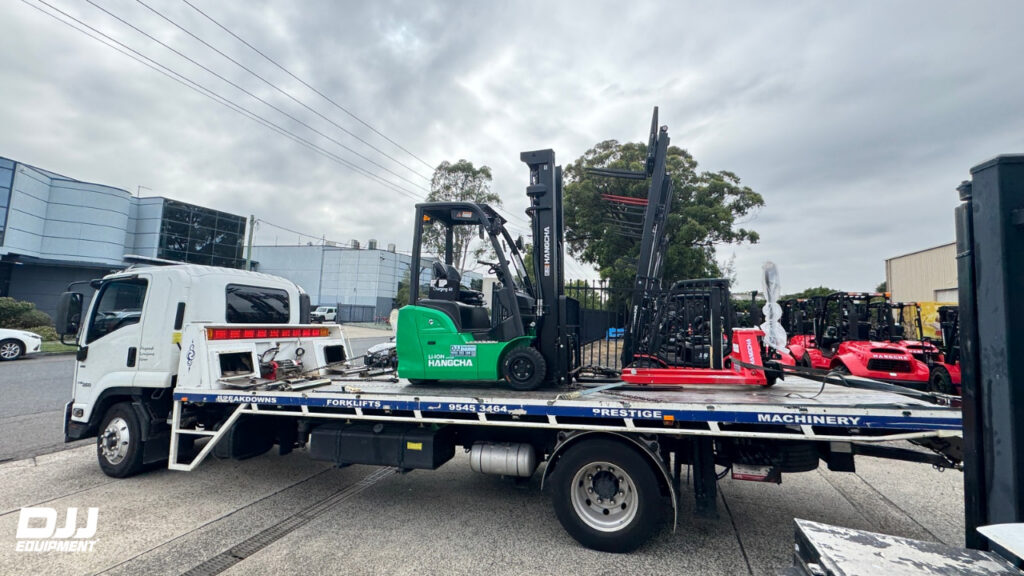
Weight is what makes site access matter. The 2.5 t lithium rough terrain forklift has a service weight of 5,000 kg and the 3.5 t version 5,600 kg, so the truck needs room to park and unload, and the ground where the forklift comes off has to carry it. Knowing how much a forklift weighs tells you whether a driveway, ramp or loading dock can take the machine before it arrives.
Check who carries the risk on the way. Under DJJ's hire terms the hirer is responsible for damage in transport unless DJJ does the transport, so confirm your own carrier's cover if you book one.
DJJ's Sydney branch is at 100 Derby Street, Silverwater, about 20 km west of the CBD near the M4 and Parramatta Road, with technicians who service machines on site up to 50 km from the branch. The branch team confirms machines, terms and availability for forklift hire in Sydney: call 1800 355 388 for hire or 1300 646 747 for service.