A 2.5 tonne counterbalance forklift weighs about 3,650-4,100 kg before it picks anything up. In the Hangcha range DJJ Equipment sells, the lithium XA Series 2.5 t weighs 3,650 kg and the lead-acid X Series 4,100 kg. Size moves the figure a long way: a 1.5 t diesel weighs 2,550 kg and a 48 t diesel 63,000 kg. Machines without a counterweight are far lighter: the XA Series electric pallet truck weighs 560-715 kg. For floors and docks the figure that matters is the front axle load under a full load: 5,390 kg on the XA Series 2.5 t.
How much do different types of forklift weigh?
Forklift weight rises with capacity and changes with the type of machine, from well under a tonne for an electric pallet truck to 63 tonnes for the largest diesel counterbalance. The table gives service weights, meaning the truck ready to work with its standard equipment, from the Hangcha spec sheets for the forklifts and warehouse trucks DJJ sells.
| Machine type | Hangcha model | Rated capacity (load centre) | Service weight | Weight compared with capacity |
|---|---|---|---|---|
| Electric pallet truck | XA Series 2-3 t | 2,000-3,000 kg (600 mm) | 560-715 kg | About 0.2-0.35 times |
| Electric pallet stacker | XA Series 1.2-2 t | 1,200-2,000 kg (600 mm) | 1,141-1,385 kg | About 0.6-1 times |
| Reach truck | XC Series CQD25 | 2,500 kg (600 mm) | 3,620 kg | About 1.45 times |
| Electric counterbalance 2.5 t | XA Series CPD25 lithium / X Series CPD25 lead-acid | 2,500 kg (500 mm) | 3,650 / 4,100 kg | About 1.5-1.6 times |
| Diesel counterbalance 1.5-3.8 t | A Series | 1,500-3,800 kg (500 mm) | 2,550-4,755 kg | About 1.25-1.7 times |
| Diesel counterbalance 5-10 t | X Series | 5,000-10,000 kg (600 mm) | 8,150-12,900 kg | About 1.3-1.6 times |
| Diesel counterbalance 38-48 t | X Series | 38,000-48,000 kg (1,200 mm) | 55,000-63,000 kg | About 1.3-1.45 times |
| Rough terrain 2.5 t | 4WD diesel CPCD25 / lithium CPD25 | 2,500 kg (500 mm) | 4,850 / 5,000 kg | About 1.9-2 times |
| Telehandler | X Series T40 | 4,000 kg (500 mm) | 13,650-13,700 kg | About 3.4 times |
The common rule that a forklift weighs 1.5 to 2 times its capacity only fits small and mid-size counterbalance trucks. The 38-48 t diesels weigh about 1.3 times their capacity, the telehandler 3.4 times, and a pallet stacker can lift more than its own weight. At 3-3.5 t, the A Series diesel weighs 4,250 and 4,555 kg and the XA Series 4,260 and 4,620 kg.
Why does a forklift weigh more than it can lift?
A counterbalance forklift weighs more than its rated load because the weight at the back has to hold up the load in front of the front wheels, with the front axle acting as the pivot. Empty, the A Series diesel forklift 2.5 t carries 2,220 kg of its 3,765 kg on the rear axle, and that rear weight is what balances a pallet on the forks.
Pallet trucks and stackers don't need that much counterweight. Their support legs run under the load, so the load sits inside the wheelbase rather than out in front of it.
Service weight and rated capacity are separate figures, and the rating only holds at a stated load centre, 500 mm on most of these counterbalance trucks. Move the load further out or lift it higher and the safe load falls, which is why how much a forklift can lift depends on far more than how heavy it is.
Where does a forklift's weight sit when it carries a load?
With a full load on the forks, most of the combined weight moves onto the front axle. Empty, the XA Series 2.5 t has 1,430 kg on the front axle and 2,210 kg on the rear. With its full 2,500 kg on the forks, the front axle carries 5,390 kg and the rear only 750 kg, so 88% of the 6,140 kg total sits on the front wheels.
Other trucks follow the same pattern. The A Series diesel 2.5 t puts 5,505 kg on its front axle when fully loaded, and the lithium rough terrain CPD25 puts 6,200 kg on its front axle. That laden front axle figure is what floors, dock plates, ramps and trailer decks have to carry, and braking hard with a load pushes more weight forward for a moment.
The same numbers decide whether a forklift can drive into a shipping container. A full 2.5 t load puts more than 5,300 kg on the front axle of these trucks, so check the container floor limits before the truck goes in.
How much do batteries change an electric forklift's weight?
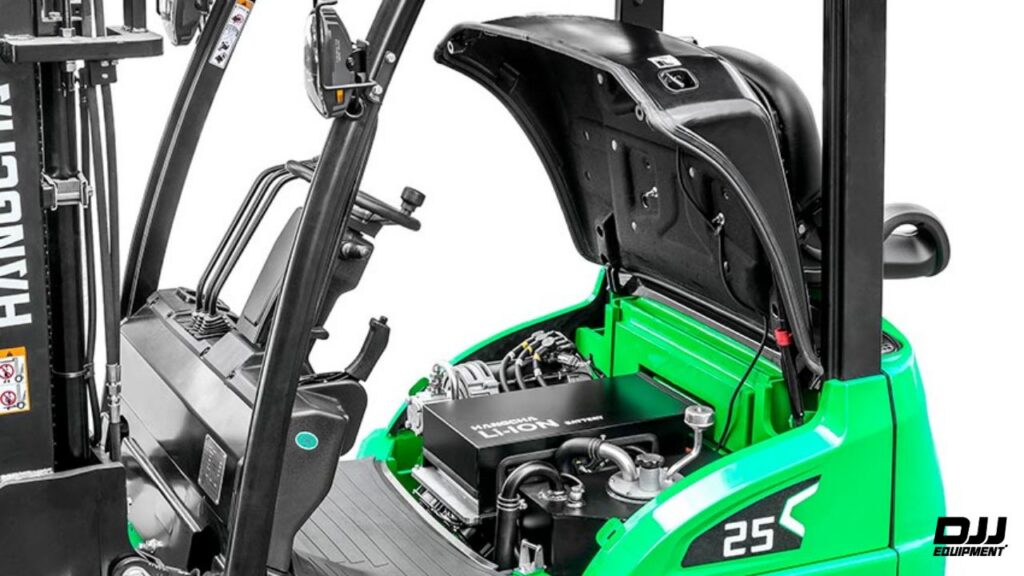
The battery is part of an electric forklift's counterweight, so the battery type changes how much the truck weighs. On the X Series 2.5 t, the 48V lead-acid version weighs 4,100 kg with a 950 kg battery, while the 48V lithium version weighs 3,720 kg with a 443 kg battery.
Hangcha lists a minimum battery weight for these electric forklifts: 900 kg for that lead-acid truck and 440 kg for the lithium one. Never fit a battery lighter than the minimum, because the truck loses part of the counterweight its rating depends on.
The gap is bigger in proportion on small machines. The XA Series pallet truck weighs 560 kg with its 70 kg lithium battery and 685 kg with a 195 kg lead-acid battery. When you compare electric forklifts, check which battery the quoted service weight includes.
How do you find out how much your forklift weighs?
The data plate on the truck and the manufacturer's spec sheet give its weight. Safe Work Australia's general guide for industrial lift trucks says the data plate should show the gross vehicle mass and the steer axle load, unladen with the mast vertical, or the drive axle loads.
On a Hangcha spec sheet, look for the service weight row and the axle load rows, laden and unladen. The XC Series reach truck brochure, for example, gives its weight with the battery included. Attachments such as a sideshifter or clamp add weight at the front, so ask for the figure with the attachment you plan to fit.
For an older truck with a missing or worn plate, the model and serial number are what a dealer or the manufacturer needs to find the right spec sheet.
Can your floor, mezzanine or dock take a forklift's weight?
A floor, mezzanine or dock has to carry the truck and its load together, so check it against the laden front axle load, not the service weight alone. SafeWork NSW says a mezzanine must be engineered and constructed for the loads handled and stored on it, including any load handling equipment.
Tyres matter as well. Solid tyres and the small polyurethane wheels on warehouse trucks touch the floor over a smaller area than pneumatic tyres, so they press harder on each point of the slab. A fully loaded 2 t XA Series pallet stacker puts more than 3,200 kg on polyurethane wheels.
Lighter trucks help where a floor has a lower rating. In the Hangcha XA Series, the 2 t and 2.5 t models are the lightest at 3,280 kg and 3,650 kg. If you don't know what a floor, dock or mezzanine is rated for, have it checked before the truck arrives.
What does a forklift's weight mean for getting it to your site?
A forklift's weight and size decide what kind of vehicle can carry it and how it gets unloaded at your site. The A Series diesel 2.5 t weighs 3,765 kg and is 3,695 mm long, 1,155 mm wide on single front tyres and 1,999 mm high with the standard mast lowered.
The X Series 38-48 t is a different job: 55,000-63,000 kg, 4,215 mm wide and 4,120 mm to the top of the cab. Give the carrier the weight and dimensions of the exact model, and budget for transport and unloading as part of the purchase. Ask our team about transport options to your site.
Before you choose a model, take its laden front axle load from the spec sheet and compare it with the rating of the floor, dock or mezzanine it will work on. Send DJJ the model you're considering, your heaviest load and where the truck will run, and the team can confirm the weights and axle loads for that machine. Call 1800 355 388 or send an enquiry to your nearest branch.