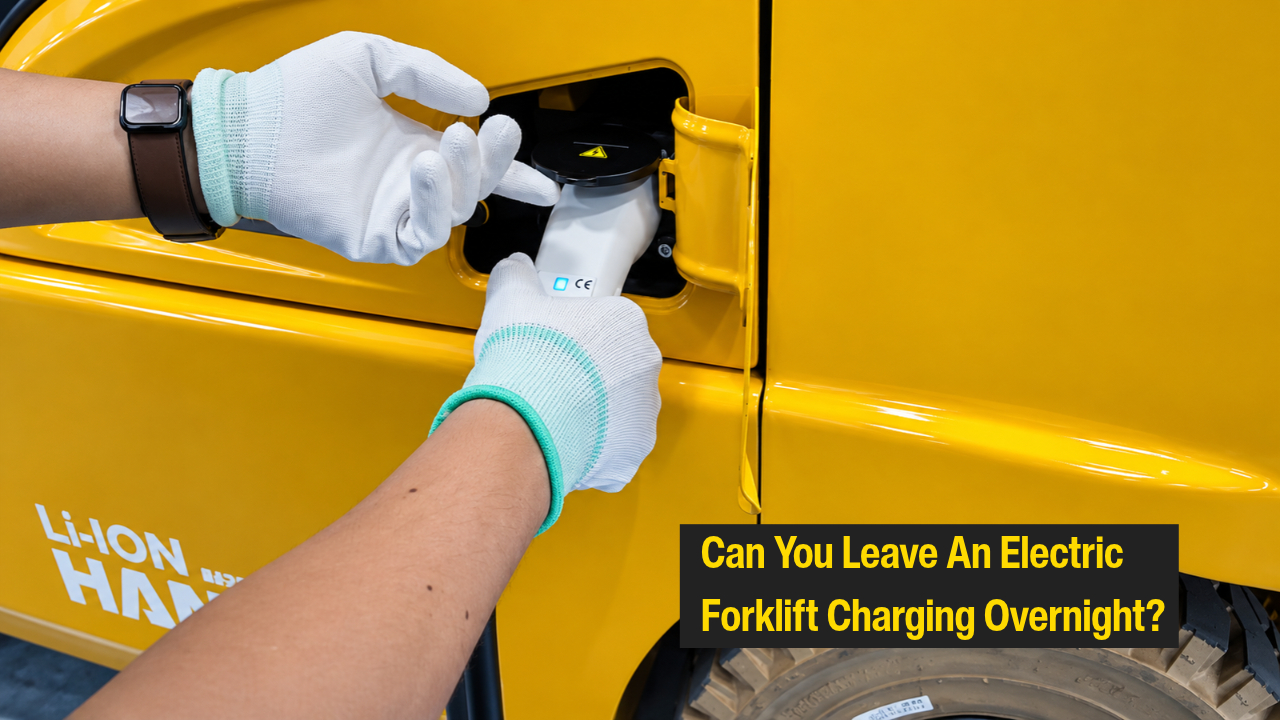
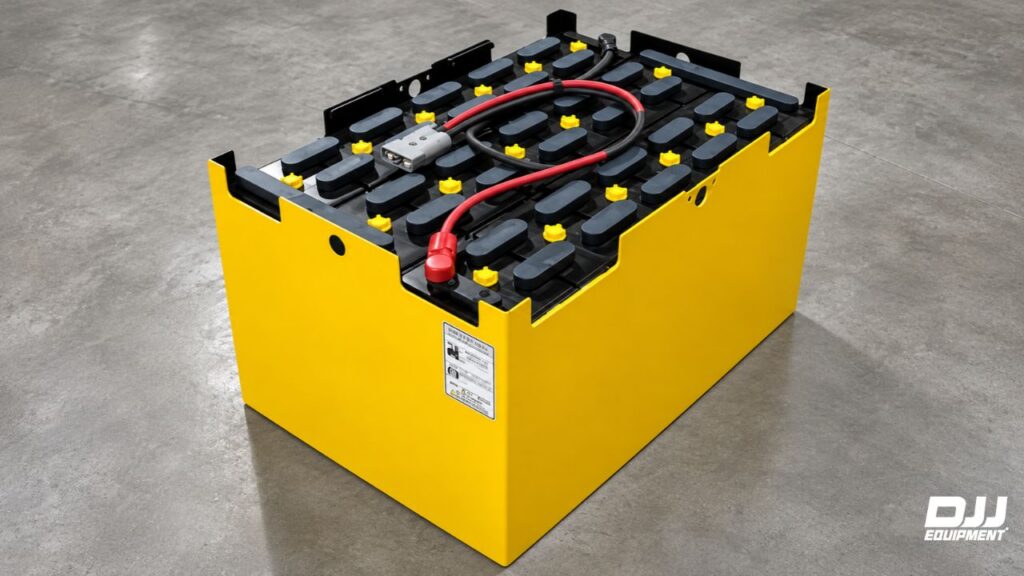
The two most common hazards with lead-acid batteries in electric forklifts are the sulphuric acid inside them and the hydrogen gas they give off while charging. The acid burns skin and eyes, and the hydrogen can explode if a spark reaches it. After those come short circuits, the weight of the battery when it's lifted or changed, and heat from overcharging. On the compact X Series 3-wheel 0.6-1 tonne, one of the battery-electric forklifts DJJ Equipment sells, the lead-acid battery alone weighs 150-340 kg.
All five hazards come from how a lead-acid battery works: liquid acid, gas on every charge, lead plates and a lot of stored energy. Each one has a known cause and a simple control, and most of those controls sit inside routine jobs like watering, charging and changing the battery.
Why is the acid in a lead-acid forklift battery dangerous?
The acid in a lead-acid forklift battery is dangerous because the electrolyte is sulphuric acid, which is very corrosive to skin, eyes and clothing. SafeWork SA names electrolyte splashed or spilled onto the body, including the eyes, as one of the two hazards of battery work. Spilled electrolyte also eats into floors and equipment and harms the environment.
Most splashes come from routine work, and watering is the usual one. The electrolyte level rises as a battery charges, so a cell filled to the brim beforehand can overflow and push acid out through the vents. SafeWork SA's advice is to fill only to the designated level, never add electrolyte during charging, and top up after the charge if needed. The water matters too: tap water in a forklift battery leaves minerals in the cells, so use distilled or deionised water.
If acid reaches someone, speed matters more than anything else. Anyone splashed should get the soaked clothing off quickly and flush the skin with large amounts of water, and SafeWork SA says to shower fully clothed if electrolyte touches any part of the body or might have. Battery areas need eye washing facilities and a spill kit. A spill is soaked up with sand, earth or vermiculite, then the area is washed and neutralised as the electrolyte's Safety Data Sheet directs.
Protective gear is part of the job, not an extra. SafeWork SA calls for safety goggles or a face shield when working on or charging batteries, plus safety footwear, and rubber gloves with overalls or an apron when a battery is cracked or damaged.
When does a lead-acid forklift battery give off explosive gas?
A lead-acid forklift battery gives off the most gas near the end of a charge, when the cells are almost full. At that stage the charger starts splitting water in the electrolyte into hydrogen at the negative plates and oxygen at the positive plates. SafeWork SA describes the hydrogen as very flammable and easily ignited, and notes that the oxygen supports combustion. Gas bubbles in a flooded cell are the sign the battery is reaching full charge.
Hydrogen becomes dangerous when it collects. The battery cover should be held open while the battery charges so the gas can escape, and the vent caps must work and stay in place to stop electrolyte spraying. The charging area needs enough ventilation to stop an explosive mixture building up, with fire extinguishers on hand. Overcharging makes it worse, because it splits more of the water into gas.
For anyone charging a forklift battery, Safe Work Australia's general guide for industrial lift trucks calls for these precautions:
- no smoking and no open flames near the charging area;
- no mobile phones or other electronic devices;
- no metal objects that might strike a spark near the cells, and the right tools for the task;
- eye protection and other PPE as required;
- rings and bracelets off before starting.
Hydrogen has no colour or smell, so nobody can tell by looking that a bay has filled with it. That's why these rules apply on every charge, including the quiet overnight one with no one around.
How does a lead-acid forklift battery cause a short circuit?
A lead-acid forklift battery short-circuits when something metal bridges its terminals or the live connectors between cells. SafeWork SA notes these batteries can deliver an electric charge at a very high rate. A dropped spanner or a wedding ring heats up almost instantly, causing burns and sometimes a fire, and the arc is a spark right where hydrogen gathers on top of the cells.
The controls are simple and easy to skip on a busy shift. Use only insulated tools, never rest tools or cables on a battery or anywhere they could fall onto the terminals, and take off watches and rings before working on it. A damaged cable, a cracked plug or a loose battery connection on a forklift belongs on the pre-start report, not taped up and left for later.
Battery voltage rises with the size of the truck. The X Series 3-wheel runs on 24V, the A Series reach truck on a standard 48V lead-acid battery, and the X Series 4-wheel 4-5 t on 80V. Watering and charging are operator jobs once people are trained, but replacing cables, connectors or cells is work for a battery technician.
Why is the weight of a lead-acid forklift battery a hazard?
The weight of a lead-acid forklift battery is a hazard because it can crush hands and feet when the battery is lifted or changed, and because on a counterbalance forklift it's part of what keeps the truck stable. Lead is dense, so a lead-acid battery weighs far more than a lithium battery for the same truck. Two of our models built with either battery show the gap:
| Model | Weight compared | Lead-acid | Lithium |
|---|---|---|---|
| X Series 3-wheel 0.6-1 t | Battery | 150-340 kg | 45-95 kg |
| X Series 4-wheel 4 t | Whole truck | 6,560 kg | 5,790 kg |
| X Series 4-wheel 5 t | Whole truck | 7,470 kg | 6,750 kg |
The lead-acid battery on the X Series 3-wheel 0.6-1 t is more than three times the weight of the lithium one, and the 4-5 tonne lithium trucks come in 720-940 kg lighter across the range. That weight sits low, behind the load, so the battery a forklift was built with is part of its balance. Fit only the battery type and size the manufacturer specifies for that truck, because a lighter replacement changes the stability the capacity rating depends on.
Changing a lead-acid battery is a job for trained people only, and the forklift should be parked in a safe position with the park brake on first. Lift the battery with gear rated for its weight and a lifting beam that keeps the chains vertical, so the tray isn't squeezed from the sides. For smaller batteries, SafeWork SA says to use a strap or cradle and never carry a battery by its terminal posts.
If you hire, check who does the battery work. Under our standard hire terms the hirer does the daily checks, including the batteries, and recharges them following our instructions, so the people on your site who charge the truck need the same training.
What makes a lead-acid forklift battery overheat?
A lead-acid forklift battery overheats mostly from overcharging, a charger that doesn't suit the battery, or charging in a hot spot. SafeWork SA says not to charge at temperatures above 49°C and to check the battery maker's recommended charging voltages. Heat speeds up gassing, so a hot battery loses water faster and gives off more hydrogen.
Neglect causes heat too. A battery left flat or stored low on charge builds up sulphate on its plates, which is why SafeWork SA says to charge regularly and not store batteries in a low state. A sulphated battery resists the charge and turns more of the charger's energy into heat and gas. In cold stores the risk runs the other way: an empty battery freezes sooner than a full one, and a frozen battery must never be charged.
A battery that is too hot to touch on charge, smells strongly of sulphur, or has a swollen or cracked case has a fault. Stop charging it and keep people away from it. If the case is cracked, don't touch the internal parts: the plates are lead, so handle a damaged battery in the same gloves and apron you'd wear for an acid spill.
Does a lithium forklift battery remove these hazards?
A lithium forklift battery removes the watering, the acid splashes and most of the gas on charge, but it doesn't remove every battery risk. Lead-acid needs watering, a charging area and full charge cycles, while lithium suits opportunity charging at breaks and needs little battery maintenance. Lithium still needs the correct charger and battery management system, so it isn't maintenance-free.
The change-out hazard mostly goes too. A lead-acid truck on two shifts usually needs a battery swap or a long charge between shifts, while lithium is topped up in the truck. The cost side of that choice, including the higher purchase price of lithium, is where lithium vs lead-acid forklift batteries differ most.
Most of the electric forklifts in our range run on lithium, and lead-acid is still offered on models such as the X Series 3-wheel and 4-wheel trucks and the A Series reach truck. If your site already has a lead-acid fleet and a charging bay, the controls above keep it safe to run.
If a lead-acid battery runs hot, leaks, smells of sulphur or keeps losing water faster than before, take the truck out of service and have the battery and charger checked. DJJ services and repairs all forklift brands. Call our service team on 1300 646 747 with the truck's model and serial number.