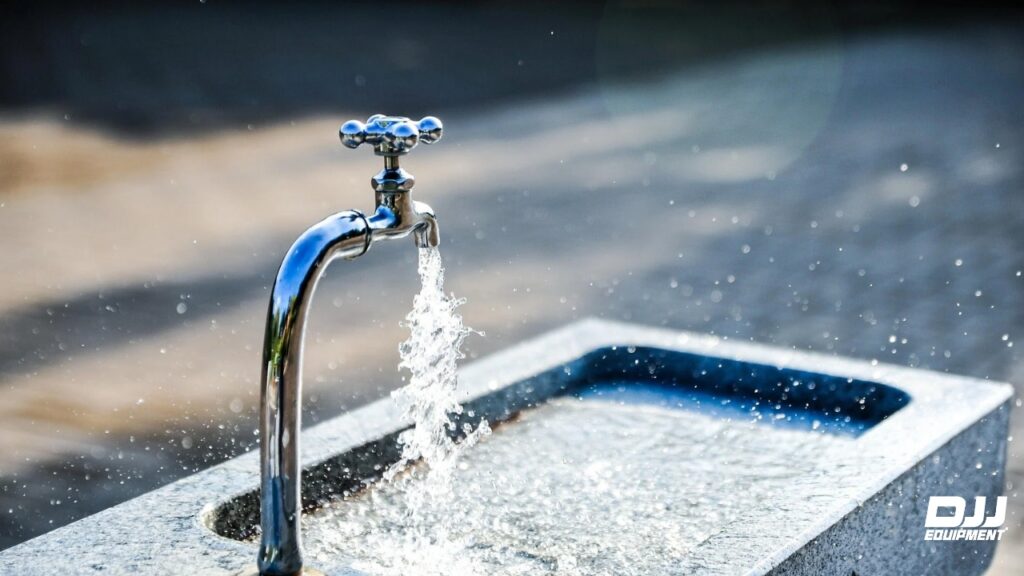
No. Tap water shouldn't go into a forklift battery, even in a city with soft water. Battery maker EnerSys calls for purified water with a conductivity of no more than 30 µS/cm, which is roughly 19 mg/L of dissolved solids. Tap water in major Australian cities runs from under 100 mg/L to more than 750 mg/L, so even the best of it carries about five times the minerals a battery can take. Use distilled, demineralised or deionised water, and add it after a full charge.
Why can't you use tap water in a forklift battery?
You can't use tap water in a forklift battery because its minerals stay in the cells and build up with every top-up. Charging splits water in the electrolyte into hydrogen and oxygen, which vent off as gas. The water leaves and the dissolved minerals don't, so each top-up with tap water adds another dose.
Those minerals attack the battery in different ways. Calcium and magnesium, the minerals that make water hard, react with the sulphuric acid and leave deposits on the plates that charging can't remove. Iron makes the battery slowly discharge itself while the truck is parked. Chlorine, added to town water as a disinfectant, corrodes the lead grids that hold the active material in place.
None of this is visible in the first week. The damage shows up later as lost capacity, which is why the cause is easy to miss. It can also cost you the warranty: EnerSys's manuals specify purified water every time, and say that ignoring the operating instructions voids the battery warranty.
How pure does forklift battery water need to be?
Forklift battery water needs a conductivity of 30 µS/cm or less, according to EnerSys's manual for its Ironclad traction batteries. Conductivity measures how well water carries current, and dissolved minerals are what carry it. Pure water barely conducts at all.
Australia's drinking water guidelines from the NHMRC give a rough conversion: multiply conductivity by 0.64 to estimate total dissolved solids. On that factor, 30 µS/cm is about 19 mg/L. The same guidelines rate drinking water as good for taste up to 600 mg/L, and say major Australian cities range from below 100 mg/L to more than 750 mg/L.
Here's what that gap looks like. Water at 100 mg/L works out to about 156 µS/cm, five times the battery limit. Water at 750 mg/L is about 1,170 µS/cm, close to 40 times. Even Sydney's water, which Sydney Water rates as soft, has a hardness of about 57 mg/L on its own, three times the 19 mg/L figure. Water that passes every drinking-water test still fails the battery test.
Groundwater is usually worse. The NHMRC notes that some rural and remote supplies exceed 1,000 mg/L, mainly because of the groundwater they draw on. A bore supply on a farm or regional site is no substitute either.
What water should you use in a forklift battery?
Use distilled, demineralised or deionised water in a forklift battery, as long as it meets the 30 µS/cm limit. All three are made by taking the minerals out, by boiling and condensing or by passing the water through filters and resin. EnerSys's manuals call for purified water and set the limit by conductivity, not by how the water was made.
A handheld conductivity meter tells you whether a supply is good enough, and it's worth testing a new source or a deioniser that's getting old. If your battery has a single-point watering system, the same purity rule applies to the water tank. EnerSys says the tank and pipes must be cleaned before the system is first used.
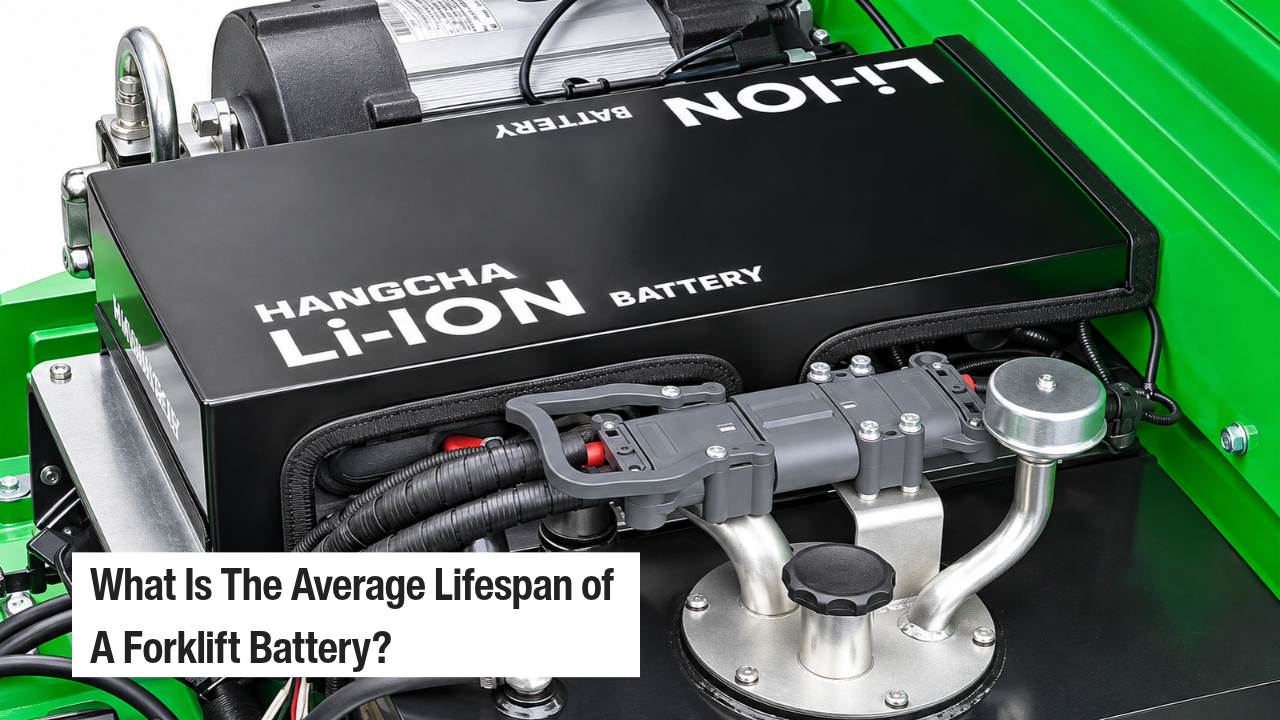
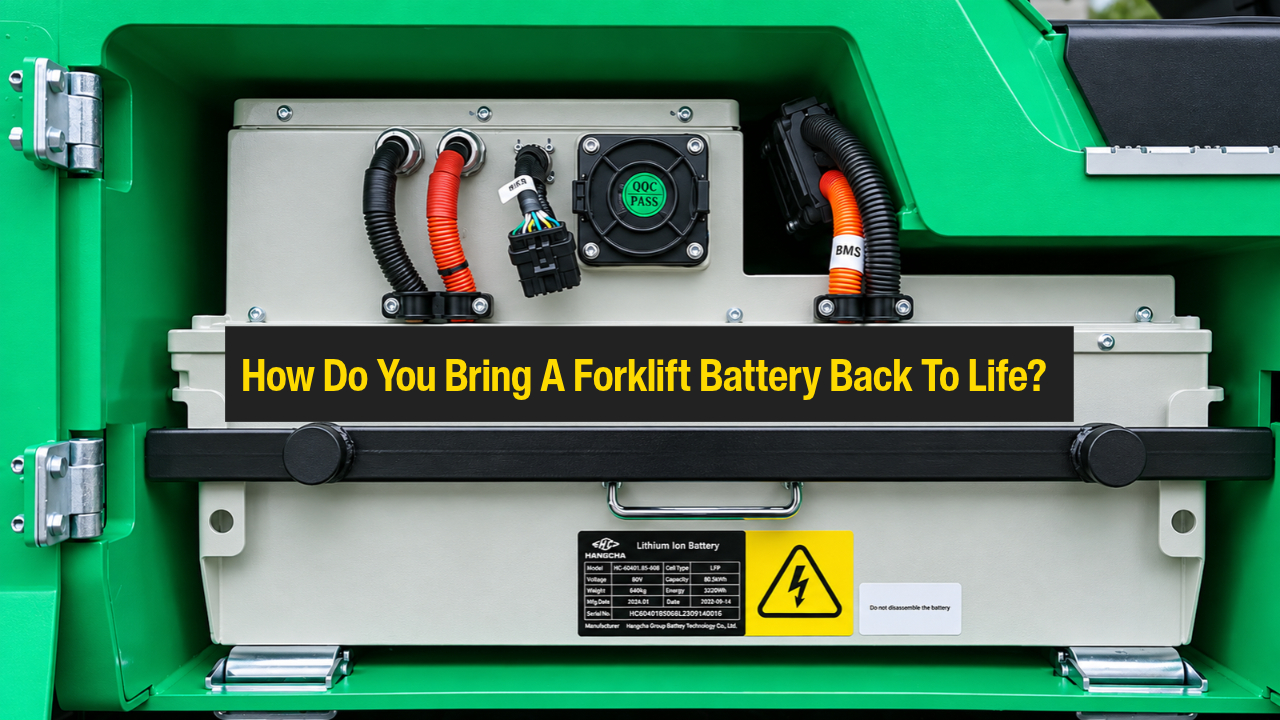
Lithium batteries are different. A lithium forklift battery is sealed and never takes water. Dropping the watering round is one of the daily savings sites weigh up when they compare lithium vs lead-acid forklift batteries. Hangcha's manual for its XH Series lithium forklifts goes further: dust on the battery comes off with compressed air or a dry cloth, never water.
When should you top up forklift battery water?
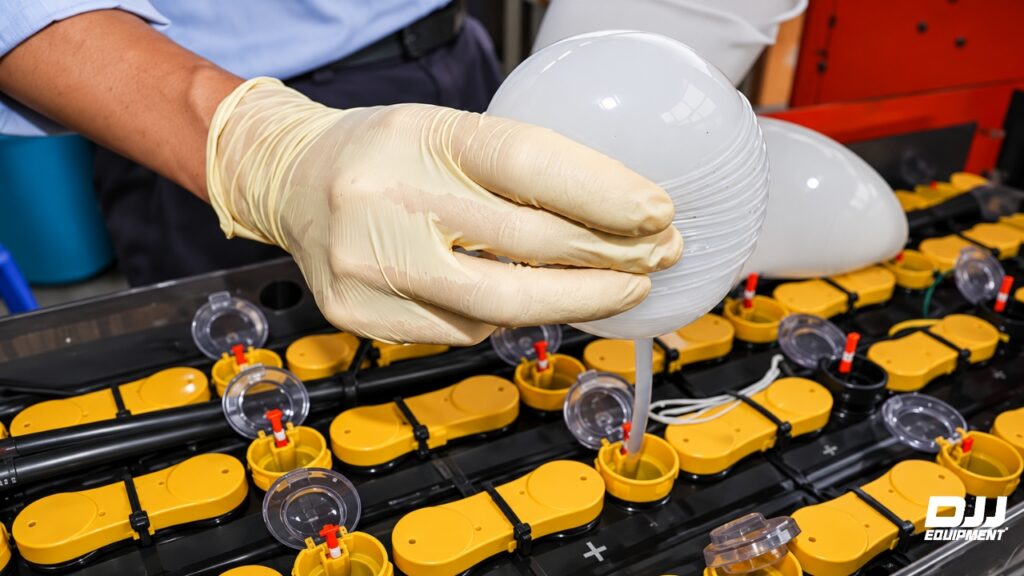
Top up forklift battery water at the end of a full charge, not before it. The electrolyte rises during charging, because it warms by about 10°C and gas bubbles lift the level. A cell filled to the top before charging can overflow and push acid out through the vents, onto the tray and the truck.
There's one exception. If the electrolyte has dropped below the top of the separators, EnerSys says to top up to that height first, charge the battery, then top up to the specified level. That keeps the plates covered during the charge without overfilling.
How often depends on how hard the battery works. EnerSys recommends filling at least once a week on batteries with automatic watering, and says multi-shift work and warm sites may need shorter intervals. Lead-acid electric forklift trucks running two shifts in a summer shed in Brisbane or Perth will use water faster than the same trucks on one shift in a cool store. New batteries are the other exception: EnerSys says not to add water in the first 10 cycles, even if a level sensor blinks red.
If you hire your forklift, check who does this. Under DJJ Equipment's standard hire terms, the hirer supplies water and does the daily checks, including the batteries, following DJJ's instructions.
How full should a forklift battery be?
A forklift battery should be filled to its specified maximum level, and the electrolyte must never fall below the top of the separators or the min mark. EnerSys batteries show the level through a float indicator in each cell's filling plug, and some add a level sensor on one reference cell.
On a level sensor, a green LED means the level is fine and a blinking red LED means it's low. Because the sensor reads only one cell, EnerSys still asks for every cell to be checked monthly. That matters on a large battery: the 48V lead-acid battery fitted as standard to our A Series reach truck 1.2-2 t has 24 cells, each with its own level.
A single-point watering system fills every cell from one connection, with a float valve in each plug that closes when that cell is full. EnerSys sets its system up for a water pressure of 0.2 to 0.6 bar, which takes at least 2 m of height between the tank and the top of the battery. Some batteries have a white-ring water-level indicator and a watering connector, so photograph the battery label and fittings if you're not sure which system you have.
What if tap water has already gone into your forklift battery?
If tap water has already gone into your forklift battery, switch back to purified water from the next top-up and tell your service technician. Don't try to drain the cells or flush them out. Tipping a heavy traction battery to pour out acid is dangerous, and it won't pull out minerals that have already reached the plates.
Keep a note of which truck got tap water and roughly how often. It helps the technician, and it helps you decide later whether a short battery life came from the water or from something else. Watering is one line in a forklift maintenance checklist, so make sure the checklist names the water too.
A one-off top-up with town water usually does far less harm than months of it, because the damage builds with each dose. The way to find out is to read the cells. EnerSys's monthly routine is the test: record every cell's voltage as the charge finishes, let the battery stand for 2 hours, then read each cell's specific gravity and temperature. Large differences between cells or against earlier readings mean the battery needs testing by a battery service.
How do you water a forklift battery safely?
Water a forklift battery safely by wearing eye and hand protection and keeping washing facilities close by, because the electrolyte is sulphuric acid. Safe Work Australia's general guide for industrial lift trucks expects battery work to be done by trained staff, wearing the face shields, aprons and rubber gloves provided.
The guide wants eye washing facilities and a spill kit in battery areas. Anyone splashed with acid should get the soaked clothing off quickly and wash the skin with plenty of water. Keep metal tools off the battery top, because the cell connectors are live, and use the proper tool to open filling plugs so the floats aren't damaged.
DJJ services all forklift brands and repairs Hangcha forklifts; repairs on other brands are assessed case by case, so check your model with the team. If your forklift has been topped up with tap water, or the cells read unevenly, our forklift servicing and repairs can check the battery and charger together. Call the service team on 1300 646 747 with the truck's model and serial number.