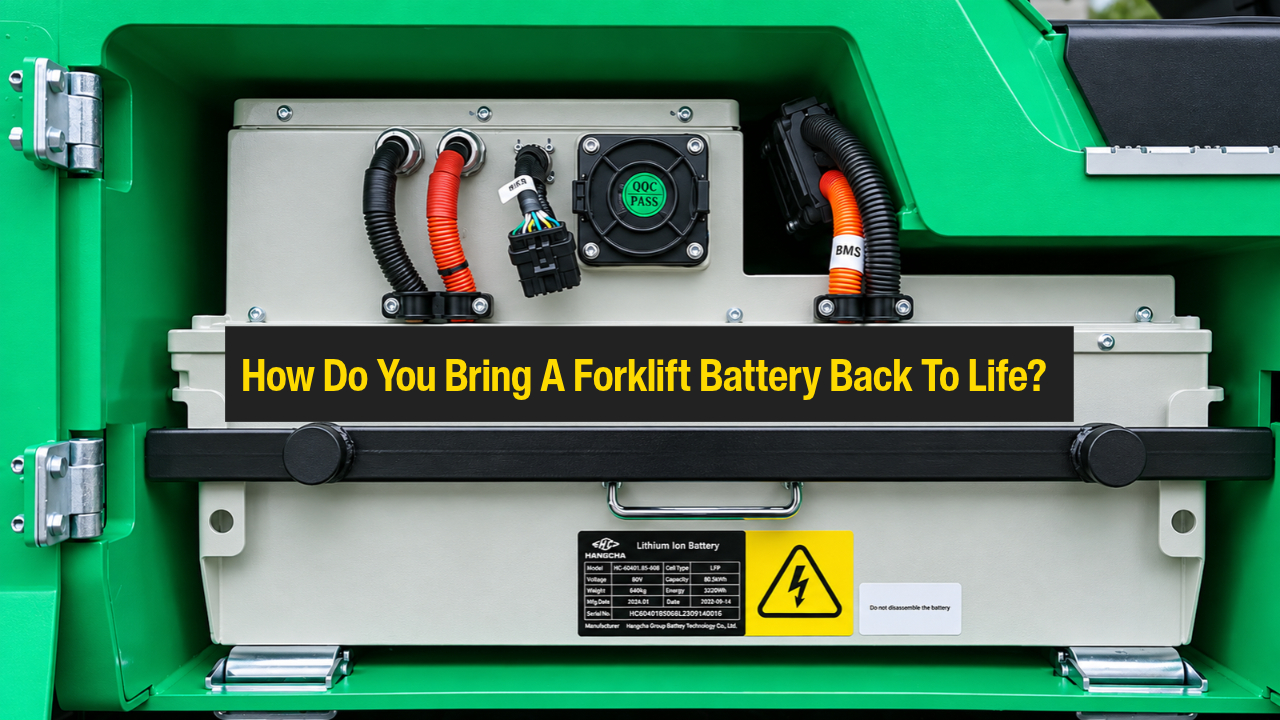
A lithium-ion forklift battery is rated for about 4,000 charge cycles and a lead-acid one for roughly 1,500. Forklift battery lifespan in years then depends on how many hours the truck works. Hangcha backs the lithium battery in its A Series reach truck with a 6-year or 12,000-hour warranty, and 12,000 hours is six years of one 8-hour shift on 250 working days. On two shifts, the same truck passes 12,000 hours in three years.
How many charge cycles does a forklift battery last?
A conventional lead-acid forklift battery lasts roughly 1,500 charge cycles, and a lithium iron phosphate (LiFePO4) battery about 4,000. One cycle is a full discharge followed by a full recharge. Battery maker Hoppecke rates its premium trak uplift lead-acid range at up to 1,956 nominal cycles, which it says is up to 30% more than conventional batteries.
These ratings come from different tests, so the last column matters as much as the number:
| Forklift battery | Rated cycle life | What the rating means |
|---|---|---|
| Conventional flooded lead-acid | About 1,500 cycles | The base Hoppecke compares its premium range against |
| Hoppecke trak uplift (premium lead-acid) | Up to 1,956 nominal cycles | Accelerated laboratory test, confirmed by DNV |
| Hangcha LiFePO4 (A Series reach truck, X Series pallet truck) | 4,000 full charging cycles | At least 75% of original capacity still available |
The lithium figure isn't 4,000 cycles until the battery dies. It's 4,000 cycles until the battery holds 75% of its original capacity, and it keeps working after that. Short top-ups at breaks don't count as full cycles either, and interim charging doesn't shorten the service life of these batteries.
The gap comes from how each chemistry wears. A lead-acid battery loses a little active material from its plates on every deep discharge, and sulphate builds up whenever it sits part-charged. The phosphate structure in a LiFePO4 cell holds its shape through thousands of charges, and the battery management system (BMS) monitors every important function of the pack.
Cycle life is only one part of the lithium vs lead-acid forklift battery decision, because purchase price, charging time and watering also change what each option costs to run.
How many years does a forklift battery last on one, two or three shifts?
A forklift battery's life in years is its rated hours or cycles divided by how hard you work it. Here's how Hangcha's 12,000-hour lithium battery warranty works out at 250 working days a year:
| Forklift shift pattern | Hours a year | Time to reach 12,000 hours |
|---|---|---|
| One 8-hour shift | 2,000 | 6 years |
| Two 8-hour shifts | 4,000 | 3 years |
| Three 8-hour shifts | 6,000 | 2 years |
The battery that covers six years on a day shift reaches 12,000 hours in two years on a 24-hour operation. So read your hour meter, not the purchase date, when you plan for a replacement.
Lead-acid works the same way but counts cycles. At one full charge per working day, 1,500 cycles is six years on paper. Heat, low water and cut-short charges all take cycles off that figure.
Two shifts are harder on lead-acid. A full lead-acid charge takes 8-10 hours, against about 2 hours for the lithium battery in Hangcha's A Series reach truck, so a two-shift lead-acid truck usually needs a second battery to swap in. Each battery still does about one cycle a day, but you're buying, charging and watering two.
When is a forklift battery at the end of its life?
A forklift battery reaches the end of its working life when it can no longer get through your shift, not when it stops working. Hangcha measures its lithium cycle rating down to 75% of original capacity, and a battery at that point still lifts and drives normally.
Here's what 75% means on a real truck. The 80V/302Ah lithium battery offered on the 1.6-2 tonne A Series reach truck stores about 24.2 kWh on paper: volts multiplied by amp-hours, divided by 1,000. At 75%, that's about 18.1 kWh. If your busiest shift used 80% of the new battery, roughly 19.3 kWh, that same shift now runs flat before knock-off.
Those are nominal figures, not run times, but they show why a worn battery shows up first on your longest day. The truck that used to finish with charge to spare starts coming back to the charger early, and the charger may still show full.
A battery that won't take a charge at all is a different problem. A forklift battery not charging can have a charger, plug or connection fault rather than worn cells, and a technician tests those before anyone prices a new battery.
What shortens the life of a lead-acid forklift battery?
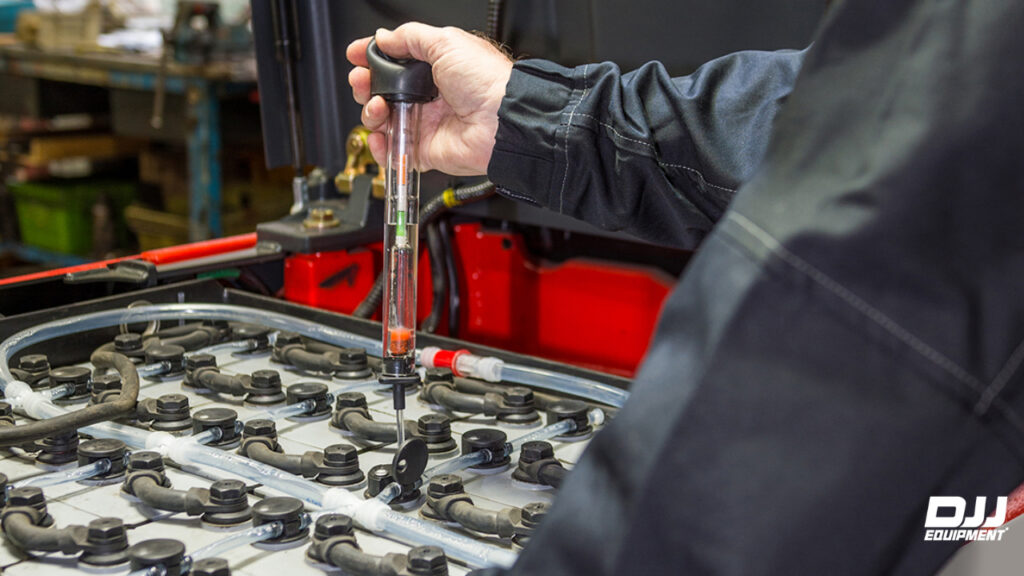
Cut-short charging, running the battery too flat, low water and heat shorten a lead-acid forklift battery's life. Each one damages the plates in a different way.
Sulphate forms on the plates every time the battery discharges and dissolves again on a full charge. A battery left part-charged, or unplugged an hour early every day, lets that sulphate harden into crystals that won't convert back. With 8-10 hours needed for a full charge, a truck charged only over short breaks never gets there.
The opportunity charging that suits lithium also wears flooded lead-acid. Short charges never reach the gassing stage at the end of a full charge, which stirs the acid. Without it, heavy acid settles at the bottom of each cell and attacks the lower half of the plates.
Overcharging does the opposite damage. It splits water into gas, the level drops and plate material left above the acid is lost for good. Hoppecke says cutting overcharging is how its trak uplift air range gains extra cycles.
Heat speeds up grid corrosion and water loss. A lead-acid battery charged in a hot shed through a Queensland or WA summer ages faster than the same battery in a cool, ventilated charging bay.
What shortens the life of a lithium forklift battery?
Heat, charging when the cells are below freezing and the wrong charger shorten a lithium forklift battery's life. Frequent short top-ups don't.
A lithium battery also ages with time, whether it works or not. A thin film inside each cell slowly thickens over the years, faster in heat, and locks away some of the lithium the battery needs. At one cycle per working day, 4,000 cycles would take 16 years, well past the six-year warranty. On a lightly used truck, age rather than cycles is what ends a lithium battery's life.
Cold is the other risk. Charging cells below 0°C makes lithium plate onto the surface of the negative electrode instead of moving into it, and that capacity doesn't come back. The A Series reach truck battery has electric heating as standard to keep it working in low temperatures. The F2 versions of the reach truck and the X Series pallet truck are built for cold stores down to -30°C.
Lithium still needs the correct charger and battery management. Use the charger supplied for that battery, never a lead-acid charger, and keep the cables and plug in good condition.
What does a forklift battery warranty tell you about its lifespan?
A forklift battery warranty is the clearest lifespan figure you'll get for a specific truck, because it's set per model and covers the battery separately. Terms on the lithium models DJJ Equipment sells differ:
- A Series reach truck 1.2-2 t: 6 years or 12,000 hours on the lithium battery.
- X Series pallet truck 2-3 t: 6 years or 12,000 hours on the 48V/105Ah lithium battery.
- A Series walkie reach stacker 1.36 t: up to 5 years or 10,000 hours on the 25.6V/230Ah lithium battery.
Hours matter as much as years. A truck that logs 4,000 hours a year passes 12,000 hours in its third year, so check the battery warranty conditions against your hours, not only the calendar.
Across the battery-electric forklifts we sell, battery terms vary by model and battery option, so ask for the battery warranty on the exact truck and battery you're quoted. The battery term covers the battery only, not the mast, hydraulics or drive.
If you're choosing a battery for a new truck, have your shift pattern, hours a year and coldest working temperature ready and call our sales team on 1800 355 388. For a battery on a truck you already run, our service team on 1300 646 747 will need the model, serial number and hour meter reading.