A forklift battery that won't charge has one of four problems: no power at the charger, a poor connection, a charger fault, or a battery that can't or won't accept charge. Trying the same charger on a second truck of the same type usually separates the charger from the battery. On a lithium forklift, a refusal to charge is often the battery management system (BMS) protecting the cells, so the charger's lights and codes tell you more than the battery gauge does.
What should you check first when a forklift battery won't charge?
Check the power, the plug and the charger's display first, because a charger with no supply looks exactly like a dead battery. These checks follow the charging steps in Hangcha's manual for the XH Series 2-3.8 t, and none of them involve opening anything:
- Park the forklift, apply the brake and turn the truck power off. The manual also has the emergency stop pressed before you plug in.
- Confirm the charger has power: the input switch is on, the circuit breaker hasn't tripped and the display is lit.
- Check the charging plug and socket for water, foreign objects, rust and burn marks. Damage here means stop and report it.
- Push the plug fully home until it locks, and give it time. The charger checks and talks to the battery first, and the XH manual allows about 15 seconds before charging starts.
- Read the charger's display and photograph any light, message or code.
In those 15 seconds a forklift charger is deciding whether it's safe to start. A power light with nothing else happening doesn't mean charging has begun, so check that the charging current on the display is above zero.
How do you tell a forklift charger fault from a battery fault?
You tell a forklift charger fault from a battery fault by charging another truck of the same type from the same charger. Hangcha's manual uses this test: if the second truck charges normally, the fault is on the first truck, and if it doesn't, the fault is in the charger. The table shows the fast charger fault list in that manual.
| What the XH charger shows | Causes the manual lists | Who deals with it |
|---|---|---|
| Battery light stays off | The charger hasn't detected battery voltage | Reseat the plug, then a technician |
| BMS light off | Damaged BMS on the truck, charger controller, charger 12V auxiliary supply or a poor connection at the charging port | Reseat the plug, run the second-truck test, then a technician |
| CAN light fault | Lost communication between the main control board and the charging module | Technician |
| Abnormality light red, showing Input Under-voltage or AC Input Fault | Problem with the 3-phase supply to the charger | Electrician to check the supply, then a technician if the supply is normal |
| Overheat light on | Charger has stopped the charge because of a fault | Stop and report it |
Those lights belong to one Hangcha charger, so yours may look different, but the logic carries over. A fault that follows the charger to a second truck is a charger problem, and one that stays with the truck is a battery, BMS or socket problem. If the second truck is a different voltage or battery type, the test tells you nothing and you shouldn't try it.
Why won't a lithium forklift battery take a charge?
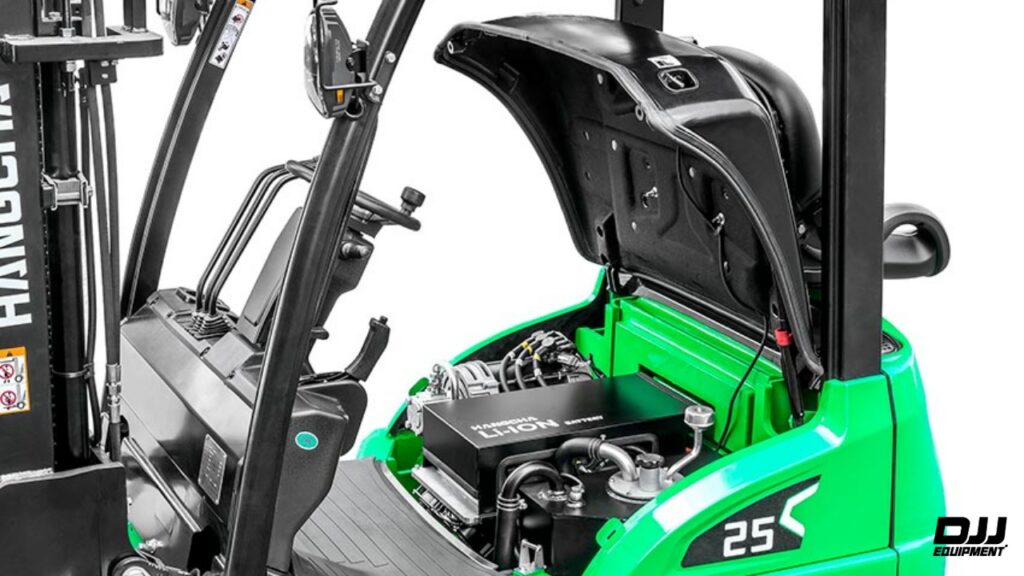
A lithium forklift battery refuses charge when its BMS finds something outside its limits, usually temperature, voltage or lost communication with the charger. Lithium is the battery on many of the electric forklifts DJJ Equipment sells, and the limits differ by model, so check the manual for your truck.
Temperature shows how much those limits vary. Hangcha's manual for the XH Series 2-3.8 t gives a charging range of 0-45°C, its XH Series 12-18 t brochure gives 0-60°C, and its XC Series PMSM brochure gives -30°C to 65°C. A truck that comes off a hot shift, or sits overnight on a cold slab, can fall outside the range on the first model and be fine on the last.
Low charge is the next cause. Hangcha's manual says to charge at 1-2 bars, which is 20-30% of capacity, and its XC brochure advises against working below 20%. A lithium battery that's been run flat or parked for months can drop so low that the charger can't detect it. The manual's rule for forklift long-term storage is a charge every month, which is what keeps a battery out of that state. A flat battery at that level is a job for a technician with the right equipment.
Communication is the cause people miss. A lithium charger only runs while the BMS is telling it what voltage and current to send, so a charger with the right voltage on its label can still refuse to start. That's why Hangcha specifies a dedicated charger for each lithium battery. One thing that isn't a fault: slightly reduced capacity in the cold is normal, and the manual says it comes back when the temperature rises.
Why won't a lead-acid forklift battery take a charge?
A lead-acid forklift battery stops accepting charge properly when sulphate hardens on its plates, its electrolyte runs low or its charges keep getting cut short. Sulphate forms on the plates during normal use and dissolves on a full charge. Leave the battery sitting part-charged and the crystals harden, and the battery loses capacity it won't get back.
This fault fools people, because the charger can finish and show full while the forklift runs flat well before the end of the shift. That truck has a capacity problem, not a charger problem, and a technician needs to test the cells one by one. Lead-acid also needs time: Hangcha quotes 8-10 hours for a full charge on its A Series stand-up 3-wheel forklift, against 3 hours for lithium on the standard charger, so a truck unplugged early every day never reaches full.
Water is the other half of it. Battery maker Hoppecke says to check the level at each charge, keep the electrolyte about 5 mm over the element, and use only distilled or demineralised water, because tap water brings in minerals that reduce performance. Top up after a full charge, once the battery has cooled. Water added before charging can boil over and carry acid out of the cells. Some batteries have a watering system with their own indicators, so photograph the label and level indicator if you're unsure which you have.
The choice between lithium vs lead-acid forklift batteries changes which of these faults you'll see. Lithium has no water, no plates to sulphate and no need for a full charge every time, but it adds a BMS and charger communication that only a technician can test.
What should you never do with a forklift battery that won't charge?
Never open a forklift battery case, jump it from another battery or try a different charger to force a charge. Hangcha's manual rules out all three on its lithium trucks: connecting the terminals with metal can cause sparks or a short circuit, and opening the pack can lead to fire or explosion. It also says to clean dust off the battery with a dry cloth or compressed air, never water.
If a lithium battery gets suddenly hot or gives off a strange smell, the manual says to stop the truck and turn off the power at once. If there's smoke or fire, use a dry powder extinguisher, but only if it's safe for people to do so.
Lead-acid has its own hazard, because charging gives off explosive hydrogen gas. Safe Work Australia's general guide for lift trucks says only trained people should charge or change batteries, the vent caps must stay in place and the battery cover should be held open during charging. Its other precautions for anyone in the charging area are:
- no smoking, open flames, mobile phones or other electronic devices;
- no metal objects that could strike a spark near the cells;
- rings and bracelets off, and eye protection on;
- ventilation, a spill kit, eye washing facilities and a fire extinguisher in the area.
Check the warranty before anyone works on the battery. Forklift warranty terms are set by model and listed on each product page. The XH Series 2-3.8 t carries 24 months or 2,000 hours, for example, and some lithium models list a separate battery warranty.
What does your forklift technician need to know?
Your forklift technician needs the model, serial number, hour meter reading, battery type and exactly what the charger shows. The data plate gives you the model and serial number. Sending these before the visit means the technician can work out the likely fault and bring the right equipment.
- A photo of the data plate, the battery label and the charger's model label.
- A photo of the display, light or fault code, and when it first appeared.
- The result of the second-truck test, if you could run it.
- What changed recently: a new charger, a move to a cold store, months in storage, or rain or water near the socket.
- Whether the truck stopped charging completely, stops partway, or charges but runs flat early.
DJJ services all forklift brands and repairs Hangcha forklifts, and repairs on other brands are assessed case by case, so check your model with the team. Our forklift servicing and repairs include on-site work within 50 km of our Silverwater, Meadowbrook and Bayswater branches, as well as workshop repairs.
When the charger still won't start, call our service team on 1300 646 747 with the model, serial number and a photo of what it's showing.