Yes. A forklift needs conditional registration before it's driven on a road or a road-related area, which includes footpaths, nature strips and car parks open to the public. The driver also needs a driver licence, Class C in NSW, on top of their forklift licence. A forklift that stays on private property closed to the public doesn't need registration. Even when it's registered, a yard forklift only gets limited road access: crossing a road, working in a set area beside its site or loading at the kerb.
Each state runs its own scheme. NSW and Queensland call it conditional registration, Western Australia grants a conditional vehicle licence, and Victoria and South Australia have their own versions.
What counts as a road for forklift registration?
For forklift registration, a road is any area the public can use, not only the street. In NSW, road-related areas include:
- footpaths and nature strips
- service station driveways
- public and private car parks and their access areas
- private roads the public drive on
- drive-in food outlets and other drive-in areas used by the public
Queensland's definition also names shopping centre car parks, railway crossings and any area open to the public for use as a road. A yard that customers or delivery drivers drive through can count as a road even though it sits on private land.
The common trap is the truck parked on the street. Say a delivery truck can't fit through your gate and stops at the kerb outside your warehouse. The forklift that crosses the footpath to unload it is on a road-related area for those few metres, so it needs registration.
If the forklift never leaves land closed to the public, registration doesn't apply, but WHS duties still do. A forklift traffic management plan keeps forklifts and people apart inside the fence.
Where a registered forklift can drive on the road
A conditionally registered yard forklift can cross a road, work in a set area and load or unload at the kerb, but it can't travel from site to site on public roads. The conditions are printed on its registration and differ by state.
In Queensland, a yard forklift on solid rubber or cushion tyres can only get limited access registration. Zone access (travel within 20, 40 or 80 km) and unrestricted access aren't available for it. Its limited access codes include:
- LO1: road use only when crossing, either directly or from one road-related area to another
- LO7: cross a footpath and operate up to 100 metres on a road to load or unload a vehicle combination
- GO7: forks and other hazardous projections covered with rigid material
- GO8: no load carried on the road, except when working in a designated area, a signed work zone or loading at the kerb
- TD1: no travel in darkness or poor visibility
NSW works the same way. Its forklift conditions restrict the truck to a designated route, which is the street next to its worksite, or to a designated area such as Flemington Markets. A forklift registered for a designated area also carries condition LO99, which means it's floated from site to site, not driven.
How to register a forklift in NSW
To register a forklift in NSW, you apply in person at a service centre, and the forklift must carry the equipment on the Transport for NSW forklift sheet. The September 2025 sheet sets one equipment list for daylight or floodlit work and a longer one for 24-hour use.
| Equipment | Daylight or floodlit use | 24-hour use |
|---|---|---|
| Amber rotating beacon | Required | Required |
| Brake and direction indicator lights | Required | Required |
| Horn and rear vision mirrors | Required | Required |
| Red rear reflectors or reflective tape | Required | Required |
| Headlights, tail lights and number-plate lights | Optional | Required |
| Side reflective tape | Optional | Required |
The difference between the two columns is lighting and side tape. A forklift without headlights, tail lights and side tape can still be registered, but condition TD1 then limits it to daylight or a floodlit work site. Condition SL1 requires the beacon to flash whenever the forklift is moving.
If you're ordering new forklifts for kerbside work that runs after dark, ask for headlights, tail lights and side reflective tape on the truck, because without them it can only be registered for daylight use.
The registration fee includes CTP insurance, but it covers you only on roads and road-related areas, not on private property. A successful application gets a Certificate of Registration, two number plates marked NSW Conditional in green on white, and a Certificate of Approved Operations, which must be carried in the forklift at all times.
How to register a forklift in Queensland
In Queensland, you register a forklift with the Department of Transport and Main Roads using a vehicle details inspection sheet (F3529), plus a new customer application (F3503) if it's your first registration. You don't need a certificate of inspection or a safety certificate. You do need evidence of identity and a Queensland address, a nominated CTP insurer and the registration duty.
Queensland CTP covers injury to other people but not property damage, including damage to other vehicles. That's why TMR suggests public liability insurance for non-standard vehicles such as forklifts.
A conditionally registered forklift that changes hands needs a transfer application (F4101) within 14 days of purchase. Changes to the forklift's details go on form F4100, and they can change the registration and CTP cost.
Can you drive a forklift on the road in WA?
Yes, but only when the WA Department of Transport accepts there's a genuine need. Its information bulletin IB-122H grants a conditional, restricted use vehicle licence only if a compliant vehicle can't do the job, the forklift needs to access a public road, even just to cross it, and the use is work-related or commercial.
Forklifts within the mass and dimension limits of the Vehicle Standards Regulations don't need special approval first. They're presented for inspection and licensed. Over-mass or oversize forklifts can't be licensed to travel along a road at all.
WA also refuses licences taken out only for insurance. Some owners have licensed off-road vehicles to get major injury cover on an industrial site, and the bulletin says there's no justification for that unless the vehicle has to cross or travel along a public road.
Do you need a driver licence to drive a forklift on the road?
Yes. A forklift licence covers operating the forklift at work, but driving it on a road also takes a driver licence. In NSW, the forklift sheet requires a valid Class C car licence for a road or road-related area, plus a high risk work licence for forklift trucks at the work site.
In Queensland, WorkSafe Queensland says you need a Queensland driver licence with a suitable endorsement for the plant you drive on the road. TMR advises which endorsement applies.
The forklift licence class depends on the truck. Class LF covers forklift trucks with a mast and an elevating load carriage, including reach trucks. Class LO covers order pickers, where the operator's controls rise with the load carriage. High risk work licences are issued by the state regulator after training with a registered training organisation, need the holder to be 18 or over and last 5 years.
Fines for driving an unregistered forklift on the road
As at November 2026, driving an unregistered forklift on a road or road-related area in NSW brings an $818 fine, or $1,728 and 4 demerit points if the vehicle's GVM is over 4.5 tonnes. Driving it uninsured is a separate $818 offence, and an owner who causes or permits the use faces an $818 fine of their own.
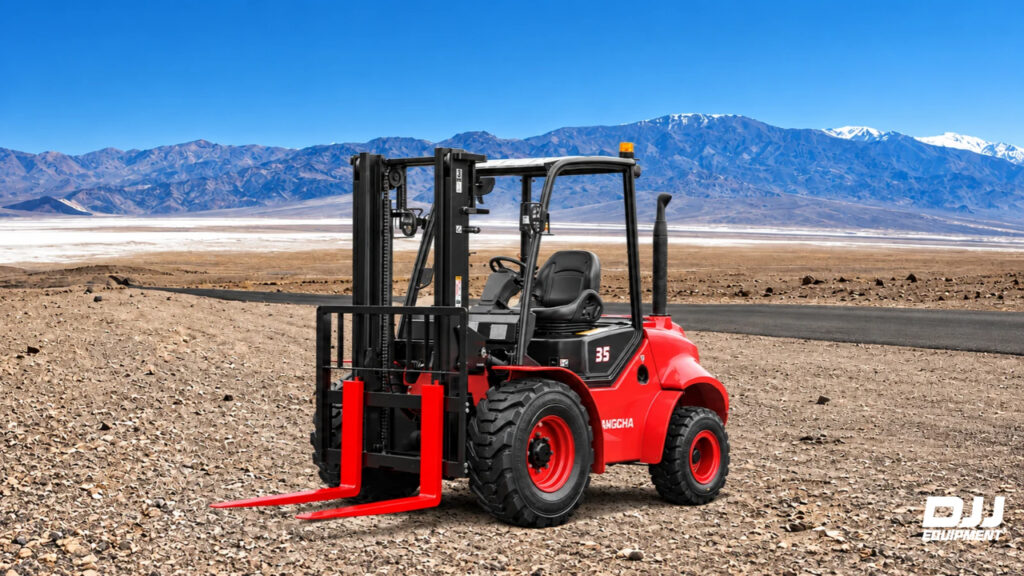
Plenty of forklifts are over that 4.5 tonne line before they lift anything. The Hangcha 2.5-3.5 t rough terrain forklift weighs 5,000 to 5,600 kg depending on its capacity.
The fine is the smaller cost. CTP insurance comes with registration, so an unregistered forklift has no CTP policy to respond if it injures someone on the footpath or in the street.
If your forklift only crosses a road or loads at the kerb, conditional registration is the normal answer, and the truck needs the lighting and beacon your state's conditions ask for. If it has to move between sites, plan to float it. DJJ Equipment sells forklifts from Silverwater NSW, Meadowbrook QLD and Bayswater WA, so tell us where the forklift will drive when you call 1800 355 388 or send an enquiry.