Class II electric narrow aisle trucks are the forklift class best suited to narrow warehouse aisles. The class covers reach trucks, which work in aisles of about 2.6 to 2.9 m, turret trucks, which stack in aisles from 1,550 mm, and high-level order pickers. A typical 2.5 tonne counterbalance forklift needs close to 4 m. Australia doesn't regulate by these classes, though. Here the class that matters is the operator's licence: LF for most narrow aisle trucks, and LO where the operator's controls rise with the load.
What are the forklift classes, and which covers narrow aisles?
The forklift classes come from the US Occupational Safety and Health Administration (OSHA), which sorts powered industrial trucks into seven classes, and Class II is the one built for narrow aisles. Class I covers electric rider trucks, including sit-down and stand-up counterbalance forklifts. Class III covers electric hand and hand/rider trucks such as pallet jacks and walkie stackers. Classes IV and V are LPG and diesel counterbalance forklifts, VI is tow tractors and VII is rough terrain forklifts, and none of those four is a narrow aisle machine.
The table compares the electric classes with an example from each, using the narrowest model in its range.
| Class | Truck type | Example model | Minimum aisle | Maximum lift |
|---|---|---|---|---|
| Class I | Stand-up 3-wheel counterbalance | A Series stand-up 3-wheel, 1,361 kg | 3,023 mm | 7 m |
| Class II | Reach truck | XC Series reach truck, 1,400 kg | 2,687 mm | 11 m |
| Class II | Man-down turret truck | A Series turret truck, 1,000 kg | 1,550 mm | 7.5 m |
| Class III | Walkie reach stacker | A Series walk-behind reach stacker, 1.36 t | 2,337 mm | 5.5 m |
The turret truck needs barely half the aisle of the stand-up forklift, and the reach truck lifts highest. Each maker measures the aisle with its own test pallet, from 1000 x 1200 mm turned crossways to 1100 x 1100 mm, so treat the figures as a guide and check the truck against your own pallets and racking.
Reach trucks suit most narrow aisle warehouses
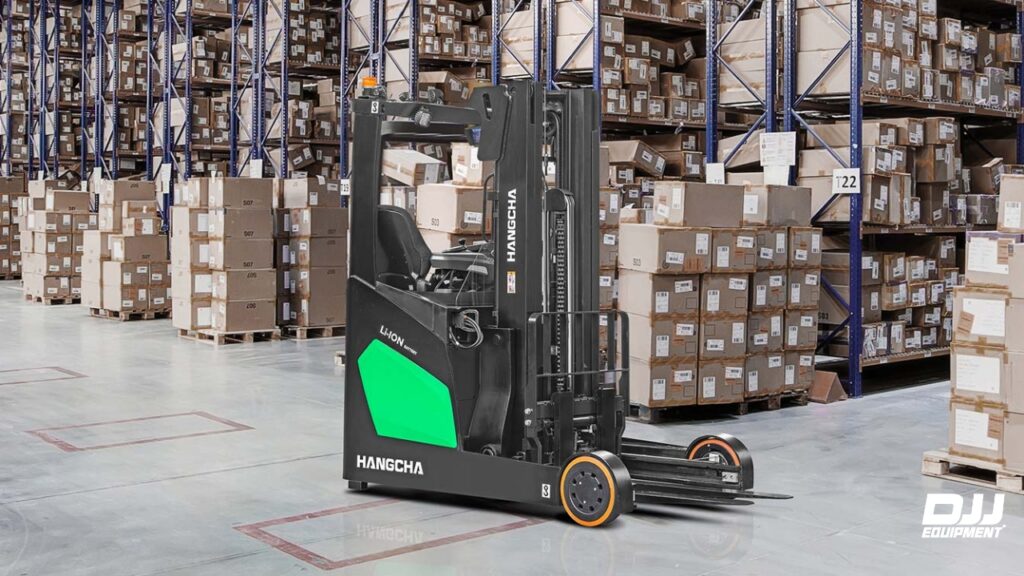
A reach truck suits most narrow aisle warehouses, because it combines an aisle under 2.9 m with lift heights above 10 m and can still be driven anywhere on a flat floor. The XC Series reach truck 1.4-2.5 t works in aisles from 2,687 to 2,867 mm and lifts 11 to 13 m. It drives with the load pulled back inside its wheelbase, then reaches forward to place it, which is why it turns in so little space.
Capacity falls sharply near the top on stand-on and seated reach trucks, because a load held high makes the truck less stable. The 2 t XC model carries 500 kg at 13 m, rated at a 600 mm load centre, so match the mast to your top beam and heaviest pallet rather than to the nameplate. Attachments cut the usable capacity further.
Some reach trucks push the forks out on a scissor (pantograph) instead of moving the mast. The X Series pantograph reach truck reaches 610 mm in single-reach form and 1,067 mm in double-reach form, which puts pallets two deep in the racking from a 2,713 mm aisle. The limit is the floor: reach trucks are indoor machines for smooth, level concrete.
Very narrow aisle turret trucks go below 2 m
A very narrow aisle (VNA) turret truck goes below 2 m, because it never turns in the aisle. Its turret head swings the forks to either side, so the truck drives straight down an aisle little wider than itself. The A Series man-down turret truck works in a 1,550 mm aisle at 1,000 kg and in 1,650 mm at 1,200 or 1,500 kg, rated at a 550 mm load centre, and lifts to 7.5 m.
That density comes with conditions. The seated 1.2 t man-down turret truck runs on rail or wire guidance in a 1,750 mm aisle, and it needs a transfer aisle of at least 3,800 mm at the end to turn into the next one. So a turret truck suits a large store with long, dedicated aisles, not a mixed warehouse where the same truck also unloads trailers.
On man-up turret trucks, the operator rides up with the load in a cab. The X Series man-up tri-lateral stacker reaches 1,300 mm sideways and lifts to 14.7 m, where it carries 650 kg. These very narrow aisle trucks let the operator see the rack face at every level, but they change the licence the operator needs.
High-level order pickers work narrow aisles for picking
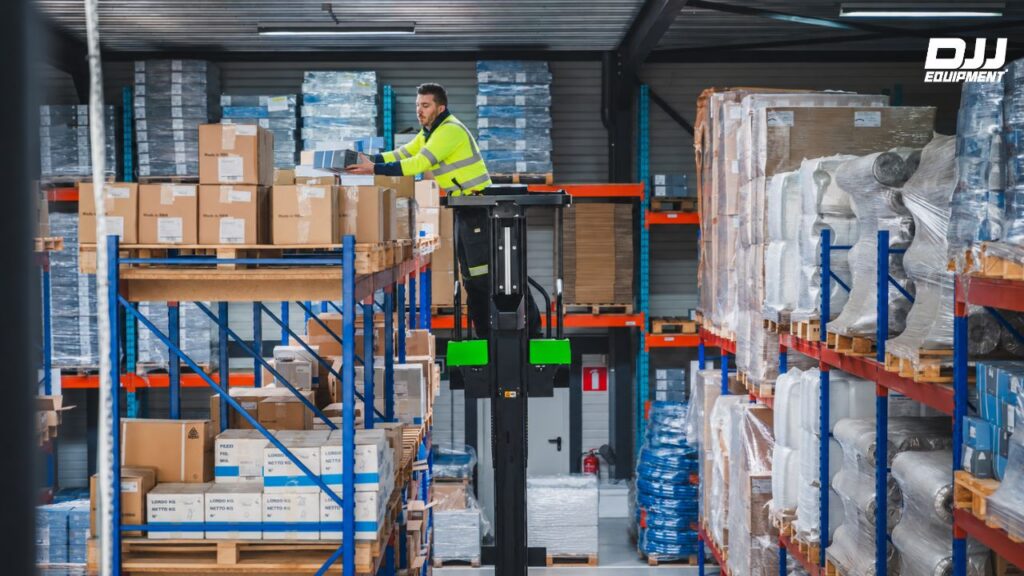
A high-level order picker works a narrow aisle when your staff pick cartons or single items rather than whole pallets. The operator's platform rises with the forks, so the operator picks straight from the shelf. At 1,015 mm wide, the A Series high-level order picker for narrow aisles carries 1,360 kg at a 600 mm load centre and lifts its platform to 6,350 mm with the tallest mast.
Order pickers and reach trucks often share a warehouse: the reach truck puts full pallets away, and the order picker breaks them down for orders. If most of your orders are single items from upper levels, high-level order pickers replace the ladders and stock trolleys that slow picking down.
Can a counterbalance forklift work in a narrow aisle?
A counterbalance forklift can work in an aisle of about 3 to 3.3 m if it's a 3-wheel or stand-up model, but not in a true narrow aisle under 2.9 m. The A Series stand-up 3-wheel forklift needs 3,023 to 3,241 mm across its range from 1,361 to 2,268 kg. The XC Series 3-wheel needs 3,158 to 3,290 mm, against 3,682 mm for a 2.5 t X Series 4-wheel model.
A Class I truck makes sense when the same machine has to load trucks at the dock and stack in the racking, because a reach truck can't do the dock work well. The cost is space: each aisle stays about 300 to 600 mm wider than it would with a reach truck. In a reach truck vs counterbalance forklift match-up, the reach truck wins on aisle width and lift height, and the counterbalance forklift wins at the dock and in the yard.
Walkie stackers handle narrow aisles at low volume
A Class III walkie stacker handles narrow aisles where the volume is low and the racking stops at about 5 m. The A Series walk-behind reach stacker carries 1,400 kg to 3.5 m and 1,000 kg at its 5.5 m top lift, and works in aisles from 2,337 mm. Hangcha recommends adding at least 300 mm to that figure for manoeuvring.
The operator walks behind, so the stacker needs no forklift licence, though operators still need training and the site must manage the risk. The trade-off is pace: a walking operator can't match a ride-on reach truck over a full shift. For a small store with a few rows of racking, electric walkie stackers are often the lowest-cost way into narrow aisles.
Which licence class do narrow aisle forklifts need in Australia?
Narrow aisle forklifts need a High Risk Work Licence in class LF or LO, depending on whether the operator rises with the load. Reach trucks, man-down turret trucks and stand-up counterbalance forklifts are forklift trucks, so their operators need class LF. Order pickers and man-up turret trucks need class LO, because their controls rise with the load and the operator.
Walk-behind stackers and pallet jacks need no licence, but they do need trained operators. Licences come from the state or territory regulator after training with a Registered Training Organisation, so check the current rules with SafeWork NSW, WorkSafe Queensland, WorkSafe WA or the regulator where your warehouse is.
To match a narrow aisle forklift to your warehouse, DJJ Equipment needs your current or planned aisle width, top beam height, heaviest pallet and its size, and the floor finish. Tell us whether the truck also has to load trucks, and how many shifts it runs. Call 1800 355 388 or send an enquiry.