The electric counterbalance forklift is the most commonly used forklift in warehouses, because one truck can unload a trailer at the dock, carry pallets across the floor and stack them into racking. A typical 2.5 tonne electric model lifts to about 7 m and needs an aisle of about 3.7 to 4 m. Warehouses built around high racking switch much of that work to reach trucks, which run in aisles under 2.9 m, and most sites also keep pallet jacks for moves at floor level.
Why the counterbalance forklift is the most common warehouse forklift
The counterbalance forklift is the most common warehouse forklift because nothing sits in front of its forks. Weight at the rear balances the load, so the truck can take a pallet off a trailer deck, the floor or a rack beam without legs to drive around. That's why the same machine works the dock, the yard and the aisles.
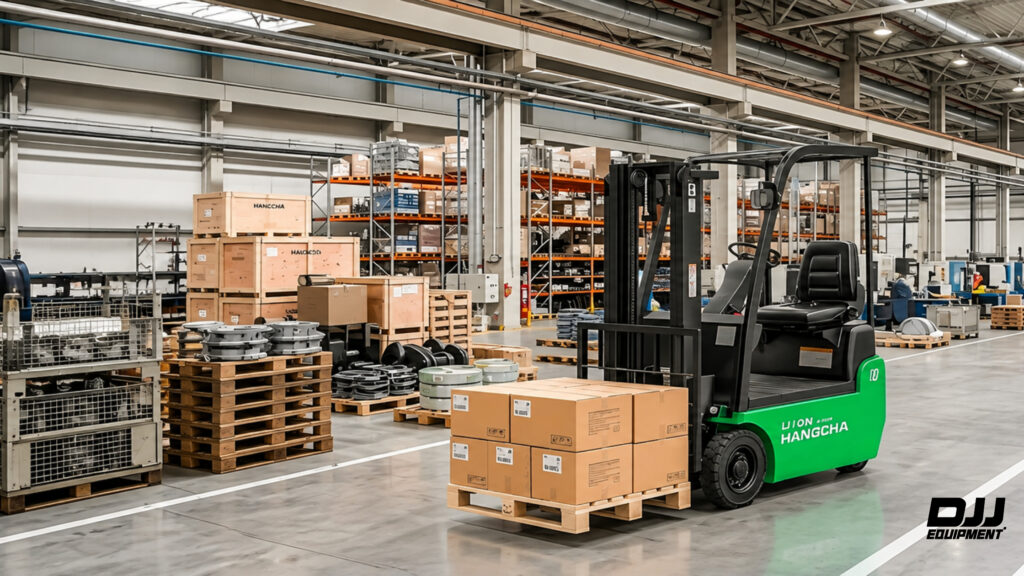
Among the new electric forklifts DJJ Equipment sells, the X Series 4-wheel electric forklift 1-3.5 t shows the range. It runs on pneumatic tyres for indoor and outdoor work, and the 2.5 t CPD25 still carries 1,350 kg at its 7 m maximum lift, rated at a 500 mm load centre. Capacity falls as the mast rises, and attachments cut it further, so the load chart for your top beam is the figure that counts.
Electric is the most common power for warehouse forklifts
Electric is the most common power type for warehouse forklifts, because a battery truck has no exhaust and runs quietly between racking and staff. LPG forklifts can work indoors only where the ventilation is adequate, and diesel is normally an outdoor machine. So once a forklift spends most of its day inside, the choice is usually electric.
The XA Series 4-wheel electric forklift is a typical warehouse truck: an 80V lithium-ion machine from 2 to 3.8 tonnes, lifting to 7 m. The 2 t and 2.5 t models need a 3,982.5 mm aisle for 1000 x 1200 mm pallets turned crossways.
The bigger decision inside electric is the battery. Lithium suits two or more shifts, because you top it up at breaks. Lead-acid costs less to buy and suits one shift with a full overnight charge, but it needs watering and a charging area. If your site runs around the clock, a lithium truck saves you buying and swapping a second battery.
3-wheel and stand-up forklifts for tighter warehouses
A 3-wheel or stand-up electric forklift is the counterbalance choice for a tighter warehouse, because it turns in less space than a 4-wheel truck of similar capacity. The XC Series 3-wheel 1.5 t needs a 3,158 mm aisle for 1000 x 1200 mm pallets crossways, while the 1.5 t X Series 4-wheel model needs 3,436 mm.
The A Series stand-up 3-wheel forklift goes further. The operator stands side-on, and the 1,361 kg model works in a 3,023 mm aisle with a 40 x 48 in pallet (about 1016 x 1219 mm) and stacks to 7 m.
The trade-off is weight and ramps. The XC 3-wheel models top out at 2 t and climb 13 to 16% laden, against 17 to 20% for the X 4-wheel range. If your pallets run past 2 t or the truck climbs a steep dock ramp, stay with 4 wheels. If the floor is flat and space is tight, 3-wheel counterbalance forklifts give you a few hundred millimetres back in every aisle.
When does a reach truck replace the counterbalance forklift?
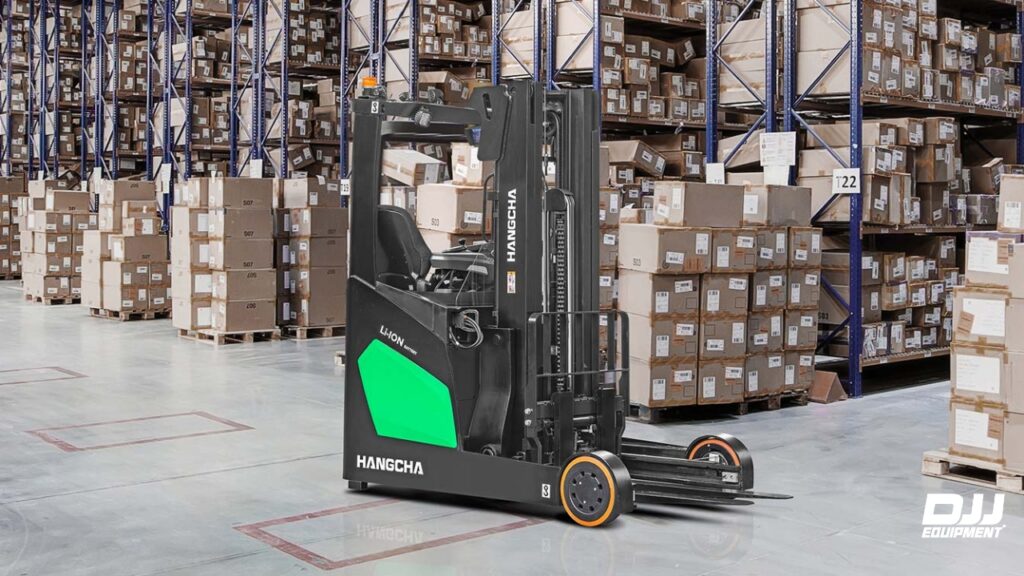
A reach truck replaces the counterbalance forklift once most of the work is putting pallets into high racking, because it needs a narrower aisle and lifts higher. The 2.5 t XC Series reach truck works in a 2,867 mm aisle and lifts to 13 m, where it still carries 1,000 kg at a 600 mm load centre. The 2.5 t XA counterbalance forklift needs 3,982.5 mm, so each aisle can be about 1.1 m narrower with the reach truck.
Across a row of aisles, that saving turns into extra racking. The reach truck pays for it in flexibility. It's an indoor truck for smooth, level floors, it isn't built for yard work or loading trucks from the ground, and its operator still needs the LF licence.
That's why a busy distribution centre often runs warehouse reach trucks in the racking and keeps one or two counterbalance forklifts on the dock. A small warehouse with a few rows of racking usually gets more from one counterbalance truck than from two machines.
Is a pallet jack the most common warehouse machine?
In many warehouses the electric pallet jack is the most common machine, but it isn't a forklift. It lifts a pallet only far enough to move it, so it does the dock and floor work that would waste a forklift's time. The XA Series pallet truck 2-3 t lifts 125 mm, travels at 6 km/h laden and needs a 2,091 mm aisle for 1000 x 1200 mm pallets.
Walkie stackers sit between a pallet jack and a forklift. The X Series pallet stacker lifts 1,200 to 2,000 kg to as high as 6 m, carrying 450 to 550 kg at that height at a 600 mm load centre, and works in aisles from 2,200 mm. It suits light stacking and low volumes, not a full shift of racking work. Both machines need trained operators, and electric pallet trucks are often the first machine a small warehouse buys, before any forklift.
Order pickers and turret trucks are specialist warehouse forklifts
Order pickers and turret trucks are less common warehouse forklifts, used where staff pick single items from high shelves or where aisles are too narrow for a reach truck. On the A Series high-level order picker, the operator's platform rises with the forks to 5,250 to 6,350 mm, depending on the mast. The A Series man-down turret truck turns its forks to either side of the aisle, so it works in aisles from 1,550 mm and lifts to 7.5 m.
Both need a warehouse planned around them. The 1.2 t man-down turret truck, for example, runs on rail or wire guidance in the aisle. Rough terrain forklifts, telehandlers and container handlers make up the rest of the different types of forklifts, but they're yard and site machines rather than warehouse trucks.
Which licence does a warehouse forklift operator need?
A warehouse forklift operator needs a High Risk Work Licence in class LF to drive a counterbalance forklift, a reach truck or a ride-on stacker. An order picker, where the operator's controls rise with the load, needs class LO instead. Walk-behind stackers and pallet jacks need no licence, but operators still need training and instruction, and the business must manage the risk.
Training is done with a Registered Training Organisation, and the licence comes from the work health and safety regulator. In New South Wales, Queensland and Western Australia that's SafeWork NSW, WorkSafe Queensland and WorkSafe WA, so check the current rules with the one where the work happens.
Before you pick a truck, measure your narrowest aisle and your top beam height, and weigh your heaviest pallet. Those three figures decide most of the choice. Send them to DJJ with your floor type and shift pattern, and we'll match the machines to your site. Call 1800 355 388 or send an enquiry.