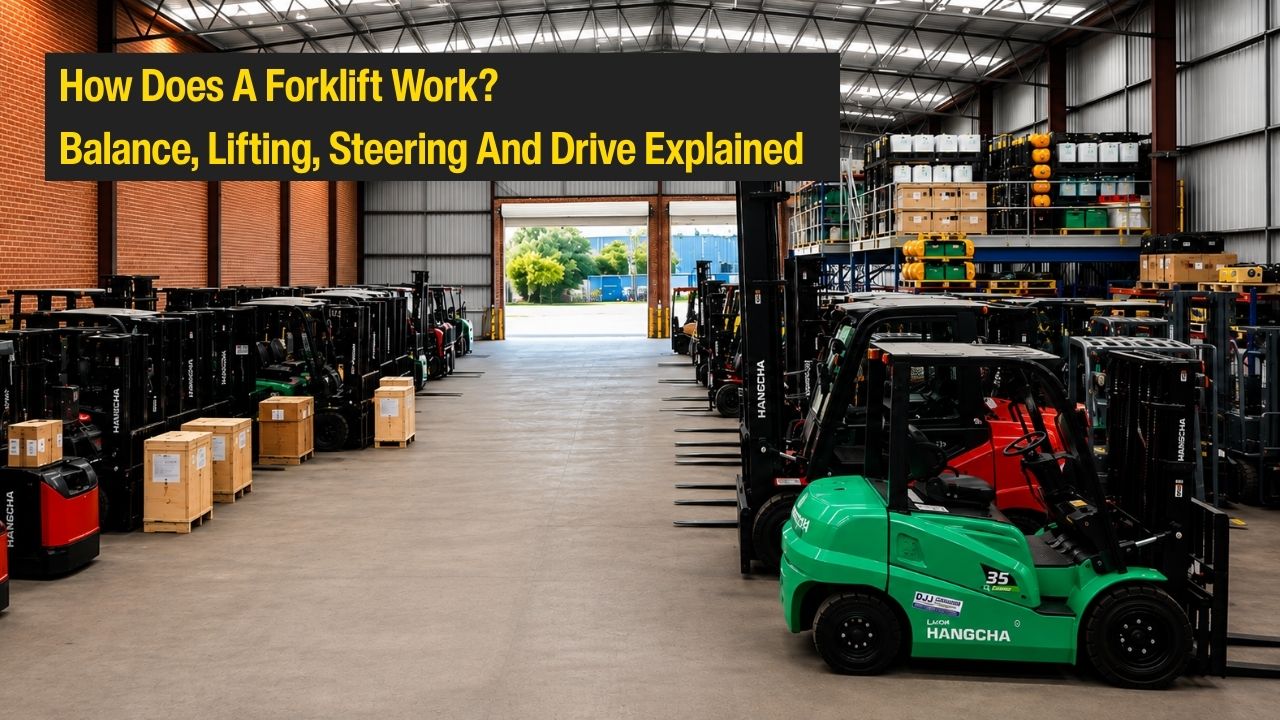
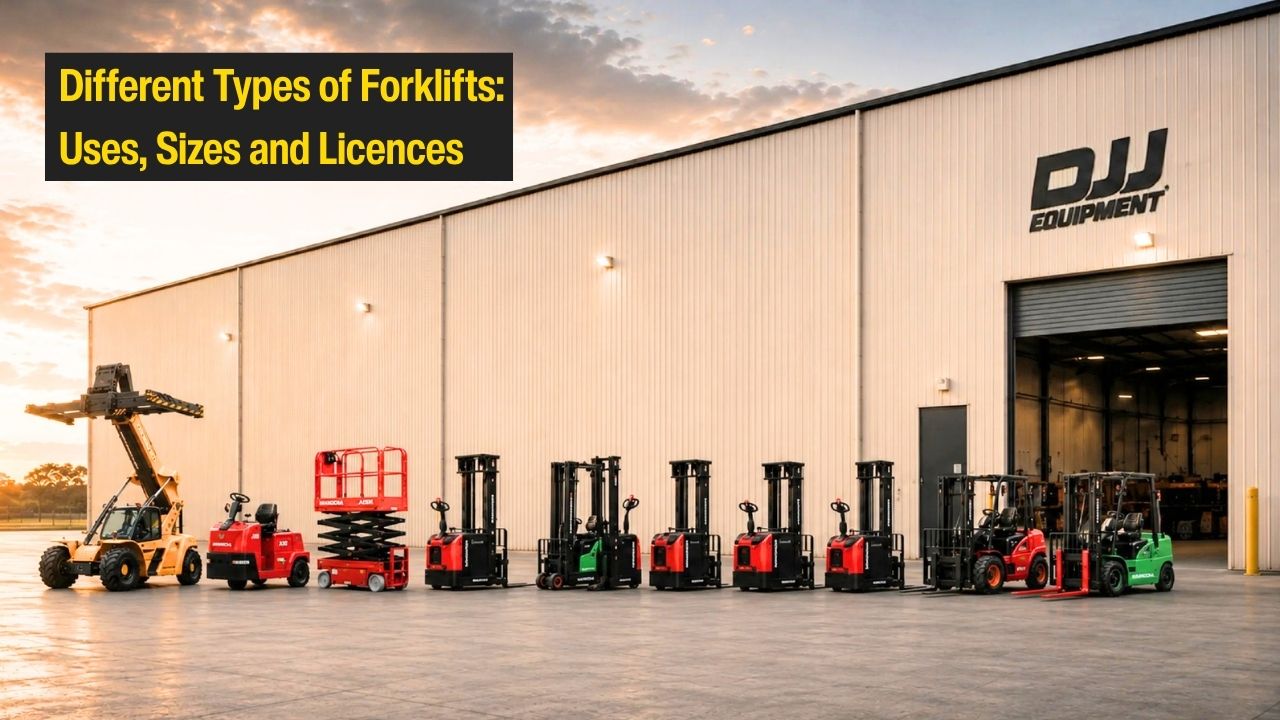
The main types of forklifts are counterbalance forklifts, reach trucks, order pickers, turret trucks, walkie stackers, pallet jacks, rough terrain forklifts, telehandlers, side loaders and container handlers. Each one suits a different floor or ground, lift height, aisle width and load. In Australia the type also decides the licence: most ride-on forklifts need a High Risk Work Licence class LF, order pickers need class LO, and walk-behind trucks need no licence but still need trained operators. Counterbalance forklifts are the type most people picture, and they handle most general pallet work.
Types of forklifts at a glance
This table sorts the common types by how they lift, where they fit and the licence each needs in New South Wales, Queensland and Western Australia, with the range DJJ Equipment carries in each category.
| Type | How it lifts | Best for | Licence (NSW, QLD, WA) | DJJ range |
|---|---|---|---|---|
| Counterbalance forklift (electric, LPG, diesel) | Weight at the rear balances the load on the forks | Docks, yards and general pallet work | LF | Counterbalance forklifts, 0.6-48 t |
| Reach truck | Mast or forks reach forward between two base legs | High racking in narrow aisles, indoors | LF | Reach trucks, 1-3 t |
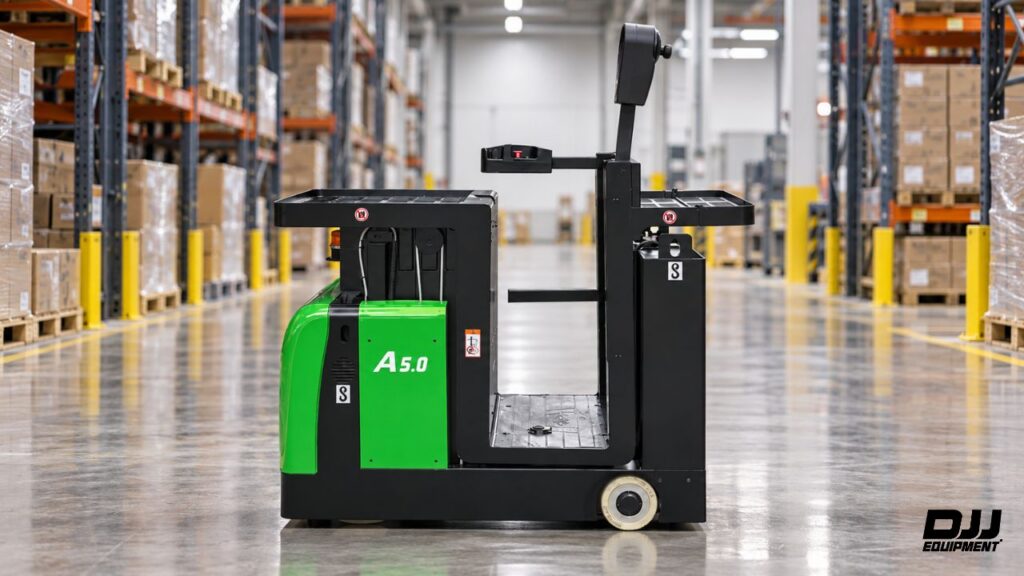
| Order picker | Operator platform rises with the forks | Picking cartons and items from racking | LO | Order pickers, low to high level |
| VNA turret truck | Forks rotate and shift sideways while the truck stays straight | Very narrow aisles at height | LO if the operator rises (man-up), LF if not (man-down) | Turret trucks, up to 14.7 m |
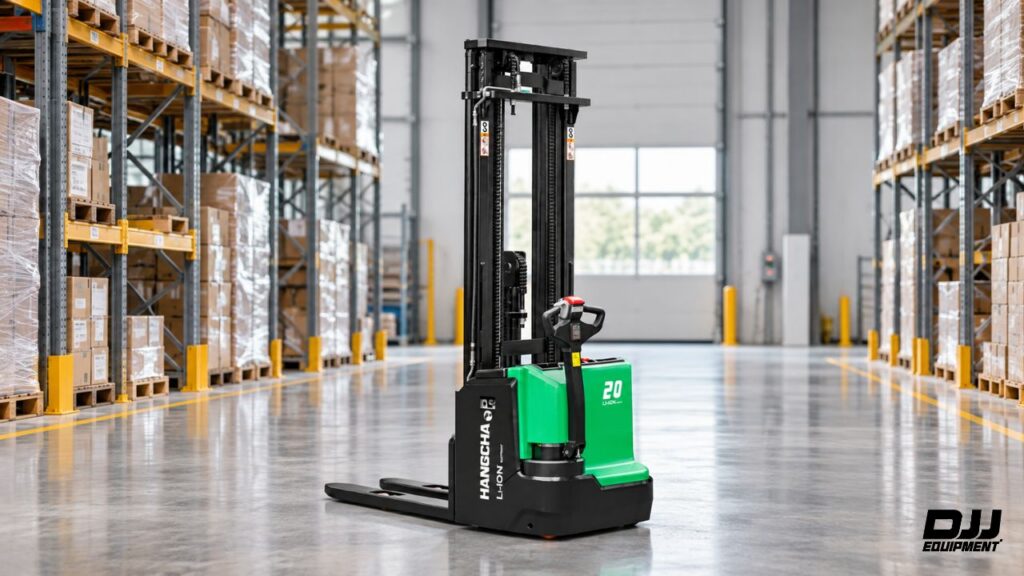
| Walkie stacker or pallet stacker | Mast lifts the pallet while the operator walks behind | Light stacking in small warehouses and backrooms | None if walk-behind (training required), LF if ride-on | Pallet stackers, 0.8-2 t |
| Pallet jack or pallet truck | Lifts the pallet just clear of the floor | Docks, truck loading and short moves | None (training required) | Electric pallet jacks, 0.5-3.63 t |
| Rough terrain forklift | Big pneumatic tyres, high clearance, 2WD or 4WD | Building sites, farms and unsealed yards | LF | Rough terrain forklifts, 1.5-10 t |
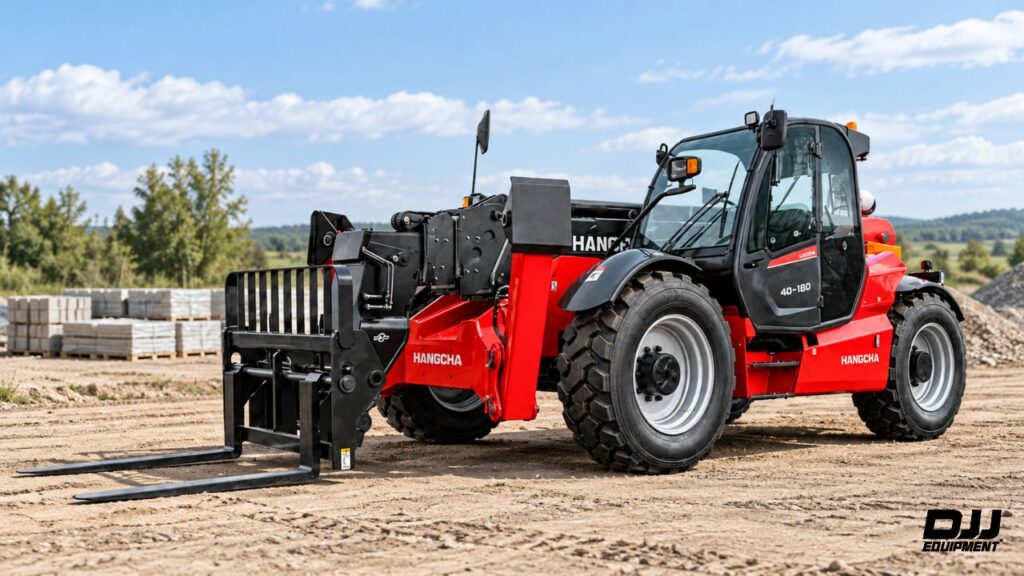
| Telehandler | Telescopic boom places loads up and forward | Construction, farms, reaching over obstacles | None with forks or a bucket; crane or platform use can need another licence | Telehandlers, 2.5-4 t |
| Side loader | Forks on the side, so long loads ride along the truck | Timber, steel and pipe | Check with your regulator | Side loaders, 3-6 t |
| Empty container handler | Vertical mast with a top-lift container spreader | Stacking empty shipping containers | Check with your regulator | Empty container handlers, 6-9 t |
| Container reach stacker | Telescopic boom with a container spreader | Laden containers across several rows | RS (over 3 t) | Reach stackers, 45 t |
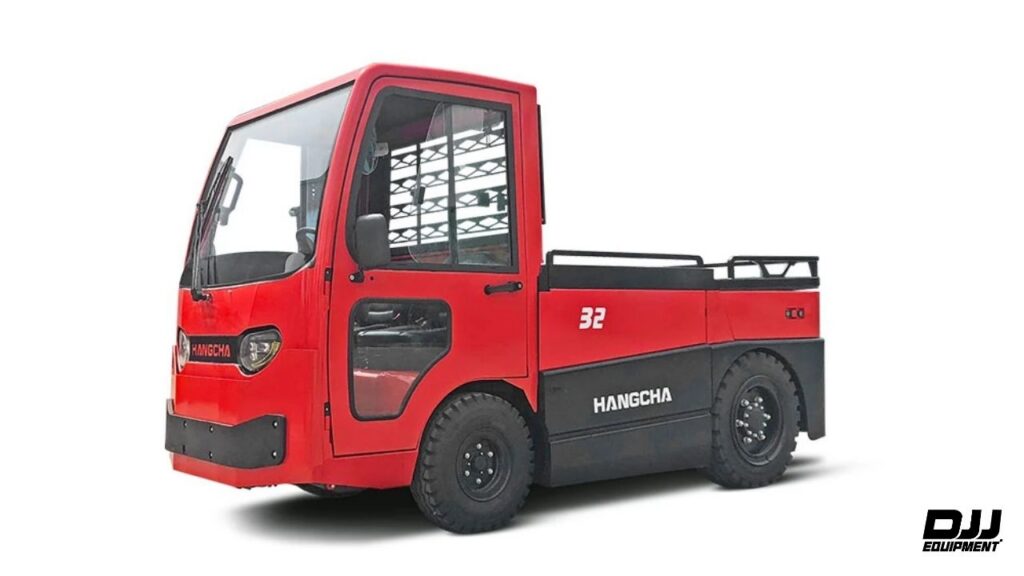
| Tow tractor (not a forklift) | Pulls trailers and lifts nothing | Trailer trains in factories and depots | None (training required) | Tow tractors, 1-40 t towed load |
| Explosion-proof forklift | Electric counterbalance with explosion-proof parts | Classified hazardous gas or dust zones | LF | XE Series explosion-proof forklift, 1-3.5 t |
Most ride-on forklifts fall under class LF. The exceptions are order pickers and man-up turret trucks, which need class LO, telehandlers and container reach stackers, which follow their own rules, and walk-behind stackers, pallet jacks and tow tractors, which have no licence class but still need trained operators. The capacities shown are the top of each range, and any single model is only rated at the load centre and lift height on its data plate.
Counterbalance forklifts: the standard type
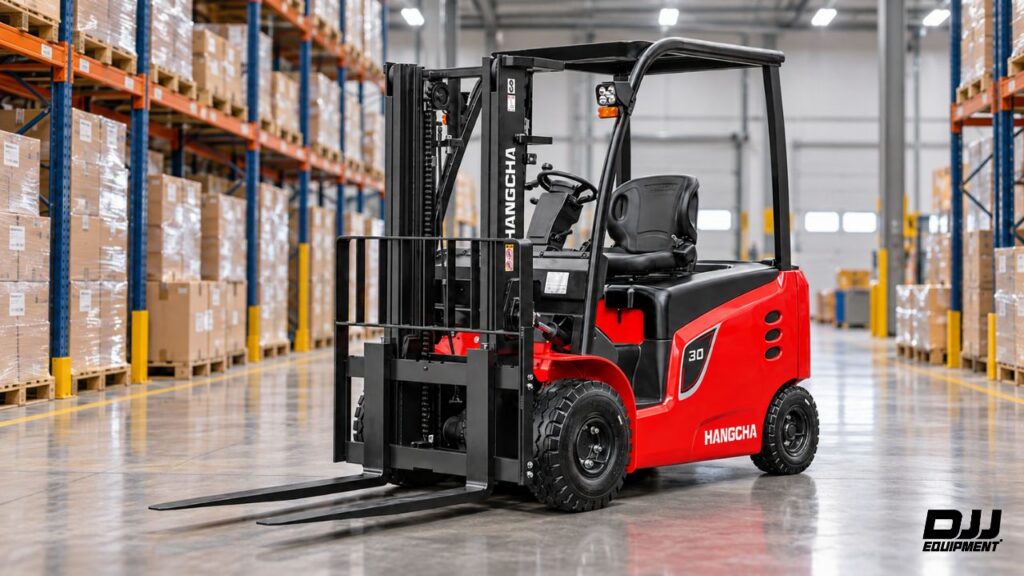
A counterbalance forklift is a sit-down truck with a heavy weight at the rear that balances the load on the forks, so it needs no legs out front and can drive straight up to a pallet, a truck or a rack. That makes it the most flexible type for docks, yards and general warehouse work. Our counterbalance range runs from 0.6 t to 48 t in three-wheel and four-wheel layouts.
The trade-off is space. A 2.5 t counterbalance forklift needs an aisle of about 3.9-4.1 m to turn and stack at right angles, against about 2.6-2.9 m for a reach truck. Its rated capacity also holds only at the load centre and lift height on the data plate, and attachments or higher lifts reduce it.
Electric counterbalance forklifts
Electric counterbalance forklifts run on a lithium-ion or lead-acid battery, produce no exhaust and run quietly, which suits enclosed warehouses, food sites and noise-sensitive areas. Electric doesn't automatically mean indoor only: some models are rated for indoor and outdoor use, so check the model before you plan yard work.
Your shift pattern decides the battery. Lithium suits multi-shift work because you can top it up at breaks, while lead-acid costs less to buy but needs full charge cycles, watering and a charging area. Our electric forklifts for sale cover 0.6 t to 48 t, with lithium on most series.
LPG and diesel forklifts
LPG and diesel forklifts refuel in minutes and keep working through long shifts, which is why they stay common on docks, in yards and on sites that run hard all day. LPG can work indoors only where ventilation is adequate, and diesel is normally an outdoor machine.
Fuel and engine servicing are ongoing costs an electric truck doesn't carry, so the choice usually comes down to your hours, your site and whether you have room to charge. DJJ's LPG and diesel forklifts run from 1 t to 48 t.
Which is better, a 3-wheel or 4-wheel forklift?
A three-wheel forklift turns tighter, so it suits narrow aisles, lighter loads and loading trucks inside a warehouse, while a four-wheel forklift is more stable, carries more and copes better with yards. In our range every three-wheel model is electric and tops out at 2.3 t, from compact 0.6-1 t trucks to 1.5-2.3 t stand-up models, while four-wheel models go up to 48 t. If you work on ramps or rough patches outdoors, four wheels usually make more sense.
Explosion-proof forklifts
An explosion-proof forklift is an electric counterbalance truck built for hazardous areas where flammable gas or dust can build up. The XE Series explosion-proof forklift in our range is rated from 1 t to 3.5 t, for gas Zones 1 and 2 and dust Zones 21 and 22, with explosion-proof motors, controller, lights and battery. If your site has classified hazardous zones, match the truck to the zone classification your site already holds and confirm it with whoever prepared it.
Warehouse forklifts for racking and narrow aisles
Reach trucks, order pickers and turret trucks are the three warehouse types built for high racking, and they differ in what rises and how narrow the aisle can be. A reach truck lifts pallets in narrow aisles, an order picker lifts the operator with the load to pick cartons, and a turret truck rotates its forks so it can work in very narrow aisles.
Reach truck (high reach forklift)
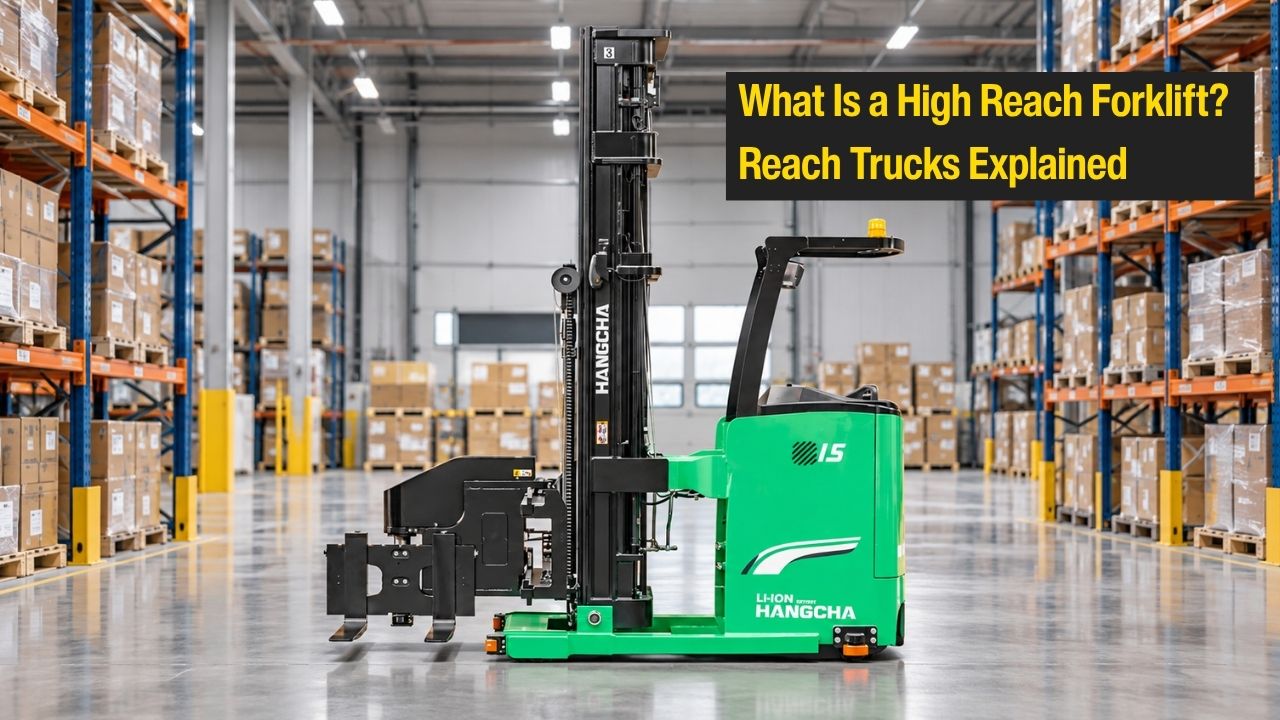
A reach truck is an electric stand-on or sit-on truck whose mast or forks reach forward between two base legs, so the load sits inside the wheelbase while it travels. That lets it stack high in aisles of about 2.6-2.9 m, and no current Hangcha reach truck needs less than 2.61 m. Our reach trucks run from 1 t to 3 t, with masts up to 13 m.
Reach trucks need smooth, level floors, and capacity drops as the mast goes up: a 2.5 t reach truck in our range still lifts 1 t at 13 m, not 2.5 t. The range also includes four-way and pantograph (double-deep) models for long loads and deeper racking. A reach truck is a forklift truck under Australian law, so the operator needs class LF.
Order picker
An order picker lifts the operator on a platform with the forks, so staff can pick single cartons or items straight from the racking instead of bringing whole pallets down. Our order pickers range from low-level stock pickers with a 4 m standing height to high-level machines with masts up to 9.5 m. A 1.2 t high-level picker carries its full rating at a 400 mm load centre up to 3 m, falling to 0.4 t at 9.5 m.
Because the operator rises with the load, an order picker needs a High Risk Work Licence class LO, not LF. Fall restraint follows the manufacturer's instructions and your site rules. Low-level pickers whose forks can't rise 900 mm may fall outside the licence definition, so confirm with your regulator.
VNA turret truck
A VNA (very narrow aisle) turret truck rotates and sideshifts its forks instead of turning the whole truck, so it travels straight down an aisle and stacks on either side. The man-up turret truck in our range lifts to 14.7 m on its tallest mast, where it still carries 0.65 t, and can run on optional rail, wire or magnetic tape guidance. Aisle width is set project by project, together with the racking design.
The licence depends on where the operator sits. On a man-up truck the operator rises with the load, which makes it class LO; on a man-down turret truck the operator stays at floor level, which makes it class LF. Articulated narrow aisle trucks are another option for tight aisles, but DJJ doesn't carry them.
Walkie stackers and pallet jacks
Walkie stackers and pallet jacks are pedestrian trucks: the operator walks behind and steers with a tiller, so they don't need an LF licence, but operators still need training and the business still has to manage the risk. They're the simplest way to move pallets over short distances.
Walkie stacker and pallet stacker
A walkie stacker has a mast that lifts pallets into racking, with legs under or around the pallet for stability, or a counterweight for closed-bottom pallets. Our pallet stackers run from 0.8 t to 2 t with lift heights up to 6 m, in walkie, platform and ride-on layouts. A walkie reach stacker adds a pantograph so the forks reach forward, and the 1.36 t model in our range lifts to 5.5 m in aisles from 2.34 m.
The licence follows the operator position. A walk-behind stacker needs no LF licence, but a ride-on stacker whose forks rise 900 mm or more is a forklift truck under the regulations, so its operator needs class LF. Stackers suit smooth floors and short travel; they're slower than a forklift and not built for yards.
Pallet jack or pallet truck
A pallet jack, or pallet truck, slides its forks under a pallet and lifts it just clear of the floor, about 120-150 mm on powered models, so it can move a pallet but not stack it. Our electric pallet jacks run from 0.5 t to 3.63 t in walk-behind, stand-on and seated layouts, and suit docks, truck loading and order assembly. Pallet trucks are excluded from the forklift licence, but operators still need training, and capacity falls on slopes, so stay within the manufacturer's gradient limit.
Outdoor and heavy-duty forklift types
Rough terrain forklifts, telehandlers, side loaders and container handlers are the types built for unsealed ground, long loads and shipping containers. They're bigger, heavier machines than warehouse trucks, and several of them follow different licence rules.
Rough terrain forklift
A rough terrain forklift has large pneumatic tyres, high ground clearance and 2WD or 4WD, so it can carry pallets across gravel, mud and building sites. Ours run from 1.5 t to 10 t with masts up to 6 m, in diesel and high-voltage lithium. Kimbriki Environmental Enterprises runs a high-voltage lithium rough terrain forklift from DJJ on its waste and resource recovery site in Sydney.
Ground and slope still limit what the machine can do, and height cuts capacity quickly. A 3.5 t Hangcha rough terrain forklift lifts 2.9 t at 3.2 m with the mast vertical, but only 1.32 t at 4.5 m tilted forward. It's a forklift truck, so the operator needs class LF.
Telehandler
A telehandler lifts with forks or a bucket on a telescopic boom, so it can place loads up and forward, over a wall or onto a roof, where a forklift mast can't reach. The 4 t telehandler in our range is rated at a 500 mm load centre, lifts to 17.7 m and reaches about 13 m forward with its stabilisers down. Our telehandlers run from 2.5 t to 4 t.
The load chart matters more than the headline figure: that 4 t machine carries 2.5 t at full height and 0.85 t at full reach. With forks or a bucket, a telehandler needs no High Risk Work Licence in NSW, Queensland or WA, though operators still need training. Used as a crane with a jib or hook, or fitted with a work platform, it can need a different licence depending on the setup.
Side loader
A side loader carries its forks on the side, so long loads such as timber, steel and pipe ride along the length of the truck instead of across it. That lets it travel narrow aisles with loads a counterbalance forklift would have to carry crossways. Our side loaders run from 3 t to 6 t, including an electric multidirectional model of 3.5-4.5 t that drives forward, sideways or turns on the spot, with masts up to 8 m.
Regulators don't name side loaders in their licence guidance, so check the licence class with your state or territory regulator before anyone operates one.
Container handlers and reach stackers
Container handlers and reach stackers both lift shipping containers with a top spreader, but they work differently and need different licences. An empty container handler lifts on a vertical mast and stacks empties high: the 9 t model in our range stacks containers seven or eight high. Regulators don't name a licence class for empty container handlers, so check with your regulator.
A reach stacker lifts on a telescopic boom, so it can reach over the first row of containers to the second or third. The 45 t reach stacker in our range lifts 45 t in the first row, 31 t in the second and 16 t in the third. A reach stacker over 3 t with a container attachment needs its own High Risk Work Licence class, RS, not LF, as WorkSafe Queensland's reach stacker licence guidance sets out.
Don't confuse either machine with a walkie reach stacker, which is a small warehouse stacker. Forklifts that load and unload inside containers are a different machine again: low-mast counterbalance trucks chosen by the container's door height and free lift.
Is a tow tractor a type of forklift?
No. A tow tractor, or tow tug, pulls trailers and trolleys and lifts nothing, so it isn't a forklift, even though dealers and hire companies often list it alongside forklifts. Ours are rated from 1 t to 40 t of towed load, in electric and engine models, for trailer trains in factories, distribution centres and depots.
Towing capacity isn't lifting capacity, and braking distance grows with the load behind you. No High Risk Work Licence class covers tow tractors, because the forklift class needs a mast and a lifting carriage, but operators still need training under WHS law.
What licence does each type of forklift need?
In Australia, most ride-on forklifts need a High Risk Work Licence class LF, order pickers and man-up turret trucks need class LO, and walk-behind stackers and pallet jacks need no licence, although their operators still need training. The line comes from the definition in the WHS regulations: a forklift truck has a mast and a lifting carriage whose forks can rise 900 mm or more, and pedestrian-operated trucks and pallet trucks are excluded.
Licence holders must be 18 or older, training is delivered by a registered training organisation (RTO), and the licence is issued by the regulator in your state or territory. SafeWork NSW's forklift licence classes describe both forklift classes, and if you work in another state, confirm the rules with your own regulator.
The Class I to VII numbering you may see online comes from the United States system; Australian law sorts forklifts by licence class instead.
How do you choose the right type of forklift?
Choosing the right type of forklift starts with your ground and the height of your top racking beam, then your aisle width and the shape of your loads. Those answers usually narrow the choice to one or two types:
- If you work on gravel, mud or an unsealed yard, look at a rough terrain forklift, or a telehandler if you also need to reach up and forward.
- If you stack high in aisles under 3 m on a smooth floor, a reach truck fits; for very narrow aisles at height, look at a turret truck.
- If your staff pick cartons rather than whole pallets at height, you need an order picker.
- If you move light pallets short distances and stack low, a walkie stacker or pallet jack is usually enough.
- If your loads are long, such as timber or pipe, a side loader carries them through aisles a counterbalance forklift can't.
- If you load trucks, work docks and yards and want one machine for most jobs, a counterbalance forklift is the usual choice.
Then match the power source to your shifts and site, and check the capacity you need at your highest lift, not just the headline rating. If you're unsure which type will work, hire is one way to test it before you buy, and minimum hire terms depend on the machine and branch.
The right forklift type comes down to your ground, your lift height and your aisles, and the type then decides the licence your operators need. Tell our team the load weight, lift height, surface and hours a day you run, and we'll recommend options to buy or hire from our full forklift range. Call DJJ on 1800 355 388 or send an enquiry.