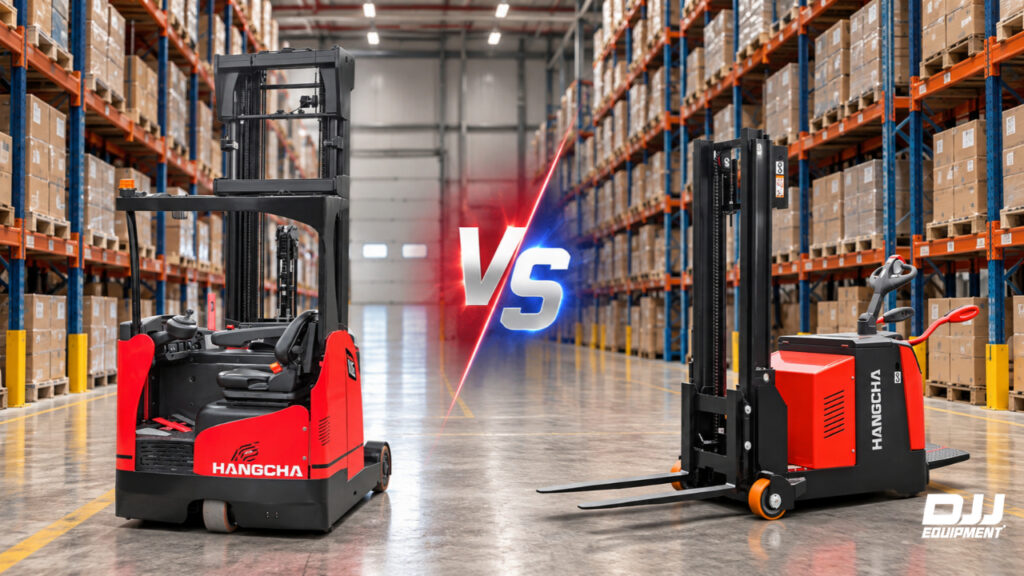
A pallet stacker does the job while your top beam sits at 6 m or lower and the pallets going up there are light: Hangcha's X Series walk-behind stacker lifts to 6 m but holds only 450-550 kg at that height, at a 600 mm load centre. Step up to a reach truck when the racking goes higher, when top-level pallets weigh more, or when operators drive long runs all shift. The compact XC Series reach truck holds 900 kg at 7 m on the same load centre and travels at 14 km/h laden, against 6 km/h for the walk-behind stacker. The aisle saving is smaller than it looks: 2,200 mm for the walk-behind stacker against 2,610 mm for the smallest XC, and it disappears once the operator rides the stacker.
Here's how five Hangcha machines from the range DJJ Equipment sells compare, from a walk-behind stacker to a 13 m reach truck.
| Machine | Operator | Licence | Rated capacity (load centre) | Maximum lift | Capacity at maximum lift | Stacking aisle | Travel speed, laden |
|---|---|---|---|---|---|---|---|
| X Series pallet stacker CDD14 | Walks behind | Training, no LF | 1,400 kg (600 mm) | 6,000 mm | 450 kg | 2,200 mm | 6 km/h |
| X Series rider pallet stacker CDD14 | Stands on a platform | LF | 1,400 kg (600 mm) | 6,000 mm | 450 kg | 2,655 mm | 9 km/h |
| A Series walkie reach stacker CQDB14 | Walks behind | Training, no LF | 1,361 kg (600 mm) | 5,500 mm | 998 kg | From 2,337 mm | 5.5 km/h |
| XC Series reach truck CQD10 | Seated | LF | 1,000 kg (600 mm) | 7,000 mm | 900 kg | 2,610 mm | 14 km/h |
| XC Series reach truck CQD25 | Seated | LF | 2,500 kg (600 mm) | 13,000 mm | 1,000 kg | 2,867 mm | 14 km/h |
The real jump from stacker to reach truck is capacity at height and speed, not aisle width. The walk-behind X Series keeps 450 kg at 6 m, while the smallest XC keeps 900 kg a metre higher. The rider stacker already needs an LF licence and a 2,655 mm aisle, 45 mm wider than the XC CQD10.
Aisles are for 1000 x 1200 mm pallets carried crossways. The walkie reach stacker figure names no pallet size, and Hangcha recommends adding at least 300 mm to it for manoeuvring.
What is the difference between a pallet stacker and a reach truck?
A pallet stacker lifts its forks straight up the mast, while a reach truck can also move its load forward into the rack. A stacker operator walks behind the machine or rides a small platform. A reach truck operator sits or stands inside the truck under an overhead guard.
The reach lets a reach truck stay compact and still lift heavier pallets high. The XC Series reaches 482 mm forward on the CQD10 and 716 mm on the CQD25. The load rides between the support legs and moves out only at the rack, close to the truck's base.
How high can a pallet stacker lift compared with a reach truck?
A pallet stacker in the Hangcha range lifts to 6 m at most, while Hangcha reach trucks lift to between 7 m and 13 m. The number that decides the switch isn't the height, though. It's the weight the machine still holds when the forks get there.
All the ratings here are at a 600 mm load centre. The X Series pallet stacker CDD14 is rated at 1,400 kg but holds 450 kg at 6 m, and the CDD20 holds 550 kg. The XC Series reach truck 1.0-1.2 t holds 900 kg (CQD10) and 1,100 kg (CQD12) at 7 m. Attachments cut these figures further, and the data plate on the truck is the authority.
Capacity falls with height because the load's centre of gravity rises further above the base, so the margin before tipping shrinks. A stacker has less weight to balance with: the walk-behind CDD14 has a 1,040 kg service weight, against 2,440 kg for the XC CQD10 with its battery. Reach trucks lose capacity too. The XC CQD14 is rated at 1.4 tonnes but holds only 350 kg at 11 m, so read the load chart for the height you need.
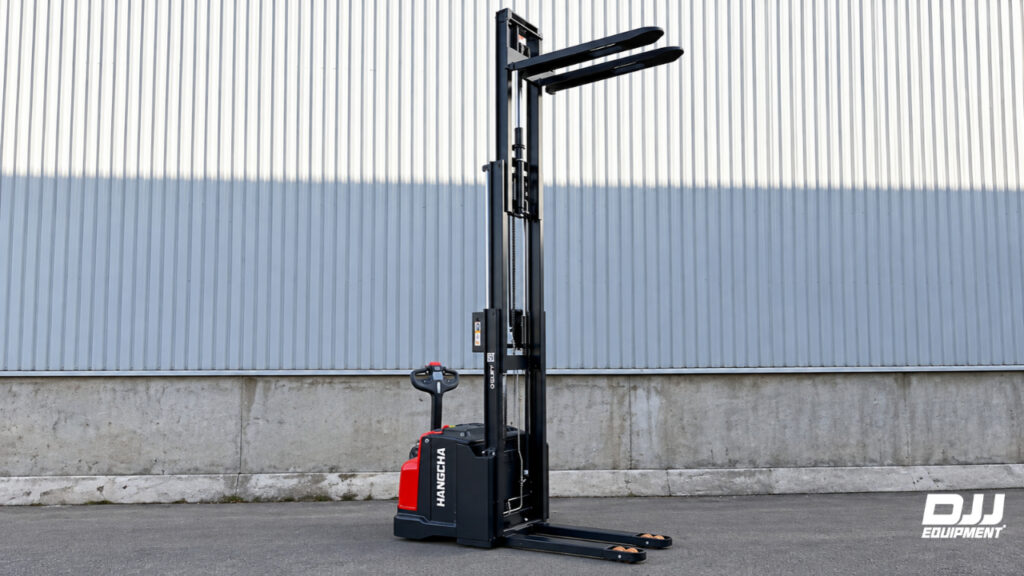
A reach truck needs about 400 mm more aisle than a walkie stacker
A reach truck needs about 400 mm more aisle than a walk-behind pallet stacker, and no more than a stacker the operator rides. With 1000 x 1200 mm pallets carried crossways, the walk-behind X Series stacker works in 2,200 mm and the XC CQD10 reach truck in 2,610 mm.
The stacking aisle depends mainly on the turning radius and the length of the load, plus a safety clearance. A ride-on platform makes the chassis longer, so the turning radius grows. The stand-on X Series stacker CDD14 turns in 1,586 mm with its platform folded and 2,017 mm with it down, which takes its aisle from 2,236 mm to 2,667 mm.
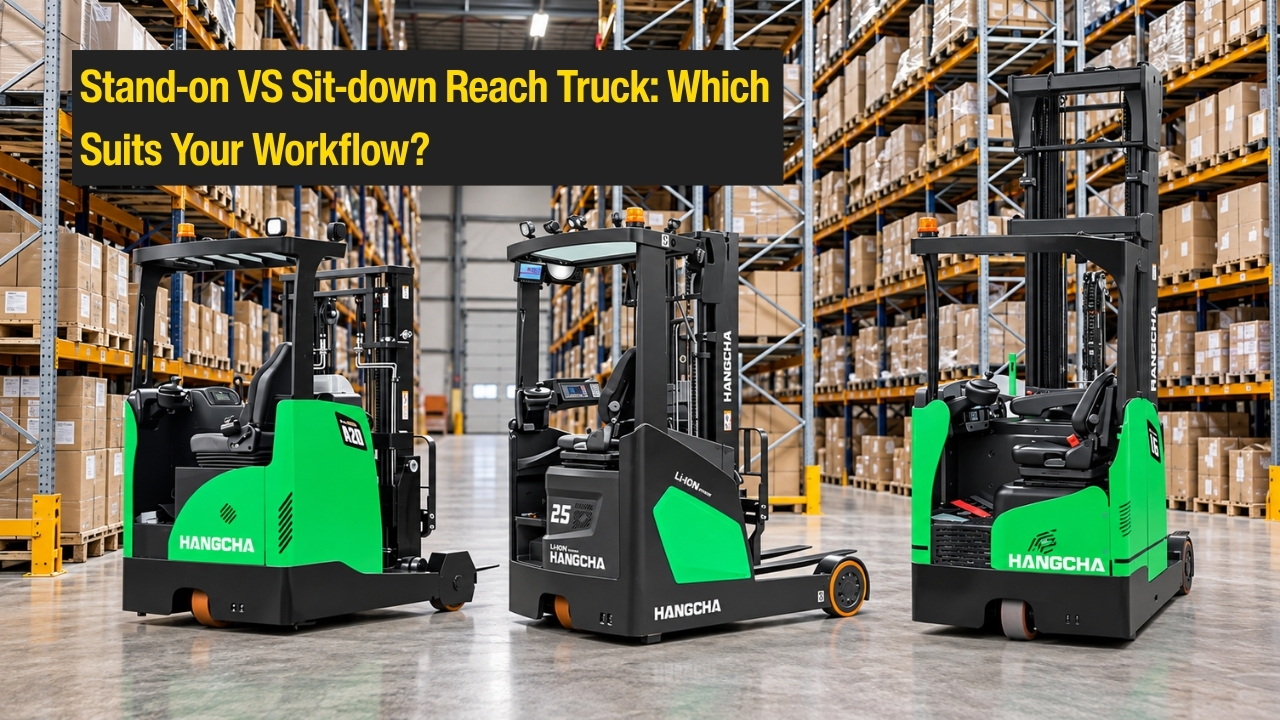
That puts a stacker with the operator on board in the same aisle as a reach truck. The X Series rider stacker needs 2,655 mm, and the A Series stand-on reach truck CQD15 needs 2,666 mm. Measure your narrowest aisle at the racking, including rack protectors, before you compare it with these figures.
Who needs a licence for a pallet stacker or a reach truck?
A walk-behind pallet stacker doesn't need a forklift licence, but a ride-on stacker and a reach truck both need an LF high risk work licence. WorkSafe Queensland's definition of a forklift truck covers a powered truck whose forks can be raised 900 mm or more, and leaves out pedestrian-operated trucks and pallet trucks.
Every machine in the table lifts well above 900 mm, so what decides it is whether the operator walks or rides. Operators of the X Series rider and stand-on stackers need the same LF class as a reach truck driver.
No licence doesn't mean no training. The business still has to train and instruct walk-behind operators and manage the risk under WHS law. Those duties sit alongside the walkie stacker licence rules, so confirm the current position with your state regulator.
When a pallet stacker is still the right machine for the warehouse
A pallet stacker is still the right machine when the top beam is no higher than 6 m, the pallets going up there are within its rating at that height, and each run is short. Within those limits, a walk-behind stacker costs less to buy than a reach truck and works in a narrower aisle.
Distance is the other limit. The walk-behind X Series travels at 6 km/h laden, and its travel speed drops automatically once the forks pass 500 mm.
Slopes matter too. The X Series CDD14 climbs 8% laden and the CDD20 only 5%, so check any ramp between the dock and the racking. Lithium pallet stackers in the Hangcha range run from 0.8 to 2 tonnes in walk-behind, platform and ride-on layouts.
Where a walkie reach stacker fits between stacker and reach truck
A walkie reach stacker sits between the two: it pushes its forks into the rack like a reach truck, but the operator walks behind it, so it needs no LF licence. Hangcha rates its CQDB14 at 3,000 lb, which converts to 1,361 kg at a 600 mm load centre.
The A Series walkie reach stacker reaches 590 mm forward and lifts to 5,500 mm on a triplex mast, where it still holds 998 kg. That's roughly double what the walk-behind X Series keeps at 6 m, half a metre lower. Its limits are the 5.5 m mast and walking pace, at 5.5 km/h laden.
Training still matters on a walk-behind machine. SafeWork NSW reported that on 19 April 2026 a warehouse worker's right safety boot became lodged under the skirt of a walkie reach stacker as it turned while travelling in the reverse direction to the forks, causing a crush injury. The regulator calls for training on the specific type in use, checks on the body placement set out in the manufacturer's instructions, suitable PPE and a traffic management plan.
Signs your warehouse needs to step up to a reach truck
Your warehouse needs a reach truck once any of these applies, because each one is a hard limit of a stacker rather than a matter of preference.
- Racking above 6 m. No Hangcha pallet stacker DJJ sells lifts higher, and XC Series reach trucks lift to 7 m or 13 m depending on the model.
- Heavy pallets on the top level. The walk-behind X Series keeps 450-550 kg at 6 m and the walkie reach stacker 998 kg at 5.5 m, both at a 600 mm load centre.
- Operators who already ride a stacker. They already need an LF licence and an aisle of 2,655-2,667 mm, wider than the 2,610 mm the XC CQD10 needs.
- Long runs all shift. A walk-behind stacker covers them at 6 km/h laden, a seated XC at 14 km/h.
- Double-deep racking. A standard stacker can't reach the second pallet. In double reach form, the X Series pantograph reach truck pushes its forks out 1,067 mm to the back pallet and still lifts 770-820 kg to 11.5 m (600 mm load centre).
If distance is the only problem, a rider stacker keeps the 6 m mast and travels at 9 km/h laden, but its operator then needs an LF licence. Once the height or the top-level weight is beyond every stacker, only a reach truck solves it, and the Hangcha high reach forklifts in the range cover 1 to 3 tonnes.
What else changes when a warehouse moves up to a reach truck?
A reach truck adds weight, battery size and purchase cost on top of the LF licence. The XC CQD10 weighs 2,440 kg with its battery, more than twice the 1,040 kg of the walk-behind X Series CDD14. Both run on polyurethane wheels, and a reach truck needs smooth, level floors.
The battery grows with the machine. The XC CQD10 runs on an 80V/125Ah lithium battery, about 10 kWh nominal, against a standard 48V/105Ah, about 5 kWh, on the X Series stacker. Those aren't run times, but the charging area and power supply have to suit the bigger battery.
The XC Series reach trucks carry a warranty of 24 months / 2,000 hours, against 12 months / 2,000 hours on the X Series pallet stacker. A reach truck also costs more to buy. Market bands for reach truck prices new, used and on hire climb with lift height and battery size, so price the mast you need rather than the tallest one.
If you're not sure the step is worth it yet, DJJ hires reach trucks as well as pallet stackers. Minimum hire terms depend on the machine and branch.
Have three numbers ready before you call: the height of your top beam, the weight of the heaviest pallet stored on it, and the width of your narrowest aisle. With those, DJJ can tell you whether a stacker, a walkie reach stacker or a reach truck fits, or you can ask about a free fleet assessment. Call 1800 355 388 or send an enquiry to your nearest branch.