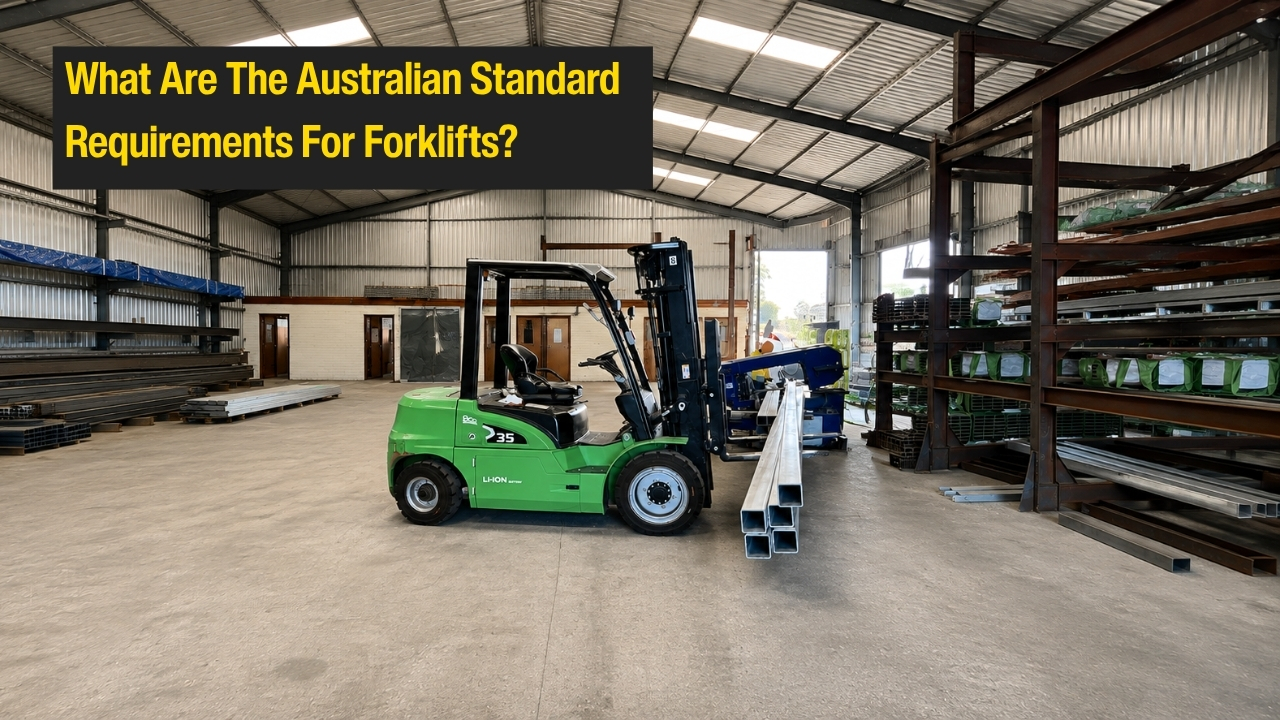
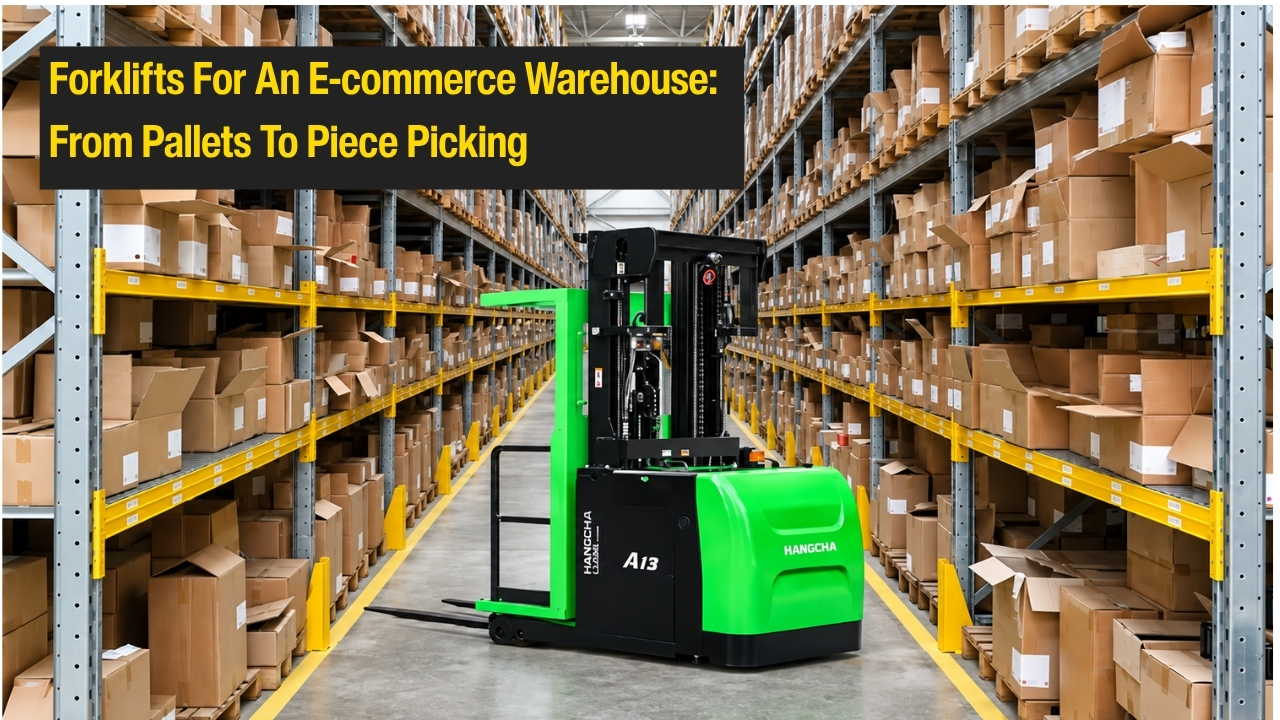
The right forklift for timber and steel depends on how long and heavy your loads are, where the truck has to travel with them, and how you store them. For short runs across an open yard, a counterbalance forklift with long forks and a fork positioner often does the job. For long loads moved down narrow aisles or into cantilever racking, a side loader or multidirectional forklift carries the load along its length instead of across it. For unsealed yards, a rough terrain forklift handles the ground. Whichever you choose, the capacity that counts is the one on the data plate for your load length, height and attachment.
Why long loads are hard on a standard forklift
A standard counterbalance forklift is designed around a pallet. Put a 6 metre timber pack or a bundle of steel lengths across its forks and the load becomes the widest part of the truck. Every aisle, doorway and gate has to be wider than the load, and the operator's view to the sides is reduced.
Long loads also behave differently on the forks. A timber pack can sag between forks that are set too close together, and the further the load's centre of gravity sits from the fork face, the less the truck can safely lift. Steel adds another problem: round bar, pipe and tube can roll, and steel on steel forks is slippery. Safe Work Australia's guidance says loads that can slip, fall or roll off the forks should be restrained with straps or similar.
Which forklift suits timber and steel?
There are four main options, and many yards use more than one. The table compares them using models from the Hangcha range DJJ Equipment sells:
| Truck | Best for | Watch for |
|---|---|---|
| Counterbalance forklift with long forks | Open yards, truck loading, mixed pallets and long loads over short distances | Needs wide aisles and doorways when the load sits across the forks |
| Side loader | Long loads moved along narrow aisles, cantilever racking, outdoor yards | Less suited to general pallet work |
| Multidirectional side loader | Long loads and pallets on the same site, indoors and outside | Check the ground and the capacity at your top racking height |
| Rough terrain forklift | Unsealed yards, mud, gravel and building sites | Capacity at height falls quickly on rough ground |
Counterbalance forklifts with long forks. The Hangcha X Series 5-10 t shows how heavier trucks are set up for longer loads: the 8.5-10 t models have 1,520 mm forks and a fork positioner as standard, and the 10 t model still carries 5,200 kg at 7 m on dual tyres. The X Series 12-16 t goes further, with versions rated at 750 mm and 900 mm load centres for longer loads.
Side loaders. A side loader's mast sits beside a flat deck. It reaches out to the side, picks the load and sets it on the deck, so the truck travels with the load along its body. The Hangcha IC side loader 3-6 t is a diesel truck built for steel pipe, section steel, utility poles and timber, with 1,220 mm forks, masts to 6 m and no stabiliser legs. Our side loaders can work outdoors as well as in sheds.
Multidirectional side loaders. A multidirectional truck can drive forwards, sideways or turn on the spot, so it handles long loads and pallets on the same site. The Hangcha X Series multidirectional side loader is electric and rated at 3,000, 4,000 and 4,500 kg at a 600 mm load centre. Its triplex masts reach 8 m, where capacity falls to 2,000-2,500 kg.
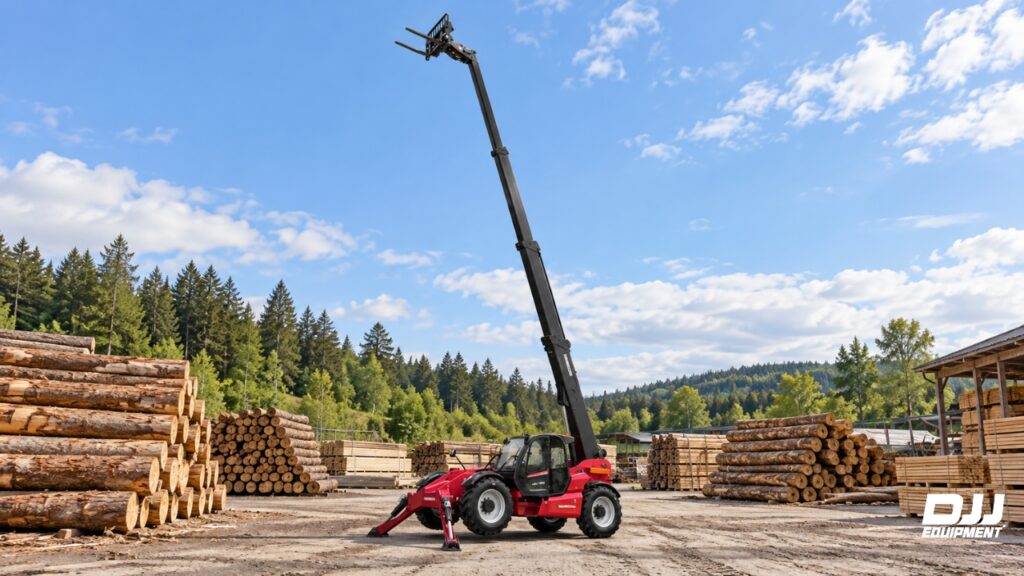
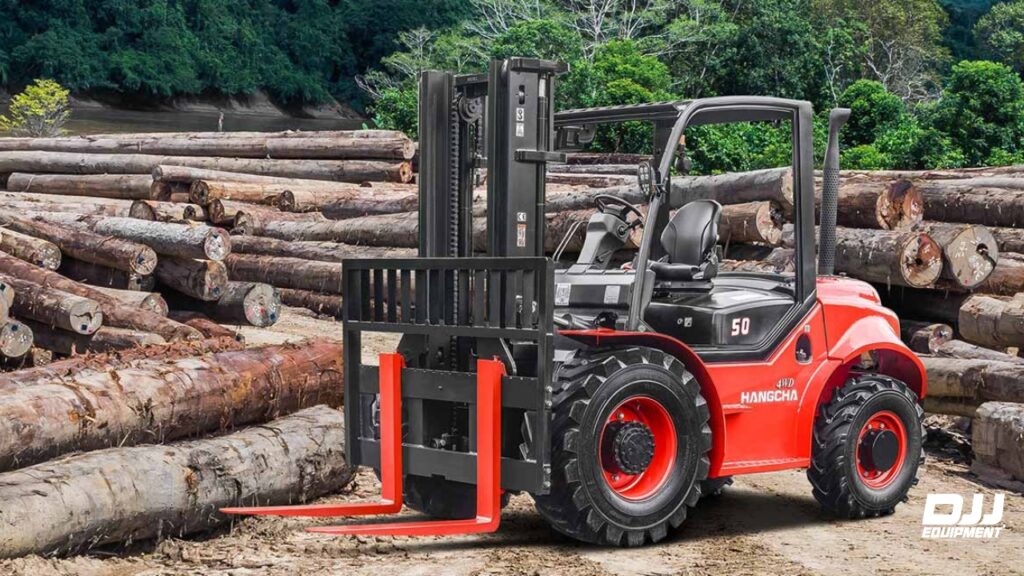
Rough terrain forklifts. For timber yards on dirt and gravel, a rough terrain forklift has the clearance, tyres and drive for unsealed ground. The Hangcha 5-10 t model has 1,520 mm forks on the 10 t version, and extra hydraulic valves are optional for attachments such as clamps. If you need to place loads over an obstacle or high up on a stack, a telehandler reaches forward as well as up.
Aisles, doors and cantilever racking
For a side loader, the aisle is set by the width of the truck plus the depth of the load, not the length of the load. The Hangcha multidirectional side loader is 2,500 mm wide and needs a 2,600 mm aisle for a 1200 x 6000 mm load. The IC side loader is 2,040 mm wide on the 3 t model and 2,100 mm on the 5-6 t models.
A counterbalance forklift is different. Its published aisle figures are for pallets, so a 6 m load carried across its forks needs far more room than those figures suggest. Measure your longest load, your narrowest aisle and your doorways before you compare trucks.
Long loads are usually stored in cantilever racking. The racking supplier designs and rates it for your products, and SafeWork NSW's racking guidance says the racking layout should suit the forklift used, with aisle width matching its turning circle. Racking should also be inspected regularly by a competent person.
Attachments for long loads
The right attachment can make a standard truck work with long loads, within limits. Common choices for timber and steel are fork positioners that widen the gap between the forks from the seat, longer forks or fork extensions to support a long pack, and clamps for loads that can't sit on forks.
Every attachment reduces what the forklift can safely lift. On the Hangcha XH Heavy Duty electric forklift, a sideshifter alone takes 200-300 kg off the rated capacity. An attachment also has to be listed on the forklift's data plate or load chart with the capacity of the truck and attachment together, so choosing a forklift attachment starts with that combined figure.
Load centre and capacity with long loads
A forklift's rated capacity applies only at the load centre on its data plate, usually 600 mm on the trucks in this article. A long load whose centre of gravity sits further out can only be lifted at a lower weight. That's why the Hangcha X Series 12-16 t is offered in versions rated at 750 mm and 900 mm load centres: those ratings are lower than the 600 mm figure, but they match longer loads.
Height and ground make it worse. On the Hangcha high-voltage lithium rough terrain forklift, the brochure's rough terrain rating at 6,000 mm is only 600-700 kg. Check the load chart at your load length and top stacking height, not the headline capacity.
Loading and carrying long loads safely
Long loads can fall without warning. In 2019, a truck driver was killed in Bathurst when a pine timber pack fell from a truck tray while a forklift was loading it. After the incident, SafeWork NSW set out controls that apply to any timber or steel yard:
- set a no-go zone wherever a load could fall, and separate people from plant in loading areas
- make sure attachments are fit for purpose, compatible with the forklift and secured before use
- never exceed the rated capacity, including when an attachment is fitted
- avoid lifting several items together that might not stay steady when travelling or unloading
- travel with the load lowered, and use a spotter or reverse if the load blocks your view
- never sling a load from the forks
Safe Work Australia adds two points for long and uneven loads: centre the load, and where one end is heavier, keep the heavy end nearer the centre line of the truck.
Electric or diesel in a timber or steel yard?
Both work, and the choice comes down to where the truck spends its hours. The Hangcha multidirectional side loader runs on an 80V lithium or lead-acid battery, with no exhaust, so it suits sites that move between a shed and the yard. The IC side loader and the X Series diesel forklifts suit outdoor yards and long shifts away from charging. For heavy electric work, the XH Heavy Duty range covers 6-10 t on a high-voltage lithium battery.
Ground matters as much as power. Whichever truck you choose, check your yard surface, slopes and drainage with our team before you buy or hire.
Moving timber or steel? Tell our team the length and weight of your heaviest pack, your narrowest aisle and doorway, and the ground the truck will work on, and we'll suggest options to buy or hire. Call 1800 355 388.