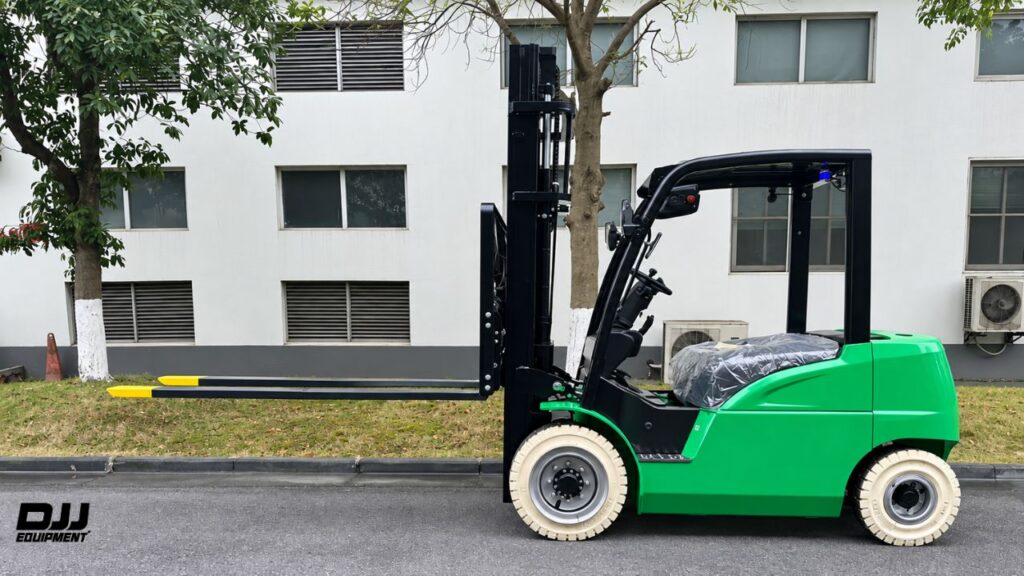
Standard forklift fork length rises with the truck's capacity, and on most trucks up to 3.8 tonnes the forks are a little shorter than an Australian pallet. On the Hangcha X Series diesel and LPG forklifts DJJ Equipment sells, the forks grow from 920 mm at 1.5 t to 1,520 mm at 10 t. On a 2.5 t truck in that range, the 1,070 mm fork reaches 92% of the way under a 1,165 x 1,165 mm Australian pallet and stops 95 mm short of the far edge. Longer forks carry deeper loads. They also make the truck longer, and a deeper load puts its centre further from the mast so the truck can lift less.
How long are standard forklift forks?
Standard forklift forks run from 920 mm on small trucks to 1,520 mm on 10 t trucks, and they get thicker and wider as capacity rises. The table lists the standard forks, rated capacity and carriage for four Hangcha ranges, from each range's brochure.
| Hangcha forklift | Rated capacity (load centre) | Standard forks, thickness x width x length (mm) | Carriage |
|---|---|---|---|
| XA Series lithium 2-3.8 t | 2,000-3,800 kg (500 mm) | 40 x 122 x 1,070 (2-2.5 t), 45-50 x 122 x 1,070 (3-3.8 t) | ISO 2328 class 3A |
| X Series diesel/LPG 1.5-3.8 t | 1,500-3,800 kg (500 mm) | 35 x 100 x 920 (1.5-1.75 t), 40 x 122 x 1,070 (2-2.5 t), 45-50 x 122 x 1,070 (3-3.8 t) | Class II or III, type A |
| X Series diesel/LPG 5-10 t | 5,000-10,000 kg (600 mm) | 60-65 x 150 x 1,220 (5-7 t), 75-80 x 160 x 1,520 (8.5-10 t) | Class IV A (5-7 t), fork positioner standard (8.5-10 t) |
| Rough terrain 2WD 2.5-3.5 t | 2,500-3,500 kg (500 mm) | 40 x 122 x 1,220 (2.5 t), 50 x 122 x 1,220 (3-3.5 t) | Type B |
Within each range fork length follows capacity, and the 2WD rough terrain forklift stands out with 1,220 mm forks from 2.5 t. The fork section grows too, from 35 x 100 mm on a 1.5 t truck to 80 x 160 mm on a 10 t one. So no, forklift forks aren't all the same size. A 2.5 t truck and a 7 t truck use different fork sections and different carriage classes. Most of the forklifts in these ranges are rated at a 500 mm load centre, and the 5-10 t trucks at 600 mm.
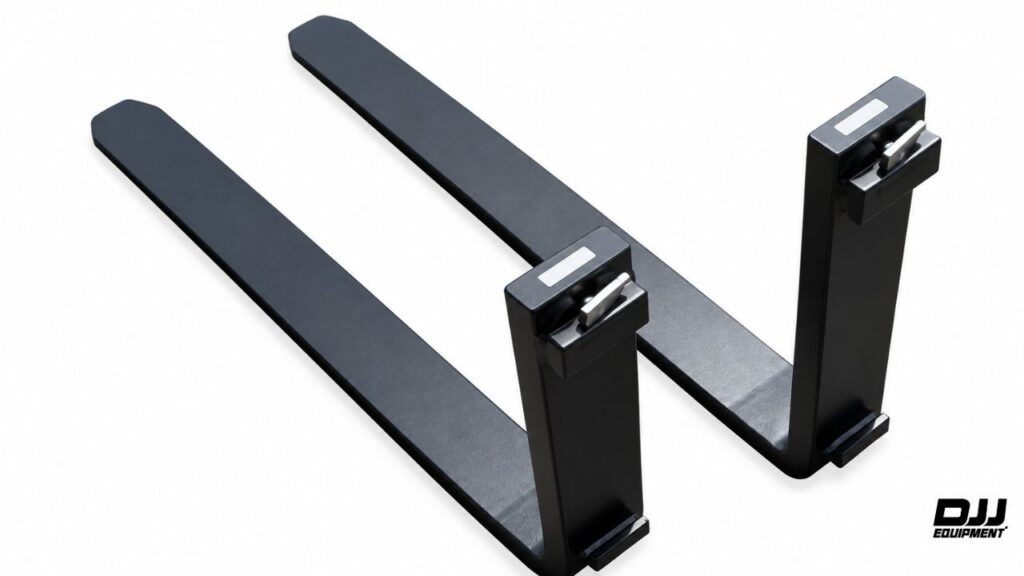
Do 1,070 mm forklift forks suit a 1,165 mm Australian pallet?
Yes, 1,070 mm forklift forks suit the standard 1,165 x 1,165 mm Australian pallet. They support 92% of its depth and stop 95 mm short of the far edge. Pushed right back against the fork shanks, the pallet keeps the fork tips underneath it, so they don't poke into the pallet, rack upright or wall behind.
The catch is the load centre. A full 1,165 mm pallet with its weight spread evenly has its centre about 583 mm from the fork face. The Hangcha XA Series and the X Series diesel/LPG 2-3.8 t are rated at 500 mm. A loaded Australian pallet sits beyond that point.
Australian capacity ratings commonly use a 600 mm load centre, about half of a 1,165 mm pallet. When you compare trucks for pallet work, ask for the load chart at 600 mm, not just the 500 mm rating on the spec sheet.
Problems with forklift forks that are too short or too long
Forklift forks that are too short leave the far end of the load unsupported. Forks that are too long stick out past the load into whatever is behind it. Fork length doesn't set the load centre on its own: the depth of the load does. A deeper load puts its centre of gravity further from the fork face. The truck can then lift less, because the load works on a longer lever around the front axle.
On the XA Series CPD38, that adds up fast. It's rated for 3,800 kg at a 500 mm load centre and carries about 2.3 tonnes at 1,100 mm. Load centre is one of several things that decide how much a forklift can lift, along with lift height and attachments.
Long forks cost space as well, because fork length is part of the truck's overall length. The X Series diesel CPCD85 is 5,420 mm long overall and 3,900 mm to the fork face, and the 1,520 mm difference is its forks. A deeper load also needs a wider aisle. The XA Series CPD20 needs 3,982.5 mm to stack a pallet 1,000 mm deep and 4,182.5 mm for one 1,200 mm deep. Both figures include Hangcha's 200 mm safety clearance.
When a forklift needs longer forks or fork extensions
A forklift needs longer forks when most of its daily loads are deeper than its standard forks. Fork extensions suit long loads that only turn up now and then. Hangcha already fits longer forks to its heavy trucks. The X Series diesel 5-10 t runs 1,220 mm forks at 5-7 t, and 1,520 mm forks with a fork positioner as standard at 8.5-10 t.
Smaller trucks take longer forks as a factory option. Hangcha offers a lengthened fork and a fork extensioner on the X Series diesel/LPG 1.5-3.8 t, and forks of other lengths on the XA Series. Ask for the capacity with the longer forks fitted, because a longer fork usually goes with a deeper load and a load centre further out.
Fork extensions slide over the standard forks, so they need a rating of their own. WorkSafe Queensland says attachments such as extension forks should have rated capacities and information on safe use. It also says the forklift's capacity may need to be de-rated when one is fitted. SafeWork NSW says the load rating plate should list any attachment used and its working load limit.
WorkSafe Queensland also says to use only attachments designed and matched for the specific forklift. DJJ supplies fork extensions and specialist forks, and any attachment can reduce usable capacity, so confirm it suits your truck and its load chart first.
How the forklift carriage decides which forks fit
The forklift carriage decides which forks fit through its class, the ISO 2328 size that hook-on forks and attachments are built to. Class doesn't always follow capacity. The XA Series 2 t uses a class 3A carriage, while the X Series electric 2.5 t uses class 2A and only moves up to 3A at 3 t.
On the X Series diesel/LPG 5-10 t, the 5-7 t models use a class IV A carriage, and the 2WD rough terrain forklift uses type B. Since forks and hook-on attachments are built for one carriage class, the class comes first when you work out how attachments fit a forklift carriage. Fit affects capacity too. An external side shifter hangs in front of the carriage and moves the load further out, and on the 3-3.8 t XA models it takes 200 kg off the rated capacity.
The carriage also sets how far apart the forklift forks can go. On the X Series diesel/LPG, the forks adjust from 200-1,000 mm apart on the 1.5-1.75 t models, 244-1,038 mm on 2-2.5 t and 244-1,100 mm on 3-3.8 t. On the 2WD rough terrain forklift they go from 290 to 1,150 mm. Set them evenly either side of the load's centre and as wide as the pallet openings allow, so the weight sits on both forks instead of twisting the carriage.
What replacement forklift forks need to match
Replacement forklift forks need to match the truck's carriage class, its fork length and a fork section sized for its capacity. On these Hangcha trucks, the section runs from 35 x 100 mm at 1.5 t to 80 x 160 mm at 10 t. When you compare quotes for a new truck, compare the forks, mast, side shift and positioner each one includes, not just the capacity.
Worn forks have to come out of service. SafeWork NSW sets the limit at the heel: measure the fork's vertical thickness, then the thickness at the heel, and the heel must not be more than 10% thinner. Forks past that limit must be replaced. SafeWork NSW also says not to modify or damage forks or tow with them.
Dragging the forks along the floor is what wears the heel, and SafeWork NSW warns against it. The heel carries the bending load where the fork turns upward, so a thinner heel weakens the fork by more than the lost thickness suggests.
Before you settle on fork length, measure your deepest load in the direction the forks go in. Note its weight, the pallet type and the narrowest aisle the truck will work in, and for replacement forks add the truck's make, model and capacity. Send those details to DJJ and we can confirm the fork length, carriage class and capacity at your load centre. Call 1800 355 388 or send an enquiry to your nearest branch.