Most forklifts used in Australian warehouses and yards lift between about 1.5 and 5 tonnes, and the 2.5 tonne counterbalance forklift is one of the most common sizes. Small warehouse trucks such as walkie stackers carry less than 1 tonne at the bottom of their range, while the heaviest counterbalance forklifts in the Hangcha range DJJ Equipment sells are rated to 48 tonnes. The capacity in a brochure is only true at one load centre and up to one lift height, so the real answer for your forklift is on its data plate and load chart.
Forklift lifting capacity by type
Each type of forklift is built for a different job, and its capacity range follows from that. The table shows the ranges in the Hangcha range DJJ sells. Other brands differ, but the pattern is the same.
| Type | Capacity range | What limits it |
|---|---|---|
| Electric pallet jack | 0.5 to 3.63 t | Lifts only a few centimetres off the floor to move pallets |
| Walkie stacker | 0.8 to 2 t | Small chassis, so capacity falls as the forks rise |
| Reach truck | 1 to 3 t | Built for height in narrow aisles, so capacity at the top beam matters more than the headline figure |
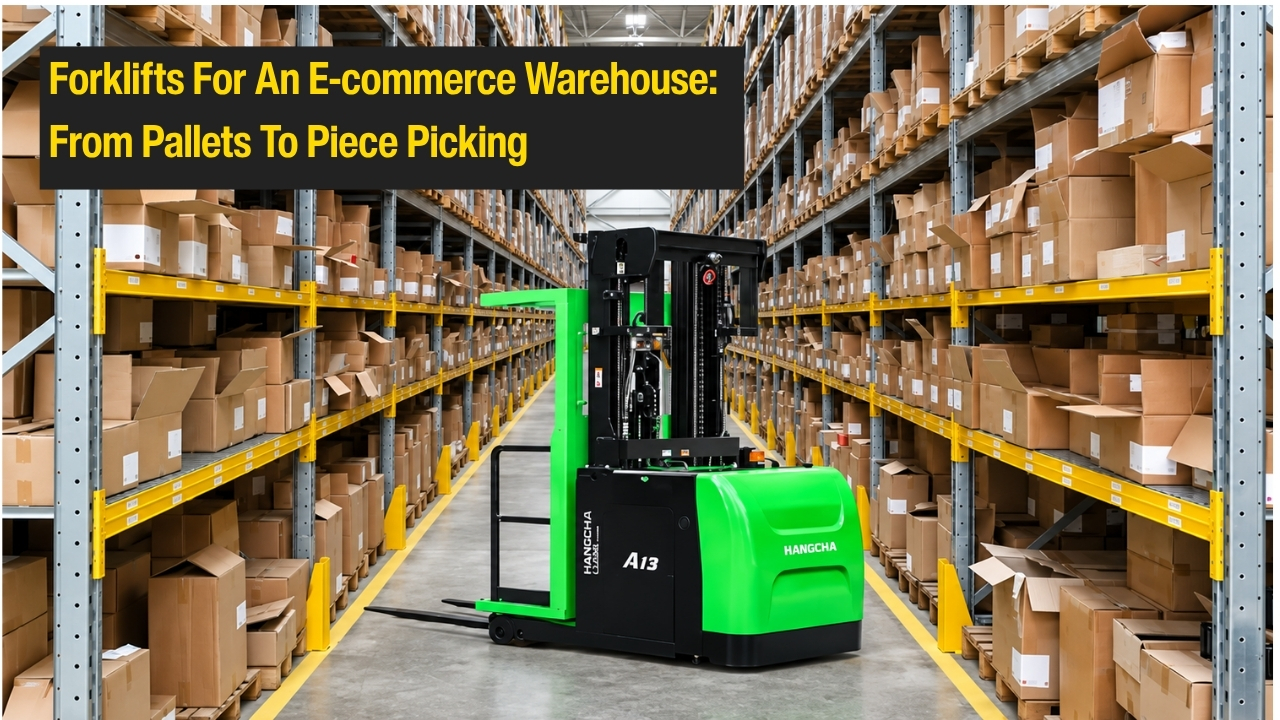
| Order picker | About 0.5 to 2.5 t | The operator rises with the load, so capacity drops with height |
| Counterbalance forklift (electric, LPG or diesel) | 0.6 to 48 t | The counterweight at the rear, which grows with the truck |
| Rough terrain forklift | 1.5 to 10 t | Ground conditions and slopes as well as the load chart |
| Telehandler | 2.5 to 4 t | Boom angle and reach: capacity falls sharply as the boom extends |
For general pallet work, most businesses choose between 1.5 and 3.5 tonne counterbalance forklifts. A tow tractor isn't in the table because its rating is a towed load, not a lifted one.
What "rated capacity" actually means
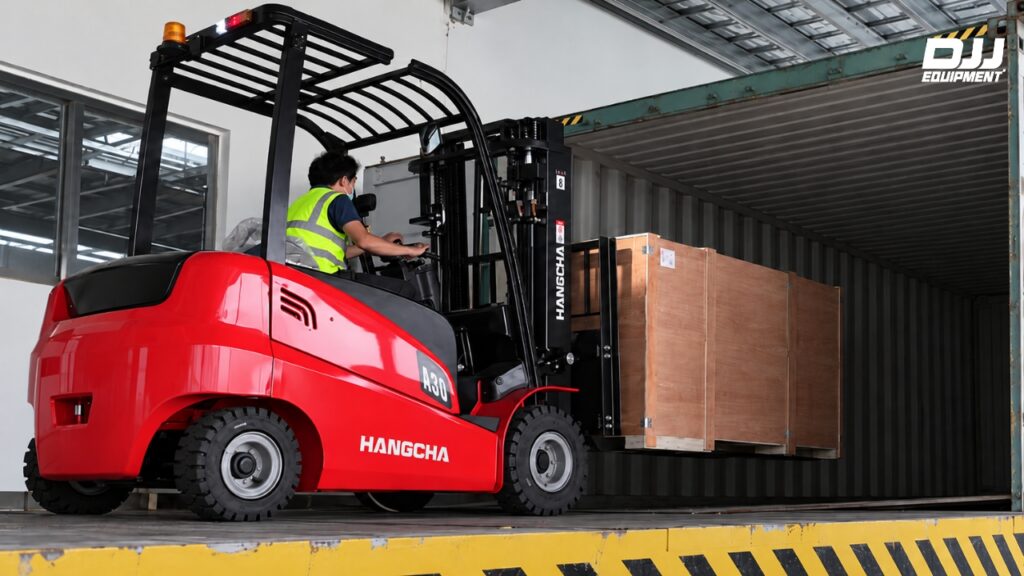
A forklift's rated capacity is the heaviest load it can lift at the load centre shown on its data plate, up to the lift height on that plate, with the mast vertical and the standard forks fitted. Change any of those conditions and the safe load changes too.
The reason is balance. A counterbalance forklift works like a see-saw: the front wheels are the pivot, the load sits in front of them and the counterweight sits behind. The truck stays upright while the combined centre of gravity of the truck and the load stays inside its stability triangle, the area between the two front wheels and the pivot of the rear axle. A heavier load, a load further out on the forks or a load raised higher all move that combined centre of gravity towards the edge of the triangle.
Manufacturers confirm the rating with stability tests on a tilting platform, set out in international standards such as ISO 22915. The plate figure is the result of that testing for the truck as built, so it already includes the safety margin the design allows.
Load centre: 500 mm or 600 mm?
The load centre is the distance from the vertical face of the forks to the centre of gravity of the load. It's the single biggest reason two forklifts with the same headline capacity can lift different weights.
WorkSafe Victoria says forklifts in Australia with a rated load of more than one tonne are typically designed for a 600 mm load centre, which suits the pallets used here. A standard Australian pallet is 1165 x 1165 mm, so a load stacked evenly on it has its centre about 583 mm from the fork face. Many spec sheets for imported forklifts quote capacity at 500 mm instead, and a truck shows a higher capacity at 500 mm than it can lift at 600 mm.
Ratings vary even within one brand. Hangcha rates the XA electric counterbalance forklift and the A Series counterbalanced stacker at 500 mm, the XC reach truck at 600 mm, and the A Series high-level order picker at 400 mm. Before you compare two forklifts, check that both capacities use the same load centre. If your loads sit on Australian pallets, ask for the capacity at 600 mm or for the load chart.
How the load centre changes what a forklift can lift
The further the load's centre of gravity sits from the fork face, the less the forklift can lift. Long crates, timber packs, steel and oversized pallets all push the load centre out.
A rough estimate shows the size of the effect. A forklift rated at 2,500 kg at a 600 mm load centre, carrying a timber pack whose centre sits 900 mm from the fork face, can lift only about 1,667 kg (2,500 x 600 / 900). That's a third less. Treat the result as an illustration only, because the real figure also depends on the distance from the front axle to the forks, which this simple ratio ignores.
A real load chart shows the same pattern. The Hangcha XA 3.8 tonne electric forklift is rated at 3,800 kg at 500 mm, and carries about 2.3 tonnes when the load centre moves out to 1,100 mm. The manufacturer's chart for your exact truck, mast and attachment is the figure to work to.
Lift height and residual capacity
A forklift lifts its full rated capacity only up to a certain height. Above that, the capacity it keeps is called residual capacity, and it falls as the forks rise, because a high load moves the combined centre of gravity up and forward and makes the truck less stable. Tilting the mast forward reduces it again.
The data plate of a Hangcha 3.5 tonne rough terrain forklift shows how far it can fall. At a 600 mm load centre it allows 2,900 kg at a 3,250 mm lift with the mast vertical, 1,890 kg at the same height with the mast tilted forward, and 1,320 kg at 4,500 mm tilted forward.
Warehouse trucks built for height show the same curve. Every Hangcha XC reach truck keeps its full rating at a 600 mm load centre up to 6 to 6.5 m. Above that, the 2.5 tonne CQD25 still lifts 1,950 kg to 10 m but only 1,000 kg at its top height of 13 m. The A Series high-level order picker carries 1,200 kg up to 3 m, 1,000 kg at 5 m and 400 kg at 9.5 m.
So the question to ask isn't "how much can it lift?" but "how much can it lift at my top beam height?"
Attachments reduce capacity
Every attachment lowers what a forklift can safely lift. It adds its own weight in front of the front wheels, and its thickness pushes the load further forward, which increases the load centre. On the Hangcha A Series reach truck, a sideshifter alone takes 200 kg off the rated capacity. Fork extensions, clamps, rotators and jibs usually cost more, because they are heavier or carry the load further out.
In Australia an attachment can be used only if it's listed on the forklift's data plate with the capacity of the truck and attachment together. When an attachment is fitted, the supplier amends the plate or adds a supplementary plate, and an attachment that isn't on the plate must not be used. On a Hangcha XH Heavy Duty electric forklift, a sideshifter alone takes 200-300 kg off the rated capacity, so choosing a forklift attachment starts with the load chart.
How to read a forklift data plate
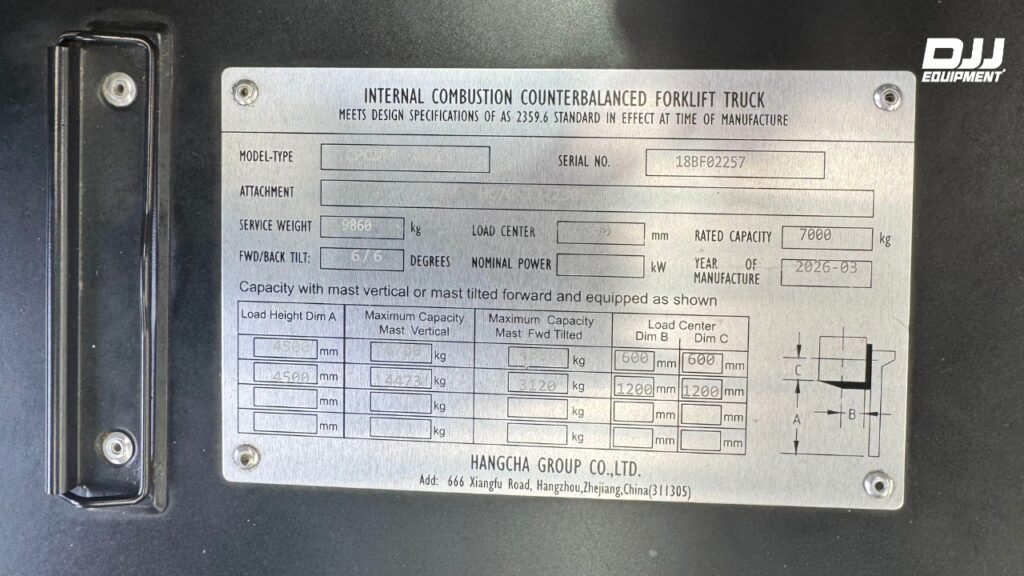
The data plate, also called the load capacity plate or information plate, is fixed to the forklift where the operator can read it. The exact layout varies by manufacturer, but it usually shows:
- the make, model and serial number
- the weight of the truck, and of the battery on electric models
- the rated capacity and the load centre it applies to
- the maximum lift height
- the capacity at greater heights or load centres, often as a small table or chart
- each approved attachment, with the capacity of the truck when it's fitted
Read the line that matches your job: your load's weight, its load centre, the height you lift to and the attachment fitted. If a plate is missing or unreadable, the truck shouldn't be used until it's replaced, and a forklift that has had its mast, forks or attachment changed needs a plate that matches the new set-up.
What happens if you go over capacity?
An overloaded forklift can tip forward over its front wheels, because the load has moved the combined centre of gravity past the pivot. The rear wheels lift and steering is lost, often before the truck goes over completely.
Height makes it worse. With the load raised, the stability triangle effectively narrows, so a turn, a slope or an uneven floor can tip the truck sideways at a load it would carry safely at floor level. Overloading also strains the forks, chains, mast and tyres, and on a hired machine damage from misuse is usually the hirer's cost. The data plate is a limit, not a starting point.
What size forklift do you need?
Size a forklift from your heaviest load and the highest point you lift it to, not from the headline capacity. Work through four questions:
- Load weight: the heaviest load you'll lift, weighed rather than guessed, including the pallet
- Load size: its length and how it sits on the forks, which sets the load centre
- Lift height: your top racking beam or highest stack, plus clearance to place the load
- Attachments: any side shift, fork positioner, clamp or extension you need
Then compare those answers with the load chart, not the brochure. Say you store 1,800 kg pallets on Australian pallets at 6 m. A 2 tonne XC reach truck keeps its full 2,000 kg rating to 6 m at 600 mm, so it covers the job with some margin. Store the same pallets at 10 m and you'd need the 2.5 tonne model, which still lifts 1,950 kg there, and the margin becomes thin. Leave room in your choice for heavier loads in future and for any attachment you may add.
For outdoor work on gravel or unsealed yards, check the chart of a rough terrain forklift at the height you need, because rough ground and slopes reduce what you can safely carry.
A bigger forklift doesn't need a different licence. In Australia the licence depends on the type of truck, not its capacity: a High Risk Work Licence class LF covers forklift trucks, including reach trucks, of any capacity, and class LO covers order pickers where the operator rises with the load.
Not sure which capacity you need? Tell our team the weight and size of your heaviest load and the height you lift it to, and we'll check the load chart of each model against your job, whether you buy or hire. Call 1800 355 388.