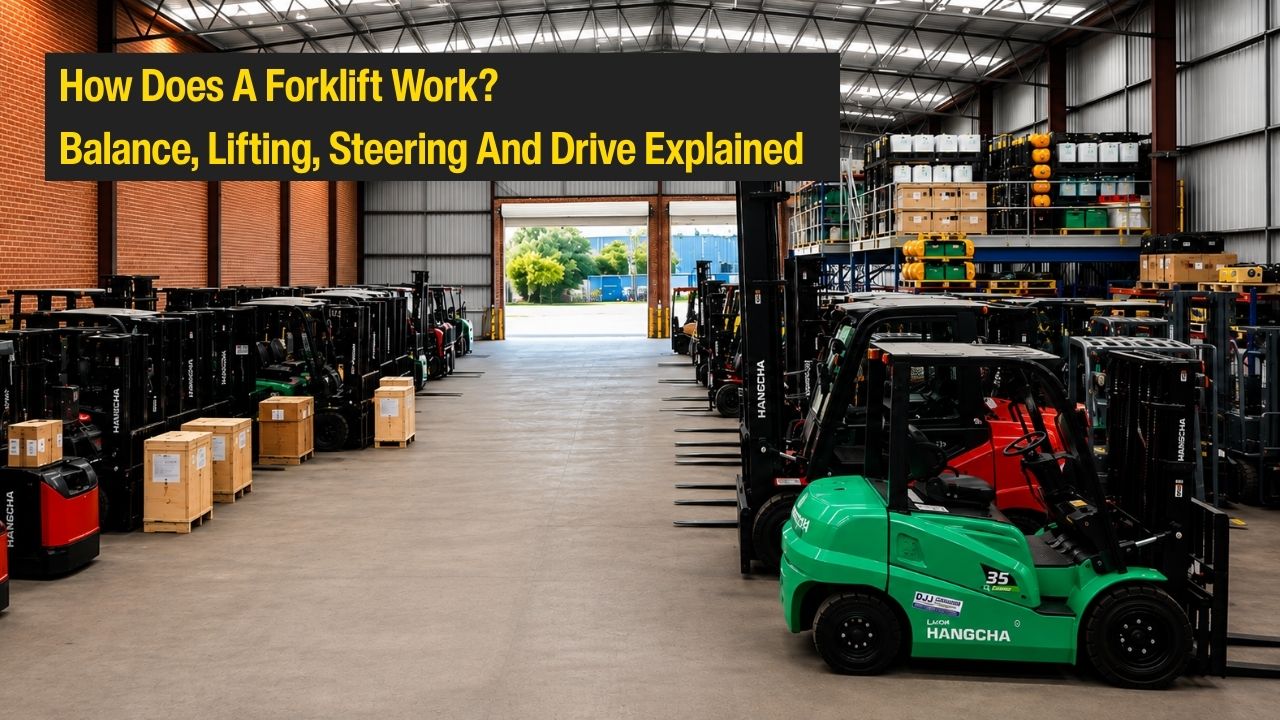
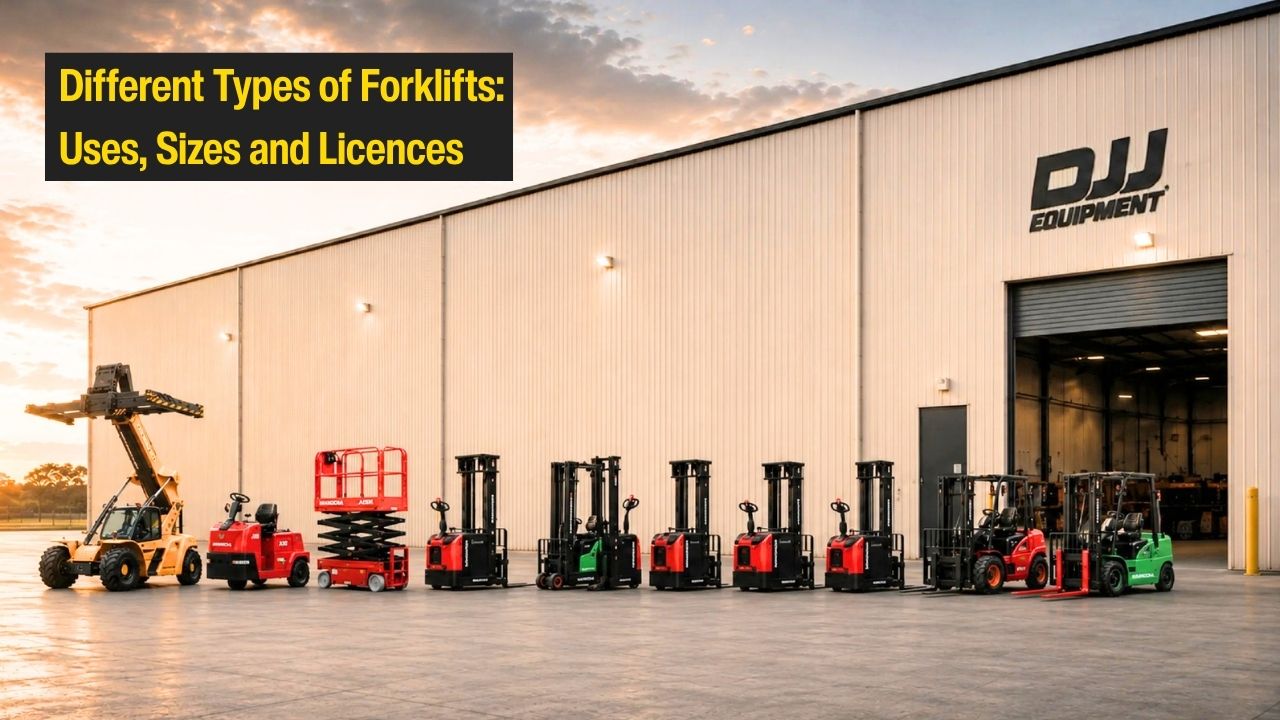
A forklift works like a see-saw: the front wheels are the pivot, and a heavy counterweight at the back balances the load on the forks. A hydraulic pump, turned by the engine or an electric motor, pushes oil into cylinders that raise the mast and tilt it, while the rear wheels steer. How much the truck can safely lift is set by the load centre and lift height on its data plate, not by the headline capacity.
The main forklift systems at a glance
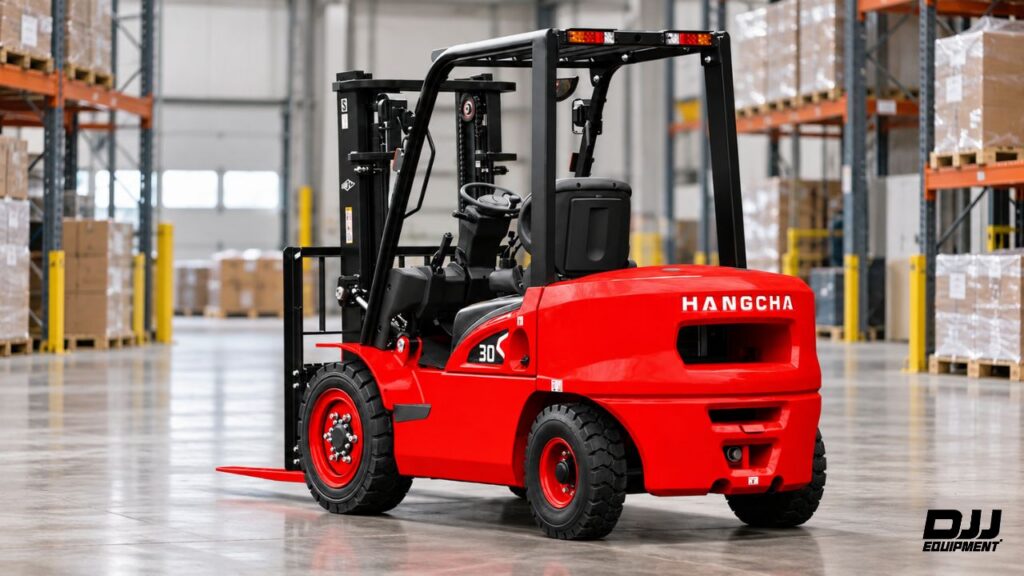
A counterbalance forklift is built from a handful of systems that work together: balance, lifting, hydraulics, steering, drive, brakes and operator protection. The Hangcha forklifts DJJ Equipment sells follow the same layout, whether they're electric warehouse trucks or diesel container forklifts. If you're new to forklifts, our guide to what a forklift is covers the basic parts, types and licences.
| System | Main parts | What it does |
|---|---|---|
| Balance | Counterweight, front axle, steer axle | Keeps the combined centre of gravity of truck and load inside the stability triangle |
| Lifting | Mast rails and rollers, carriage, lift chains, lift cylinders | Raises and lowers the forks |
| Tilting | Tilt cylinders, forward tilt lock valve | Leans the mast forward to pick up a load and back to carry it |
| Hydraulics | Pump, control valve, oil tank and filter | Turns engine or motor power into oil pressure for lifting, tilting, steering and attachments |
| Steering | Steering wheel, hydraulic steering unit, steer axle, rear wheels | Turns the truck around its front wheels |
| Drive (electric) | Battery, controllers, drive motor, reduction gearbox | Turns the front wheels |
| Drive (LPG or diesel) | Engine, torque converter or clutch, transmission | Turns the front wheels and the hydraulic pump |
| Brakes | Service brakes, parking brake, inching pedal on engine trucks | Slows, stops and holds the truck |
| Operator safety | Overhead guard, load backrest, seat belt, seat switch | Protects the operator and stops the truck when nobody is seated |
The systems depend on each other. Every time the mast lifts, tilts or the truck turns, the weight shifts, so balance and lifting are where most of the mechanics sit.
How a forklift balances its load
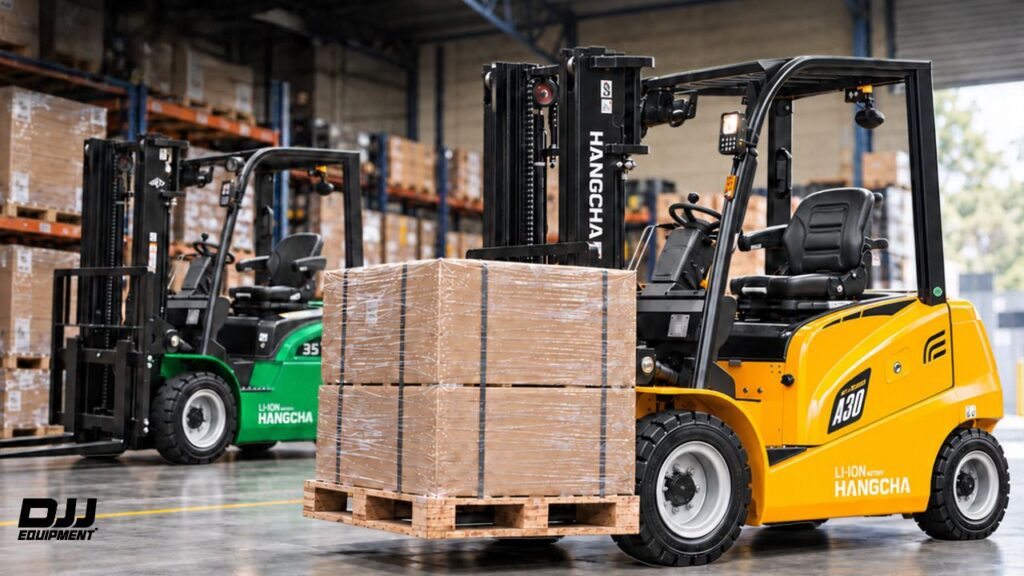
A counterbalance forklift balances its load like a see-saw. The front axle is the pivot, the load sits in front of it, and the counterweight and truck body sit behind it. With no load, the truck's weight sits towards the rear. Pick up a pallet and the combined centre of gravity of truck and load moves forward towards the front wheels.
The heavier the load, and the further it sits from the front wheels, the harder it pulls the truck forward around that pivot. The counterweight is sized to hold the truck down up to its rated capacity at its rated load centre, and no further.
The stability triangle
The stability triangle is the area the combined centre of gravity must stay inside for a forklift to stay upright. Its three corners are the two points where the front tyres touch the ground and the middle of the rear axle. If the combined centre of gravity moves outside that triangle, the truck tips in that direction.
The triangle narrows to a point at the rear axle, so a forklift has much less room for error side to side than front to back. That's why a forklift can tip sideways when it turns with a raised load, even at a speed that feels slow.
Why forklifts tip forward or sideways
A forklift tips when something moves the combined centre of gravity outside the stability triangle. Hangcha's operating manual lists the factors that move it:
- the weight and shape of the load
- lift height
- mast tilt angle
- acceleration, braking and turning radius
- the road surface and its slope
- the attachment fitted
Two of these work through inertia. Braking hard with a load throws weight forward, which can tip the truck forward or slide the load off the forks. Turning fast creates a sideways force that pushes the centre of gravity towards the outside of the turn, and the higher the load is carried, the stronger that push becomes.
Load centre and the data plate: what a forklift can really lift
A forklift's rated capacity is only true at the load centre and lift height shown on its data plate. The load centre is the horizontal distance from the fork face, or the load backrest, to the centre of gravity of the load. Move the load's centre further out and the truck has to carry less, because the load is working on a longer lever.
Australian capacity ratings commonly use a 600 mm load centre, about half the depth of a standard 1165 mm pallet. Many imported spec sheets quote 500 mm, so check which one a figure uses. The Hangcha XA Series, for example, is rated at 500 mm. Its largest 3.8 t model carries about 2.3 t when the load centre moves out to 1,100 mm.
Capacity also falls as the forks go higher and the mast tilts forward. On one Hangcha 3.5 t rough terrain forklift, the load chart allows 2,900 kg at 3.2 m with the mast vertical, but only 1,320 kg at 4.5 m tilted forward.
Attachments cut capacity again, because they add weight at the front and push the load further out. The data plate should list each attachment used and its working load limit. The Safe Work Australia general guide for industrial lift trucks says the load chart should be revised before use after any change that affects rated capacity.
How a forklift mast lifts the load
A forklift mast lifts the load with hydraulic lift cylinders and chains. The mast is a set of steel rails: a fixed outer rail and one or more inner rails that slide inside it on rollers. The carriage, which carries the forks, runs on its own rollers inside the innermost rail.
When the lift cylinders extend, they push the inner rail up. The lift chains are anchored at one end, run over rollers at the top of the moving section and connect to the carriage. That lets the forks rise faster and further than the cylinders extend. The chains, not the mast rails, carry the weight of the load, which is why chain wear and chain adjustment are regular service items.
To lower the load, the operator pushes the lift lever forward and oil flows back out of the cylinders. On the Hangcha XE, the angle of the lever sets how fast the forks lift or lower.
Simplex, duplex and triplex masts
Masts are named by how many rail sections they have. A simplex mast has a single stage, a duplex has two telescoping sections and a triplex has three. More stages let the forks reach higher while the mast stays short when lowered, which helps under doors and low roofs, but capacity at full height is usually lower.
The Hangcha XA Series comes with a 3,000 mm standard mast and taller masts up to 7 m. On engine-powered Hangcha XF forklifts, full free lift duplex masts go to about 4.0 m and full free lift triplex masts run from about 4.0 m to 7.0 m.
Free lift
Free lift is how far the forks can rise before the inner rails extend above the mast's lowered height. A standard mast has little free lift. A full free lift mast raises the carriage to the top of the inner rail first. The forks can then stack a pallet inside a container or under a low roof without the mast touching it.
The Hangcha X Series in-container diesel forklift, for example, has a lowered mast height of about 2,180 mm and an optional triplex mast to 3,600 mm. Free lift, lowered height and the container's door height together decide whether a truck can work inside a container.
Forklift hydraulics: pump, valves and cylinders
A forklift's hydraulic system turns engine or motor power into oil pressure for lifting, tilting, steering and attachments. On an LPG or diesel forklift, the engine drives the hydraulic pump. On an electric forklift such as the Hangcha XE, a separate pump motor with its own controller drives the pump, so lifting doesn't depend on the drive motor.
The control valve sits between the pump and the cylinders. Each hydraulic lever opens a section of the valve and sends oil to one circuit: lift, tilt, or an attachment such as a side shift. Oil returns to a tank, and a filter cleans it before it goes back to the pump.
On many forklifts the steering is hydraulic too. The Hangcha XE manual warns that if the pump motor shuts down or a hydraulic line fails, the truck can't be steered.
How mast tilt works
Tilt cylinders lean the mast forward to pick up or set down a load, and back to cradle it against the backrest while travelling. Tilting back moves the load's centre of gravity towards the truck. Tilting forward with a raised load moves it out towards the front edge of the stability triangle.
Some trucks lock forward tilt when they're switched off. On the Hangcha XE, a self-locking valve stops the mast tilting forward when the power is off, even if someone pushes the tilt lever.
How does a forklift steer, and why does the back swing out?
A counterbalance forklift steers with its rear wheels, while the front wheels drive and carry the load. Because the front wheels are the pivot, the truck turns around its front end and the counterweight swings out to the side, the opposite of how a car behaves.
Rear-wheel steering gives a forklift its tight turning circle. The Hangcha XA Series has a 2,230 mm turning radius on its 2-2.5 t models and 2,375 mm on the 3 t model. The trade-off is tail swing: the counterweight sweeps an arc behind the truck. The Hangcha manual tells operators to slow down before turning and check there's room behind.
What drives a forklift: electric and engine drivetrains
A forklift's drivetrain turns the front wheels, either from a battery and electric motor or from an LPG or diesel engine.
Electric forklifts: battery, controller and motors
In an electric forklift, the battery feeds a traction controller, which decides how much power goes to the drive motor. The motor turns the front wheels through a reduction gearbox. A second controller runs the hydraulic pump motor. On the Hangcha XE, both are permanent magnet synchronous motors.
Battery size decides how long the truck runs between charges. Our electric forklifts include the XA Series, which uses an 80V/150Ah lithium-ion battery on the 2-2.5 t models and an 80V/230Ah battery on the 3-3.8 t models.
Lithium-ion and lead-acid batteries power the same drive system but are looked after differently. A lithium battery has a battery management system that tells the charger what current and voltage to deliver, and it can be topped up at breaks. Lead-acid needs watering, full charge cycles and a charging area. Neither chemistry is maintenance free.
Electric trucks can also brake through the drive. Many can slow the truck through the motor and return some energy to the battery, which is called regenerative braking. On the Hangcha XE, moving the direction lever to the opposite direction while driving brakes the truck until it starts moving the other way.
LPG and diesel forklifts: engine, torque converter and transmission
In an LPG or diesel forklift, the engine drives the front wheels through a transmission and also turns the hydraulic pump. Engine-powered forklifts use either a torque converter with a powershift transmission or a friction clutch with a manual gearbox. With a torque converter, the operator selects forward or reverse and drives off without a clutch.
Torque converter trucks have an inching pedal. Pressing it slackens the drive, so the truck creeps slowly while the engine revs high to lift quickly, and pressed all the way down it works as a brake. The Hangcha X Series in-container diesel forklift, for example, uses a 2-speed powershift transmission.
Forklift controls and brakes
Forklift controls are a steering wheel, a direction lever, pedals and a set of hydraulic levers. On a typical sit-down counterbalance truck you'll find:
- the steering wheel, which turns the rear wheels
- a direction lever for forward, neutral and reverse
- an accelerator pedal and a brake pedal, plus an inching pedal on torque converter trucks
- a lift lever, a tilt lever and extra levers for attachments such as a side shift
- a parking brake, either a hand lever or an electronic button depending on the model
- an emergency stop switch on many electric trucks
On Hangcha counterbalance trucks, the service brakes work from the brake pedal through a hydraulic brake circuit. The parking brake holds the truck when parked and isn't meant for slowing it down. On the Hangcha XE, the emergency stop cuts every electric function and brakes the truck to a standstill. With a load on the forks, hard braking can slide the load or tip the truck forward, and wet floors and towed loads lengthen the braking distance.
Safety systems built into a forklift
A forklift's built-in safety systems protect the operator from falling loads, from being thrown out in a tip-over and from the truck moving when nobody is in the seat. The overhead guard above the seat protects against falling objects, and the load backrest above the carriage stops a load falling back towards the operator.
The seat belt keeps the operator inside the guard if the truck tips over. The SafeWork NSW forklift safety fact sheet says the seat belt must be worn at all times. It also suggests a seat belt interlock so the forklift can't operate when the belt isn't worn. If a forklift starts to tip, Hangcha's manual tells the operator not to jump out, but to hold the steering wheel firmly and brace their feet.
Operator presence sensing stops the truck working when the operator isn't seated. On the Hangcha XE, a seat sensor cuts drive, lifting and tilting if the operator leaves the seat for more than about one second. Where a belt switch is fitted, unbuckling does the same, and an alarm sounds until the operator is seated again.
Warning devices tell people nearby that a forklift is coming: the horn, a flashing light, a reversing beeper and, on many trucks, blue warning lights. They work best alongside barriers and exclusion zones that keep people and forklifts apart.
How reach trucks and walkie stackers work differently
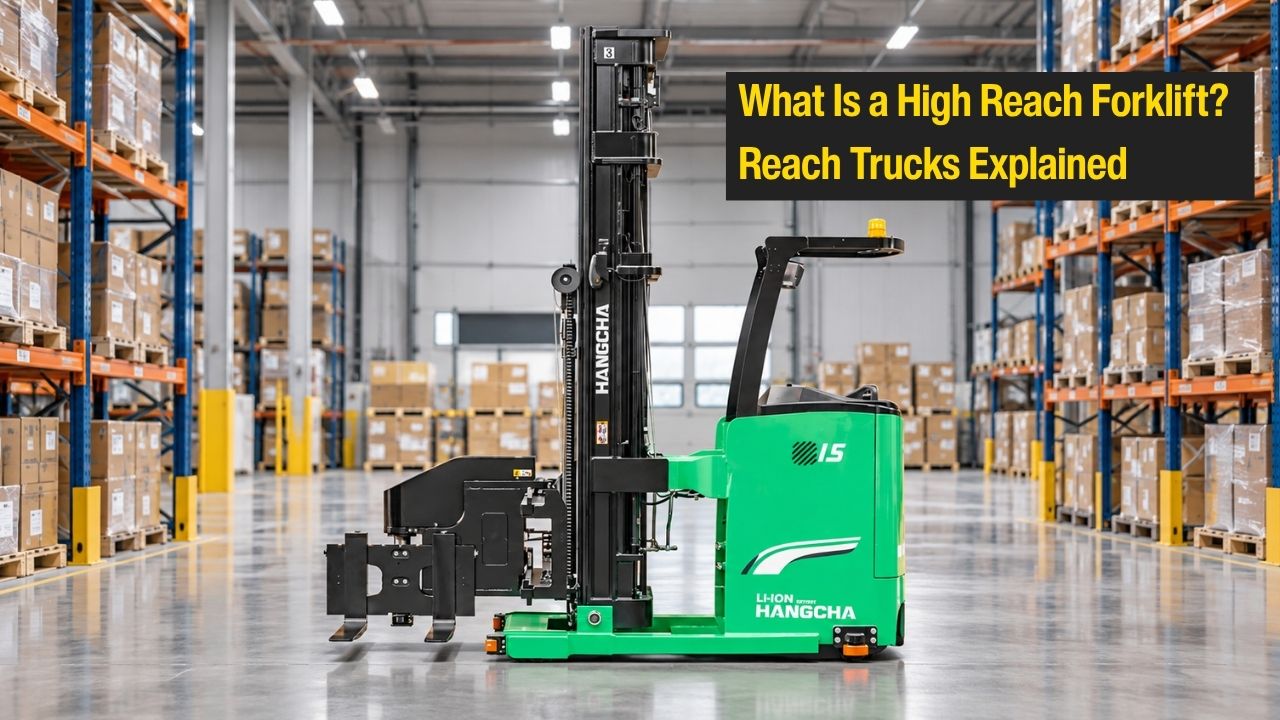
Reach trucks and walkie stackers differ from a counterbalance forklift mainly in how they balance the load: most carry it over support legs instead of relying only on a counterweight. Their hydraulics and masts work the same way.
A reach truck carries the load between its two support legs while it travels, then moves its mast forward to reach into the rack. Hangcha's XC reach trucks reach 571-716 mm forward. Keeping the load inside the legs on the move lets a reach truck work in much narrower aisles than a counterbalance forklift. Our reach trucks lift as high as 13 m.
A walkie stacker is driven by an operator walking behind it. On most models the forks sit above two support legs that roll into or around the pallet. The Hangcha stackers we sell are rated at a 600 mm load centre. A counterbalanced walkie stacker has no front legs and balances the load with weight at the back, like a small forklift.
Because the operator walks behind it, a walkie stacker doesn't need a High Risk Work Licence, although operators still need training and the site must manage the risk. A reach truck counts as a forklift truck, so its operator needs an LF licence. Our walkie stackers are lithium powered and handle 0.8 to 2 t.
Order pickers, rough terrain forklifts and the other types of forklifts use the same building blocks: a mast, hydraulics, a drive system and a way to balance the load.
Once you know how the pieces fit, choosing a forklift comes down to three things. You need capacity at your real load centre and lift height, a mast with the height and free lift your site needs, and a drive system that suits your shifts. DJJ's sales team can work through those with you on 1800 355 388, or you can browse our forklifts for sale and send an enquiry on the model that fits.