Forklifts should be serviced at the hour-meter intervals in the manufacturer's manual, which for many forklifts means a scheduled service every 250 hours, or about every six weeks on a single shift. Operators also run a pre-start check at the start of every shift. Safe Work Australia's guidance is to service a forklift at least once every 12 months even if it barely runs, and cold, dusty, wet or multi-shift sites need shorter intervals.
Forklift service intervals: hours or months first?
Forklift service intervals run on the hour meter, with the calendar as a backstop: the service is due at whichever comes first. Two identical forklifts on different sites can be due on very different dates.
A forklift running one 8-hour shift, five days a week, logs about 40 hours a week and reaches 250 hours in a little over six weeks. On two shifts it gets there in about three weeks. You can also count down from what's left: 80 hours to the next service is 20 working days at 4 hours a day, but only 10 days at 8 hours a day.
A forklift that runs an hour or two a day may take months to reach 250 hours, and that's where the calendar matters. Seals and hoses still age, fluids still break down, and a lead-acid battery that sits partly charged deteriorates.
A typical forklift service schedule
A typical forklift service schedule steps up from daily checks to a major service at 2,000 hours. As an example, Hangcha's manual for its Hangcha XE series electric forklifts sets these service levels:
| Service level | Hour meter | Calendar guide in the manual |
|---|---|---|
| Daily | Every 8 hours | Each day |
| Weekly | Every 40 hours | Each week |
| 250-hour service | Every 250 hours | About every 1.5 months |
| 500-hour service | Every 500 hours | About every 3 months |
| 1,000-hour service | Every 1,000 hours | About every 6 months |
| 2,000-hour service | Every 2,000 hours | About once a year |
The calendar column assumes a single shift. The manual also treats the first 100 hours as a running-in period with lighter loads, and some items keep their own timing: the drive axle oil, for example, is changed first at 250 hours and then every 2,000 hours. Engine-powered models can use different steps, so always work from the manual for your exact model.
What typically happens at each service level
Task lists differ between manufacturers and models, but the work usually builds like this:
- Daily and weekly: operator checks of forks, chains, tyres, brakes, steering, leaks and safety devices.
- 250 hours: the first full service. A technician inspects and lubricates the mast, chains and pivot points, checks brakes, steering, tyres and hydraulics, and on many engine forklifts changes the engine oil and filter.
- 500 hours: the 250-hour work plus closer checks of the mast, rollers and hydraulic system, often with filter changes.
- 1,000 hours: a deeper look at wear parts such as mast rollers, brakes and steering components.
- 2,000 hours: the major service, usually with hydraulic and axle or transmission oils replaced and the main systems tested.
Electric vs LPG vs diesel forklift servicing
Electric, LPG and diesel forklifts all follow hour-based service levels, but the work at each service differs. Electric forklifts have fewer service items, though not always longer intervals: the XE manual above is for an electric forklift and still starts at 250 hours.
| Power type | What the technician adds at a service | What operators watch each shift |
|---|---|---|
| Electric, lead-acid battery | Battery electrolyte levels and cell readings, terminals and cables, charger, contactors, motors and wiring | Charge level, damaged cables or connectors, water level where the battery has an indicator |
| Electric, lithium-ion battery | Battery management system (BMS) faults, charger, cables and connectors, contactors, motors and wiring | Charge level, warning lights, damaged cables or connectors |
| LPG | Engine oil and filters, air filter, cooling system, belts, ignition and tuning, plus the gas system: cylinder bracket, hoses, regulator and relief valve | Gas leaks, cylinder secure in its bracket, fuel level |
| Diesel | Engine oil and filters, fuel and air filters, cooling system, belts and exhaust | Fuel level, leaks, exhaust smoke, oil and coolant where the manual makes them an operator check |
A lithium battery doesn't need watering, but it still needs the charger the manufacturer specifies, and the Hangcha XE manual calls for a full charge once a week. Flooded lead-acid batteries are topped up with distilled water after charging, not before.
On LPG and diesel forklifts, regular engine tuning keeps carbon monoxide in the exhaust down, which matters most indoors.
When to service a forklift more often
A forklift needs servicing more often than the manual's standard intervals when it works in harsh conditions. WorkSafe Queensland lists severe operating conditions such as freezers as a reason for more frequent maintenance inspections, and the Hangcha XE manual cuts lift chain lubrication to every 100 hours in cold or corrosive environments.
- Cold stores and freezers: moving between the cold room and the dock causes condensation, which attacks chains, electrics and bearings.
- Dust: cement, timber, grain and recycling sites clog air filters and radiators and wear seals faster.
- Wet or salty yards: corrosion on chains, the mast and electrical connectors.
- Multiple shifts: the hours pile up so fast that the calendar guide stops meaning much.
- Heavy loads, rough ground or attachments: more strain on tyres, steering, the mast and hydraulics.
No Australian regulator sets a number for these sites, so ask your technician to set a shorter schedule from your hours and site, and to write it on the service record.
Chains, filters and tyres get replaced sooner on harsh sites too. DJJ Equipment keeps common forklift parts at its Sydney, Brisbane and Perth branches.
What Australian law requires for forklift servicing
Australian law doesn't set a fixed forklift service interval. Under the WHS Regulations in NSW, Queensland and WA, the business with management or control of a forklift must have its maintenance, inspection and, where needed, testing done by a competent person.
That work follows the manufacturer's recommendations. If there are none, a competent person's recommendations apply, and if following either isn't reasonably practicable, the forklift is inspected annually. Safe Work Australia's general guide for industrial lift trucks adds that forklifts should be serviced at least once every 12 months.
Victoria has its own OHS laws, and WorkSafe Victoria's forklift maintenance and inspection guidance points the same way: a pre-operation inspection at the start of each shift and when the operator changes, a competent forklift technician, and records of what was inspected and fixed.
Competent means competent on forklifts. WorkSafe Queensland advises using only a trained, qualified person to inspect, maintain or repair forklifts, and only licensed gas fitters to repair or replace parts on LPG forklifts.
Daily checks vs a technician's service
Daily checks and a technician's service do different jobs, and one doesn't replace the other. The operator's pre-start check, at the start of each shift and whenever an operator changes to a different forklift, looks for damage, leaks and anything that doesn't work as it should.
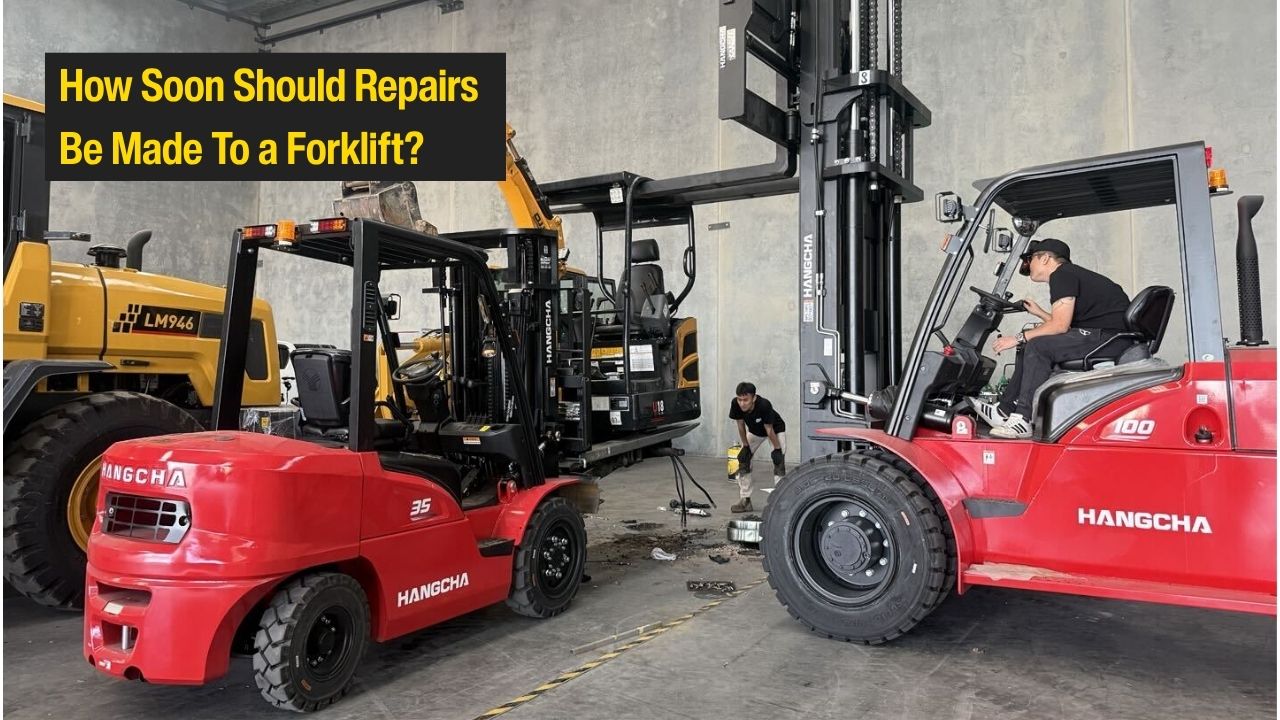
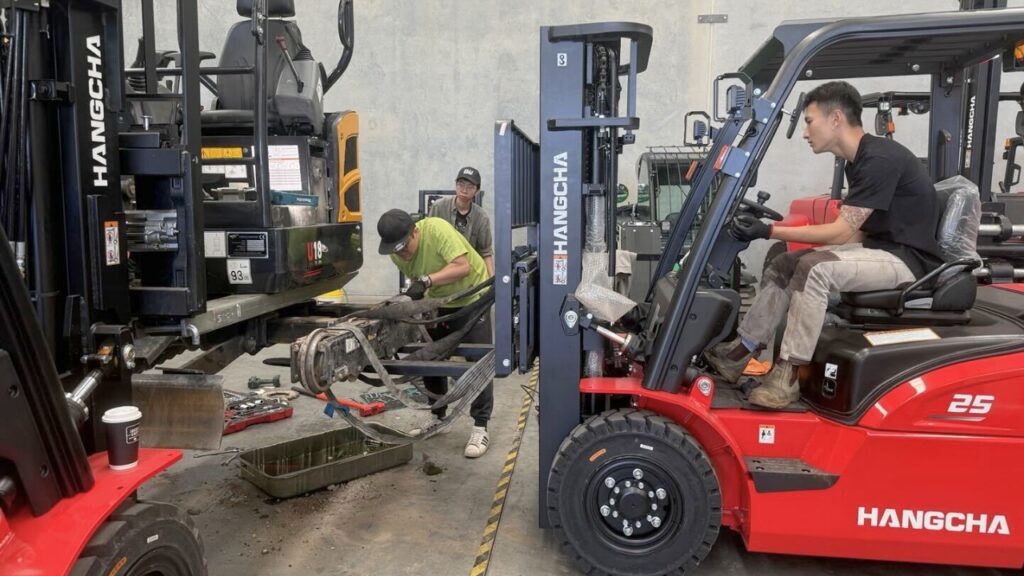
A technician's service goes further: measuring chain stretch and fork wear, adjusting brakes, changing oils and filters, and testing the battery, charger or engine.
If a pre-start check finds a fault that could affect safe operation, the forklift comes out of service until it's repaired, whatever the hour meter says. Operators can work from a daily forklift pre-start checklist adapted to the manufacturer's list.
On a hired forklift, the hire agreement sets who does what. Under DJJ's standard hire terms, we service hired equipment during business hours and the hirer does the daily checks.
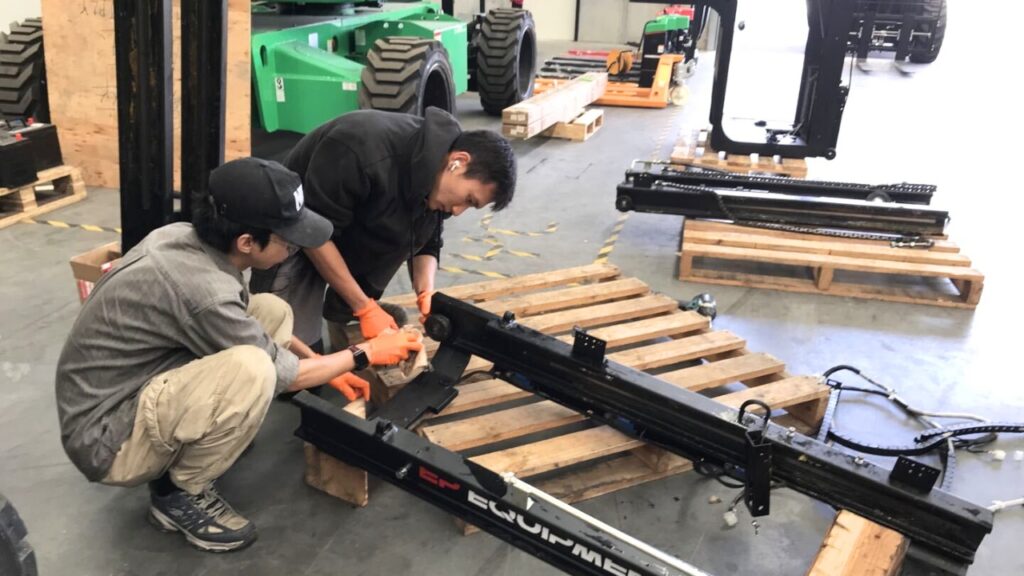
Keeping forklift service records
Forklift service records show what was done, when and by whom. SafeWork NSW's forklift safety guidance tells businesses to use a competent person to inspect and service forklifts and to keep maintenance, inspection and repair records. Safe Work Australia recommends keeping them at or near the workplace for as long as the forklift is there.
Each entry should cover:
- the forklift's identification or serial number
- the date and the hour meter reading
- the service level or work done, including repairs and parts replaced
- who did it and their qualifications
- defects found, and anything still waiting on parts or follow-up
- any changes to the forklift, such as a new attachment
A useful service report also says what's wearing and what to plan for next time. Service history counts again when you sell or trade in a forklift, because it helps set the value.
Forklift servicing from DJJ
DJJ services all forklift brands and repairs Hangcha forklifts; repairs on other brands are assessed case by case, so check your model with the service team. If you buy a forklift from us, DJJ Care covers scheduled maintenance, parts replacement and technical assistance through our after-sales support team.
Servicing and repairs are done at our workshops in Silverwater NSW, Meadowbrook QLD and Bayswater WA. Our technicians also service forklifts on site within 50 km of each branch, during business hours, Monday to Friday.
To book forklift servicing, call 1300 646 747 with the make and model, the hour meter reading, how many hours a day the forklift runs and whether the site is cold, dusty, wet or multi-shift. That's enough to work out which service is due.