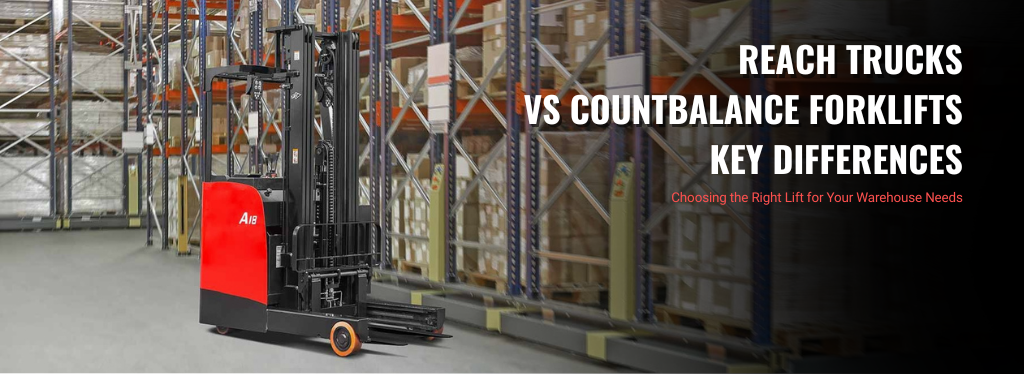
A reach truck stacks pallets high in narrow warehouse aisles, while a counterbalance forklift lifts heavier loads, works outdoors and loads trucks. A Hangcha reach truck needs an aisle of about 2.6-2.9 m and lifts up to 13 m. A 2.5 t counterbalance forklift needs about 3.9-4.1 m of aisle and usually lifts 3-7 m. Choose a reach truck for dense racking on smooth indoor floors, and a counterbalance forklift for yards, docks and mixed work.
Reach truck vs counterbalance forklift at a glance
Reach trucks and counterbalance forklifts balance the load in different ways, and that drives every other difference. The table compares Hangcha models in each class.
| Reach truck (Hangcha XC) | Counterbalance (2.5 t) | |
|---|---|---|
| Capacity | 1.0-2.5 t | From about 1 t, up to 48 t in Hangcha's range |
| Rated load centre | 600 mm | 500 mm on most models |
| Typical lift height | Up to 11-13 m (7 m on smaller models) | 3 m standard, up to about 7 m |
| Right-angle stacking aisle | About 2.6-2.9 m | About 3.9-4.1 m with a 1,200 mm pallet |
| Turning radius | About 1.5-1.9 m | About 2.2 m |
| Wheels and floor | Polyurethane wheels, smooth level concrete | Pneumatic or solid tyres, yards and docks |
| Laden gradient | Up to 10% | Up to 25% (diesel 2.5 t) |
| Power | Electric (lithium) | Electric, LPG or diesel |
How each machine balances the load
A counterbalance forklift carries the load in front of its front axle and balances it with a heavy counterweight at the back. That makes it stable on uneven ground and able to drive straight up to a truck or rack, but it needs room to turn the whole machine.
A reach truck carries the load between two support legs while it travels, then moves the mast forward to reach into the rack. The Hangcha XC reach trucks are moving-mast designs that reach 571-716 mm forward, and the battery and chassis add to the counterweight. A reach truck is not much lighter than a counterbalance forklift of the same capacity: a 2.5 t Hangcha reach truck weighs about 3,620 kg, against about 3,765 kg for a 2.5 t diesel counterbalance.
Aisle width and storage space
Aisle width is the main reason warehouses switch to reach trucks. The right-angle stacking aisle is the turning radius, plus the distance from the axle to the fork face, plus the pallet length, plus a clearance of about 200 mm. For a 2.5 t counterbalance forklift that comes to about 3.9-4.1 m with a 1,000 x 1,200 mm pallet.
Hangcha reach trucks need about 2.6-2.9 m, depending on the model and how the pallet is presented. As a worked example, with back-to-back racking about 2.3 m deep, cutting a 4.1 m aisle to 2.8 m shrinks each rack-and-aisle module from about 6.4 m to 5.1 m, which fits roughly a quarter more rack rows in the same floor. Your racking supplier should check any layout change.
Lift height and capacity at height
Reach trucks are built to lift high. Hangcha XC 1.4-2.5 t reach trucks lift up to 11-13 m, and the smaller models up to 7 m. Counterbalance forklifts usually come with a 3 m mast, with options up to about 7 m.
Rated capacity applies only up to a certain height. A 2.0 t Hangcha reach truck keeps its full 2,000 kg up to 6.5 m, then drops to about 1,450 kg at 10 m and 500 kg at 13 m, at a 600 mm load centre. Plan the top beam levels on the capacity at that height, not the headline figure.
Compare load centres before comparing capacities. Hangcha reach trucks are rated at 600 mm and most counterbalance forklifts at 500 mm, so a longer load reduces the real capacity of either machine. Check the roof, sprinklers and lights against the mast's extended height too, which on a Hangcha reach truck is about 965 mm above the lift height.
Floors, ramps and outdoor work
Floor quality decides whether a reach truck is an option at all. Reach trucks run on polyurethane wheels with only about 80 mm of ground clearance, so they need smooth, level concrete indoors. A Hangcha reach truck climbs up to 10% laden.
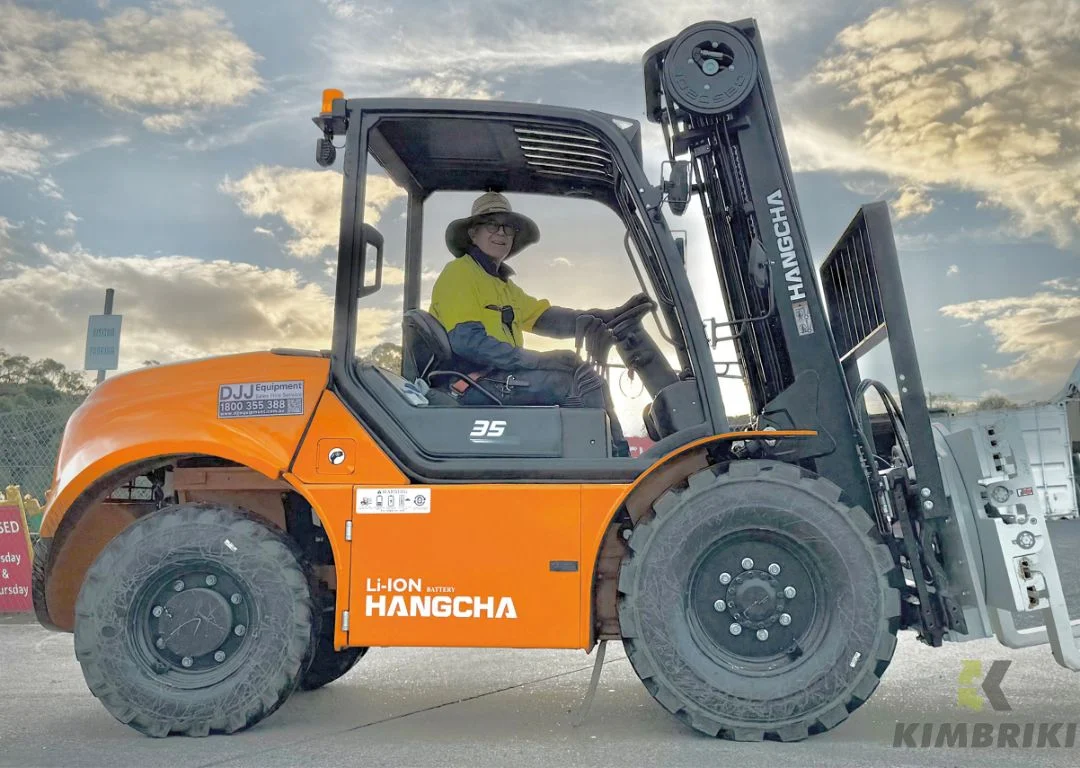
A counterbalance forklift on pneumatic tyres handles yards, rough concrete and ramps, and a 2.5 t diesel model climbs up to 25% laden. If the forklift has to work outside, in the rain or across a car park, one of the counterbalance forklifts is the practical choice.
Loading trucks and containers
Loading trucks and containers is counterbalance work. The support legs, small wheels, low ground clearance and gentle gradient limit of a reach truck make dock plates and truck decks impractical. Most warehouses with reach trucks keep at least one counterbalance forklift at the dock for receiving and dispatch.
The same applies to power type. Reach trucks are electric, while counterbalance forklifts come in electric, LPG and diesel: this comparison of electric vs LPG vs diesel forklifts covers running costs and where each fits.
Speed, controls and operator comfort
A counterbalance forklift is usually faster in open space. A Hangcha reach truck travels at up to 14 km/h, against about 19 km/h for a 2.5 t diesel counterbalance. Reach trucks make up for it in the aisle, with tight steering, height pre-selection and fingertip controls on some models.
Reach trucks come as stand-on or sit-down machines. Hangcha's A series is stand-on, while the XC series is sit-down with options such as a fork camera, a positioning laser and a blue floor-spot warning light. Cold-store versions with an enclosed cab are built for rooms down to -30°C.
Licence, training and racking checks
In Australia, one high risk work licence covers both machines. The LF class covers forklift trucks with a mast whose forks can lift 900 mm or more, which includes reach trucks and counterbalance forklifts. Order pickers, where the operator's controls rise with the load, need class LO. A driver moving from a counterbalance forklift to a reach truck still needs familiarisation, because the controls and handling are different.
Racking must suit the forklift. Pallet racking should be operated and maintained to AS 4084.2:2023, with a safe working load sign for each beam level and a formal inspection by a competent person every 12 months. The WorkSafe Victoria pallet racking guidance also says the racking supplier should check any change, such as bringing in a different forklift.
Keep people and forklifts apart in every layout, with physical barriers, exclusion zones and signage where pedestrians cross forklift routes.
Which one does your site need?
Choose a reach truck when you store pallets in racking above about 6 m, floor space is tight and the floor is smooth concrete. Choose a counterbalance forklift when you load trucks or containers, work outdoors or on ramps, or lift loads over 2.5 t. Many warehouses run both: reach trucks in the racking and a counterbalance forklift at the dock.
DJJ Equipment sells and hires Hangcha reach trucks and counterbalance forklifts from Silverwater, Meadowbrook and Bayswater, and the team can check your aisle widths, rack heights and floor before you choose.
Call 1800 355 388, or compare the range of reach trucks.