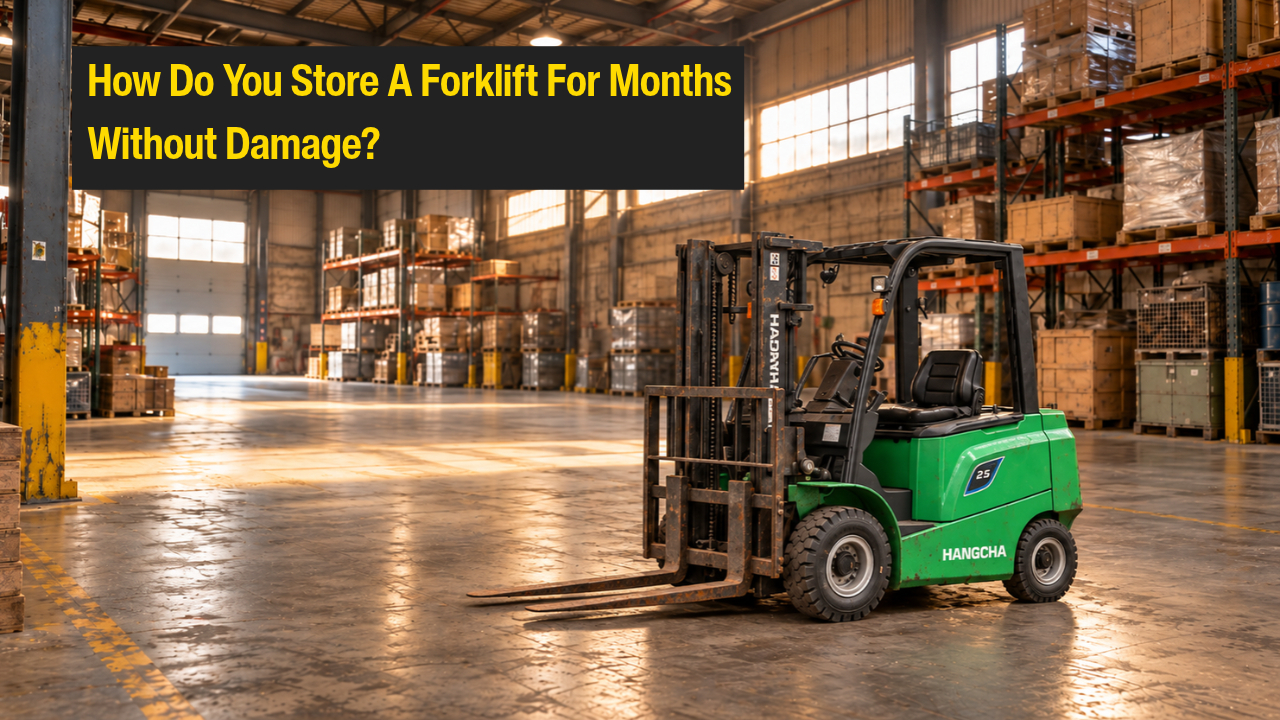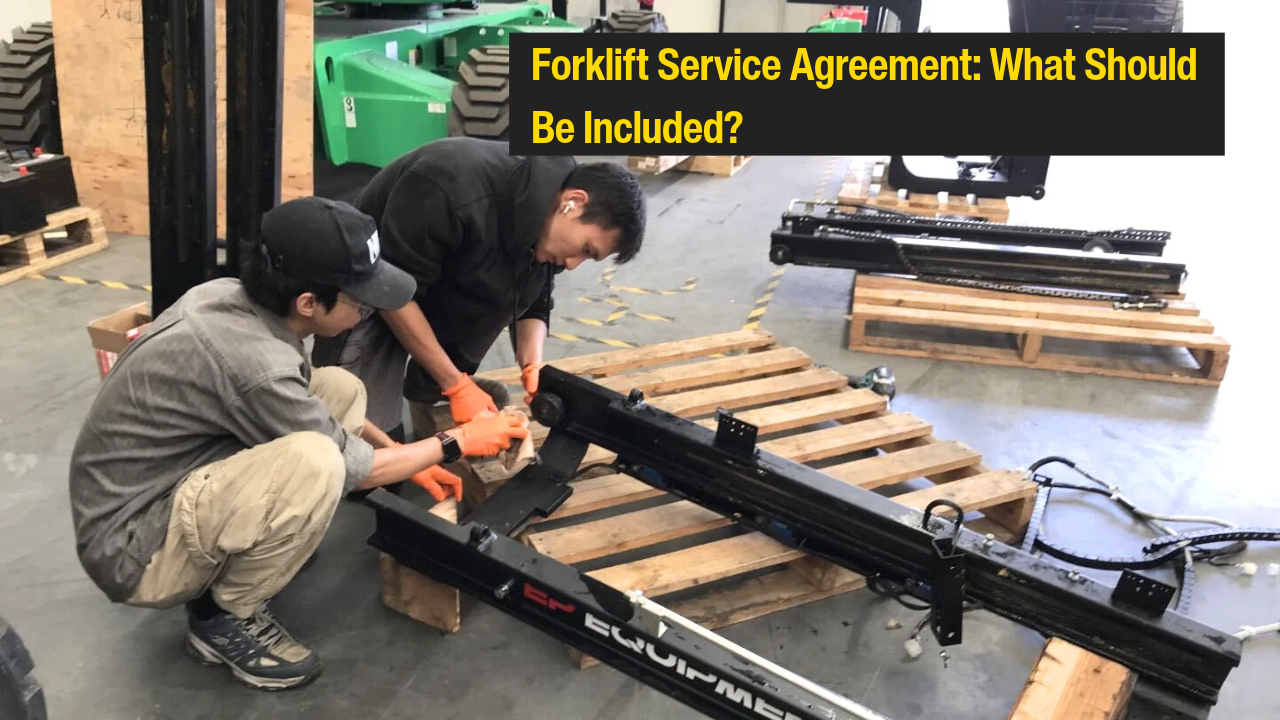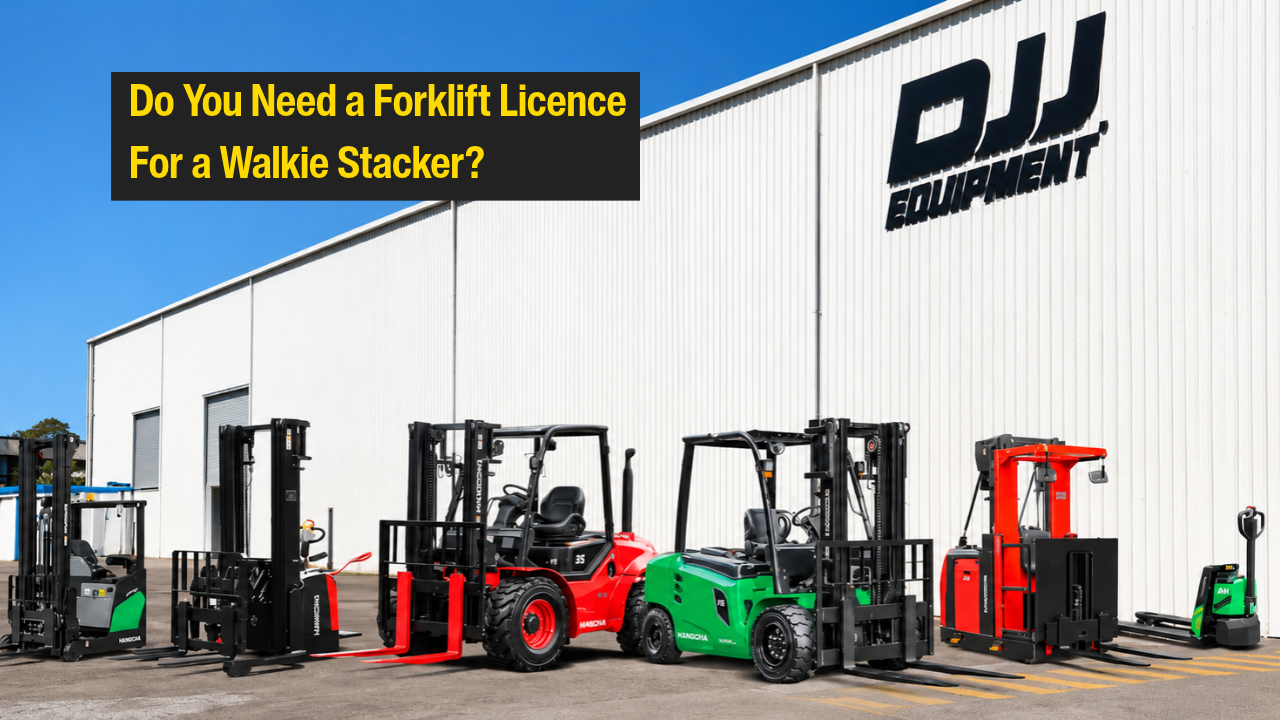
A forklift test drive should compare five parts of the operator's space: the step and grab handle, the seat and suspension, the hydraulic controls, the steering and foot room, and the view of the fork tips and the path behind. The Hangcha X Series 12 t diesel, for example, has an adjustable steering column as standard but lists a suspension seat as an option, so the quote has to name the seat you tested. Bring your own operators, including the tallest and the shortest, and run the jobs they do every day.
Why operator comfort matters when you choose a forklift
Comfort is a safety issue as much as a convenience. WorkSafe Queensland's forklift safety guide lists the strains that build up over a shift: looking up repeatedly when stacking high, looking behind when reversing, hitting bumps on uneven ground and using controls that are poorly placed or poorly maintained. Sprains and strains to the neck, back and arms can become long-term health problems.
Many forklift injuries also happen while getting on and off, not while driving. The guide's advice to employers is to buy or hire forklifts with features that prevent these injuries, which is why a test drive should look at the operator's space as closely as capacity and lift height.
The operator's position varies a lot across the forklifts DJJ Equipment sells, from stand-up trucks for short runs to heavy diesel models with an optional cabin. An operator who is fighting the seat or stretching for a lever all day also has less attention left for pedestrians and racking.
How easy is it to get on and off the forklift?
Test the step and grab handle before you sit down, because the operator repeats that climb at every stop. Climb on and off each truck several times, as an operator would during a shift, and check that:
- the step is low, wide enough to stand on firmly and has an anti-slip surface
- the grab handle sits where your hand naturally goes, so you can keep three points of contact
- your head clears the overhead guard leg as you climb in
- you can still get out if the truck is parked close to racking on one side
On jobs where the operator gets off every few minutes to scan freight or move a carton by hand, a stand-up truck can suit better than a sit-down one.
Does the forklift seat soak up bumps and vibration?
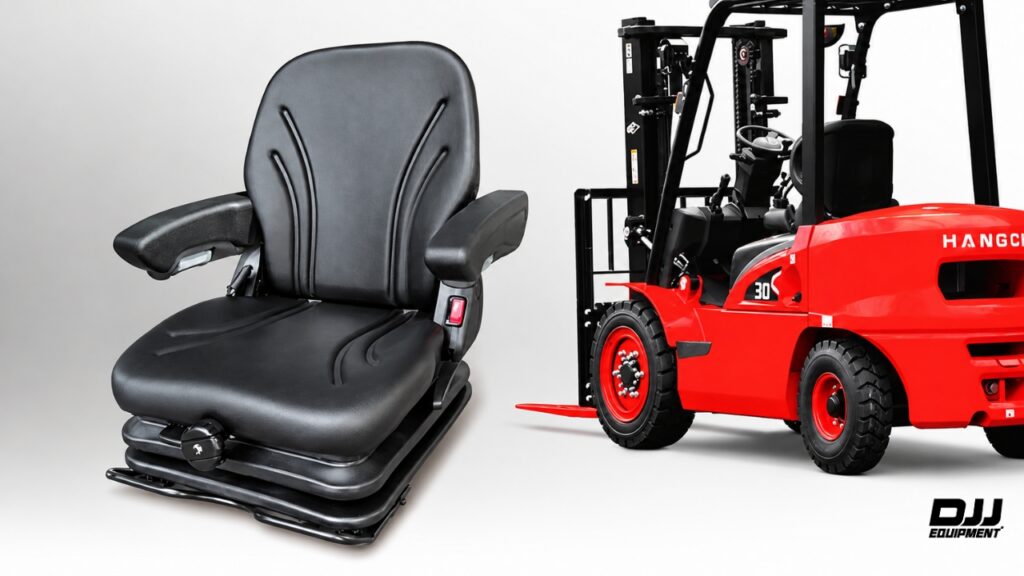
A forklift seat soaks up bumps and vibration only if it has suspension that adjusts for the operator's weight. It sits between the operator's spine and every floor joint, dock plate and pothole. Look for one that also slides far enough for every operator and supports the lower back. Sit in it for more than a minute, because a seat that feels fine in a showroom can be hard work by the end of a shift.
Bumps come from the ground as much as the seat. WorkSafe Queensland links vibration and jolting to uneven surfaces and to seats in poor condition, so the tyres, the floor and the seat's upkeep all play a part.
On rough ground, look for a suspension seat as standard. Every model in Hangcha's 5-10 tonne rough terrain forklift range has a full-suspension seat, and every version of the 1.5-1.8 t model has a suspension seat as well.
Forklift hydraulic controls: levers or fingertip controls?
Hydraulic controls come in two main layouts. Mechanical levers usually sit in front of the operator, so every lift, lower and tilt means reaching forward to push or pull. Fingertip controls sit on or beside the armrest, so the forearm stays supported and the movements are small.
Hangcha's XC Series reach truck 1.4-2.5 t shows the difference within one range. XC4 models use a mechanical control lever, while XC4D models add fingertip controls with a height display, height selection and a height limit across the full lift range.
On the test drive, check that:
- the armrest moves with the seat when you slide it, so the controls stay in the same place for your hand
- the direction switch and horn are within reach without letting go of the steering or the controls
- each control moves smoothly and does what its label says
Fingertip controls matter most on trucks that lift all day across two or three shifts, and less on a truck that lifts a few pallets an hour.
Checking the forklift's steering, pedals and foot room
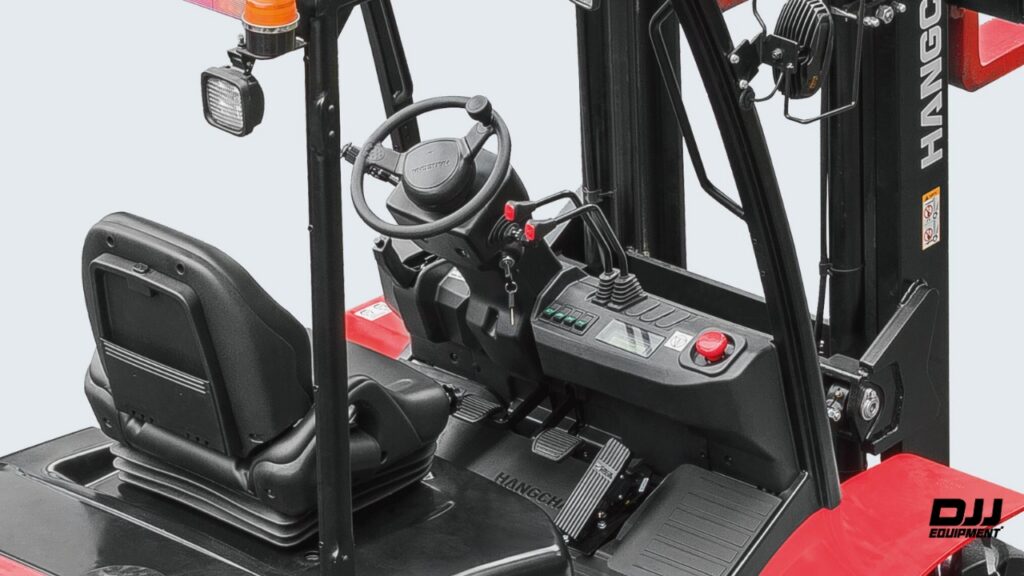
Check that the forklift's steering suits the operator, because one hand is on the wheel all shift, often turning lock to lock in narrow aisles. A compact wheel with a spinner knob and a column that tilts to suit the operator cuts the reach.
Then look down. The floor should be clear of bolts, hoses or raised panels that catch a boot, and the pedals should be far enough apart for a work boot to press one at a time. WorkSafe Queensland asks for controls and foot pedals placed so they don't create a trip hazard.
Can the operator see the fork tips and behind the forklift?
An operator who can't see past the mast or behind the forklift ends up leaning forward, craning up or twisting round. With the forks at travel height, check you can see the tips and the floor in front of them through the mast without leaving the backrest. Wide-view masts, used on many Hangcha models, and hoses routed neatly behind the mast make a real difference.
Lift a load to your highest beam and look up through the overhead guard to see how much the bars block. Some models offer a taller guard for this reason: the XC Series 4-wheel electric forklift PMSM 1.5-3.8 t has a 2,550 mm high-vision overhead guard on its GW versions. Then reverse the length of an aisle. WorkSafe Queensland suggests swivel seats or camera systems to reduce neck twisting when reversing, and a panoramic mirror helps too, so ask which of these the quoted truck has.
Sit-down forklift, stand-up forklift or ride-on pallet truck: which suits your shifts?
The operator position should suit how long people drive and how often they get off. A sit-down counterbalance truck suits long shifts and longer runs. A stand-up truck, such as Hangcha's A Series stand-up 3-wheel forklift, has the operator standing side-on in a 1,082 mm wide truck, which suits short runs and frequent stops in narrow aisles.
For long runs with pallets, a ride-on pallet truck takes the walking out of the job. The XA Series stand-on and side-seated pallet truck lets the operator stand or fold down a side seat, with knee pads, a cushioned footplate and torque-feedback steering for comfort over a full shift.
How to run a fair forklift test drive
Running the same short routine on every truck gives a fairer comparison than a lap of the yard:
- Bring two or three operators who will drive the truck, including your tallest and shortest.
- Have each operator adjust the seat, steering column and armrest before moving off.
- Run your real jobs: lift a typical load to the top beam, reverse the length of an aisle and cross floor joints or a dock plate, loaded and empty.
- Get on and off several times, as you would in a normal shift.
- Score each truck on the same sheet for access, seat, controls, foot room and visibility.
- Check the quote lists the seat, controls and mirrors or cameras you tested, and whether each is standard or an option.
A score sheet with these five rows keeps the comparison even, with what to test on each and a Hangcha example of the feature.
| What to compare | What to test on the drive | Example from the Hangcha range |
|---|---|---|
| Getting on and off | Step height and grip, grab handle position, head clearance | XH Series heavy duty 4-5 t: stainless boarding step standard |
| Seat and vibration | Weight adjustment, back support, ride over joints and dock plates | XF2 Series 1.5-3.5 t: three-stage vibration reduction |
| Hydraulic controls | Lever reach or fingertip controls on the armrest | XC Series reach truck: lever on XC4, fingertip on XC4D |
| Steering and pedals | Column adjustment, wheel size, room for a work boot | X Series 12 t diesel: adjustable steering column standard |
| Visibility | Fork tips at travel height, view at the top beam, reversing | X Series 3-wheel 0.6-1 t: 2.5 m duplex wide-view mast standard |
Weak scores on the seat or the controls can sometimes be fixed by choosing another seat or version, such as the XC4D's fingertip controls instead of the XC4's lever. Weak scores on getting on and off or on visibility usually can't, because they come from the truck's frame, cabin and mast.
If a short drive still leaves you unsure, forklift hire lets your operators use a machine on real work for longer. Minimum hire terms depend on the machine and branch.
On indoor sites, noise belongs in the same comparison, so listen while the truck lifts and reverses, not only while it drives.
Keeping forklift seats and controls in good order
Seats, controls, steps and grab handles wear like any other part. WorkSafe Queensland's guide asks employers to service and maintain forklifts including their controls and seating, and to repair or replace broken steps, rails and handles.
Operators catch problems first. A torn seat, a loose armrest or a sticky lever should be reported straight away, and seat condition and adjustment are part of the daily forklift pre-start checks.
Tell the DJJ team who will drive the truck, how many shifts it works, what floor or ground it runs on and how high it lifts. Call 1800 355 388 to ask about a live video walk-around or a free fleet assessment, and our Sydney, Brisbane or Perth branch will help you compare models.