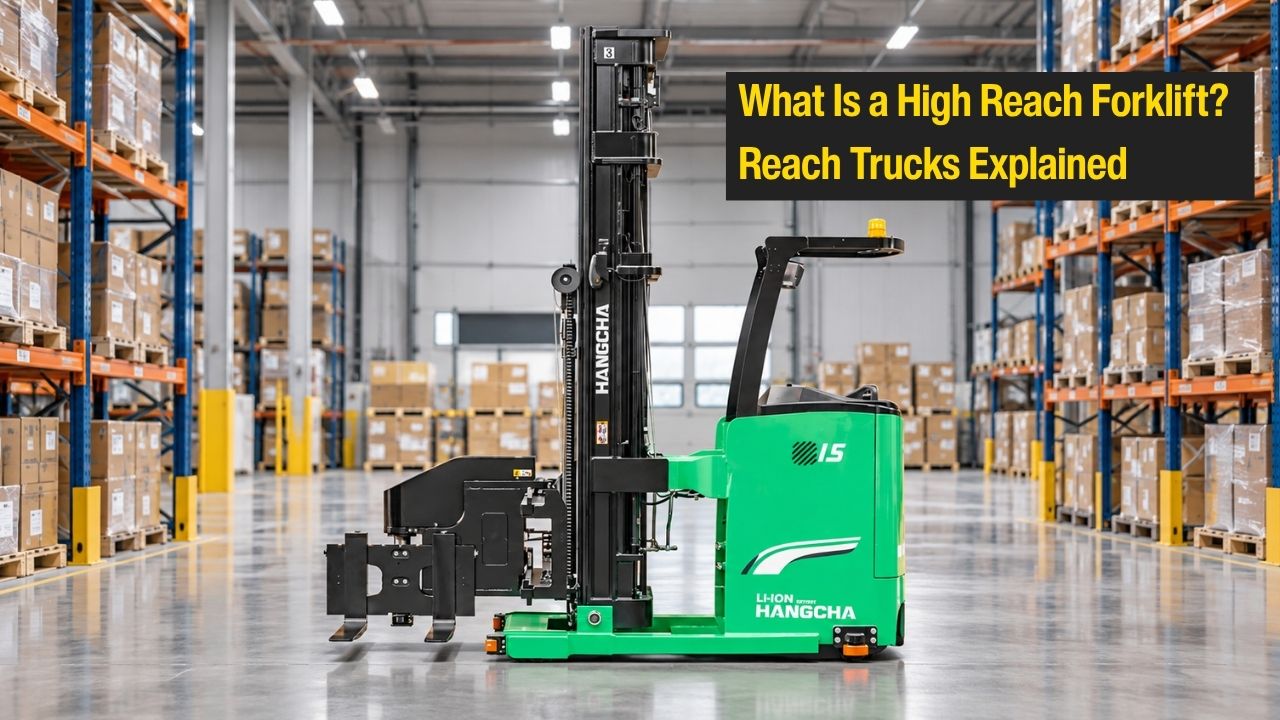
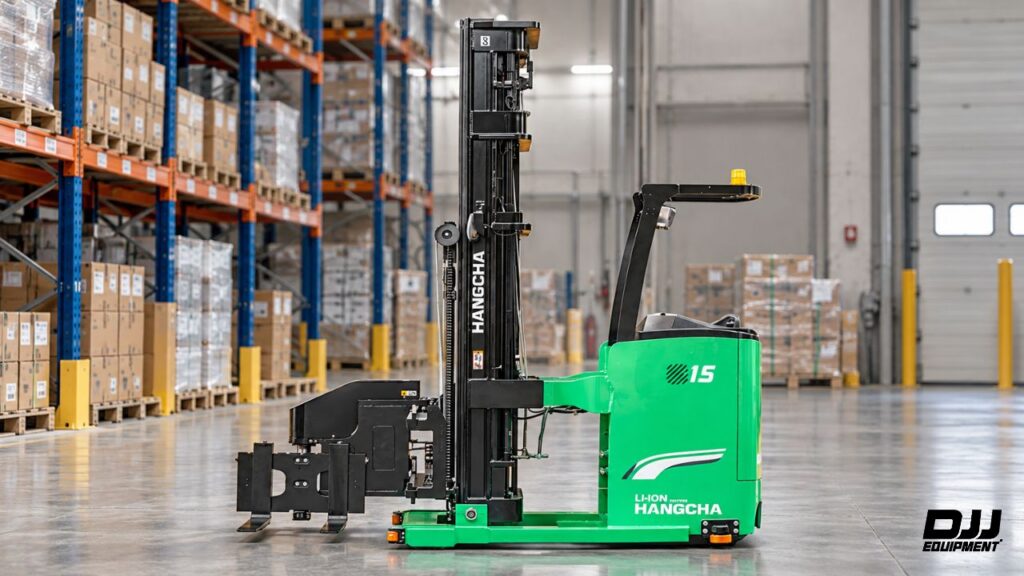
A high reach forklift (reach truck) is an electric warehouse forklift that carries the load between two front support legs and moves its mast or forks forward to place pallets in racking up to about 13 m high, in aisles under 3 m wide. It needs smooth indoor floors, carries less weight the higher it lifts, and its operator needs a class LF licence.
What does high reach forklift mean in Australia?
In Australia, high reach forklift almost always means a reach truck, and job ads, training courses and dealers use both names for the same machine, along with reach forklift and hi-reach. A few suppliers stretch the term to turret trucks, but a tall-mast counterbalance forklift is not a reach truck.
How does a reach truck work?
A reach truck works by carrying the load between two support legs while it travels, then reaching the forks forward into the rack to pick up or set down a pallet. With the load pulled back inside the wheelbase, the truck is shorter than a counterbalance forklift and turns in a much tighter space.
Support legs keep the reach truck stable
Support legs, also called outriggers or straddle legs, run forward from the chassis with a load wheel near each tip, while the battery and chassis act as the counterweight. That is why you should never fit a smaller battery than the manufacturer specifies. The legs also shape your racking: at floor level they slide in under the bottom beam, so that beam has to sit high enough to clear them.
Moving mast or pantograph reach
Reach trucks reach forward in one of two ways. On a moving mast truck the whole mast travels forward along the legs. On a pantograph truck the mast stays put and a scissor mechanism pushes the fork carriage out, which lets it reach further.
| Reach type | How it reaches | Hangcha example and reach distance |
|---|---|---|
| Moving mast | The whole mast travels forward | XC Series 1.4-2.5 t: 571-716 mm |
| Pantograph, single reach | Scissor arms push the forks out | X Series pantograph 1.4-2 t: 610 mm |
| Pantograph, double reach | A longer scissor stroke reaches the second pallet | X Series pantograph 1.4-1.6 t: 1,067 mm |
A longer reach lets the truck work double-deep racking, where one pallet sits behind another, at the cost of capacity.
How high can a high reach forklift lift?
Most reach trucks lift between about 7 m and 13 m, and the mast you choose sets the highest beam you can reach. The table lists the tallest mast for each Hangcha reach truck DJJ Equipment sells.
| Hangcha model | Rated capacity | Maximum lift height |
|---|---|---|
| A Series stand-on 1.5-1.8 t | 1,500-1,800 kg | 7 m |
| XC Series 1.0-1.2 t | 1,000-1,200 kg | 7 m |
| X Series four-way 2-3 t | 2,000-3,000 kg | 8.5 m |
| XC Series 1.4-1.8 t | 1,400-1,800 kg | 11-11.5 m |
| X Series pantograph 1.4-2 t | 1,361-2,041 kg | 11.5 m |
| A Series 1.2-2 t | 1,200-2,000 kg | 12.5 m |
| XC Series 2-2.5 t | 2,000-2,500 kg | 13 m |
Those are options, not standard fit: the A Series 1.2-2 t comes with a 3 m mast as standard and triplex masts from 4.3 m to 12.5 m. The Hangcha XC Series reach truck reaches 13 m on its 2 t and 2.5 t models.
Why reach truck capacity drops as the forks go higher
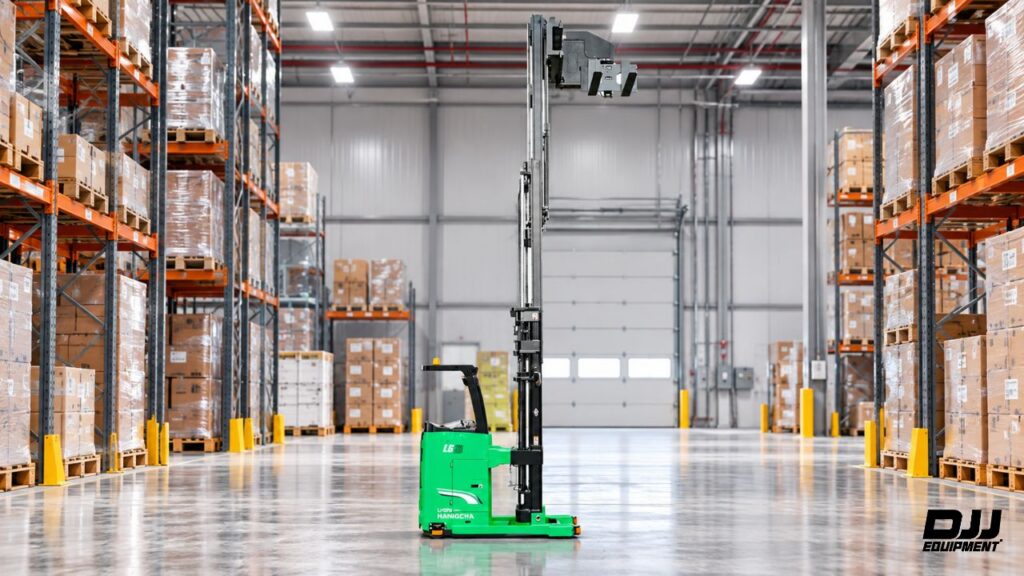
A reach truck's rated capacity applies only up to a certain lift height, and above that the data plate allows less weight the higher the forks go. A load high on the mast and reached out in front of the legs puts more tipping force on the truck. Hangcha XC models keep their full rating up to 6-6.5 m, and the load chart on the data plate is the figure to work from.
| Hangcha model | Rated capacity (load centre) | Capacity at height |
|---|---|---|
| XC Series CQD25 | 2,500 kg (600 mm) | 1,950 kg at 10 m, 1,000 kg at 13 m |
| A Series CQD18 stand-on | 1,800 kg (500 mm) | 1,800 kg up to 4.5 m, 1,050 kg at 7 m |
| X Series pantograph CQD20, single reach | 2,041 kg (600 mm) | 1,050 kg at 11.5 m |
| X Series pantograph CQD16, double reach | 1,588 kg (600 mm) | 820 kg at 11.5 m |
Check the load centre before comparing: the same truck shows a higher capacity at 500 mm than at 600 mm. Attachments reduce capacity too, and a sideshifter takes 200 kg off the A Series 1.5-1.8 t.
Say your heaviest pallet is 900 kg and your top beam is at 11.5 m. The single-reach Hangcha X Series pantograph reach truck carries 1,000 kg at that height, but the 1.6 t double-reach version carries only 820 kg. Double-deep at that height needs lighter pallets or a lower beam.
Types of reach truck
Reach trucks differ mainly in where the operator rides, how deep the forks reach and which way the truck can travel.
Stand-on and sit-down reach trucks
On a stand-on reach truck, such as the Hangcha A Series 1.5-1.8 t, the operator stands in a compact cab, which suits short trips and frequent stepping on and off. Sit-down models such as the Hangcha XC Series have a suspension seat and an adjustable steering wheel, and the XC4D adds fingertip controls with height selection. We'd usually suggest a seated truck for long shifts and high racking.
Single-deep and double-deep reach trucks
A single-deep reach truck reaches one pallet into the rack, so every pallet is directly accessible. A double-deep truck reaches past the front pallet to the one behind it, so you need fewer aisles, but the racking has to be built for it. Hangcha's X Series pantograph comes in a double-reach version on its 1.4 t and 1.6 t models.
Four-way reach trucks
A four-way reach truck drives forwards and sideways and turns on the spot, so it can carry long loads such as pipe or timber down an aisle sideways. The Hangcha X Series four-way is rated at 2-3 t and works in aisles from 2,601 mm.
Cold-store reach trucks
Cold-store reach trucks are built for freezer rooms. Hangcha rates its A Series F2 models down to minus 30 degrees, and the XC Series has a cold storage option, so ask for it by name when you quote.
A walkie reach stacker is not a reach truck. The operator walks behind it, it lifts lower (5.5 m on the Hangcha A Series) and it needs no LF licence, although operators still need training.
Where a high reach forklift fits, and where it doesn't
A high reach forklift fits indoor warehouses with smooth, level concrete floors and tall pallet racking, and it is the wrong machine for yards, ramps and truck loading. Hangcha reach trucks work in right-angle stacking aisles of about 2.6-2.9 m, so they suit sites where floor space is tight and the racking is too tall for a counterbalance forklift.
Outdoors, the answer is no. Hangcha XC reach trucks run on polyurethane wheels with 80 mm of ground clearance and climb up to 10% laden, so gravel, cracked slabs, dock plates and truck decks are out. So are loads over 2.5 t, or 3 t on the four-way model.
Reach truck batteries: lead-acid or lithium
Reach trucks are battery electric, and the choice between lead-acid and lithium-ion comes down to how many shifts the truck runs. The A Series 1.2-2 t has a 48V lead-acid battery as standard with a lithium option on the 1.6-2 t models, while the XC Series is lithium only, with an 80V 250Ah battery as standard and 404Ah as an option.
Lithium suits two or three shifts, because you can top it up at breaks, and it needs no watering, though it still needs the correct charger and battery management system. Lead-acid costs less upfront and suits one shift with a full charge between shifts, but it needs watering and a ventilated charging area. If price decides it, compare both in our guide to what a reach truck costs.
Do you need a licence to drive a high reach forklift?
Yes. In Australia a reach truck is a forklift truck under the high risk work rules, so the operator needs a high risk work licence, class LF. LF covers forklift trucks whose forks lift 900 mm or more.
Class LO is a separate licence for order-picking trucks where the operator's controls rise with the load, such as order pickers and man-up turret trucks. Walk-behind stackers need no high risk work licence, but your business must still train the people who use them. WorkSafe WA's forklift licence class sheet shows both counterbalance and non-counterbalance forklift trucks under LF.
A registered training organisation delivers the training and your state or territory regulator issues the licence. A driver moving from a counterbalance forklift still needs familiarisation on a reach truck, because the controls are different.
Reach trucks vs other high reach machines
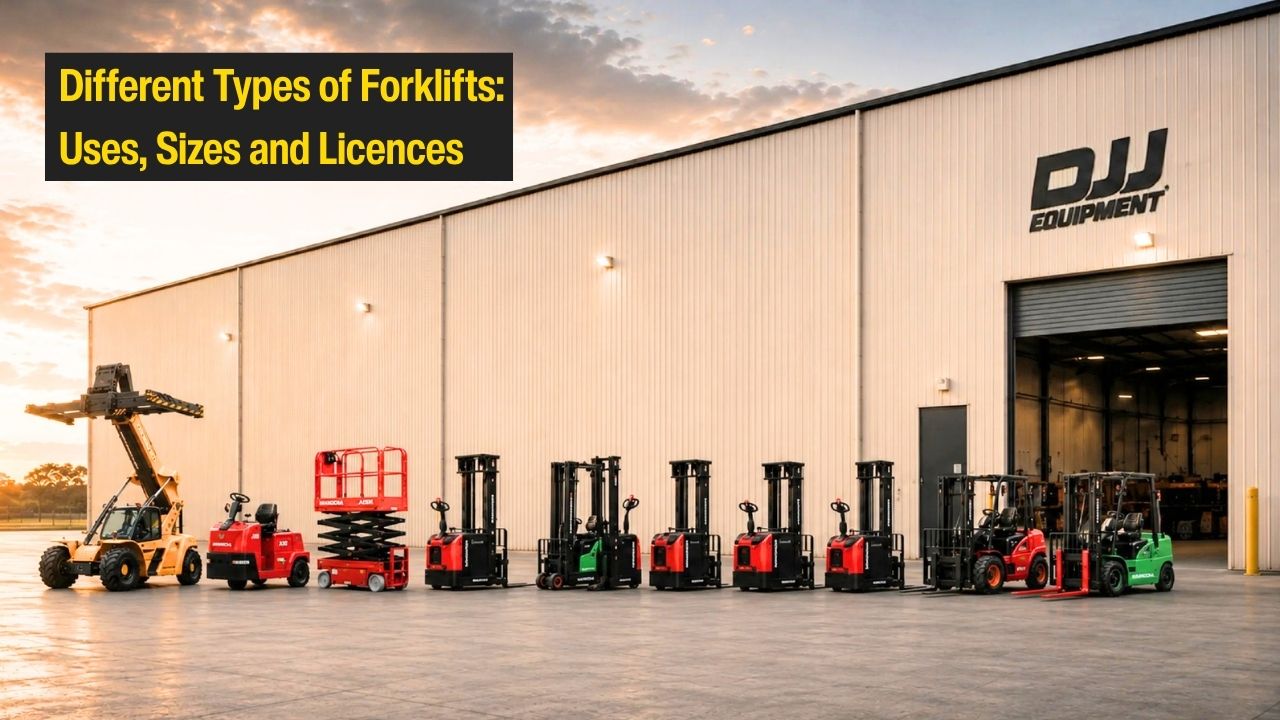
A reach truck is the most common high reach machine, but turret trucks, order pickers and tall-mast counterbalance forklifts also lift high, each with its own trade-off.
| Machine | Where the operator is | Highest lift in the Hangcha range | Licence |
|---|---|---|---|
| Reach truck | At floor level, standing or seated | 13 m | LF |
| Man-down turret truck | At floor level | 10 m | LF |
| Man-up turret truck | In a cab that rises with the load | 14.7 m | LO |
| Order picker | On a platform that rises to pick by hand | Forks to 9.5 m | LO |
| Tall-mast counterbalance forklift | Seated at floor level | Up to 8 m | LF |
Turret trucks lift higher and work in narrower aisles, but the layout is planned around the truck, so they suit large high-bay sites.
A counterbalance forklift lifts heavier loads, works outdoors and loads trucks, so many warehouses run both. Aisle width, floors and truck loading are the deciding points in how reach trucks and counterbalance forklifts compare.
What to check before choosing a reach truck
Before choosing a reach truck, check your heaviest pallet against the capacity at your top beam, not the headline rating. Then check:
- top beam height, and roof, sprinkler and light clearance with the mast raised
- aisle width, and a bottom beam high enough for the support legs
- a smooth, level floor, with any ramps inside the gradient rating
- single-deep or double-deep racking
- shifts per day, which decides the battery
A reach truck earns its place in a warehouse with tall racking, tight aisles and good floors, and it is the wrong buy for a yard or a dock. DJJ sells Hangcha reach trucks from 1 to 3 t and also hires reach trucks from Silverwater, Meadowbrook and Bayswater. Call 1800 355 388 with your heaviest pallet, top beam height and shifts per day, and our team will suggest models to buy or hire.