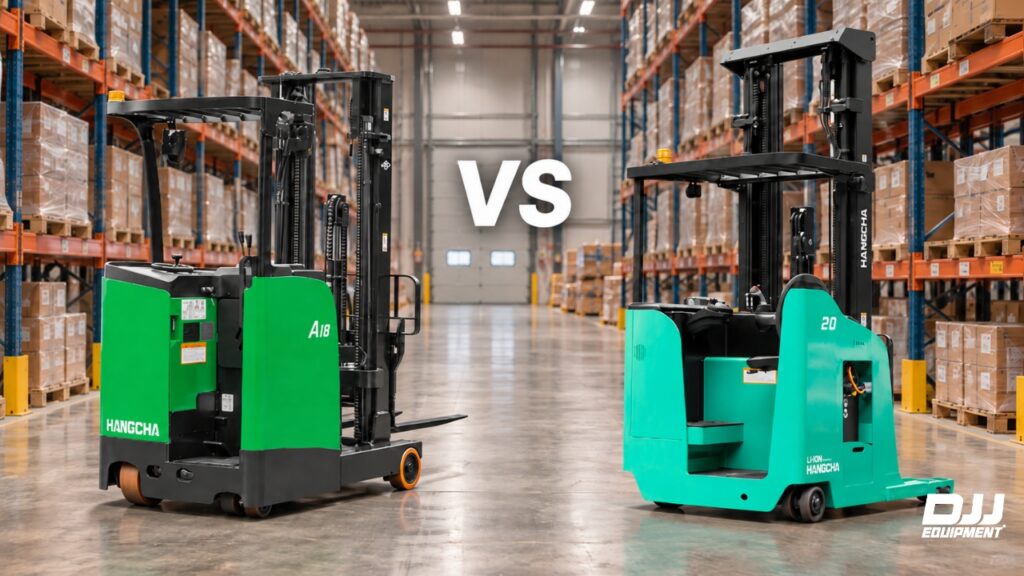
A stand-on reach truck suits shifts where the operator steps off often and the racking tops out around 7 m. A sit-down reach truck suits operators who stay on the truck for most of the shift, drive long runs and stack higher. In the Hangcha range DJJ Equipment sells, the A Series stand-on trucks have a step-in floor 280-285 mm off the ground and lift to 7 m. The seated XC Series lifts up to 13 m and travels at 14 km/h, against 10.5 km/h. The aisle barely changes: at 1.8 tonnes, the stand-on truck needs 2,715 mm and the seated XC needs 2,719 mm.
The table compares the stand-on and seated Hangcha reach trucks on the figures that change with the operator position.
| Model | Operator | Capacity (load centre) | Maximum lift | Aisle, 1000 x 1200 mm pallet crossways | Overall width | Travel speed |
|---|---|---|---|---|---|---|
| A Series 1.5-1.8 t | Standing | 1,500-1,800 kg (500 mm) | 7 m | 2,666-2,715 mm | 1,094 mm | 10.5 km/h |
| A Series 2-2.5 t | Standing | 2,000-2,500 kg (500 mm) | 7 m | 2,745-2,865 mm | 1,194 mm | 10.5 km/h |
| XC Series 1.0-1.2 t | Seated | 1,000-1,200 kg (600 mm) | 7 m | 2,610-2,627 mm | 1,120 mm | 14 km/h |
| XC Series 1.4-2.5 t | Seated | 1,400-2,500 kg (600 mm) | 13 m | 2,687-2,867 mm | 1,270 mm | 14 km/h |
| A Series 1.2-2 t | Seated | 1,200-2,000 kg (600 mm) | 12.5 m | 2,838-2,922 mm | Not listed | 10.2 km/h |
The biggest differences are lift height and chassis width, not aisle width. Seated trucks reach higher, and the stand-on trucks are narrower across the body. Speed depends on the model rather than the seat, since the seated A Series is the slowest of the five. Check the load centre before comparing capacities. The A Series stand-on trucks are rated at 500 mm and the others at 600 mm, so 1,800 kg on one isn't the same load as 1,800 kg on the other.
What is the difference between a stand-on and a sit-down reach truck?
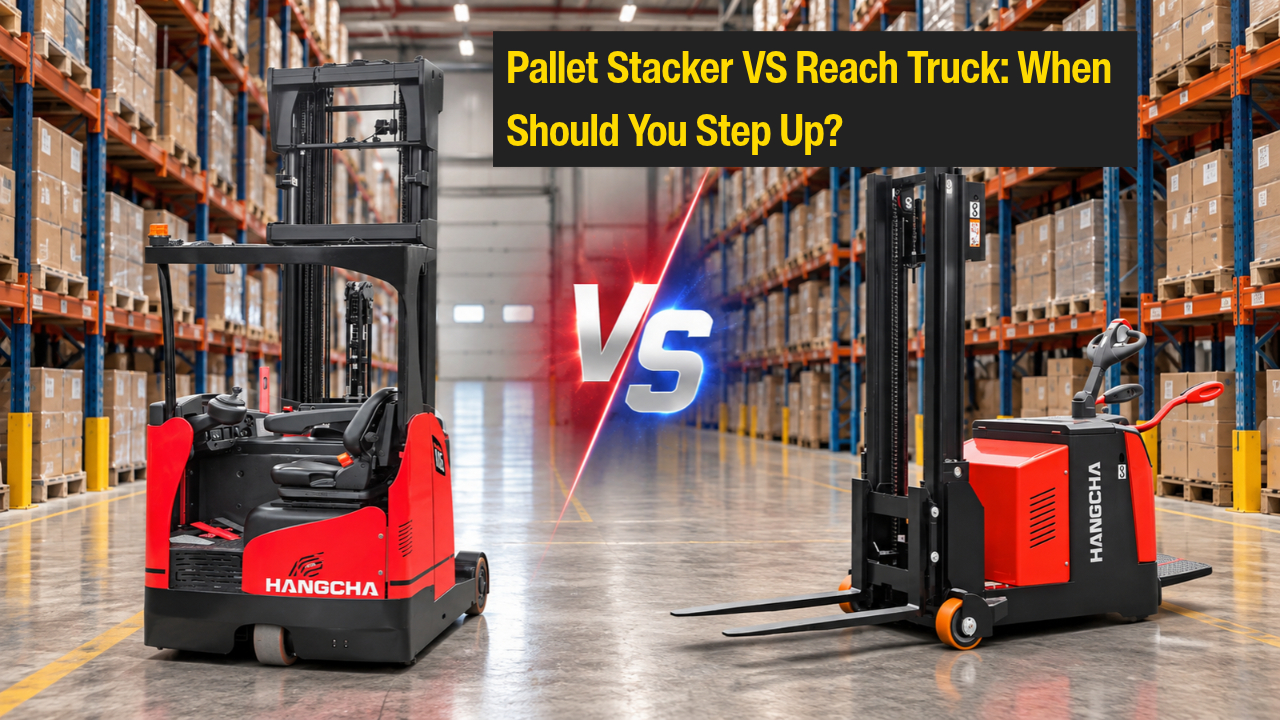
The difference is where the operator rides and how they control the truck, while the reach and lift work the same way on both. On the A Series stand-on trucks, the operator stands in a compact compartment against a large padded back support, with the steering wheel, lift lever and accelerator close to hand. On the seated XC Series, the operator sits in a suspension seat with an adjustable steering wheel and dashboard.
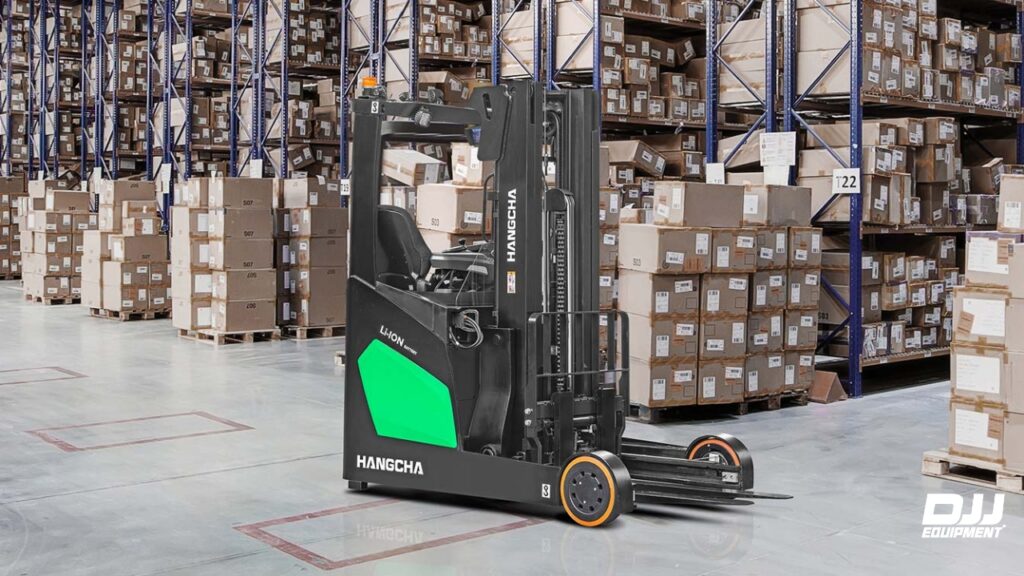
Operator position doesn't decide the reach mechanism. The A Series stand-on trucks and the seated XC both move the whole mast forward along the support legs to set the pallet on the beam. The mast then pulls back so the load travels between the legs, the layout that lets a high reach forklift work in narrow aisles. The X Series pantograph reach truck also has a standing operator, but it pushes the forks out on a scissor linkage instead.
Does a stand-on reach truck need a narrower aisle than a sit-down one?
A stand-on reach truck needs almost the same aisle as a sit-down one of the same capacity. At 2.5 t, the stand-on A Series needs a 2,865 mm right-angle stacking aisle and the seated XC needs 2,867 mm. The narrowest of the five is a seated one: the XC Series CQD10 works in 2,610 mm.
The aisle depends on the truck's turning radius, its length and the pallet, so a compact seated chassis can match a stand-on one. The gap widens on some models. At 2 t, the stand-on A Series needs 2,745 mm, the XC needs 2,802 mm and the seated A Series 1.2-2 t needs 2,922 mm.
Width is where the stand-on trucks save space. The A Series stand-on reach truck 1.5-1.8 t is 1,094 mm across, against 1,270 mm for the XC 1.4-2.5 t. That extra room counts in staging lanes, doorways and cross aisles. Measure the narrowest point of each aisle, including rack protectors and columns, then compare it with the stacking aisle figure for the model and pallet you use.
When does a stand-on reach truck suit the workflow?
A stand-on reach truck pays off when the operator gets off many times to scan labels, wrap pallets or check stock, with short drives between the racking and a staging area. A seated operator has to undo the seatbelt and climb out of the seat at each stop, then do it all again. A standing operator steps down from the compartment floor.
That floor sits 280 mm off the ground on the A Series 1.5-1.8 t and 285 mm on the 2-2.5 t, and Hangcha designed the low step for operators who get on and off frequently. Safe Work Australia's general guide for industrial lift trucks lists safe entry and exit, with enough steps and handholds, among the features to look for when choosing a truck.
The cost is standing time. An operator who stays on a stand-on truck for most of an eight-hour shift is on their feet the whole time, and these A Series models stop at 7 m. To decide, watch a real shift: count how often operators step off, and how far they drive between pallets.
When is a sit-down reach truck the better choice?
A sit-down reach truck is the better choice when operators spend hours on the truck without a break, cover long distances between the dock and the racking, or store pallets above 7 m. The XC Series reach truck 1.4-2.5 t lifts to 13 m, and its CQD25 still carries 1,950 kg at 10 m at a 600 mm load centre. At up to 14 km/h, it also covers long runs faster than a 10.5 km/h stand-on truck.
Comfort matters more as the hours on the truck add up. Safe Work Australia lists a sprung, adjustable seat as one way to reduce noise and vibration. The XC has an integral suspension seat, and its pedal height can be set electrically to suit each driver.
High racking also strains the neck, because the operator looks up at the forks for every placement. XC4D models have fingertip controls with height display, height selection and a height limit. The optional fork camera shows the view on a screen in the cab, which Hangcha says reduces strain on the shoulders and neck.
How do stand-on and sit-down reach trucks protect the operator?
A stand-on reach truck protects the operator through a safety pedal and the guard around the compartment, while a sit-down truck relies on the seat, the seatbelt and presence sensing. On the A Series stand-on trucks, releasing the safety pedal stops travel and leaves only the hydraulics working. If the operator isn't in the normal operating position, travel stops and so does load handling, except lowering. The right leg of the overhead guard is set back to protect the operator's back in a collision.
On a seated truck, Safe Work Australia says seat restraints, where they're fitted, should be used unless a risk assessment shows that isn't safe and other controls are in place. The XC Series can be fitted with a sequential seatbelt interlock and an operator presence system.
The licence is the same for both. A reach truck is a forklift truck under the high risk work licence rules, so the operator needs an LF licence whether they stand or sit. The controls differ, though, so train each operator on the type they'll drive.
Which reach truck suits double-deep racking, cold stores and mixed shifts?
Racking depth, temperature and the shift pattern can each settle the choice. For double-deep racking, the X Series pantograph reach truck comes in a double reach version that extends its forks 1,067 mm to the second pallet. It carries 770-820 kg at 11.5 m at a 600 mm load centre, with the operator standing and steering the same way whether the forks lead or trail.
For cold stores, Hangcha builds F2 versions rated down to -30°C, both in the stand-on A Series 1.5-1.8 t and 2-2.5 t and in the seated A Series 1.2-2 t. Cold storage is also an option on the XC Series.
Where one fleet covers both kinds of work, choose by the pattern that fills most of the shift. Another option is to run some of each, with stand-on trucks on dock and staging work and seated trucks on bulk put-away to high racking.
Is a stand-on reach truck the same as a stand-up forklift?
A stand-on reach truck is not the same as a stand-up forklift, which is a counterbalance truck with no support legs and no reach movement. Hangcha's A Series stand-up 3-wheel forklift balances the load with its own weight. It is 1,082 mm wide, travels at 12.4 km/h laden and lifts about 7 m.
A reach truck carries the load between its support legs and reaches forward into the rack, so it needs smooth, level indoor floors. If the same truck also has to load trailers at a dock or drive up ramps, compare it with a counterbalance forklift.
Before you choose, measure your narrowest aisle, the height of your top beam and the heaviest pallet that goes there, and count how often operators step off during a real shift. Send those figures to DJJ and the team can match them to a stand-on or seated model from its range of high reach forklifts. Call 1800 355 388 or send an enquiry to your nearest branch.