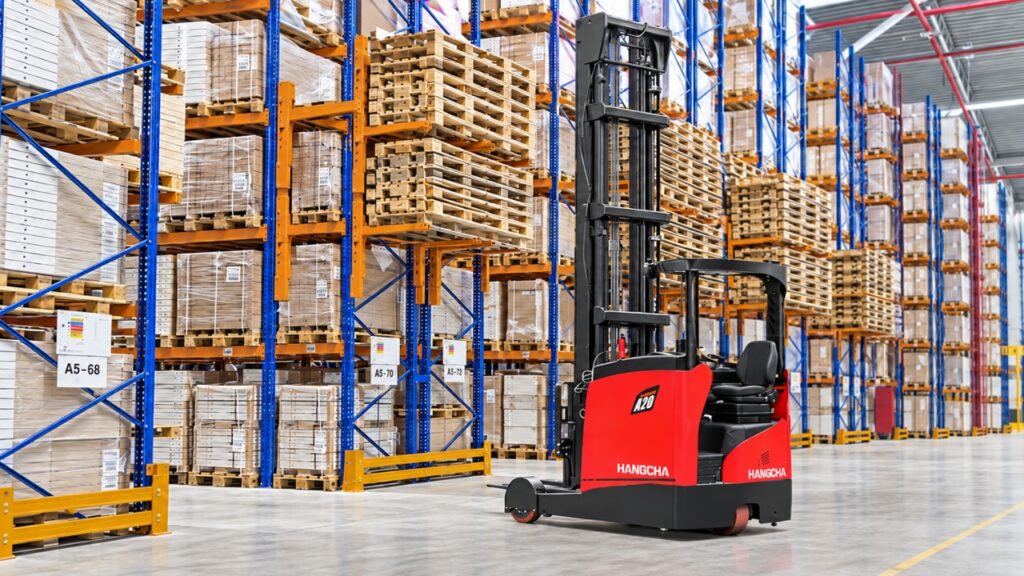
Drive-in racking is usually worked with an electric counterbalance forklift, or with a reach truck whose base legs fit under the bottom pallets. The truck has to clear three things inside the lane: the width between the uprights, the height of the lowest rail above the overhead guard, and the rails and pallets at floor level. Hangcha overhead guards range from about 2,200 mm to 2,580 mm high, depending on the model. A compact counterbalance truck such as the XC Series 3-wheel 1.3-1.8 t is 1,080 mm wide, against 1,252 mm for the XC 4-wheel CPD20. Because drive-in racking is designed around one truck's dimensions, choose the forklift together with the racking supplier, not after the racking is built.
How drive-in racking differs from selective racking
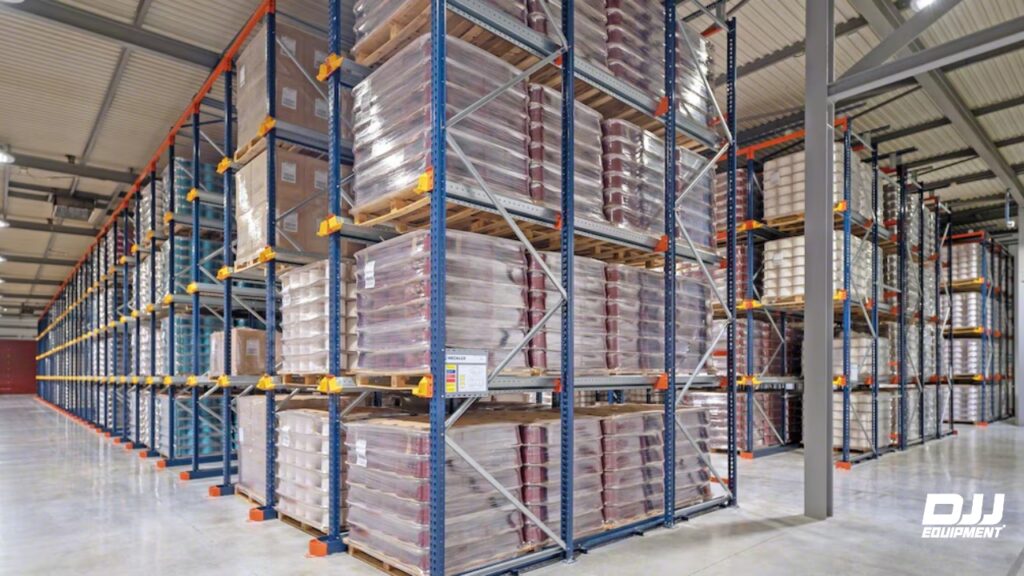
Drive-in racking has no front beams: pallets sit on rails along each side of a lane, and the forklift drives into the lane to place or collect them. Lanes are entered from one end, so the last pallet in is the first out. Drive-through racking uses the same structure, open at both ends.
The layout stores a lot of pallets in a small floor area, which suits food, drinks, cold stores and other sites holding large quantities of a few products. These are usually indoor sites, where electric forklifts are the usual choice because they produce no exhaust inside the enclosed lanes. Several Hangcha models have cold store versions: the A Series reach truck F2 models are rated to -30°C, and the XC Series PMSM 1.5-3.8 t has a -30°C option.
Because the truck works inside the racking, a truck that doesn't fit damages uprights and rails or knocks pallets off their supports. SafeWork NSW says the racking layout should match the equipment that works it, and that drive-in racking may need safety measures beyond those for standard pallet racking.
Counterbalance or reach truck for drive-in?
Both types work in drive-in racking, and the lanes, the floor and the truck's other jobs decide between them. A counterbalance truck is the simpler choice when the same truck also works the docks, while reach trucks lift higher and turn in a narrower aisle, as long as their base legs clear the bottom pallets. The table compares the two on Hangcha models.
| Factor | Counterbalance forklift | Reach truck |
|---|---|---|
| Floor level in the lane | No base legs, so bottom pallets can sit on the floor | Base legs must fit under or beside the bottom pallets |
| Width (examples) | XC 3-wheel 1.3-1.8 t: 1,080 mm overall; XC 4-wheel CPD20: 1,252 mm | A Series 1.5-1.8 t: 1,094 mm chassis (ask for the width across the base legs); X Series pantograph: 1,080 mm overall |
| Entry aisle (1000 x 1200 pallet crossways) | XC 3-wheel 1.3-1.8 t: 3,158 mm | A Series 2-2.5 t (CQD20): 2,745 mm |
| Lift height | XC 3-wheel 1.3-2 t: up to 6.5 m; XC 4-wheel 1.8-3.1 t: up to 7,055 mm | A Series reach truck 1.2-2 t: up to 12.5 m; XC Series reach truck 1.4-2.5 t: up to 13 m |
| Dock and trailer work | Can also load trucks at the dock | Not suited to trailer loading, so docks need another truck |
| Floor | Copes with typical warehouse floors | Needs smooth, level floors |
The floor-level row is usually the first test: bottom pallets sitting on the floor point to a counterbalance truck, because a reach truck's base legs need room under or beside them. Where the racking is high and floor space is tight, a reach truck saves about 400 mm of entry aisle over the XC 3-wheel counterbalance in the table.
Will the forklift fit the width of a drive-in lane?
A forklift fits a drive-in lane only if the truck, its mast and the load all clear the uprights and rails. Inside the lane the truck passes between uprights, with rails on each side at every level. Compare the overall width of the truck, its overhead guard and its mast with the clear width between the uprights and rails at three heights: the floor, the truck body and the load.
The load has to fit too. Each pallet must sit on both rails with enough bearing on each side, so the pallet width and any goods hanging over its edges count. Overhanging cartons or loose wrap catch the uprights before the truck does.
Guide rails along the floor of each lane keep the truck straight and away from the uprights, and protectors at the lane entry take the knocks on the way in. The SafeWork NSW pallet racking fact sheet calls for upright and end-of-rack protection wherever forklifts could hit the frame.
Overhead guard height and free lift in drive-in racking
The overhead guard has to pass under the lowest rail in the lane, so its height is the first figure to check. The Hangcha XF Series box car cushion forklift has a 2,248 mm guard and the XF diesel 8-12 t a 2,580 mm guard. The XC Series PMSM 1.5-3.8 t offers a taller 2,550 mm high-vision guard, which helps visibility in open aisles but costs clearance in a drive-in lane.
If the first rail sits close to the guard, there are two fixes: a narrower drive-in overhead guard that fits between the rail arms, or a higher first level. Ask which guard options exist for the model you are considering.
Full free lift is the other essential. On a full free-lift mast, the forks rise to the top of the inner mast before the mast itself extends. Inside a lane, that lifts the pallet clear of the rails without the mast striking the level above. Many Hangcha masts offer it: the A Series reach truck 1.2-2 t reaches 12.5 m on a full free triplex mast, and the XH Series 4-5 t has full free duplex masts to 3,700 mm.
Then check the extended mast height against the top of the racking, the roof structure, lights and sprinkler heads, and the lowered height against any doors on the way to the racking.
Reach truck base legs and pallets at floor level
Reach trucks carry their front wheels on base legs, also called outriggers. In a drive-in lane those legs must fit under or beside the bottom pallets, so either the bottom level is raised off the floor or the truck is narrow enough at the base. The racking supplier makes that call, with the truck's dimensions in hand.
A counterbalance truck avoids the base-leg problem but is longer, so it needs more room to turn into the lane. The same trade of aisle space against floor clearance applies in open racking, and it is one of the differences between reach trucks and counterbalance forklifts.
SafeWork NSW warns that pallets smaller than the racking was designed for can drop through, and larger ones push others off their supports. Overseas pallets often differ in size from those used in Australian racking. Check the pallets you actually receive, not only your own.
Forklift capacity at the top rail of drive-in racking
A forklift's rated capacity applies at its rated load centre and up to a certain lift height, and falls above that. If your drive-in racking runs high, check how much a forklift can lift at the height of the top rail, with your real pallet depth and weight.
The drop is large. The Hangcha A Series reach truck 2-2.5 t (CQD20) holds 2,000 kg up to 4.3 m but 1,100 kg at 7 m, at a 500 mm load centre. Goods that overhang the pallet move the load centre forward and cut capacity further.
Taller lanes call for a truck rated at the height you need. Single-reach models of the Hangcha X Series pantograph reach truck are rated at 1,361 to 2,041 kg at a 600 mm load centre and still carry 1,000 to 1,050 kg at 11.5 m.
The racking has limits of its own. SafeWork NSW says the racking supplier should provide the working load limit for each unit load, each beam level and each bay, and these limits should never be exceeded.
Entry aisles and lane depth for drive-in forklifts
The aisle in front of the lanes must let the truck turn square to the lane with a pallet on the forks and line up before the load enters the racking. A forklift's right-angle stacking aisle figure is the minimum for turning and stacking at a rack face. A drive-in truck has to be straight before it goes in, so allow extra room when you check the aisle. For a 1000 x 1200 pallet carried crossways, the XC 3-wheel 1.3-1.8 t needs a 3,158 mm stacking aisle and the CQD20 model of the A Series reach truck 2-2.5 t needs 2,745 mm, before that extra room.
Deep lanes mean longer reversing distances inside the racking. Even lighting inside the lanes, and options such as fork cameras or height indicators, help the operator see the rails and pallets. Keep the lane floor flat and clean, because a truck that leans loses clearance on one side.
Forklift attachments and aids for drive-in work
A side shift moves the forks left or right so the operator can centre the pallet between the rails without repositioning the truck. DJJ Equipment can supply forklift attachments such as side shifters and fork positioners. On the A Series reach truck 2-2.5 t, a sideshifter takes 200 kg off the rating, so check the load chart and confirm the attachment suits the truck before you fit one.
Fork height indicators, height pre-selection and fork cameras help at the upper levels. They vary from model to model, so ask which ones are available on the truck you are quoted.
Questions to settle before choosing a drive-in racking forklift
Racking drawings show the steel, not the truck the racking was designed for, so get these answers in writing before you buy:
- Which truck, by model and dimensions, was the racking designed for?
- What are the clearances across the lane, above the overhead guard and at floor level?
- How high is the lowest rail, and how far apart are the rail levels?
- What is the working load limit per pallet, per level and per bay?
- Which pallet sizes and types can the racking take?
- Who will inspect the racking, and how often? SafeWork NSW says a competent person should do formal inspections at intervals of no more than 12 months.
- If you change trucks later, who checks the new truck against the racking design?
Send the DJJ team your racking drawings, photos of the lane entries, the height of the lowest and highest rails, and your pallet sizes and weights. They can then help match a truck to the racking. Call 1800 355 388 or send an enquiry to your nearest branch.