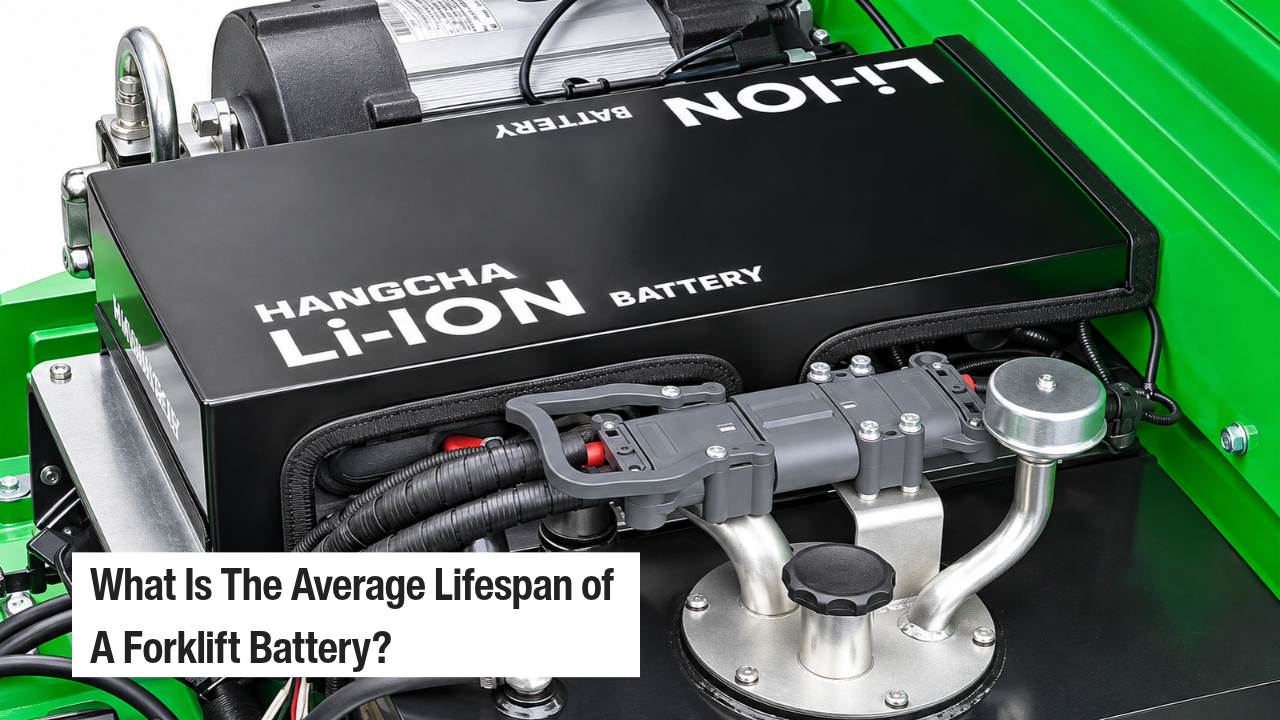
A lead-acid forklift battery that has lost capacity from short or skipped charges can often be brought back with a full charge, an equalising charge and correct water levels. A battery that sat flat for weeks, has a failed cell or a cracked case won't recover on a charger, though a battery workshop can sometimes replace single cells. A lithium battery that won't wake is usually its battery management system (BMS) protecting the cells, and recovery is a job for the manufacturer's service, not a jump start.
Can a dead forklift battery be brought back to life?
A dead forklift battery can be brought back to life when the damage is chemical and recent, and not when it's physical or old. Soft sulphate and mixed-up acid respond to the right charge. Worn plates, a shorted cell or a swollen case don't respond to anything a charger can do.
The cause decides the outcome, so match what you see to what comes back:
| What's wrong | What you see | Can it be recovered? |
|---|---|---|
| Short or skipped charges on lead-acid | Charger shows full, truck runs flat before the shift ends | Often, with a full charge then an equalising charge |
| Deep discharge on lead-acid | More than 80% of capacity used, specific gravity at or below 1.14 kg/l at 30°C | Sometimes, if it's recharged straight away and equalised |
| Low electrolyte on lead-acid | Level below the top of the separators | Partly; plate area left dry loses capacity for good |
| One weak cell on lead-acid | One cell reads lower than the rest after every full charge | Yes, but by replacing the cell, not by charging |
| Lithium battery in protection | Charger won't start, no response from the battery | Often, but only by the manufacturer's service |
| Cracked, bulging or deformed case | Visible damage on the battery or its tray | No. Take the truck out of use |
The table shows why charging harder isn't a general fix. Only the first two rows are charging problems. The rest need a technician to test, rebuild or replace, and the last one is a safety issue before it's a battery issue.
Why a lead-acid forklift battery loses capacity
A lead-acid forklift battery loses capacity when sulphate stays on its plates and the acid separates into layers. Every discharge coats the plates with soft lead sulphate, and a full charge turns it back into active material. Leave the battery part-charged and those crystals harden, block the plate surface and stop taking charge.
Short charges are where this starts. Battery maker EnerSys counts a charge on its Hawker Perfect Plus traction batteries as finished only when the specific gravity and voltage have held steady for 2 hours. A truck unplugged at the morning break every day never gets there. The heavier acid also sinks to the bottom of each cell, so the top of the plates works in weak acid and the bottom in strong acid.
The same manual says a discharged battery must be recharged immediately, and that includes a part-discharged one. Following it costs nothing and stops the damage before it starts. It's also why lead-acid battery-electric forklifts do best on a single shift with a full overnight charge.
How to recover a sulphated lead-acid forklift battery
You recover a sulphated lead-acid forklift battery by giving it a full charge, then an equalising charge, then topping up the water. An equalising charge is a controlled overcharge at low current. It brings the weaker cells up to full and the gassing stirs the acid back into an even mix.
EnerSys says equalising charges are needed after deep discharges and after repeated incomplete recharges, which are the two usual reasons a battery comes up short. The rules in its Hawker manual are specific:
- Run the equalising charge straight after a normal charge has finished.
- Keep the current at or below 5 A per 100 Ah of rated capacity.
- Start charging only when the electrolyte is below 45°C, because it rises about 10°C while charging.
- Keep the electrolyte well under 55°C, which EnerSys sets as the upper limit.
- Top up with demineralised water at the end of the charge, never before it.
Here's what that means on a real truck. The A Series reach truck 1.2-2 t that DJJ Equipment sells runs a 48V/400Ah lead-acid battery as standard on the 1.2 and 1.4 tonne models, and 48V/500Ah on the 1.6 and 1.8 tonne models. That's 24 cells at 2 volts each, and an equalising current of no more than 20 A on the 400Ah battery or 25 A on the 500Ah.
Check the charger manual for how your charger runs an equalising charge. If it has no equalising function, or you're not sure the charger suits the battery, have it checked before you try. EnerSys recommends the battery maker check any charger that wasn't bought with the battery.
Forklift battery charging safety during recovery
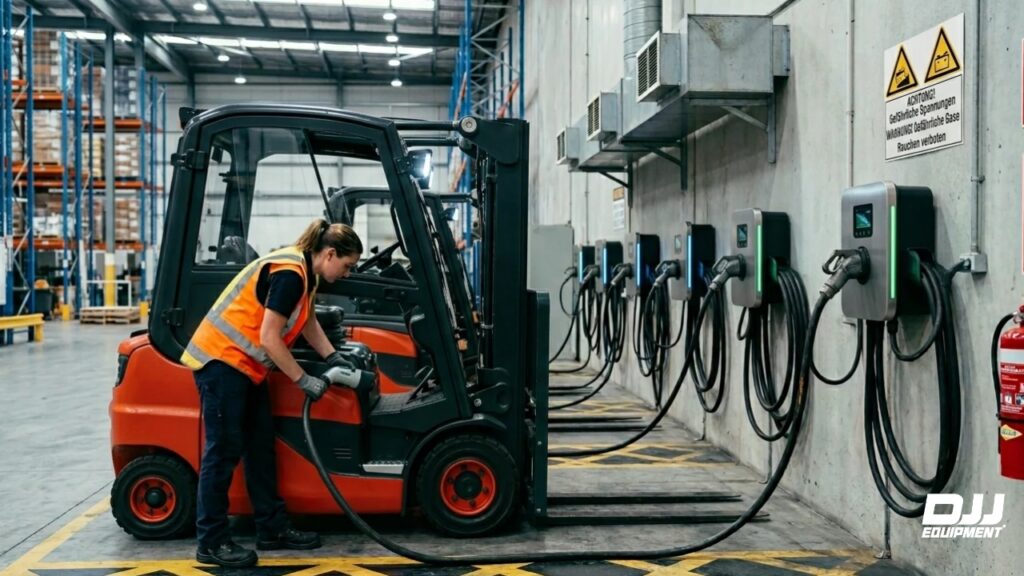
Forklift battery recovery carries more gas risk than a normal charge, because an equalising charge is a deliberate overcharge. The extra current splits water in the electrolyte into hydrogen and oxygen, and hydrogen is explosive. Safe Work Australia's general guide for industrial lift trucks limits battery charging and changing to people who've been properly trained.
Before the charge starts, the guide has the truck parked safely with the parking brake on. The vent caps stay on the cells to stop electrolyte spraying, and the battery cover stays open so gas can get out. While the battery gasses, keep these out of the charging area:
- cigarettes, flames, mobile phones and other electronic devices;
- loose metal tools, rings and bracelets, which can spark across the cell tops.
The area itself needs eye wash and washing facilities, a spill kit for acid, fire extinguishers and enough ventilation to disperse the gas. Wear eye protection. If acid splashes on someone, the guide says to take off the contaminated clothing and flush the skin with large amounts of water. Run the equalising charge when a trained person is on site and the area is quiet.
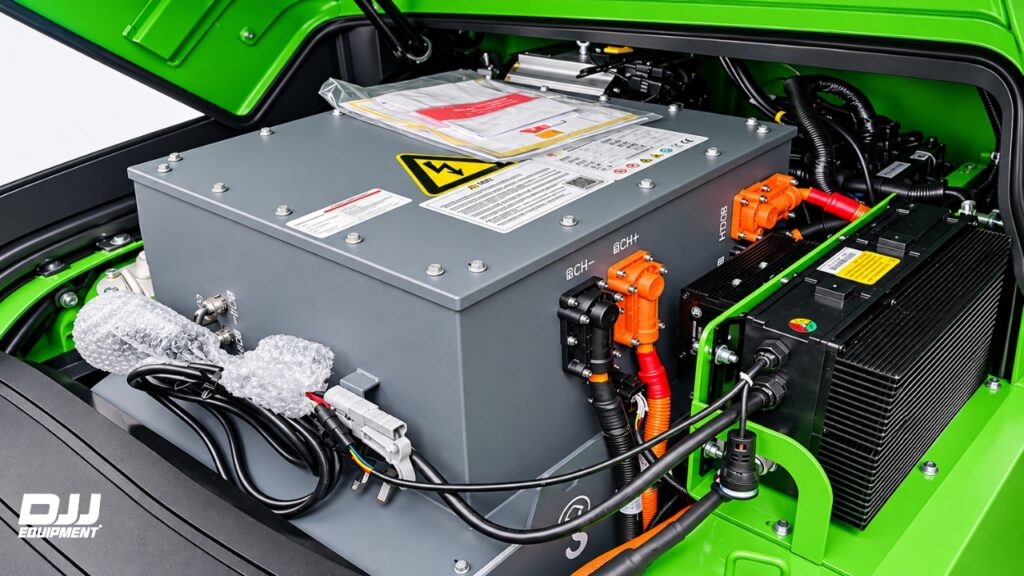
Checking a forklift battery after an equalising charge
You check a forklift battery after an equalising charge by reading every cell, not just the battery gauge. A gauge shows the total voltage, and one weak cell hides easily inside a total that looks fine. The cell readings tell you whether the recovery worked.
The Hawker manual's monthly routine is a good test. Measure the voltage of every cell at the end of the charge with the charger still on. After at least 2 hours' rest, measure each cell's specific gravity and temperature. A fully charged Hawker PzS cell reads 1.29 kg/l at 30°C.
Temperature changes the reading, so correct for it. The manual's factor is 0.0007 kg/l per degree, and its example is 1.28 kg/l at 45°C, which equals 1.29 kg/l at 30°C. A hot Queensland or WA shed can make a healthy cell look weak if you skip the correction.
Cells that now read the same mean the recovery worked, so put the truck through a normal shift and see whether it lasts. Cells that still read lower than the rest point to a cell fault. EnerSys says to call the battery maker's service team for that, because replacing a cell is workshop work.
Can you revive a lithium forklift battery?
A lithium forklift battery that won't respond can often be revived by the manufacturer's service, but not with the methods used on lead-acid. A lithium battery has no water, no acid to mix and no sulphate, so equalising and desulphating do nothing. No watering is one of the everyday differences between lithium vs lead-acid forklift batteries, but lithium still needs the right charger and a working BMS. When it seems dead, its BMS has cut it off because the cell voltage fell below the discharge cut-off.
That happens when a truck is parked flat for weeks, or stored for months without a charge. Hangcha's manual for its XH Series lithium forklifts gives four rules that keep a battery out of protection:
- Charge when only 1-2 bars are left, which is 20-30% of capacity.
- Give the battery a full charge once a week.
- Store it with at least 50% charge and fully charge it every three months.
- After more than three months in storage, check for a battery fault alarm before use, and contact after-sales service if there is one.
Once a lithium battery on an XH Series 2-3.8 t is in protection, the manual's rules are strict. Don't open the battery case, and contact the manufacturer for any battery fault. Don't use another type of charger, link it to another battery or bridge the terminals with metal. That rules out every jump-start trick you'll see online.
Reduced capacity on a cold lithium battery isn't a fault. The XH manual says slightly reduced capacity in low temperatures is normal and comes back as the battery warms up.
When a forklift battery isn't worth saving
A forklift battery isn't worth saving when the case is damaged, several cells keep failing or it no longer covers your shift after a proper recovery. A cracked, bulging or deformed case means the truck stops work, which is why the XH manual has the case checked every month. Plates that have worn out over years of cycles can't be rebuilt by charging.
A replacement battery has to match the truck, not just the voltage. The battery is part of the counterweight, so never fit a smaller, cheaper battery to an electric forklift. Weights differ a lot by chemistry: on our X Series 3-wheel 0.6-1 t, the lithium battery weighs 45-95 kg against 150-340 kg for lead-acid.
That weight gap is why a change of chemistry is a decision for the manufacturer, not a straight swap. Ask for the approved battery options for your truck's model and serial number before you order one.
DJJ services all forklift brands and repairs Hangcha forklifts; repairs on other brands are assessed case by case, so check your model with the team. Before anyone tries a recovery, call our service team on 1300 646 747 with the model, serial number and a photo of the battery label. When the truck can't come to a branch, our forklift servicing and repairs cover site visits within 50 km of Silverwater, Meadowbrook and Bayswater.