In Australia, a telescopic forklift and a telehandler are usually the same machine. It lifts on a boom that slides out up and forward, with forks or another attachment at the tip. Telehandler is short for telescopic handler, and telescopic forklift is the name people use when that attachment is a set of forks. The real difference is between a telehandler and a mast forklift, which lifts straight up and can't reach forward.
This table compares a telehandler with a mast forklift built for the same rough ground, using the Hangcha machines DJJ Equipment sells.
| Telehandler (telescopic forklift) | Rough terrain mast forklift | |
|---|---|---|
| How it lifts | Telescopic boom, up and forward | Vertical mast, straight up |
| Rated capacity, Hangcha models | 2.5-4 t | 1.5-10 t |
| Lift height, Hangcha models | 5.8-17.7 m | 3,000 mm standard mast, options to 6,000 mm |
| Forward reach, Hangcha models | 3.31-13.02 m | None: the load rises in front of the front wheels |
| Capacity at full reach | 850 kg on the X Series, rated 4,000 kg | No forward reach. Tall masts lose some capacity at full height |
| Steering | Front, crab and circle steering | Rear-wheel steering |
| Licence in NSW, QLD and WA | None with forks or a bucket, training required | LF high risk work licence |
| Licence in Victoria | Non-slewing telehandler licence above 3 t rated capacity | LF high risk work licence |
The table shows the trade a telehandler makes: it gives up capacity to put the load forward, while a mast forklift keeps the load close and lifts it straight up. Any machine sold as a telescopic forklift with a boom belongs in the left-hand column, whatever the brochure calls it.
Why is a telehandler also called a telescopic forklift?
A telehandler is called a telescopic forklift because it picks up pallets on forks, like a forklift, but from the end of a telescopic boom. The boom is a set of steel sections that slide out of each other under hydraulic power. Forks are the default tool: both Hangcha telehandler series DJJ sells come with a quick-change fork carriage as standard, and a bucket is an option.
Australian regulators use their own names. WorkSafe Queensland calls the machine a multi-purpose tool carrier: plant with a boom that can take fork arms, a bucket, a jib, a grab or a work platform. WorkSafe Victoria calls the fixed boom version a non-slewing telehandler, meaning the boom doesn't rotate on a turntable.
A telehandler also works on unsealed ground, so it often gets listed with rough terrain forklifts. We list the electric Hangcha XH Series telehandler in both places. It lifts 2,500-3,500 kg on four-wheel drive like a rough terrain forklift, but on a boom that reaches 3.31-7.0 m forward.
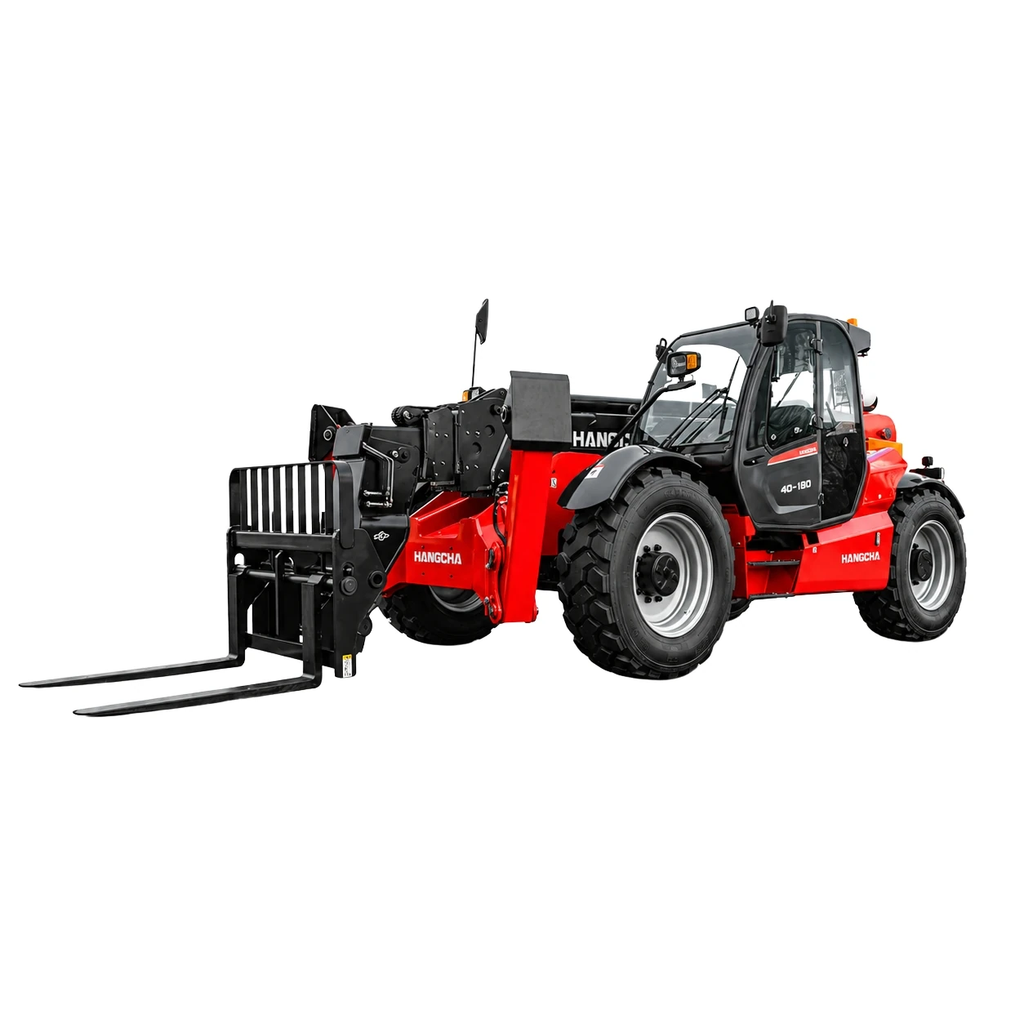
How does a telehandler lift differently from a mast forklift?
A telehandler lifts differently from a mast forklift because its boom moves the load out in front of the machine. The further out the load goes, the less the telehandler can carry. A mast keeps the load just ahead of the front wheels as it rises, so a forklift has no forward reach to lose.
The 4 tonne Hangcha X Series telehandler is rated at 4,000 kg at a 500 mm load centre, carries 2,500 kg at its full 17.7 m lift height and only 850 kg at its full 13.02 m forward reach. Those figures need the front stabilisers down. With them up, the load chart stops at 12.72 m of height and 9.61 m of reach, with 400 kg at full reach.
The two machines drive differently too. A telehandler uses crab steering to move sideways along a wall or trench and circle steering for tight turns. It's also a bigger machine: the X Series weighs 13,650-13,700 kg and turns in 4,100 mm. Hangcha rough terrain forklifts up to 3.5 t are rated at the same 500 mm load centre and lift on a standard 3,000 mm mast.
Telehandler work runs off the load chart for each height and reach, not off the number on the side of the machine. A load moment limiter, standard on both Hangcha series, watches the load and boom position. It stops movements that would take the machine past its stability limit, a part of how a telehandler works that a mast forklift doesn't carry.
When does telescopic forklift mean a different machine?
A telescopic forklift means something other than a telehandler in three cases, and each one changes the work the machine suits and sometimes the licence.
A forklift with a telescopic mast
Some sellers call a forklift with a duplex or triplex mast telescopic, because the mast sections slide up inside each other. It's still a mast forklift: the load goes straight up, never forward, and the operator needs an LF licence. A tall triplex mast lifts higher, but the capacity left at full height is lower than the nameplate figure.
A warehouse truck with a side boom
A few manufacturers build an industrial telescopic forklift. It's a low, compact truck with a short boom beside the cab instead of a mast, made for loading trucks from one side on sealed yards. It mixes a forklift's chassis with a telehandler's boom, so ask the supplier which licence the maker specifies before you put an operator on it.
A telescopic boom lift
A telescopic boom lift raises people in a platform, not loads on forks, so it's an elevating work platform rather than a telehandler. A boom-type work platform with a boom length of 11 metres or more needs a WP high risk work licence. Boom length is the platform floor height at full extension or the outreach, whichever is greater. It isn't the working height quoted for boom lifts.
Do you need a forklift licence to drive a telehandler?
No. In NSW, Queensland and WA, a telehandler fitted with forks or a bucket needs no high risk work licence, including the LF forklift licence. The business must still train operators to use it safely.
The licence changes with the attachment. WorkSafe Queensland says a non-slewing tool carrier used as a crane, with a boom or jib and a hook, needs a crane licence when its rated capacity exceeds 3 tonnes. Fitted with a work platform on the main boom that extends 11 metres or more, it needs a WP licence.
Victoria sets a different line. There, a non-slewing telehandler rated at more than 3 tonnes needs a high risk work licence. That's either the non-slewing telehandler licence, with training available since 1 July 2024, or a mobile crane licence. At 3 tonnes or less, operators must be trained and competent but don't need a licence.
That 3 tonne line puts the X Series (4,000 kg) and the XH T35 (3,500 kg) under a licence in Victoria, while the XH T25 (2,500 kg) sits below it. Some training pages apply the Victorian rule to other states, so check with your own state regulator before you book a course.
Should you choose a telehandler or a mast forklift?
Choose a telehandler when loads have to go forward as well as up, and a mast forklift when every lift is straight up and close to the machine. A rough terrain forklift is the simpler machine and keeps more of its capacity, so it's the better buy when you don't need the reach.
- Placing loads over a wall, a trench or onto scaffolding: a telehandler. The X Series lifts to 17.7 m and reaches 13.02 m forward with the stabilisers down.
- Stacking pallets in an unsealed yard: a rough terrain forklift from 1.5 to 10 t, with masts to 6,000 mm on most models.
- Mixed indoor and outdoor work with no exhaust: the electric XH Series, which runs on a 310V lithium iron phosphate battery with a built-in charger.
- Smooth concrete floors and racking: a standard counterbalance forklift or reach truck rather than either rough terrain machine.
The two Hangcha telehandlers we sell run from a compact 2,500 kg electric model to a 4,000 kg diesel that lifts to 17.7 m. The right one is the smallest machine whose load chart covers your hardest lift. If you need the reach for one project only, DJJ also hires telehandlers, and terms depend on the machine and branch.
Before you ask for a quote on a telescopic forklift, work out your heaviest load and the height and forward reach it has to go to. Send us those three figures and a description of the ground, or call DJJ on 1800 355 388. Our branches at Silverwater NSW, Meadowbrook QLD and Bayswater WA will match them to a load chart.