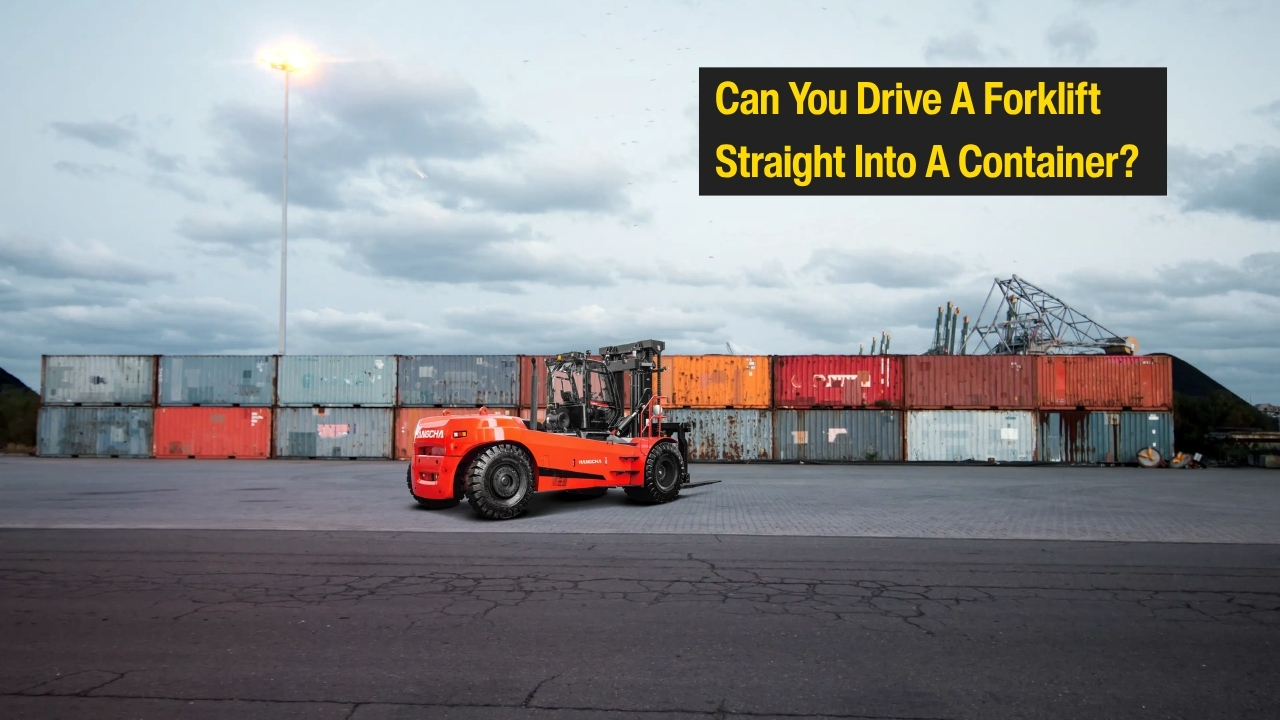
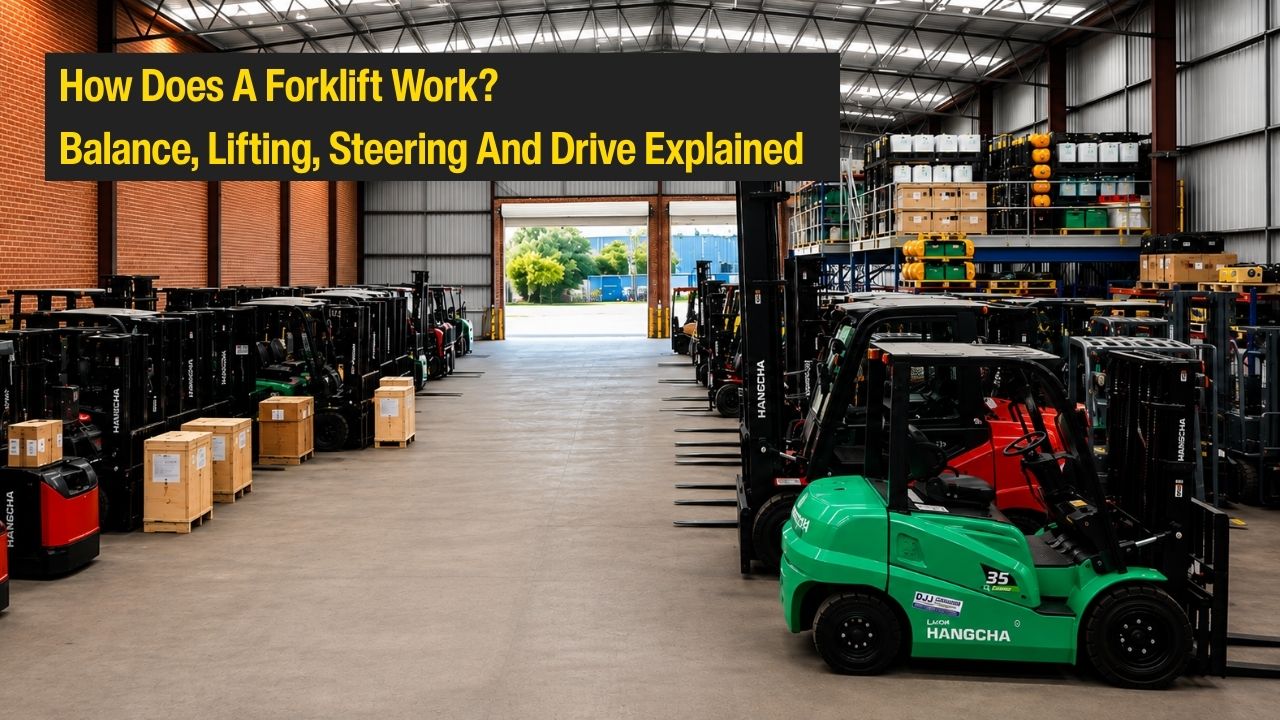
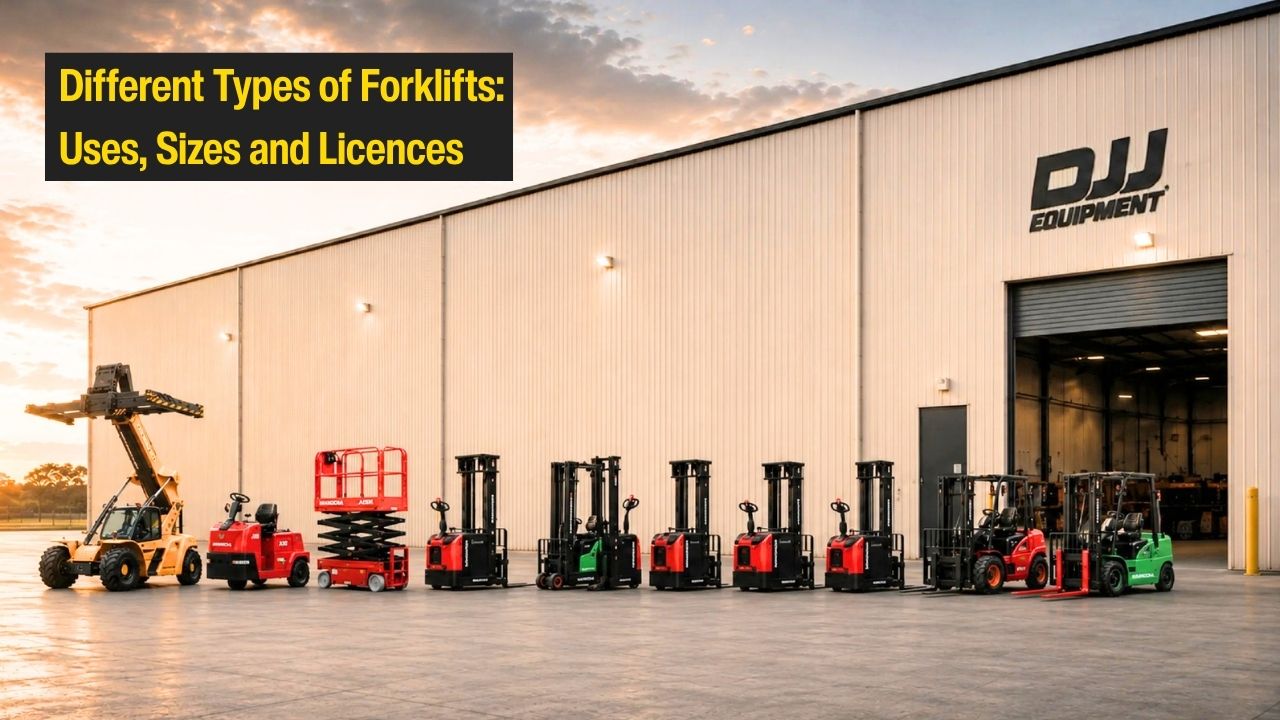
A container forklift is a counterbalance forklift set up to drive into a shipping container and work inside it. It must pass under the door opening, which is about 2,280 mm high on a standard box. It also needs a full free lift mast, so the forks can rise without the mast hitting the roof. Its laden front axle must also stay within what the container floor can carry. Most container work in Australian warehouses is done by 1.5-2.5 t forklifts, and electric models suit work inside the box best.
Container sizes that set the limits
A container forklift is chosen around the box, not the warehouse. These are the typical inside dimensions of standard and high cube dry containers.
| Standard 20 ft or 40 ft | 40 ft high cube | |
|---|---|---|
| Door opening height | About 2,280-2,292 mm | About 2,597 mm |
| Door opening width | About 2,340 mm | About 2,340 mm |
| Inside height | About 2,393 mm | About 2,695-2,700 mm |
| Inside width | About 2,350 mm | About 2,350 mm |
| Inside length | About 5,898 mm (20 ft) or 12,032 mm (40 ft) | About 12,032 mm |
Figures vary a little between container builders, and a dented header or a high trailer deck changes the real clearance. Measure the boxes you actually receive before you choose a mast.
Overall height: the door, not just the mast
The tightest point is the door header. Everything on the forklift has to pass under it: the lowered mast, the overhead guard, a beacon and an LPG bottle. A truck that is exactly 2.28 m tall has no clearance at all, and it pitches up as it crosses a ramp or dock plate. On the spec sheet, check both the lowered mast height and the overhead guard height.
On some trucks the overhead guard is the tallest point. Hangcha's in-container X series has a lowered mast of about 2,180 mm and a 2,240 mm overhead guard. These 5-10 t diesel trucks weigh 8,100-11,900 kg, far above the floor figures for a standard box. Confirm the container's floor rating with the shipping line before a heavy truck goes inside.
Free lift: stacking inside the box
Free lift is how far the forks rise before the mast's inner rails extend above the lowered height. With enough free lift, the forks can place a pallet on top of another inside the container without the mast touching the roof, which sits about 2.39 m above the floor of a standard box. A standard wide-view duplex mast has little free lift and is the one to avoid for stacking inside.
What matters is free lift, not the number of mast stages. Hangcha XF forklifts are offered with full free lift duplex masts up to about 4.0 m and full free lift triplex masts from about 4.0 m to 7.0 m. Triplex is the common container choice because it still gives useful lift height in the warehouse. Read the free lift figure for the exact mast on the spec sheet.
If your loads go into the container one pallet high, free lift matters less. It becomes essential when you double-stack inside the box.
Floor loads: the limit most buyers miss
Container floors have a published forklift limit. Shipping lines quote a maximum of 5,460 kg on the forklift's front axle, forklift plus load, with at least 142 cm² of tyre contact per wheel. Boxes built to the current ISO 1496-1 are tested at 7,260 kg, but you cannot tell which box will arrive, so plan around 5,460 kg. Some steel-floor containers take 9,200 kg, but they are a small part of the fleet.
Weight adds up quickly. A Hangcha XF 2.5 t LPG forklift weighs about 3,765 kg, so with a full 2,500 kg load the total is about 6,265 kg, and most of it sits on the front axle. Compare the laden front axle load on the spec sheet with the floor figure before a 2.5 t or larger forklift works inside a container at full capacity. Electric forklifts can weigh as much or more, because the battery is part of the counterweight.
Heavy cargo has its own limit. Spread concentrated loads to no more than about 4.8 t per running metre in a 20 ft container and 3.0 t per metre in a 40 ft. A 10 t item needs about 2.1 m of floor in a 20 ft box, or 3.3 m in a 40 ft, on timber bearers laid lengthwise.
Width, pallets and load centre
There is no fixed width limit for a container forklift. A container is about 2,350 mm wide inside, and a Hangcha 2.5 t forklift is 1,155 mm wide, which leaves about 600 mm each side. Width matters more for how close you need to work to the walls.
Australian standard pallets are 1,165 x 1,165 mm. Two side by side take 2,330 mm, leaving about 20 mm in a standard box, so a sideshifter helps place the second pallet. A full, even load on that pallet has its centre about 583 mm from the fork face. Most small forklifts are rated at 500 mm, so check the load chart for the real capacity.
A sideshifter costs capacity too. Hangcha deducts 150 kg on 1-2.5 t XF models and 200 kg on 3-3.5 t models. Use an attachment only if the forklift maker has approved it and it is listed on the data plate with the combined rated capacity.
Electric or LPG inside a container
Petrol, diesel and LPG forklifts produce carbon monoxide, and it builds up in shipping containers, loading docks and cold rooms. Regulators advise using electric forklifts or pallet jacks in enclosed or poorly ventilated spaces. The workplace exposure standard for carbon monoxide is 30 ppm averaged over 8 hours, falling to 20 ppm from 1 December 2026.
If a fuel-powered forklift has to go in, do a risk assessment with a competent person, monitor the air, fit CO alarms and arrange ventilation. Check gradeability as well: LPG and diesel trucks usually climb well over 10% laden (the Hangcha XF 2.5 t LPG lists 30%), while electric trucks are usually lower.
Ramps, docks and trucks
Most forklifts reach the container floor over a dock leveller, a bridge plate or a yard ramp. A box on the ground still sits about 170 mm up, so it needs a container ramp. A reach truck is a poor fit for this work, as the reach truck vs counterbalance forklift comparison explains. Check the forklift's laden gradeability against the slope of your ramp or dock plate.
Before driving onto a truck or trailer, make sure its brakes are set and its wheels are chocked. Check that the floor can carry the forklift and load, and that any ramp is locked in place. Keep the trailer coupled to the prime mover where possible, and use a procedure that stops the truck driving away until loading is finished.
Before you unpack: fumes, fumigants and people
Imported containers can hold residues of fumigants such as methyl bromide and phosphine, and solvents such as formaldehyde that off-gas from the goods. Ask the importer whether the container was fumigated, look for warning notices and clearance certificates, and treat it as fumigated if in doubt. The WorkSafe Victoria guidance on fumigated containers covers venting. Unless the air is tested, allow at least 30 minutes with fans, or at least 12 hours of natural ventilation. Timber, nuts, seeds and tightly packed loads need longer.
Never let people and forklifts work inside a container at the same time. Open the doors carefully, with a short safety rope on them so you can see whether the load has shifted before they swing fully open. SafeWork NSW recorded 31 serious injuries and 3 deaths from unpacking containers in a five-year period from 2011.
Operating a container forklift needs an LF high risk work licence, like any forklift with a mast that lifts 900 mm or more. A container reach stacker of 3 t or more needs a separate RS licence, which an LF licence does not cover.
Machines that lift the container itself
A container forklift moves the cargo, not the box. To lift and stack containers, Hangcha builds empty container handlers. The 6-7 t models stack 3-4 high, and the 9 t model stacks up to 7-8 high, depending on box height. For laden containers, the Hangcha X series reach stacker is rated at 45 t for 20 ft and 40 ft boxes.
Choosing a container forklift for your site
Match the forklift to how often it goes inside the box. For occasional unloading at a dock, a standard 1.5-2.5 t counterbalance forklift with a container mast is usually enough. For regular stacking inside containers, choose a full free lift triplex mast, check the overall height and laden front axle load, and prefer electric. If the same forklift also works outdoors, pneumatic tyres and LPG or diesel suit, with a ventilation plan for every container entry.
DJJ Equipment sells Hangcha forklifts from Silverwater, Meadowbrook and Bayswater, with finance, hire and rent to own. Send the container types you receive, your door heights and pallet sizes, and the team will match the mast and capacity to them.
Call 1800 355 388, or compare the range of counterbalance forklifts.