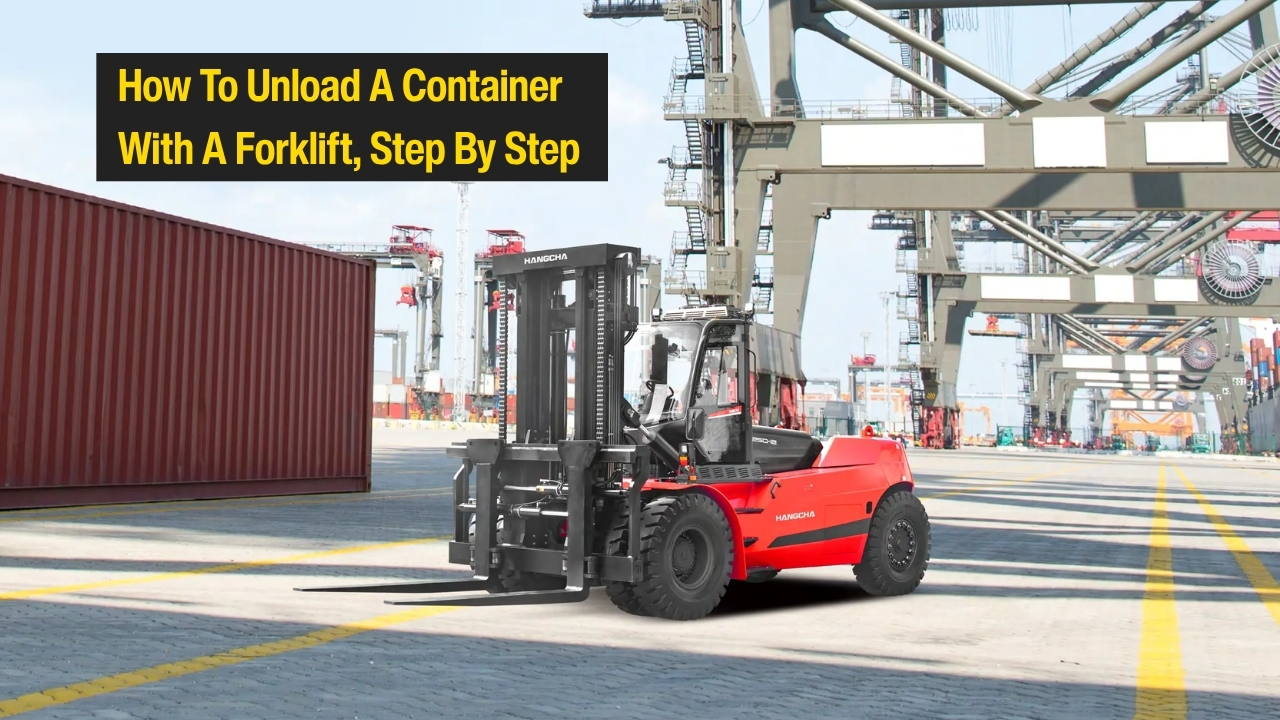
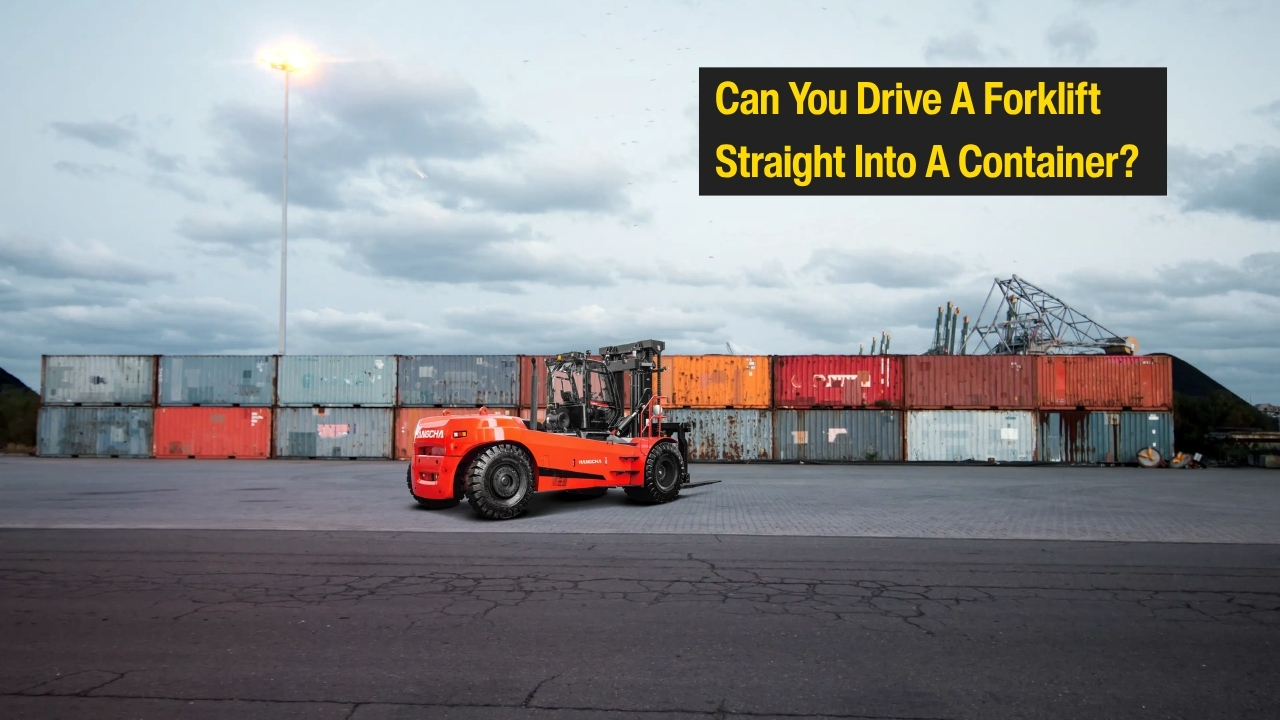
Yes, you can drive a forklift into a shipping container, but only a forklift that fits the door, the floor and the way in. The door of a standard dry container is about 2,280 mm high, so every part of the forklift has to pass under it. Most container floors are rated for a forklift front axle load of up to 5,460 kg, load included, and the container has to be reached over a dock leveller or a secured ramp. Petrol, diesel and LPG forklifts also need a plan for exhaust fumes before they go inside.
When a forklift can and can't go into a container
Whether a forklift can go into a container depends on the box, where it sits, and what the forklift measures and weighs. This table sets out the common situations and what decides each one.
| Situation | Forklift inside? | What decides it |
|---|---|---|
| Standard dry container at a dock with a leveller | Usually yes | Forklift height against the door, laden front axle load, dock controls |
| Container sitting on the ground | Yes, over a rated container ramp | The floor sits about 170 mm above the ground; ramp rating and slope |
| Container still on a trailer, with no dock | Only over a dock or yard ramp, with the trailer secured | Brakes set, wheels chocked, trailer coupled to the prime mover where possible |
| 40 ft high cube container | Yes, with more headroom | Door opening about 2,597 mm high |
| Refrigerated (reefer) container | Check with the container owner first | Lower door on 20 ft units, T-bar floor, load line |
| Fumigated container that hasn't been vented | No, not until it is cleared | Venting or air testing |
| Forklift plus load heavier than the floor rating | No | Laden front axle load against 5,460 kg |
| People working inside the container | No | People and forklifts don't work inside together |
Most of the cases where a forklift has to stay out come from the floor, the fumes or people inside, not from the height of the forklift. Height is still the first check, because it decides whether the truck gets through the door at all.
Will your forklift fit through the container door?
A forklift fits a container only if its tallest point clears the door header, which is about 2,280-2,292 mm high on a standard 20 ft or 40 ft box. That tallest point might be the lowered mast, the overhead guard, a beacon or an LPG cylinder. The forklift also pitches up as it crosses a ramp or dock plate, so it needs a margin, not a bare fit. On the spec sheet, read both the lowered mast height and the overhead guard height, and measure the doors of the boxes you actually receive.
Say your forklift measures 2,240 mm to the top of its overhead guard. This is how much room it has at the door of three common containers.
| Container | Door opening height (about) | Room above a 2,240 mm forklift |
|---|---|---|
| Standard 20 ft or 40 ft dry | 2,280-2,292 mm | 40-52 mm |
| 40 ft high cube dry | 2,597 mm | 357 mm |
| 20 ft refrigerated (reefer) | 2,264 mm | 24 mm |
The forklift that passes a standard dry box with a few centimetres to spare has almost nothing left at a 20 ft reefer door, and plenty of headroom in a high cube. If your containers arrive in a mix of types, size the forklift for the lowest door you receive.
If you're buying a forklift for this work, start with the door heights above, then work out how to choose a container forklift by mast, free lift and floor load.
Turning and lifting inside the container
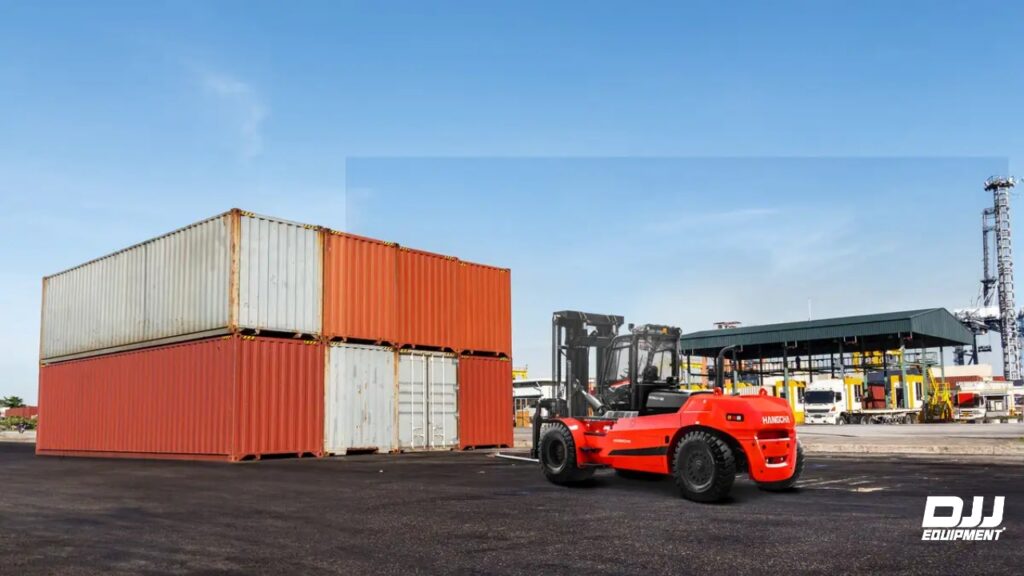
A counterbalance forklift can't turn around inside a standard container, so it drives in straight and reverses out the same way. The box is about 2,350 mm wide inside. A Hangcha XF 2.5 t forklift, for example, is 1,155 mm wide, and its 2,245 mm turning radius is close to the full inside width of the box.
Lifting inside is limited by the roof, which sits about 2,393 mm above the floor of a standard box. A mast without enough free lift pushes its inner rails up as soon as the forks rise, so it can hit the roof when you lift one pallet onto another. If your pallets go in one high, free lift matters less.
Can the container floor take the forklift's weight?
Most container floors are rated for a forklift with a front axle load of up to 5,460 kg, including the load it carries. That rating assumes each front wheel has at least 142 square centimetres of contact with the floor. A few shipping lines run steel-floor containers rated for 9,200 kg, but they are a small share of the fleet, so plan around 5,460 kg.
A counterbalance forklift carries most of its own weight and the load on its front axle when it lifts. A Hangcha XF 2.5 t LPG forklift weighs about 3,765 kg, so with a full 2,500 kg load the combined weight is about 6,265 kg. Read the laden front axle load on the spec sheet rather than estimating it. Electric forklifts aren't automatically lighter, because the battery is part of the counterweight.
Look at the floor before the forklift goes in. Soft spots, broken boards or holes weaken the floor where the wheels run. If the forklift and a full load come close to the rating, carry lighter loads or keep the forklift outside.
Getting into the container: dock, ramp or trailer
A forklift reaches the container floor over a dock leveller, a container ramp or a yard ramp, not over loose boards or pallets. Which one you need depends on where the container sits.
At a loading dock
A dock with a leveller is the simplest way in when the container arrives on a trailer. The dock edge needs protection so a forklift can't drive off it, and there should be a control that stops the truck leaving the dock too soon. Check that the leveller is rated for the forklift and its load.
Container on the ground
A container on the ground still has its floor about 170 mm above the ground, so the forklift needs a container ramp. The ramp has to carry the forklift and its load, sit firmly against the container and be fixed so it can't move. Keep the ramp slope within the forklift manufacturer's recommendations, and compare it with the laden gradeability on the spec sheet.
Container still on a trailer
A container on a trailer is only safe to enter once the trailer can't move. The WorkSafe Queensland forklift safety guide sets out the checks: brakes set, wheels chocked, a floor that can carry the forklift and load, and any ramp locked in place. Keep the trailer coupled to the prime mover where possible, and use a procedure that stops the truck driving away before loading is finished.
If the trailer has been uncoupled, ask the transport operator how it will be supported before a forklift drives on.
Fumes and ventilation inside a container
Petrol, diesel and LPG forklifts give off carbon monoxide, and it builds up inside a shipping container. Regulators name shipping containers, loading docks and cold stores as places where exhaust fumes collect, and advise electric forklifts or pallet jacks for enclosed spaces.
If an LPG forklift has to go in, do a risk assessment with a competent person, monitor the air, fit carbon monoxide alarms and ventilate the container. Diesel forklifts are normally outdoor machines and a poor choice for work inside a box.
Imported containers can also hold fumigant residues. Ask the importer whether the container was fumigated, and follow WorkSafe Victoria's venting guidance for fumigated containers before any person or forklift goes inside.
Reefer containers: lower doors and a T-bar floor
A refrigerated container is lower inside than a dry box, so a forklift that fits a standard container may not fit a reefer. A 20 ft reefer has a door opening about 2,264 mm high and about 2,255-2,267 mm of height inside. A 40 ft high cube reefer has more room, with a door about 2,545-2,569 mm high.
Cargo can't be stacked above the red load line painted inside the reefer, about 2,155-2,184 mm up in a 20 ft unit and about 2,420 mm in a 40 ft high cube, because the cold air needs room to circulate. The floor is different too: a reefer has a T-bar floor with channels that carry cold air under the cargo. Cargo should sit only on the T-bar area, with gaps filled by boards or dunnage. Ask the container owner whether forklifts may go inside and what the floor is rated for.
Shipping lines ask for the refrigeration unit to be switched off while the container is loaded, and the cargo should already be at its transport temperature, ideally loaded from a refrigerated dock. Cool rooms and reefers are also where exhaust fumes cause trouble: NT WorkSafe has reported two workers poisoned by carbon monoxide from an LPG forklift in a cool room. For reefer work, an electric forklift or a pallet jack is the safer choice.
What if a forklift shouldn't go into the container?
When a forklift can't safely go in, it can work from the dock or the ground while a pallet jack brings pallets to the door. An electric pallet jack is lighter and lower than a forklift, makes no exhaust and suits the tight space inside a box. The forklift then lifts each pallet at the door end without leaving the dock or the ground.
Pallet jacks and walkie stackers don't need a high risk work licence, but operators still need training and the business still has to manage the risk. For regular work, a side-opening container is another option, because the forklift loads it from the outside along its length.
If a forklift does go in, the operator needs an LF high risk work licence, as for any forklift work. People and forklifts should never work inside a container at the same time.
If containers arrive at your site every week, an electric forklift that clears your lowest door and stays within the floor rating, with a proper dock or ramp, is worth setting up. If they arrive now and then, a pallet jack inside and a forklift at the door often does the job with less risk. DJJ Equipment sells and hires forklifts from Silverwater, Meadowbrook and Bayswater, and hires pallet jacks on selected models; availability varies by location and term. Tell us the container types you receive, your door heights and whether boxes arrive at a dock, on the ground or on a trailer: call 1800 355 388 or ask about forklift hire.