For indoor and noise-sensitive sites, an electric forklift is the quietest choice, because it is close to silent when it stops and has no engine idling between loads. Hangcha's A Series stand-up 3-wheel electric forklift, for example, is rated at 63 dB(A) at the driver's ear. Safe Work Australia's exposure limit is 85 dB(A) averaged over eight hours, counting all the noise a worker hears in the shift. The rating is only a starting point. The hydraulic pump, the mast, the tyres on your floor and the reversing alarm decide how loud the truck is in your own building.
How much electric forklift noise is too much at work?
Noise from an electric forklift, or any forklift, is too much when it helps push a worker's exposure over the Australian legal limit. According to Safe Work Australia, workers must not be exposed above 85 dB(A) averaged over eight hours, or to a peak above 140 dB(C) at any moment. The limit works on a trade-off between level and time: 91 dB(A) for two hours carries the same risk as 85 dB(A) for eight.
A simple check is the one metre rule. If you need to raise your voice to talk to someone one metre away, the noise level is probably too high. The table sets the published Hangcha figures at the driver's ear beside Safe Work Australia's limits and suggested levels.
| Level | What it means | Source |
|---|---|---|
| Below 50 decibels | Suggested for work that needs high concentration or a lot of conversation | Safe Work Australia |
| 63 dB(A) | Sound at the driver's ear on the A Series stand-up 3-wheel electric forklift | Hangcha brochure |
| Below 70 decibels | Suggested for routine, fast-paced work where people still need to talk | Safe Work Australia |
| Under 75 dB(A) | Upper limit at the driver's ear on the A Series reach truck 1.5-1.8 t | Hangcha brochure |
| 85 dB(A) over 8 hours | Legal exposure limit, the same risk as 91 dB(A) for 2 hours | Safe Work Australia |
| 140 dB(C) | Legal limit for a peak at any moment | Safe Work Australia |
A forklift is usually only one source of noise on a site. What counts is the total noise each worker is exposed to across the shift, and the business running the site is responsible for assessing it.
How noisy are electric, LPG and diesel forklifts?
An engine forklift makes noise whenever the engine runs, including while it waits for the next pallet. An electric forklift makes almost no sound at a standstill, and most of its noise comes from lifting and driving.
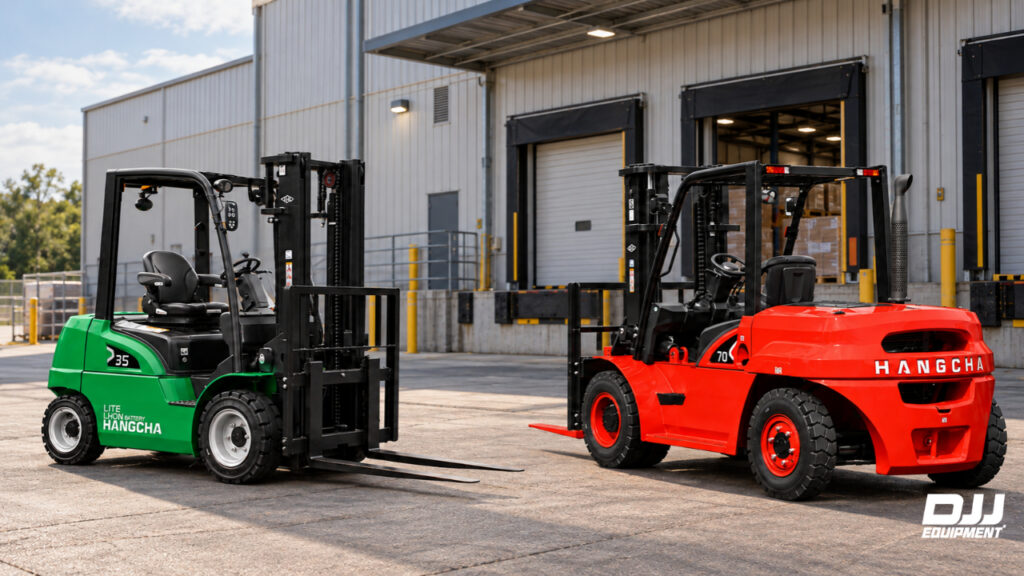
Some brochures for the Hangcha forklifts DJJ Equipment sells print the sound level at the driver's ear. The A Series stand-up 3-wheel forklift is rated at 63 dB(A) on all four models and has a low-noise gear pump as standard. The A Series reach truck 1.5-1.8 t is rated at under 75 dB(A), an upper limit rather than an exact reading.
Not every brochure prints a figure. The Hangcha brochures for the XA Series 2-3.8 t and XE Series 6-10 t electric forklifts don't, and the XF2 Series diesel and LPG brochures describe noise control features instead of a number. If the figure matters for your site, ask for it in writing for the exact model and power option you are quoted.
For enclosed buildings, noise is only part of the case against engine trucks. Exhaust matters more, which is why running a diesel forklift indoors is rarely a good idea where people work all day.
How many decibels is an electric forklift?
The Hangcha electric forklifts that publish a figure are rated at 63 dB(A) and under 75 dB(A) at the operator's ear. The first is the A Series stand-up 3-wheel, the second the A Series reach truck 1.5-1.8 t. That rating helps you compare machines measured the same way, but it is one input to a worker's 85 dB(A) shift average, not a measure of it.
A single figure also hides how the sound changes through the work. An electric forklift is quietest at a standstill and loudest while the pump lifts a heavy pallet to the top beam, so if your trucks lift most of the day, ask whether the supplier can give a figure for lifting on its own.
The figure is also measured at the operator's seat, not where your other workers stand. A cab can lower the level for the driver without changing what people nearby hear. A warehouse with concrete floors, block walls and a metal roof also reflects sound back, so the same truck sounds louder indoors than in the open.
Where the noise comes from on an electric forklift
With no engine, the hydraulic system is usually the loudest part of an electric forklift. A gear pump can whine as it lifts, and the sound changes with load and lift speed, which is why some trucks are built with a quieter pump. Other sources include:
- the mast changing stages as it extends, and the carriage settling at the bottom when it lowers
- tyres crossing floor joints, dock plates and ramps
- cooling fans on motors and controllers
- the horn and reversing alarm
Battery type makes little difference to any of these. A lithium or a lead-acid battery powers the same pump, motors and alarm, so swapping one for the other won't make the truck quieter.
The best comparison is a test drive in your own building. A short routine shows most of it:
- Lift a typical load to your highest beam and listen to the pump and the mast stages.
- Lower it and listen for knocks as the mast and carriage come down.
- Drive over your floor joints, dock plates and any ramps, loaded and empty.
- Reverse through a busy aisle and listen to the alarm from where your workers stand.
Forklift reversing alarms and warning lights for quiet and night sites
On a quiet electric forklift, the reversing alarm is often the loudest thing on the truck. A traditional beeping alarm echoes off walls and racking indoors, so people nearby can hear it but struggle to tell which aisle it is coming from, and it carries well beyond the area where the truck is working.
Broadband alarms, which make a rushing sound across many frequencies, are easier to locate and fade faster outside the danger zone. Warning lights that project a spot or line onto the floor, and rotating beacons, add a warning that doesn't depend on hearing at all.
Don't remove or switch off a reversing alarm to make a site quieter. SafeWork NSW lists the reversing beeper among the items to check at the start of each day. Any change to warning devices needs to keep pedestrians at least as safe as before, so check it against your site's risk assessment and forklift traffic management plan first.
Is an electric forklift quiet enough for night work near homes?
An electric forklift is the best starting point for night work near homes, because it has no engine idling between loads, but the loudest single noises on the site decide whether neighbours are disturbed. Background noise drops at night, so a reversing alarm, a pallet dropped on concrete or a truck crossing a loose dock plate stands out far more than it would by day.
In NSW, the EPA's Noise Policy for Industry assesses those single events separately from average noise. If a site's night-time noise at a nearby home goes above 40 dB(A) averaged over 15 minutes, or a single event goes above 52 dB(A) (or 15 dB above the background level, if that is higher), the policy calls for a detailed sleep disturbance assessment. That assessment looks at how loud each event is, how far it rises above the background and how many times it happens between 10 pm and 7 am (8 am on Sundays and public holidays). The policy is written for EPA-licensed premises, but councils can use it as a reference for the sites they regulate.
Those levels are measured at the home, not at the truck. A 63 dB(A) rating at the driver's ear says little about what a neighbour hears through an open roller door, which depends on distance, the building openings, screening and everything else running on site.
On a site near homes, a battery-electric forklift with a broadband alarm removes the idling engine and cuts how far the alarm carries. The rest depends on how the work is done: load inside and away from open doors where that is safe, fix rattling dock plates, set pallets down rather than drop them, and check the operating hours and noise conditions in your site's development approval before adding a night shift.
Keeping a quiet forklift quiet
A forklift that was quiet when new can get louder as parts wear. Low or contaminated hydraulic oil, a worn pump (even a low-noise one like the A Series stand-up's), dry or worn mast rollers and chains, flat-spotted tyres and loose panels all add noise.
A new noise is often the first sign that something needs attention, so report it rather than turning the radio up. Catching wear early stops a small noise turning into a bigger repair, and regular forklift servicing checks the hydraulics, mast, chains and tyres where that noise usually starts.
Tell the DJJ team where the forklift will work, the hours it runs and who works or lives nearby, and ask for the noise figure for the model you are considering. Call 1800 355 388 or send an enquiry, and our Sydney, Brisbane or Perth branch will help you compare models.