The most common forklift problems are forks that drift down or lift slowly, electric forklifts losing power, engine forklifts overheating, soft brakes or heavy steering, worn tyres, and worn forks and lift chains. Most of them start as wear that a daily pre-start check can catch. Some can't wait. WorkSafe Queensland's figures show a 2.5 tonne forklift at 12 km/h needs 7-8 m to stop even with good brakes, and SafeWork NSW says forks worn more than 10% at the heel must be replaced.
Why do forklift forks drift down or lift slowly?
Forklift forks that creep down while holding a load almost always have hydraulic oil leaking past a seal inside the lift cylinder or the control valve. Pressurised oil slips past the piston seal into the low-pressure side, so the load sinks while nobody touches the lever. The leak is internal, so the floor under the forklift can stay dry.
Slow lifting has different causes: low hydraulic oil, a blocked filter or a worn pump. Oil running down the chrome rod of a cylinder is an external leak, which points to the rod seal rather than the dust wiper in front of it.
The hydraulic oil level is a daily item on any forklift maintenance checklist, and Safe Work Australia lists it as a pre-start check. It also says forklifts should be cleaned regularly, so loose or worn parts are easy to spot and oil or fuel leaks don't lead to fires. Flow restrictors in the hydraulic lines stop the forks dropping freely if a hose bursts, but they don't make a leaking hose safe to keep using.
Why is an electric forklift losing power or cutting out?
An electric forklift that runs flat early, slows on ramps or cuts out under load has a battery or charging problem in most cases. What goes wrong depends on the battery type.
Lead-acid forklift batteries
A lead-acid battery loses capacity when it's regularly undercharged, left flat or run with low electrolyte. Sulphate crystals form on the plates as the battery discharges and dissolve again on a full charge. If the battery sits half charged, the crystals harden and it can no longer hold a full charge.
Safe Work Australia says only trained people should charge or change forklift batteries. The vent caps must stay in place so electrolyte can't spray, and charging areas need ventilation because charging gives off explosive hydrogen gas.
Lithium forklift batteries
A lithium battery doesn't need watering, but its battery management system cuts power when the cells get too hot, too cold or too low. A forklift that keeps slowing or shutting down is often protecting its battery, and the fault code tells a technician which limit it hit. Cold stores and cold winter starts are where this shows up most. The Hangcha XE Series 1.5-3.8 t has battery heating for cold weather and IPX4 protection against water spray.
The Hangcha X Series 4-5 t offers the lithium vs lead acid forklift battery choice in one truck: an 80V lead-acid battery as standard, or a CATL lithium battery on the -I models, which weigh 720-940 kg less.
Why does an LPG or diesel forklift overheat or blow smoke?
An LPG or diesel forklift overheats when air can't get through a radiator clogged with dust, the coolant is low or the fan belt slips. Recycling, timber and dusty yards block radiators fastest. Heavy smoke, a strong exhaust smell or rough running means the engine needs tuning.
Exhaust is a health problem as well as a mechanical one. Safe Work Australia recommends regular engine tuning and air monitoring to keep carbon monoxide and diesel particulates down. It notes that diesel engines produce less carbon monoxide than LPG or petrol engines, but dirtier exhaust. WorkSafe Queensland adds that poorly maintained fuel-powered forklifts produce more carbon monoxide.
The transmission suffers from driving habits too. The Hangcha A2 Series diesel forklift, rated from 1,500 to 3,800 kg, uses a powershift transmission that changes gear through clutch packs. Shifting from forward to reverse while the forklift is still rolling makes those clutches slip and heat up. Stopping before changing direction is the cheapest fix.
What causes forklift brake and steering problems?
A soft or spongy forklift brake pedal means air or moisture in the brake fluid, and a forklift that pulls to one side when braking has oil or fluid on the linings of one wheel. Brake fluid absorbs moisture over time. Moist fluid can boil under hard braking on ramps, which leaves vapour in the lines that compresses when you press the pedal. Linings soaked in oil can't be cleaned, so they're replaced.
Weak brakes matter because forklifts need more room to stop than drivers expect. WorkSafe Queensland gives a total stopping distance of 2.9-3.2 m at 6 km/h for a 2.5 tonne forklift, on a dry, even surface with an alert driver. It lists the forklift's mechanical and tyre condition among the things that lengthen that distance.
Heavy or jerky steering comes from low hydraulic oil, a worn steering pump or a damaged steer axle. A steering fault stops work, because the operator can't control where the forklift goes. Safe Work Australia's pre-start list includes the brake fluid and hydraulic oil levels.
Why won't a forklift go forward or backwards?
A forklift that won't drive is most often being held by a safety interlock, not a failed transmission. Check the parking brake, the direction lever, the seat switch and the seatbelt first. The A2 Series has a neutral safety switch, so the engine won't start with the lever in gear, and the XE Series offers a seat sensor that stops drive when the operator leaves the seat. WorkSafe Queensland also encourages systems that only let a forklift start with the seatbelt fastened.
If the interlocks check out, the cause is low transmission oil on an engine forklift, or a drive motor, controller or battery fault on an electric one, which shows as a code on the display. Never bypass a seat switch or seatbelt interlock to keep working. It's there to stop the forklift moving when nobody is in control.
How do worn tyres cause forklift problems?
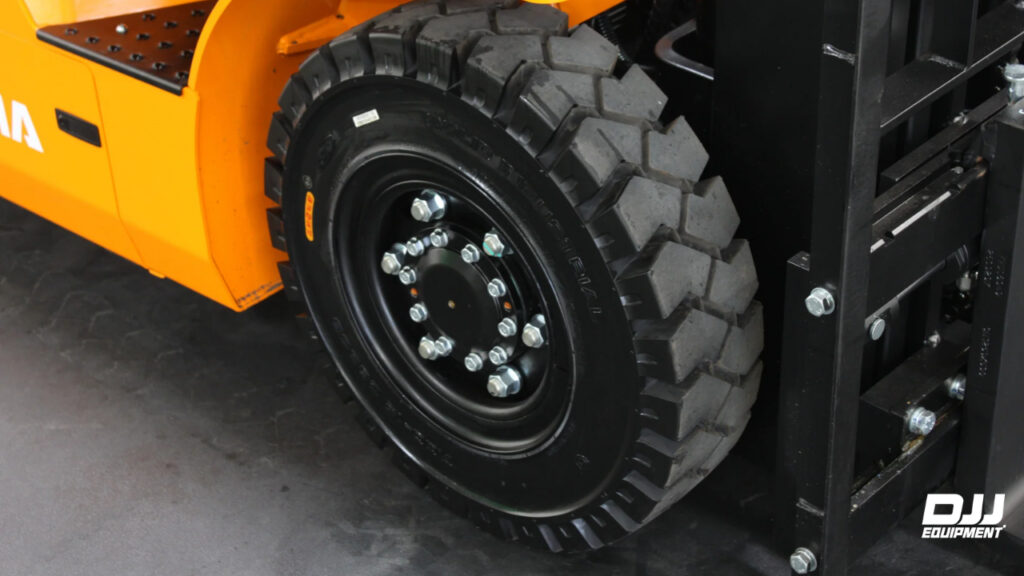
Worn, chunked or under-inflated tyres make a forklift vibrate, pull to one side, take longer to stop and lean more on corners.
Solid tyres avoid punctures on sites with scrap, glass or nails. They're an option on the A2 Series diesel forklift and on the X Series 4-5 t, one of the electric forklifts DJJ Equipment sells from 0.6 to 48 t.
Pneumatic tyres need the pressure shown on the data plate, which Safe Work Australia says should list tyre pressures for pneumatic tyres. One soft tyre tilts the mast to that side. WorkSafe Queensland says only qualified tyre fitters should remove and fit forklift tyres, and split-rim wheels need a safety cage during inflation in case the assembly fails.
When do worn forks and lift chains become a forklift problem?
Forklift forks become a problem when the heel wears thin, a crack appears or a fork bends, and lift chains do when they stretch, crack or stiffen. SafeWork NSW says forks worn more than 10% at the heel must be replaced. It measures wear by comparing the thickness at the heel with the thickness of the upright part of the fork, and tells operators not to drag the heels along the floor.
The heel is where a loaded fork bends most, so a thinner heel carries the same rated load with less steel. Worn forks are replaced, not built up with weld. Safe Work Australia says holes shouldn't be drilled or cut through fork arms unless a competent person, such as a mechanical engineer, has specified it.
Lift chains stretch as their pins and links wear. Once a chain passes the manufacturer's stretch limit, a technician replaces it, together with the other chains on the same mast. Uneven chains also show up as a carriage that sits crooked or a mast that jerks as it lifts. Measuring stretch takes a chain gauge and the manufacturer's figure, so it's a technician's job at each service.
Which forklift problems mean you should stop using it?
Any forklift problem that affects braking, steering, holding a load or protecting the operator means the forklift comes out of service until a competent person makes it safe. Safe Work Australia's out-of-service procedure has three steps: report the fault straight away, identify and isolate the forklift as out of service, and don't operate it until it's made safe and the tag is removed. That rule also sets how soon repairs should be made to a forklift: before its next use whenever the fault affects safe operation.
Eight common symptoms split into faults that stop the forklift now and faults to report the same shift:
| Symptom | Common cause | What to do |
|---|---|---|
| Soft or sinking brake pedal | Air or moisture in the brake fluid, leaking cylinder | Stop and tag out |
| Heavy or jerky steering | Low hydraulic oil, worn steering pump | Stop and tag out |
| Forks drift down under load | Internal leak in a cylinder or the control valve | Stop and tag out |
| Fork cracked, bent or worn more than 10% at the heel | Wear, overloading, dragging the heels | Stop and replace the fork |
| Seat switch, seatbelt, horn or lights not working | Interlock or electrical fault | Stop and tag out |
| Engine temperature warning on | Blocked radiator, low coolant, slipping fan belt | Stop, let it cool, report |
| Shorter run time on a full charge | Ageing battery, undercharging, low electrolyte | Report and book a service |
| Vibration or pulling while driving | Worn, damaged or soft tyre | Report; stop if a tyre is damaged |
Six of the eight rows start with stop, because those faults take away control of the forklift or its load, or can wreck the engine. The other two get worse slowly, so the operator reports them that shift and the business books a technician before a weak battery or a worn tyre turns into a breakdown.
Our service team services all forklift brands and repairs Hangcha forklifts; repairs on other brands are assessed case by case, so check your model with the team. Work is done at our Silverwater, Meadowbrook and Bayswater workshops, or on site within 50 km of each branch. To book forklift servicing and repairs, call 1300 646 747.