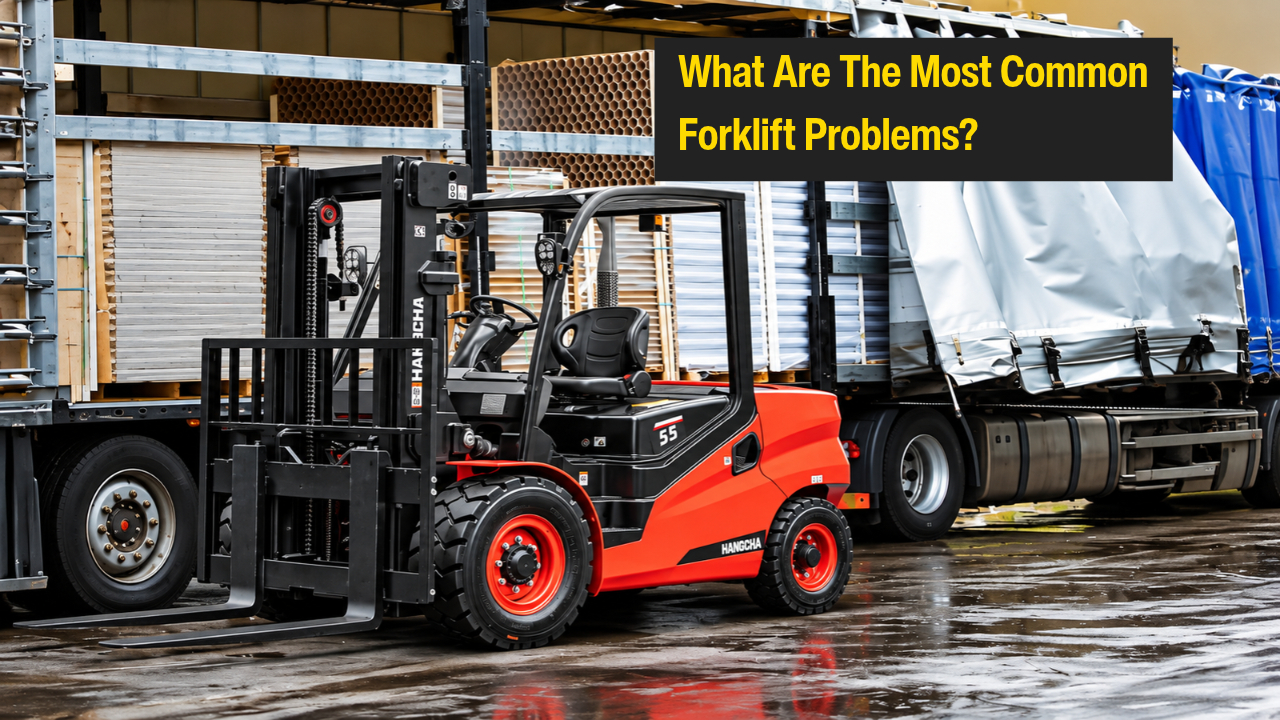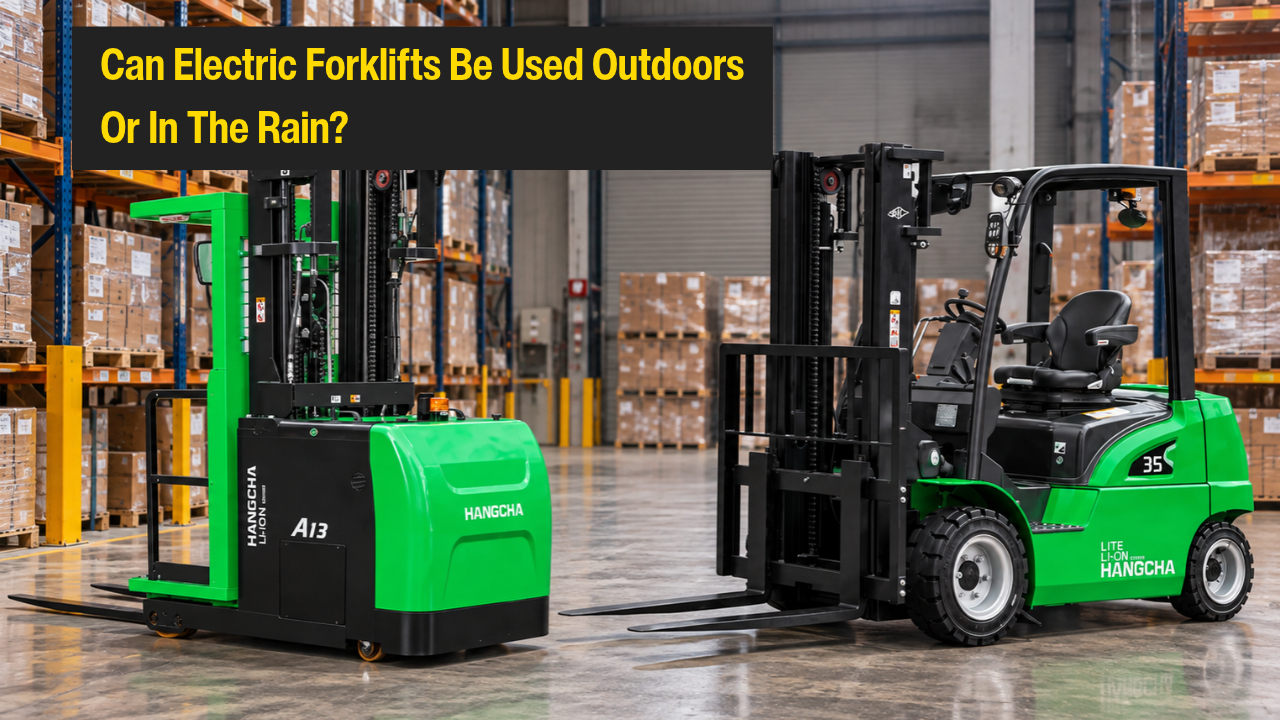
On the standard European energy test, a 1.6-2.5 tonne electric forklift uses between 4.2 and 6.5 kWh for each hour of work, and a 2 t ride-on pallet truck uses under 0.5 kWh. That test runs at a busy pace, so a truck on a normal shift often uses less. At about 40 c/kWh, the forklift test range works out to about $1.70-$2.60 an hour.
How many kWh per hour does an electric forklift use?
An electric forklift in the 1.6-2.5 t range uses 4.2 to 6.5 kWh an hour on the DIN EN 16796 test, the fixed pattern of travelling, lifting and lowering that makers use to publish energy figures. These are figures from manufacturer data sheets:
| Truck type | Rated capacity | Energy use on the test (kWh per hour) |
|---|---|---|
| Ride-on pallet truck | 2 t | 0.43 |
| Compact 4-wheel counterbalance | 1.6 t | 4.2 |
| Compact 4-wheel counterbalance | 1.8 t | 4.4 |
| Compact 4-wheel counterbalance | 2 t | 4.7 |
| Heavier-duty 4-wheel counterbalance | 2 t | 6.1 |
| Heavier-duty 4-wheel counterbalance | 2.5 t | 6.5 |
A pallet truck uses a tenth or less of what a forklift does, because it's far lighter and lifts a pallet only far enough to clear the floor. And capacity alone doesn't set the figure: two 2 t trucks sit at 4.7 and 6.1 kWh, and the second weighs 4,837 kg against 3,475 kg.
The test is also harder than most shifts. The same data sheet credits the 4.7 kWh truck with moving 149 t an hour, which is about 74 full 2 t loads. You'll see 8-12 kWh an hour quoted online for this size of truck. That's well above the published test figures, and the pages quoting it don't name a test.
DJJ Equipment sells Hangcha electric forklifts, and Hangcha's brochures point buyers to a separate technical table for each model's energy figure. If you're comparing two models on electricity use, ask us for that figure.
How much electricity does an electric forklift use in a shift or a year?
An electric forklift working flat out at the test rates would use 34-52 kWh in eight hours. Few trucks hold that pace, because they also wait on trucks, sit between jobs and travel empty.
Over a year, the sum is hours multiplied by kWh. At 1,500 hours, about one shift on weekdays, the test range gives about 6,300-9,750 kWh. Treat that as the top of the likely range for a truck doing ordinary warehouse work, and double it for two shifts.
How much power does a full forklift battery charge take from the grid?
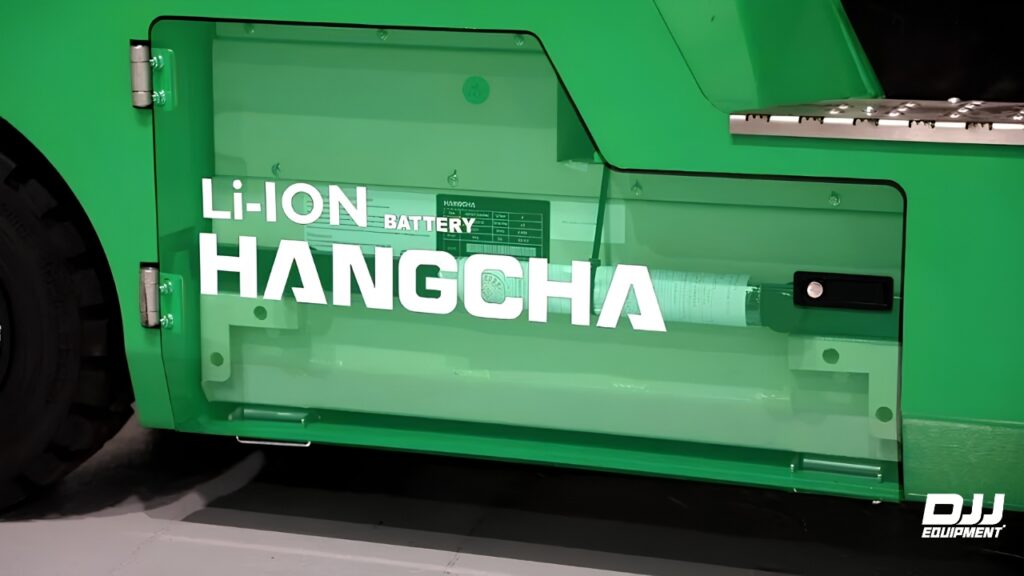
A full forklift battery charge takes about 12-18 kWh from the grid on a 2.5 t Hangcha lithium forklift. Hangcha's own formula gets there in two steps. Usable energy is voltage x amp-hours x 90%, because low-power protection keeps the last 10% in reserve. Grid energy is that figure divided by 93%, the charger efficiency Hangcha uses.
| Hangcha model | Battery | Nominal (kWh) | Usable at 90% (kWh) | From the grid per full charge (kWh) |
|---|---|---|---|---|
| X Series pallet truck 2-3 t | 48V/105Ah | 5.0 | 4.5 | 4.9 |
| XA Series CPD25, 2.5 t | 80V/150Ah | 12.0 | 10.8 | 11.6 |
| XC Series PMSM CPD15, 1.5 t | 80V/173Ah | 13.8 | 12.5 | 13.4 |
| XC Series Light Duty CPD25, 2.5 t | 80V/230Ah | 18.4 | 16.6 | 17.8 |
| XC Series CPD50, 5 t | 80V/608Ah | 48.6 | 43.8 | 47.1 |
Read the last column as the cost of filling the tank, not as the truck's appetite. The two 2.5 t trucks carry different battery sizes, so the bigger one runs longer between charges. A bigger battery doesn't mean more electricity per pallet. A top-up from half full draws about half the figure shown, and a full charge may last more or less than a shift, depending on the work.
What does an electric forklift's electricity cost in Australia?
Electric forklift electricity costs about 38-45 c/kWh in our three branch cities on a regulated small business price, once the daily supply charge is counted. The AER publishes yearly prices for 10,000 kWh in NSW and south-east Queensland, and the WA Government publishes its regulated L1 tariff.
| Area | Regulated small business price from 1 July 2026 | All-in at 10,000 kWh a year |
|---|---|---|
| Sydney (Ausgrid) | $4,523 a year, flat rate, inc. GST | 45.2 c/kWh |
| South-east Queensland (Energex) | $3,849 a year, flat rate, inc. GST | 38.5 c/kWh |
| Perth (L1 tariff) | 33.13 c/kWh plus $2.13 a day, as published | 40.9 c/kWh |
That makes 40 c/kWh a fair round number for planning, but it's a ceiling more than a quote. The AER says only about 15% of small businesses are on its default price, and a market plan can be cheaper. Your own bill's rate always beats this table. At 40 c/kWh, the test range costs about $1.70-$2.60 an hour, and a full charge of the XC Series Light Duty CPD25 costs about $7.
Our own estimate for Sydney is about $7 a shift to charge, against about $40-70 a shift for LPG or diesel, and it depends on usage, power and fuel prices. That $7 buys about 17 kWh, well below the 34-52 kWh of a flat-out test shift, because a normal shift has waiting in it. The fuel side of that gap is in our electric vs LPG forklift running cost comparison.
How do you measure your own forklift's electricity use?
You measure a forklift's real electricity use with the charger's power meter and the truck's hour meter over a normal week. It's the only figure that reflects your loads, your floor and your operators.
- Write down the truck's hour meter reading at the start of the week.
- Have your electrician fit a sub-meter to the charger circuit, or read the kWh from the charger if it logs energy.
- Charge only from that charger for the week, then read both meters again.
- Divide the kWh by the hours worked to get kWh per hour, then multiply by the rate on your bill.
Say the charger used 90 kWh and the hour meter moved 40 hours. That's 2.25 kWh an hour, or $36 for the week at 40 c/kWh. A result well above the same truck's figure last year is a reason to book it in for a check.
Why does one electric forklift use more electricity than another?
One electric forklift uses more electricity than another mainly because of how much work it does in each hour: the weight lifted, the height, the distance and the slope. Lifting takes the biggest short burst of power, because the pump motor pushes the whole load and the mast up against gravity. A 2,500 kg pallet draws more than a 1,000 kg pallet at the same height, and a ramp makes the drive motor work on every trip.
The motor and controller matter too. Hangcha's brochure for the XC Series PMSM scores the new truck at 8.6 against 10.7 for the older XC in the same working environment, which is about 20% less energy. A permanent magnet motor doesn't spend current creating its own magnetic field, and regenerative braking on these trucks feeds some energy back to the battery as the truck slows.
Specification changes the picture as well. On that same range, the 2 t CPD20-XCY2-SI has a 17 kW drive motor, 16 km/h and an 80V/230Ah battery, while the 2 t CPD20-XCY2H-SI has 20 kW, 19 km/h and 80V/304Ah. Same capacity, more speed and more power on tap, and a bigger battery to feed it.
Drivers and temperature account for the rest. Hard acceleration, hard braking and high average speed all pull more current, so two operators can get different results from one truck. Cold costs energy too: the XA Series lithium battery has electric heating as standard to keep working in the cold, and that heater runs on electricity.
Does a lead-acid forklift use more electricity than a lithium forklift?
A lead-acid forklift takes more electricity from the wall than a lithium forklift doing the same work, because lead-acid loses more energy as heat and gassing during charging. Its voltage also sags under heavy draw, so the truck gets slower late in a shift and takes longer over each pallet. Charging also ties the truck up for longer: on Hangcha's A Series stand-up 3-wheel forklift, lead-acid takes 8-10 hours, against 3 hours for lithium on the standard charger.
The electricity gap rarely decides the choice on its own. A single-shift site with a few hours of light work may never earn back the higher purchase price of lithium on power savings alone. The bigger differences between lithium vs lead-acid forklift batteries are charging breaks, battery swaps, watering and how many shifts the truck runs.
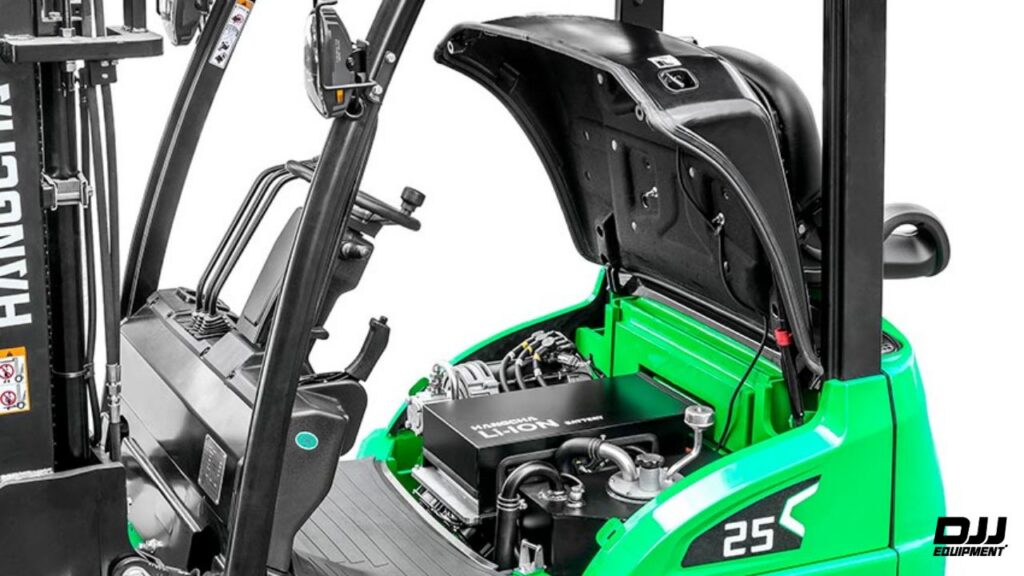
Can forklift charging raise your power bill beyond the kWh?
Forklift charging can raise your power bill beyond the kWh if your tariff has a demand charge, because that charge is set by your highest power draw rather than your total use. In south-east Queensland, Energex classes a site using more than 100,000 kWh a year as a large customer, and its demand tariffs bill on the single highest 30-minute reading in the month.
Charging speed sets that reading. Put 17.8 kWh back in 2 hours and the charger draws about 9 kW. Spread the same energy over 8 hours and it draws about 2 kW. Heavy trucks go much further: the XH Series 12-18 t uses a 120 kW charger to take its 123 kWh battery from 20% to 100% in about an hour.
Timing matters as much as size. Energex's small business time-of-use network tariff has its peak from 5pm to 8pm on weekdays and its off-peak from 11am to 1pm every day, so a lunchtime top-up costs less than plugging in as the afternoon shift ends. Your retailer decides how those network charges reach your bill, and Sydney and Perth have their own tariffs, so check yours before you set a charging routine. If several trucks stop at the same break, stagger the chargers rather than starting them all at once.
Check the supply as well as the bill. Hangcha lists an optional 35 A charger with a 220V plug for the XA Series, while the on-board charger on the XE Series 1.5-3.8 t takes single-phase or three-phase power. Confirm which charger comes with your truck and what your switchboard can feed before the delivery date. Rooftop panels can help as well: at midday, solar power can charge your forklift if they make more than the building is using.
If you can tell us your load weights, lift height, hours a day and charging breaks, we'll match a truck and battery to that work. Call 1800 355 388 or send an enquiry to the nearest DJJ branch in Sydney, Brisbane or Perth.