Yes, solar power can charge an electric forklift, but through your site's solar system and the forklift's charger, not through panels on the truck itself. How much of the charge actually comes from the sun depends on when the forklift charges: top-ups during the day can run on solar as it's produced, while overnight charging runs on grid power unless the site also has a stationary battery. Before you plan solar charging, check your shifts, your forklift's battery type and charger, and who will design and install the electrical side.
Can you put solar panels on a forklift?
Not in any useful way. A forklift's overhead guard has room for only a small panel, far less than 1 kW, and Australian government guidance puts the yearly average output of 1 kW of panels at between 3.5 and 5 kWh a day. A working forklift battery holds several times that, and forklifts that work indoors get no sun at all. Solar charging works at the building, not on the truck.
How much power a site solar system makes
The Australian Government's energy.gov.au site gives typical daily output for 1 kW of panels, averaged over a year: about 4.0 kWh in Sydney, 4.2 kWh in Brisbane and 4.4 kWh in Perth. The actual figure depends on the panels' direction, tilt and shading.
Output also changes through the year. Panels make the most in summer and the least in June and July, when days are short and the sun is low. A charging plan that works in January can fall short in winter, so plan around the lower months.
When your forklifts charge matters most
Solar makes power during the day. Whether that power reaches your forklifts depends on when they plug in:
| Charging pattern | How much can come from solar |
|---|---|
| Top-ups during breaks on a day shift | Most of it, on a sunny day, if the solar system is big enough for the chargers and the rest of the site |
| One full charge overnight | Little, unless the site has a stationary battery that stored solar during the day |
| Two shifts or 24/7 operation | Only the share that happens in daylight |
Many sites already use most of their daytime solar for lighting, air conditioning and machinery. Forklift charging competes for the same output, so look at what the site uses in the middle of the day before counting on spare solar.
Lithium or lead-acid with solar
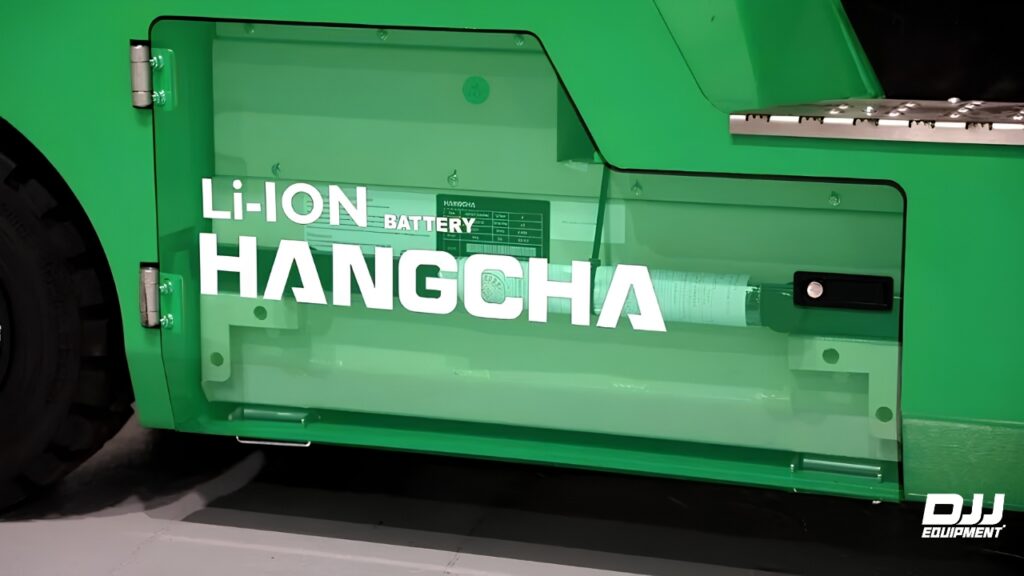
Lithium-ion batteries suit solar charging better. They can be topped up at breaks during the day, when the panels are producing, without waiting for a full cycle, as long as the correct charger and the battery management system are doing their job.
Lead-acid batteries normally need a long, full charge and a cooling period, which usually ends up overnight, after the sun has gone. They also give off hydrogen while charging, so they need a ventilated charging area, as WorkSafe Queensland notes. Lithium batteries take short daytime top-ups and don't give off hydrogen while charging, which is why lead-acid and lithium forklift batteries fit solar so differently.
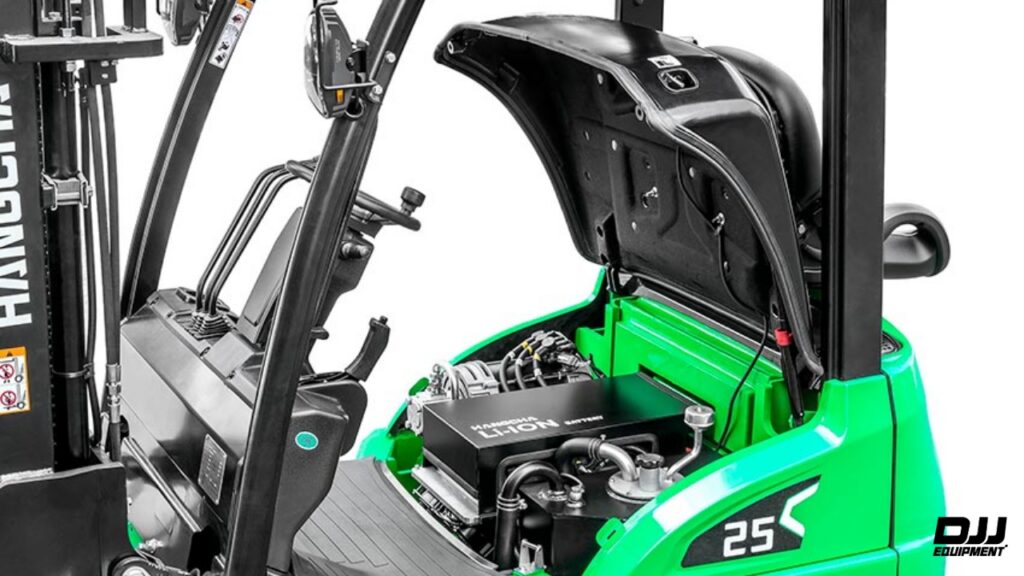
Solar power doesn't harm a forklift battery. The forklift's charger controls the charge whatever the source of the power, so use the charger the manufacturer specifies for the battery and follow the manual's charging instructions.
How big is a forklift battery?
A battery's nominal capacity in kWh is its voltage multiplied by its amp-hours, divided by 1,000. On the Hangcha forklifts we sell, a few examples:
- XA Series CPD25 (2.5 t), lithium: 80V/150Ah, about 12.0 kWh
- X Series CPD25 (2.5 t), lithium: 48V/500Ah, about 24.0 kWh
- XC Series FB25Li (2.5 t), lithium: 80V/456Ah, 36.48 kWh
That's nominal capacity. It doesn't tell you how much energy the forklift uses in a shift, how long it runs, or how long it takes to charge, and the charger loses some energy along the way. For scale only: at Sydney's yearly average, 3 kW of panels make about 12 kWh on an average day, roughly the nominal capacity of the Hangcha XA Series 2.5 t battery. That isn't a way to size a system, because it ignores charger losses, how much of the battery you use each day, winter output and when the charging happens.
Demand charges and charging every truck at once
Many business electricity tariffs include a demand charge based on the site's highest power draw. Ausgrid, for example, measures demand over the busiest 30 minutes in the month. If every forklift goes on charge at the same time late in the afternoon, just as solar output drops, the chargers can set a new peak.
Staggering charging, and topping up across the day while the panels are producing, can help. Ask your electricity retailer how your tariff works before you change your charging routine.
Rebates and who installs it
Small-scale technology certificates (STCs) reduce the cost of solar systems up to 100 kW, and from 1 October 2026 the Clean Energy Regulator has extended the scheme to systems between 100 kW and 1 MW. Rules and values change, so check the current position with your installer. A forklift's own battery isn't a home or business storage battery, so it doesn't attract battery rebates.
The electrical work isn't a DIY job. Solar systems that claim STCs must be designed and installed by people accredited by Solar Accreditation Australia, and installers also need an electrical licence. WorkSafe Queensland notes that a battery energy storage system must be installed by a licensed electrician, and new charger circuits are licensed electrical work too.
What to ask before you add solar charging
Work through these questions with your team, your electrician and your forklift supplier:
- Does the site already have solar, how big is it, and how much of its daytime output is already used?
- When do your forklifts work, and when do they charge?
- What battery does each forklift have, and can it be topped up during the day?
- What power supply does each charger need?
- Is your electricity tariff based on demand, and when is the peak?
- Who designs and installs the solar, any storage battery and the charger circuits?
Some Australian warehouses already run electric equipment from large rooftop systems. Jaycar, for example, says the 800 kW solar system on its Eastern Creek distribution centre can serve the automation in its warehouse, including its electric forklifts.
Planning solar charging for electric forklifts? Ask our team which charger each model uses and the power supply it needs, so your electrician can plan the rest. We also sell electric forklifts with lithium batteries suited to daytime top-ups. Call 1800 355 388.