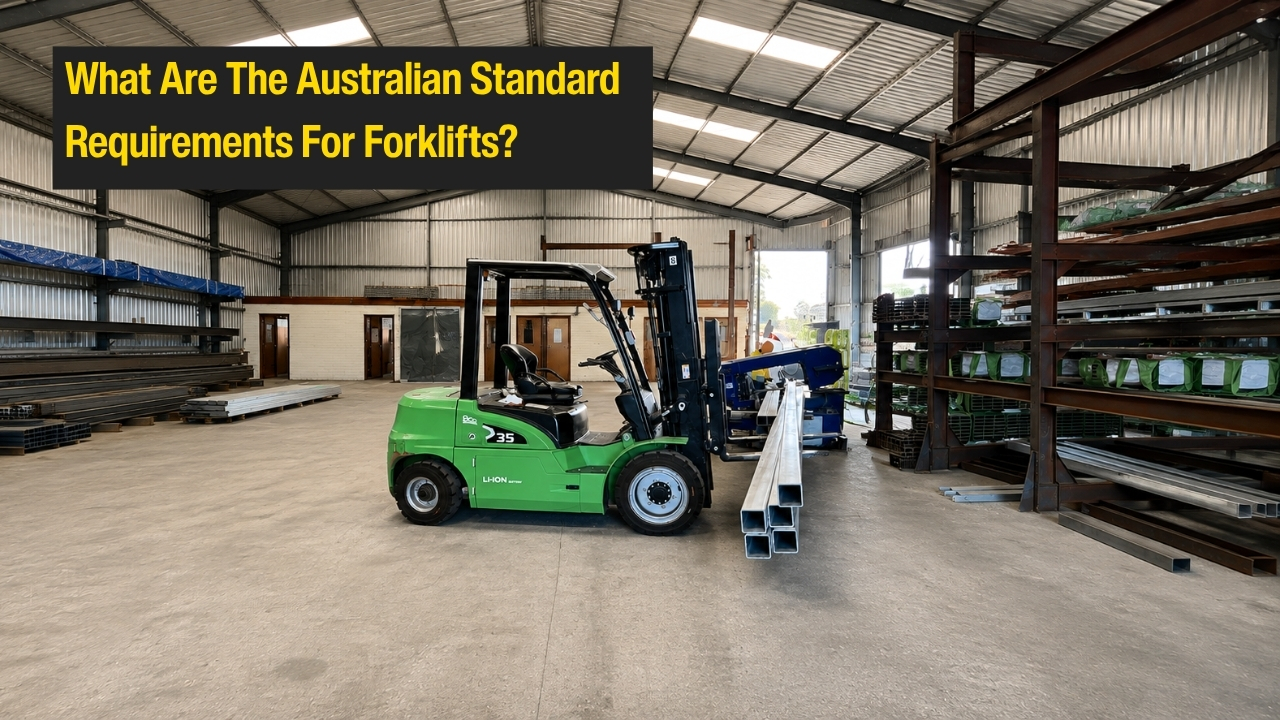
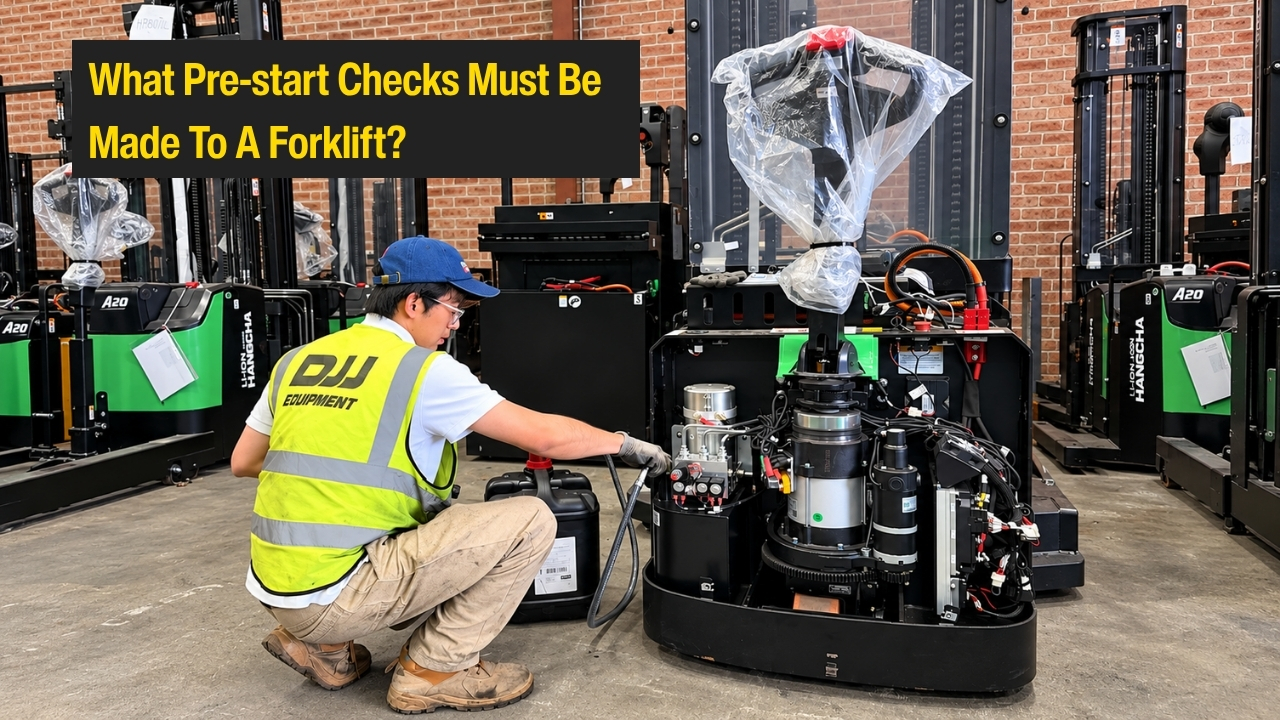
An e-commerce warehouse rarely runs on one type of forklift, because stock moves through four different jobs. Electric pallet jacks and counterbalance forklifts unload containers and receive goods, walkie stackers or reach trucks put pallets away into racking, order pickers bring staff up to the shelves to pick single items, and pallet jacks move finished orders to dispatch. The right mix depends on how your stock arrives, how high you store it and whether your team picks whole pallets, cartons or single items.
The four jobs in an e-commerce warehouse
Online retail in Australia keeps growing: Australia Post's 2026 eCommerce Report puts online spending at $82.6 billion in 2025, up 14% on the year before. More orders mean more stock moving through the same building, and each stage of that movement suits a different machine:
| Zone | Job | Typical equipment | What to check |
|---|---|---|---|
| Receiving | Unloading containers and trucks, checking stock in | Electric pallet jack, counterbalance forklift | Container floor, dock ramp gradient, pallet size |
| Storage | Putting pallets away and replenishing pick faces | Walkie stacker, reach truck | Top beam height, aisle width, capacity at height |
| Picking | Picking single items, cartons or part pallets | Order picker, stock picker, pallet jack | Pick height, item size, licence class |
| Dispatch | Moving packed orders to the dock and loading trucks | Electric pallet jack, counterbalance forklift | Travel distance, dock layout |
| Returns | Receiving, checking and restocking returned goods | Pallet jack, walkie stacker | Space near receiving, how often returns are put back |
Returns are easy to forget when planning a fleet. They arrive in small, mixed loads and need space and equipment near receiving, especially after the end-of-year peak.
Receiving and container unloading
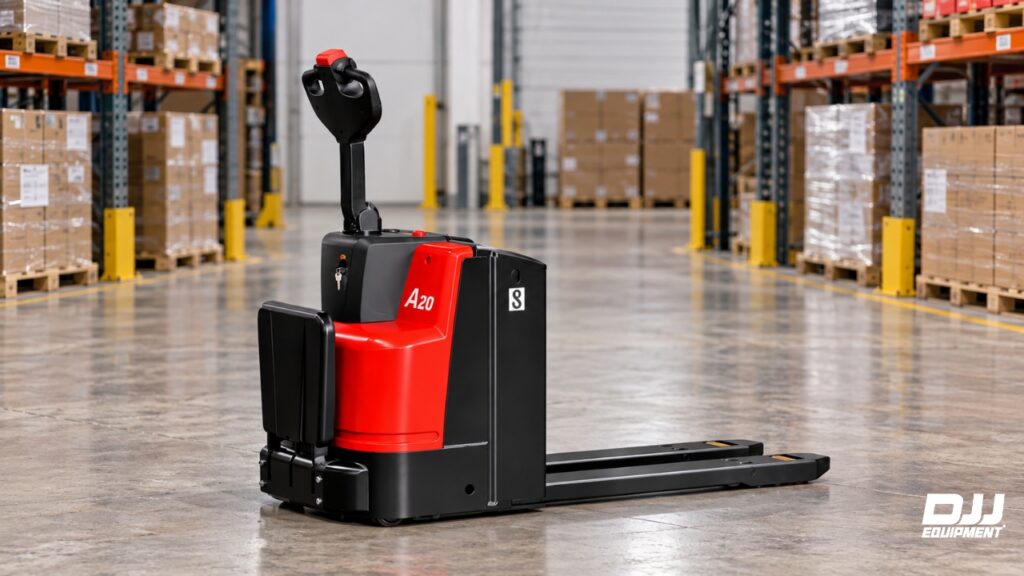
For businesses that import stock, receiving usually means unloading shipping containers, and the workhorse is an electric pallet jack. Hangcha's WS Series pallet truck weighs around 125 kg, close to a hand pallet truck, with a 48V lithium battery that swaps in about 6 seconds, and a low-profile version with 65 mm lowered forks suits low pallets. For long runs across a large warehouse and dock, the X Series rider pallet truck carries 2,000 or 3,000 kg with the operator standing on board.
Check the ramp into the container or onto the dock before you choose. These trucks are rated for laden gradients of 6-10%, depending on the model, and a steep or slippery dock plate can be beyond that. Australian standard pallets are 1165 x 1165 mm, so check the fork length and width against your pallets. The DJJ Equipment range of electric pallet jacks covers walk-behind and rider trucks from 0.5 to 3.63 tonnes.
If you unload with a counterbalance forklift instead, the container door height, the forklift's lowered mast height and free lift, and the container floor rating all decide whether it can work inside. Those checks are a topic of their own.
Pallet storage: walkie stacker or reach truck?
A small online store with racking to about 3-4 m often manages with a walkie stacker. Hangcha's WS Series pallet stacker works in an aisle of 2,268-2,290 mm for 1000 x 1200 mm pallets, and a low-mast version suits containers and lift heights below 3.3 m. Walkie stackers are pedestrian trucks, so operators don't need a forklift licence, though they still need training.
Once racking goes higher and traffic gets busier, a reach truck makes better use of the floor. The question to ask is how much it lifts at your top beam, not its headline capacity. Every Hangcha XC reach truck keeps its full rating to 6-6.5 m; above that the 2.5 t CQD25 still lifts 1,950 kg to 10 m. The compact 1-1.2 t models work in aisles from 2,610 mm.
All of these aisle figures are for 1000 x 1200 mm pallets. Ask for the stacking aisle with your own pallet size before you set your racking layout, because a 1165 x 1165 mm pallet changes the numbers. Our reach trucks run from 1 to 3 tonnes.
Picking: pallets, cartons or single items?
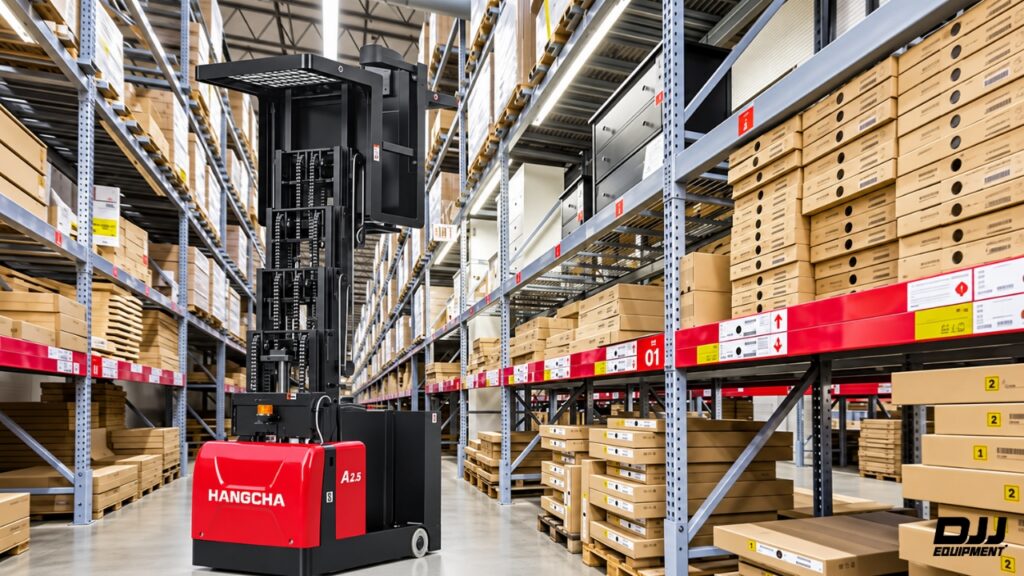
Picking decides more about your fleet than any other job. Start by asking your team how they pick: single items into totes, cartons onto a pallet to build an order, or whole pallets. Then keep three heights separate: how high the operator's platform goes, how high they can reach to pick, and how high the forks lift.
- Single items and small cartons: a stock picker such as the Hangcha A Series 0.45 t lifts the operator to a platform about 4 m high, with 250 kg on the front tray, and works in a 2,040 mm aisle
- Order building in stores below about 5 m: a medium-level order picker such as the A Series 1 t carries the operator and a 1,000 kg load up to the racking, and its lithium battery charges fully in about 2 hours
- High-bay picking: the A Series 1.2 t high-level order picker carries 1,200 kg up to 3 m, falling to 1,000 kg at 5 m and 400 kg at its 9.5 m maximum
- Large items from low shelves: the X Series 2.5 t low-level order picker has 2,400 mm forks for bulky goods, with a platform that rises to 1,030 mm
Licences follow the machine. An order picker where the operator rises with the load needs a High Risk Work Licence class LO, while reach trucks and ride-on stackers need class LF. For low-level pickers, check the model with your regulator, because how an order picker lifts the operator decides which licence applies.
Batteries and charging for long or split shifts
E-commerce warehouses often run long days, split shifts or a second shift in peak. Lithium-ion batteries suit this, because they can be topped up at breaks instead of waiting for a long full charge, and there's no battery room for watering and changing lead-acid batteries. Lead-acid still works for single-shift sites, but it needs a ventilated charging area and a full charge, usually overnight.
Think about where the chargers will go before the trucks arrive. A leased warehouse may have limited power at the right spot, and moving a charger later costs more than planning for it now.
Peak season: buy, hire or both?
The online peak starts with Black Friday and Cyber Monday and runs through to Christmas. Australia Post reported $1.5 billion spent online over the 2025 Black Friday and Cyber Monday weekend, by 3.1 million households, and the end of the financial year brings another busy period for many sellers.
Buying for the peak leaves machines idle for much of the year, so many warehouses buy for their normal volume and hire extra machines for the busiest weeks. Book forklift hire early, because demand rises before Christmas. Minimum hire terms depend on the machine and branch, and you'll need licensed operators for any hired forklift that requires a licence, including staff brought in for the peak.
How the fleet changes as you grow
Most online sellers grow into their fleet in stages:
- Starting out: one or two electric pallet jacks for unloading and dispatch, and a walkie stacker for low racking
- Growing: a reach truck once racking goes higher, and an order picker once single-item picking from height becomes a daily job
- Multi-shift or third-party logistics (3PL): more of each, plus a very narrow aisle truck or automation where floor space is tight
At the top end, very narrow aisle trucks such as Hangcha's X Series man-up tri-lateral stacker reach sideways and rotate their forks to stack on both sides of an aisle, up to 14.7 m, with rail, wire or magnetic guidance as options. Hangcha also makes an autonomous pallet truck that it rates to move pallets of up to 2,000 kg without a driver. Both need careful planning of floors, racking and routes before they make sense.
Setting up or growing an e-commerce warehouse? DJJ sells and hires order pickers, stackers and pallet jacks, so tell us how your stock arrives, how high you store it and how your team picks. Call 1800 355 388.