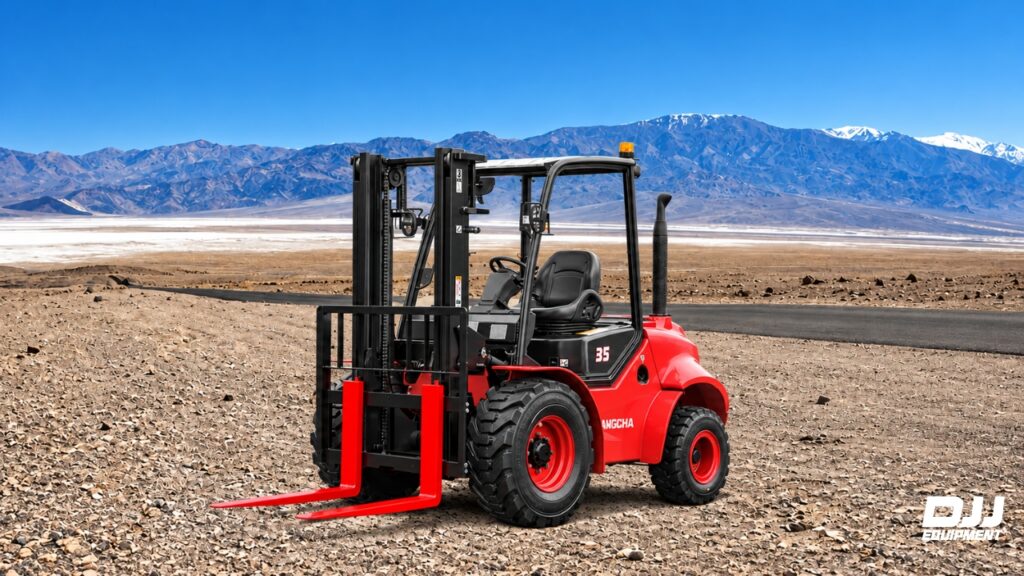
An off-road forklift and a rough terrain forklift are the same type of machine in Australia: a forklift with a mast, large pneumatic tyres and high ground clearance, built to work on gravel, dirt and unsealed yards. All terrain forklift is a third name for it. What differs between machines is the configuration, such as 2WD or 4WD, diesel or lithium, not the name on the brochure. The one exception is a supplier that calls an articulated, loader-style machine an off-road forklift, so read the spec sheet before you compare quotes.
What makes a forklift an off-road forklift?
An off-road forklift is defined by what sits under the mast: large pneumatic tyres with deep tread, high ground clearance, a heavier frame and axles, and usually a differential lock to stop one wheel spinning in mud or loose gravel. The mast, carriage and forks work the same way as on any counterbalance forklift.
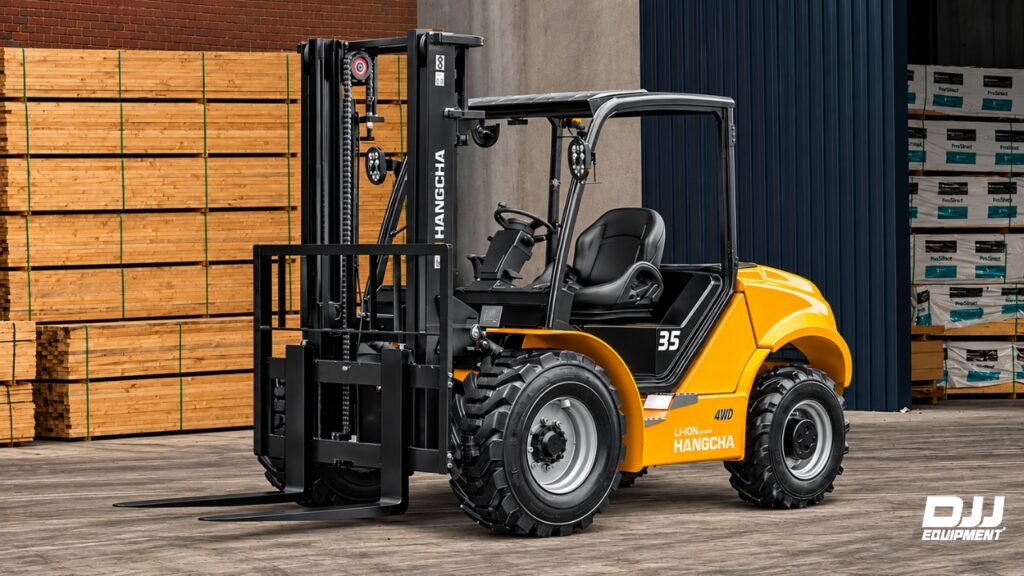
Tyres alone don't make a forklift off-road. A yard forklift on pneumatic tyres still has the low clearance and drive of a machine built for hard, level ground. On the Hangcha 2WD rough terrain forklift 2.5-3.5 t, which is built on the XF series IC forklift, the change runs through the whole truck: bigger front tyres, 235-270 mm of clearance under the mast and laden gradeability of up to 32%.
Off-road, rough terrain or all terrain: how suppliers use the names
Off-road, rough terrain and all terrain describe one category of forklift in Australia, but suppliers don't use the names consistently. The table shows what each name usually means and what to check instead of trusting the label.
| Name you'll see | What it usually means | What to check on the spec sheet |
|---|---|---|
| Rough terrain forklift | A mast forklift with pneumatic tyres and high clearance for unsealed ground; some suppliers use it for their 2WD line | 2WD or switchable 4WD, ground clearance, laden gradeability |
| All terrain forklift | The same machine; some suppliers keep the name for 4WD models | Whether 4WD and a differential lock are standard |
| Off-road forklift | Usually the same machine; a few makers use it for articulated forklifts on a loader-style frame | Frame type (rigid or articulated) and how it steers |
| Yard forklift on pneumatic tyres | A standard counterbalance forklift for hard outdoor ground | Clearance, drive and gradeability against your worst ground |
The spec sheet, not the name, tells you what the machine will do. At DJJ Equipment, both names cover the same Hangcha rough terrain forklifts, from 1.5 to 10 t, in 2WD and 4WD, diesel and high-voltage lithium.
When an off-road forklift is a different machine
An off-road forklift can mean a different machine in two cases. Some Asian manufacturers sell articulated forklifts under that name: the frame comes from a wheel loader, bends in the middle to steer, and carries a mast instead of a bucket. It turns tightly, but its stability changes as the frame bends.
The other case is a telehandler, which lifts on a telescopic boom instead of a mast. A telehandler reaches forward over obstacles, while a rough terrain forklift lifts straight up close to the machine.
Every rough terrain forklift DJJ sells is a rigid-frame Hangcha machine with a mast at the front. If a quote shows an articulated frame or a boom, you're comparing a different machine with different load charts.
Off-road forklift vs a standard forklift on pneumatic tyres
A standard forklift on pneumatic tyres handles hard, fairly level outdoor ground, such as a sealed yard or compacted gravel. An off-road forklift is for ground that's soft, rutted, sloping or changes with the weather. The tyres, clearance and drive behind that difference are set out in the comparison between an all terrain forklift and a warehouse forklift.
Choose by the worst section of the route, not the average. A yard that's sealed except for one wet gravel track to the back shed needs a machine that can cross that track loaded, all year. Walk the route from where loads arrive to where they're placed, after rain. If every section stays hard and level, a standard yard forklift usually costs less and turns tighter.
2WD or 4WD, diesel or lithium off-road forklifts
A 2WD rough terrain forklift suits firm unsealed ground and moderate slopes, while 4WD is for soft ground, mud and steeper grades. On Hangcha's 2.5-3.5 t diesel range, the 2WD models are rated at 22-32% laden gradeability, depending on capacity and engine. The 4WD rough terrain forklift 2.5-3.5 t is rated at 46-60%, switches between 2WD and 4WD, and has a differential lock as standard.
4WD costs more to buy and needs more room: the 4WD range turns in 3,300 mm against 2,900 mm for the 2WD. A gradeability rating is the manufacturer's figure, not a safe slope for your site. The operator manual, load chart and site rules still set the limits.
Lithium is now an option for rough ground too. The high-voltage lithium rough terrain forklift 2.5-3.5 t comes in 2WD (RT2) and 4WD (RT4), runs without exhaust and charges fully in about 1.5 hours. Its 2WD and 4WD versions share the same gradeability (52-63%), so the choice comes down to traction on soft ground and turning space.
Diesel still makes sense where there's no charging point near the work. Kimbriki Environmental Enterprises in Terrey Hills chose a high-voltage lithium rough terrain forklift with switchable 2WD/4WD for its resource recovery site.
Do you need a different licence for an off-road forklift?
No. An off-road, rough terrain or all terrain forklift needs the same high risk work licence as any other forklift truck: class LF. WorkSafe Queensland's definition of a forklift truck covers a powered truck with a mast and an elevating load carriage whose forks can be raised 900 mm or more, and it says nothing about tyres or ground.
Training is through a Registered Training Organisation, and your state or territory regulator, such as SafeWork NSW, WorkSafe Queensland or WorkSafe WA, issues the licence. DJJ doesn't provide licence training.
A telehandler is licensed differently, and the rules vary by state and by what's fitted to the boom. Check how telehandlers work and how they're licensed before you treat one as a forklift.
What should you check before you buy or hire a rough terrain forklift?
Check these points on the spec sheet and load chart of the exact model, whatever the supplier calls it:
- Drive: 2WD, or switchable 4WD with a differential lock.
- Ground clearance: under the mast and at the centre of the wheelbase.
- Tyres: deep-tread pneumatic tyres for grip on soft ground, or solid tyres where punctures are the bigger problem.
- Gradeability: the laden figure, against the steepest slope on your route.
- Capacity at height: Hangcha quotes these 2.5-3.5 t capacities at a 500 mm load centre, and on the lithium model the rough terrain rating at 6,000 mm falls to 600-700 kg.
- Turning space: on the lithium CPD25, the right-angle stacking aisle for 1000 x 1200 mm pallets crossways is 4,635 mm for the 2WD and 5,085 mm for the 4WD.
- Frame: a rigid frame with a mast, an articulated frame, or a telescopic boom.
If the rough ground is temporary, such as a site that will be sealed later, hire is worth a look. DJJ hires rough terrain forklifts on selected models, and minimum hire terms depend on the machine and branch.
If the worst ground on your route is hard and level all year, a standard yard forklift may be enough; if it isn't, you need a rough terrain forklift, whatever the quote calls it. Send our team photos of the route after rain, including a side view of any ramp, with your heaviest load, highest lift and hours a day, and we'll recommend options to buy or hire. Call 1800 355 388.