In Australia, forklifts are regulated as powered mobile plant under state and territory work health and safety laws, and the technical standard regulators point to is the AS 2359 series, Powered industrial trucks, which covers design, manufacture, operation and maintenance. Australian Standards aren't law on their own, but they're the benchmark: SafeWork NSW expects the owner of a forklift to make sure it complies with AS 2359. Alongside the standards, the practical requirements are a licensed operator, a readable data plate and load chart, operator protection such as a seatbelt, pre-start checks and regular servicing.
Laws, codes, standards and the manual: what's the difference?
Four layers of rules apply to a forklift, and they carry different weight:
| Layer | What it is | How binding |
|---|---|---|
| Work health and safety law | The WHS Act and Regulations in each state and territory. Victoria has its own OHS laws | Mandatory |
| Codes of practice | Approved guidance on how to meet the law, such as the code for managing the risks of plant | Courts can use them to decide what was reasonably practicable |
| Australian Standards | Technical standards such as the AS 2359 series for forklifts | Guidance on their own, but regulators and codes point to them as the benchmark |
| Manufacturer's manual | Operating, inspection and servicing instructions for your model | The law expects plant to be maintained as the manufacturer recommends |
Under the regulations, the business that manages or controls a forklift must manage the risks of it overturning, of things falling on the operator, of the operator being thrown out, and of it colliding with people or other things. It must also provide, maintain and make sure operators use suitable operator protective devices, such as the overhead guard and seatbelt.
The NSW code of practice for plant says standards provide guidance only, and meeting them doesn't guarantee you meet the law in every case. Treat a standard as the minimum technical benchmark, not the whole answer.
The AS 2359 series and related standards
These are the main standards for forklifts and their equipment, with their status as listed by Standards Australia in October 2026:
| Standard | What it covers |
|---|---|
| AS 2359.1:2019 Powered industrial trucks, Part 1: General requirements | Australian requirements for the design, manufacture, marking and testing of self-propelled industrial trucks and their attachments |
| AS 2359.2:2026 Powered industrial trucks, Part 2: Operations | Operation, maintenance, repair and modification of industrial trucks and their attachments |
| AS 2359.6-2013 Powered industrial trucks, Part 6 | Safety requirements for self-propelled trucks such as counterbalance forklifts, adopted from the international standard ISO 3691-1 |
| AS 2359.12-1996 Powered industrial trucks, Part 12: Hazardous areas | Trucks working where flammable gas or combustible dust may be present (listed as pending revision) |
| AS 2359.14-2005 and AS 2359.15-2005 | Fork arms, and fork-arm extensions and telescopic fork arms |
| AS 6055:2026 Industrial trucks: Overhead guards | Specification and testing of overhead guards, replacing AS 2359.9-2006 |
| AS 5144.3:2019 | Extra requirements for trucks with an elevating operator position, such as order pickers |
| AS 5144.4:2021 | Driverless industrial trucks and their systems |
| AS 4973-2001 | Inspection and repair of fork arms in service |
| AS 4983-2010 and AS/NZS 1596:2026 | Gas fuel systems for LPG forklifts, and the storage and handling of LP Gas |
Racking has its own standards in the AS 4084 series, and work platforms, jibs and other attachments have requirements of their own. Standards are updated, replaced and withdrawn over time, so check the current edition with Standards Australia before you rely on one.
What changed in 2026
Two forklift standards changed in 2026. AS 2359.2:2026, the operations part, was published in June 2026 and replaced the 2013 edition, and AS 6055:2026 replaced AS 2359.9-2006 for overhead guards in January 2026. The stability standards in the AS ISO 22915 series also have recent editions.
Some articles describe a wholesale switch from AS 2359 to another series in 2026. That isn't what the standards catalogue shows: AS 2359 remains the forklift series, with individual parts updated or replaced.
Licences to operate a forklift
A High Risk Work Licence is needed to operate a forklift truck in Australia. Class LF covers counterbalance forklifts, reach trucks and side-loading forklifts, and class LO covers order-picking forklifts where the operator's controls rise with the load. Pedestrian-operated trucks, such as walkie stackers and pallet jacks, don't need a licence, but operators still need training. The business must sight each operator's licence, and a licence is issued by the state or territory regulator after training and assessment with a registered training organisation.
Data plates, load charts and attachments
Every forklift should have a manufacturer's data plate and load chart in clear view, showing details such as the model and serial number, the maximum lift height and the rated capacity at a stated load centre and height. If anything changes the rated capacity, the load chart should be revised before the forklift is used.
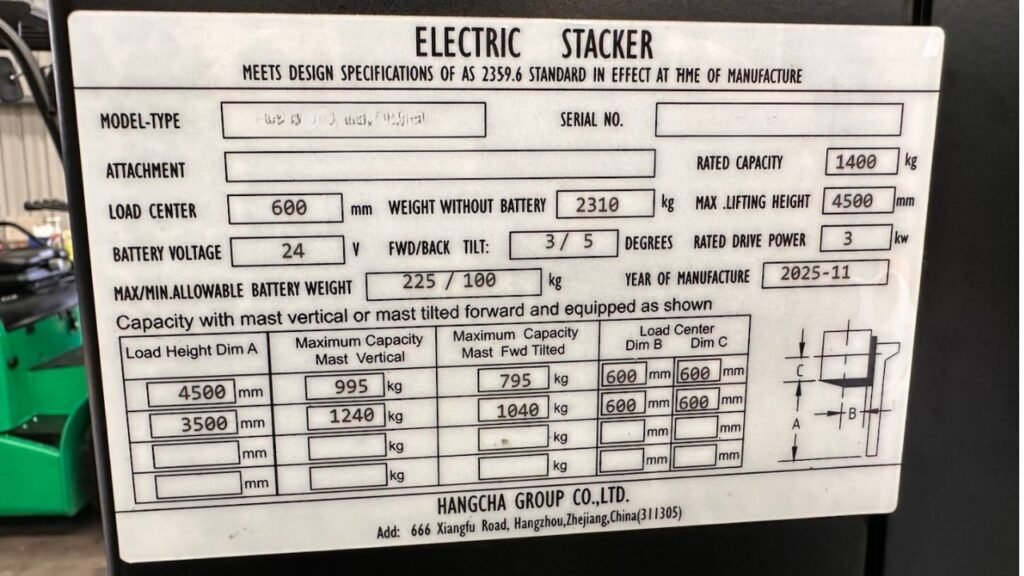
An attachment can be used only when the forklift manufacturer has approved it for that model, it has a rated capacity, and it's listed on the forklift's plate with the capacity of the truck and attachment together. When an attachment is fitted, the supplier amends the plate or adds a supplementary plate, and that combined rating is the first check when choosing a forklift attachment.
Load centre matters when you compare machines. WorkSafe Victoria notes that forklifts in Australia with a rated load over one tonne are typically designed for a 600 mm load centre, and warns buyers that some direct imports are rated at 500 mm.
Seatbelts and operator protection
A sit-down forklift needs an overhead guard and an operator restraint such as a seatbelt, and operators should wear it unless a risk assessment shows it isn't safe and other controls stop them being thrown out. WorkSafe Victoria says Australian Standards have required sequential interlocking seatbelts, which stop the forklift starting or moving until the operator is seated and buckled in, on new forklifts since 2013. For older forklifts without one, regulators encourage retrofitting where reasonably practicable.
Pre-start checks, servicing and inspections
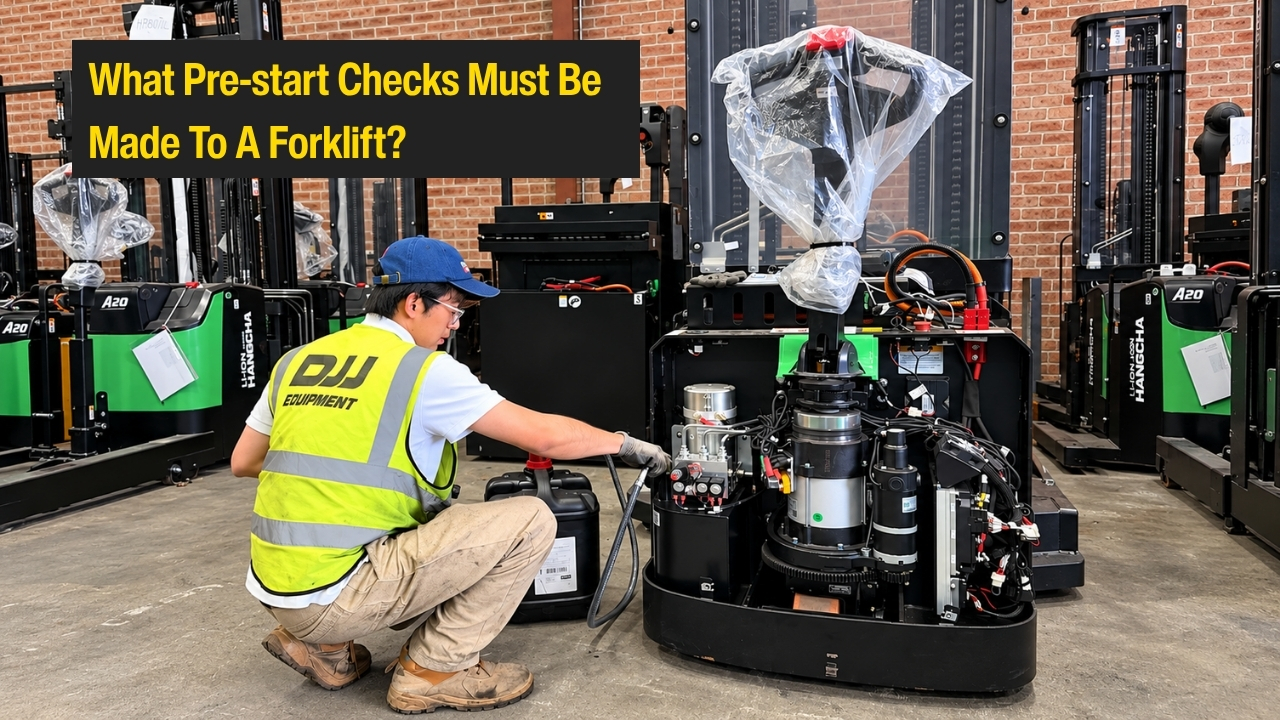
Operators should complete and record a pre-start check at the start of each shift and whenever they change to a different forklift, using the manufacturer's checklist. The WHS regulations require plant to be maintained and inspected as the manufacturer recommends, or as a competent person recommends, and inspected at least once a year where neither is possible. Safe Work Australia recommends servicing forklifts at least every 12 months.
Forklifts don't need design or item registration with the regulator, unlike tower cranes and larger mobile cranes. In-service fork inspection is covered by AS 4973, and our forklift maintenance checklist covers service intervals, fork and chain wear limits and records.
LPG forklifts
LPG forklifts bring gas rules into the picture. AS 4983 covers gas fuel systems for forklifts, and AS/NZS 1596 covers the storage and handling of LP Gas, including cylinder storage. In Queensland, the gas system on an LPG forklift must also be inspected and certified at least once a year under the state's petroleum and gas safety laws.
Buying a forklift: what to ask the dealer
The paperwork matters as much as the machine. SafeWork NSW's guidance on buying a forklift sets out what a buyer should check, and it turns into these questions for the dealer:
- Will you pass on the manufacturer's information: the operator's manual, maintenance schedule and safety information?
- Does the forklift have a readable data plate and load chart, and at what load centre is it rated?
- Are any attachments approved by the manufacturer and listed on the plate?
- Does it have an overhead guard and seatbelt, and a seatbelt interlock?
- Will you confirm in writing that it complies with AS 2359?
- For an LPG forklift, does the gas system have its compliance plate, and in Queensland a current gas certificate?
- For a used forklift, will you give written notice of its condition and any faults, its service history and when its next major inspection is due?
- Are parts and service support available in Australia for this model?
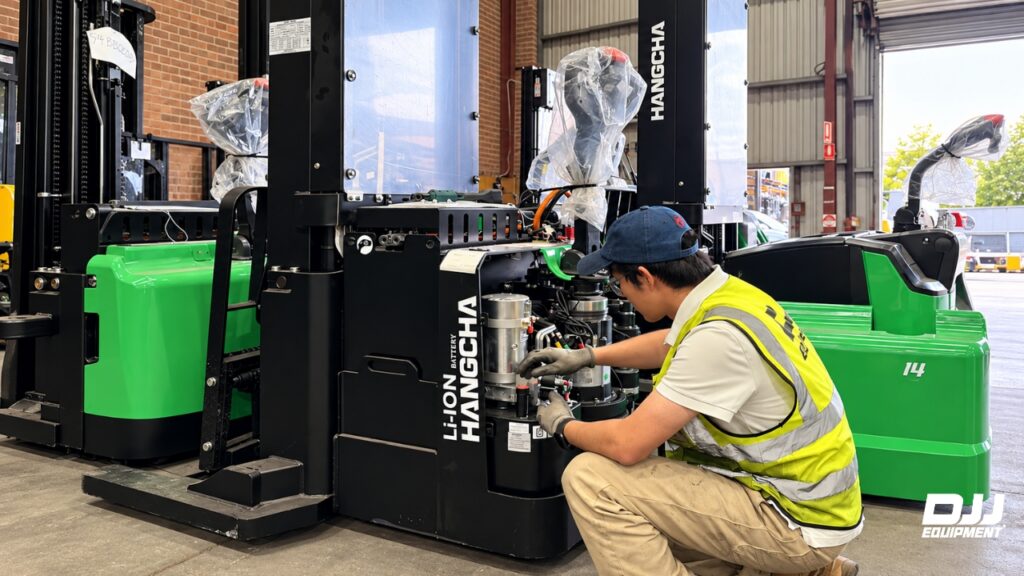
Every machine we sell gets a pre-delivery inspection before it leaves us, and we service all forklift brands from our Sydney, Brisbane and Perth branches.
An imported forklift isn't automatically compliant. The importer must obtain the manufacturer's information and pass it on, and the forklift should comply with AS 2359, so check the data plate, the load centre and the documents before you buy.
Buying a forklift and want to check what comes with it? Ask about the data plate, load chart, manuals and documents for any of the Hangcha forklifts for sale before you buy, or call 1800 355 388.