A forklift traffic plan for a shared warehouse is built from a handful of facts you collect before the truck arrives. You need the truck's speed and stopping distance, the aisle width and floor load it needs, where people walk and when each business is busy, and who is responsible for which part of the building. The numbers matter: WorkSafe Queensland's figures show a forklift needs about 3 m to stop at 6 km/h and 9.5 to 12 m at 16 km/h. These inputs are not a traffic management plan in themselves. The plan has to be written for your site with everyone who shares it.
Why a shared warehouse needs its own forklift traffic plan
In a building with one occupant, one business sets the traffic rules. In a shared warehouse, a third-party logistics site or a multi-tenant building, several businesses have duties for the same aisles, docks and walkways, and none of them controls all the traffic.
Under the WHS laws, each business with a duty for the same matter must consult, cooperate and coordinate with the others, so far as is reasonably practicable. Safe Work Australia's guidance on working with other duty holders uses a multi-tenanted building as its example, and WHS duties can't be transferred to someone else. A lease that says the landlord manages traffic doesn't remove your duty for the forklift you bring in.
Agree early on who will coordinate the plan. It could be the property manager or the business with the most vehicle movements, with every tenant adding what it knows about its own people and trucks.
How the forklift you choose changes the traffic plan
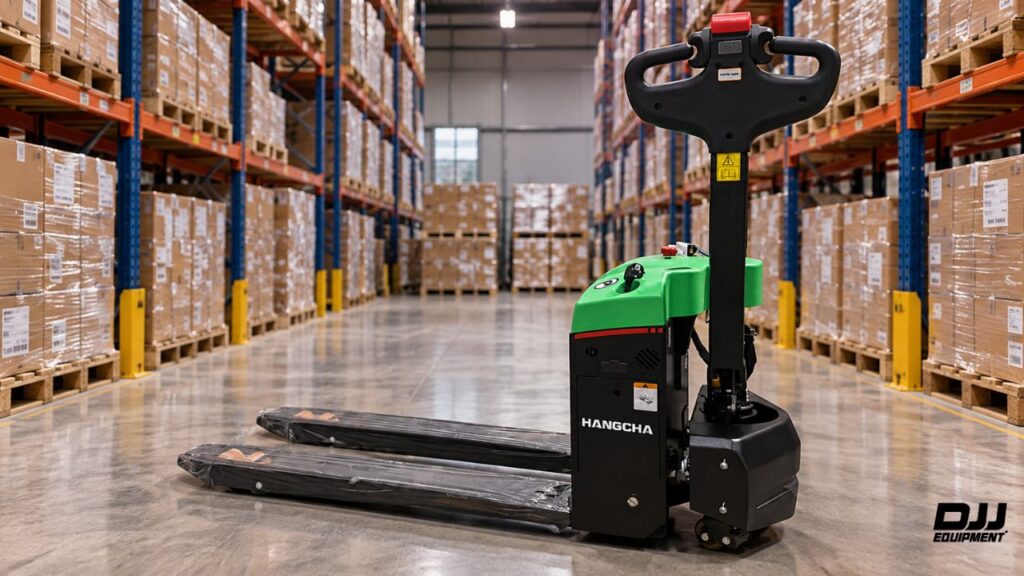
A light, slow truck needs less space, less stopping distance and less floor strength than a ride-on forklift. Safe Work Australia's traffic guide for warehousing says the most effective way to reduce the likelihood and severity of collisions is low-speed, stable, lightweight equipment such as powered pallet trucks or walkie stackers. The figures from three Hangcha trucks show why.
| Truck | Top travel speed | Aisle for a 1000 x 1200 mm pallet crossways |
|---|---|---|
| A Series walkie pallet truck 2 t | 5 km/h | 1,902 mm |
| A Series reach truck 2-2.5 t (CQD20) | 10.5 km/h | 2,745 mm |
| XF2 Series diesel or LPG forklift 1.5 t | 19-20 km/h | 3,595 mm |
If the new machine mainly moves pallets at floor level between the dock and a staging area, electric pallet jacks may do the job with far less risk to the people around them. Ride-on counterbalance trucks and reach trucks earn their place when you need to lift into racking, load trucks at the dock or carry heavier pallets.
The truck type also decides who can drive it. A ride-on forklift needs a High Risk Work Licence class LF, and an order picker whose controls rise with the load needs class LO.
Pedestrian-operated trucks are different: pallet trucks and walkie stackers need training but no high risk work licence. Check licences and training for every business whose staff might use the truck, not only the one that owns it.
How far does a forklift need to stop?
A forklift travelling at 16 km/h needs three to four times the distance to stop that it needs at 6 km/h. A loaded forklift can't stop quickly, and the distance grows fast with speed. WorkSafe Queensland's traffic management template gives these minimum stopping distances from braking tests with an alert, skilled driver on a level surface:
| Speed | Distance travelled while the driver reacts | Actual emergency stopping distance |
|---|---|---|
| 6 km/h | 2.5 m | 2.9 to 3.2 m |
| 12 km/h | 5.0 m | 7 to 8 m |
| 16 km/h | 6.7 m | 9.5 to 12 m |
| 18 km/h | 7.5 m | 11 to 14 m |
Use those distances when you decide where speeds must drop: at crossings, at the ends of aisles, near doors and docks. Each site sets its own limits by area, and SafeWork NSW notes that speed limiters, or location detectors that slow a forklift automatically in set zones, can enforce them. Some trucks slow themselves already: the Hangcha A Series stand-up 3-wheel electric forklift slows automatically in corners.
Will the forklift fit the aisles, doors and ceiling?
A forklift that fits the main aisle can still be stopped by a narrow cross-aisle, a fire door or a roller door lower than the rest of the building. The tightest point on the route decides whether the truck fits, so walk every route it will use and measure the narrow and low spots.
Aisle width depends on the truck and the load together. A 1.5-tonne engine forklift needs almost twice the aisle of a walkie pallet truck for the same pallet: 3,595 mm against 1,902 mm. Reach trucks work in narrower aisles than counterbalance forklifts because they carry the load closer to the truck. A pallet picked up the long way needs more room again.
Height matters at every stage of the lift. Check the lowered mast height against doorways and dock headers, then the lift height and free lift against lights, sprinkler heads, ducts and mezzanines.
Have these measurements ready before you compare forklifts, so the shortlist only includes trucks that fit the building.
Can the warehouse floor carry a loaded forklift?
Floors in older or converted buildings were not always designed for forklift traffic. The Hangcha XC Series FB20Li electric forklift, for example, weighs 4,010 kg before it picks up its rated 1,810 kg at a 600 mm load centre, and most of that combined weight sits on the front wheels when the load is raised. A walkie pallet truck such as the A Series 2 t weighs 490 kg.
The weak spots are joints and slab edges, ramps, dock plates and any area that has cracked or settled. Ask the building owner for the floor's design load and condition, give them the truck's service weight and rated capacity, and have a structural engineer check it if the information isn't available. In a shared building the landlord may own the floor, so raise it with them early.
Mapping people and vehicles in a shared warehouse
Map a normal day and a peak day for every business in the building. Note shift times and overlaps, when trucks and vans arrive and which docks each tenant uses, and where picking, packing and stocktakes put people on foot among the racks. Add everyone else who comes in: visiting drivers, contractors, cleaners, office staff and customers collecting goods.
Then estimate how often forklifts and people will meet in each area during a shift. Safe Work Australia lists this as part of a warehouse traffic plan, because it shows where controls matter most. A forklift that passes a packing bench all day needs a different answer from one that crosses a walkway twice a shift.
Separating pedestrians from forklift routes
The first step is to design the layout so people and forklifts don't meet, with separate routes, separate areas or overhead walkways. Only where that isn't reasonably practicable do you move on to controls that reduce the risk.
Safe Work Australia's warehouse guide lists the controls to use next. They include barriers or fences between walkways and forklift areas, separate pedestrian doors beside vehicle doors, railings or bollards where people could step out from a blind spot, pedestrian exclusion zones, and right-of-way rules that say who gives way. Painted lines mark routes and crossings, but they won't stop a forklift that swerves or reverses, so use barriers where people and forklifts work side by side.
One-way routes and fewer intersections cut down head-on meetings. A site map at each entrance shows tenants and visitors how traffic flows.
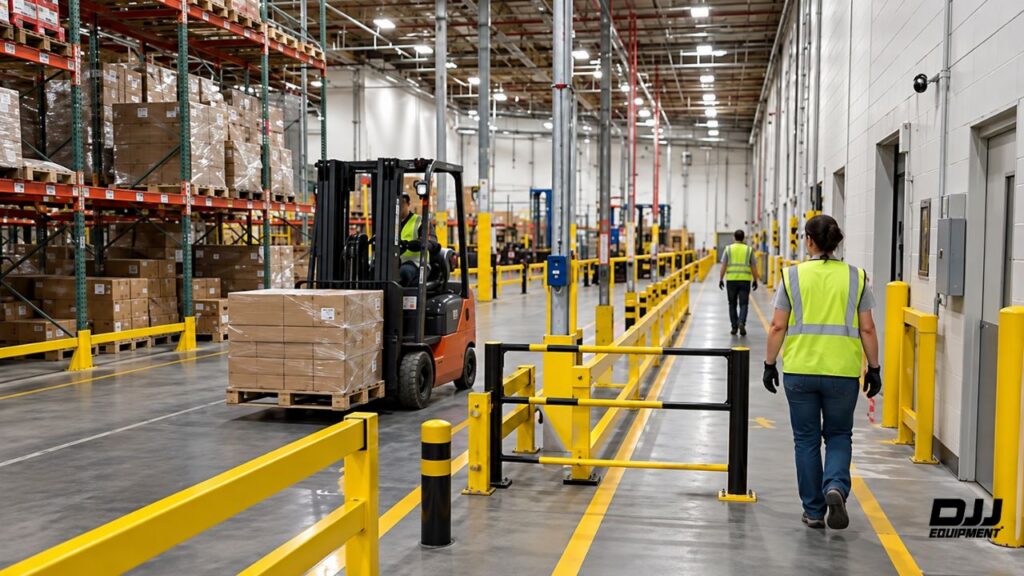
Forklifts, loading docks and visiting drivers
Docks are where forklifts, tenants' staff and visiting drivers meet, and visiting drivers don't know your routes. Safe Work Australia says drivers should wait in a designated safety zone and that operators should not load or unload until everyone is clear.
WorkSafe Queensland's template suggests that where a vehicle such as a courier van, bulk tanker or waste truck doesn't need a forklift to load or unload, all mobile plant and other vehicles should keep at least 3 metres from it to protect its driver. In a shared building, agree dock times between tenants so two businesses are not loading at the same bay at once. Decide, too, whose rules apply to a driver who delivers to more than one tenant.
Where will the forklift park and charge?
Every forklift needs a marked place to park and charge that is off walkways and away from main aisles. Trucks pulling in and out of a charging bay beside a busy aisle force passing traffic around them.
Lead-acid batteries need a ventilated charging area, while lithium batteries can be topped up during breaks: the Hangcha XH Series 2-3.8 t charges fully in about an hour. The choice between lithium and lead-acid forklift batteries changes how much space you set aside.
Writing the forklift traffic management plan and keeping it current
A written plan records the travel paths and entry points, the pedestrian routes and how often vehicles and people interact. It sets out the control for each interaction, with drawings of barriers, walkways and signs. It also names who manages traffic, the procedures for emergencies and how the plan will be checked.
WorkSafe Queensland's traffic management template gives a worked example to start from. Put the finished plan into every tenant's site induction, and give visiting drivers the parts that apply to them.
Review the plan after any incident and whenever something changes: a new tenant, a new truck, new racking or new dock times.
If you are adding a forklift to a shared building, send the DJJ Equipment team a floor plan, your pallet sizes and weights, the racking heights and the door sizes. DJJ offers a free fleet assessment and on-site visit to look at the site and the equipment you need. Call 1800 355 388 or send an enquiry to your nearest branch.