An Australian summer works a forklift harder in two ways at once. The heat makes the radiator, battery, controller and tyres shed heat more slowly, and the Christmas peak, harvest and the pre-break rush on construction sites push the truck's hours up. In the heat, watch four things: dust in the radiator, charging a hot battery, tyres on hot bitumen and trucks worked at full load all afternoon. Service the truck before the hot months and spread the work so no truck runs flat out through the hottest hours.
What summer heat does to a forklift
Every cooling system on a forklift works by passing heat to the air around it. The hotter that air, the smaller the temperature difference, so the same radiator, oil cooler or battery pack sheds heat more slowly on a 40-degree afternoon than on a mild morning. Parts then run hotter, wear faster and, on electric trucks, cut back power to protect themselves. The table lists what heat does to each part and what to check.
| Part | What heat does | What to check |
|---|---|---|
| Radiator and oil coolers | Dust in the fins blocks airflow, so the engine and transmission run hotter | Clean the fins with the engine cold; check coolant, hoses and belts |
| Lead-acid battery | Heat speeds up wear and water loss | Electrolyte level after charging; ventilation in the charging area |
| Lithium battery | The battery management system slows charging when the cells are hot | Park and charge in the shade; keep charger vents clear |
| Motor controller | The truck slows or lifts more weakly to protect itself | Clean vents and fans; report repeat slowdowns |
| Hydraulic oil | Oil thins, so worn seals and pumps leak more inside the system | Oil level, leaks, cylinder rods; grade as the manual says |
| Tyres | Pneumatic pressure rises; solid tyres build up heat on long runs | Pressure checked cold; cracks or chunking on solid tyres |
| Brakes | Fluid absorbs moisture over time, which lowers its boiling point | Pedal feel; fluid changed when the manual says |
The checks split between the technician and the operators. Radiator cleaning, coolant, hydraulic oil and brake fluid belong in a pre-summer service, while operators can watch battery water, tyre pressures and repeat slowdowns on every shift.
Book the forklift's pre-summer service before the peak
The best time to service a forklift for summer is spring, before the heat and before the Christmas peak. A breakdown in the busiest month of the year costs more in lost work than at any other time, and it is harder to find a spare truck.
Follow the schedule in the manual for your model rather than a general rule. Heavy use, dust and heat can count as severe conditions in the manufacturer's schedule, so check how often your forklift should be serviced against its hours and the work it does.
Ask the technician to note anything the heat will make worse: a weeping hose, a cracked tyre, a battery that runs flat early. Those repairs are easier to plan in October than in the middle of January.
For the service itself, DJJ Equipment's technicians provide on-site forklift servicing within 50 km of the Silverwater, Meadowbrook and Bayswater branches, and each branch holds common parts. DJJ services all forklift brands and repairs Hangcha forklifts, with repairs on other brands assessed case by case.
Keeping air moving through an engine forklift's radiator
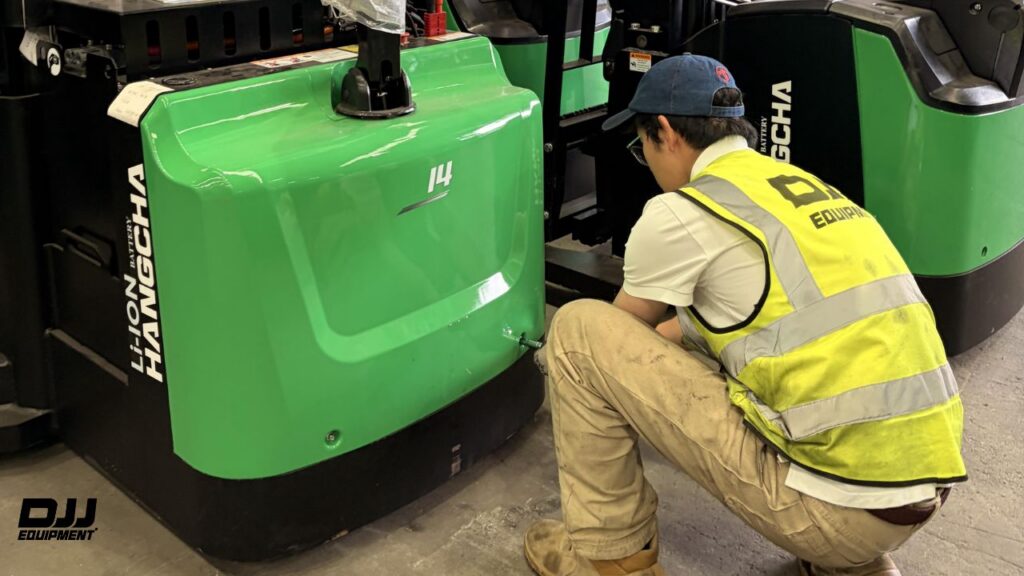
On LPG and diesel forklifts, a clogged radiator is the first thing to check in summer. Dust, lint, chaff and leaves pack into the fins, airflow drops, and the engine and transmission run hot. Clean the radiator and oil coolers as the manual describes, with the engine cold, and more often on dusty yards.
Some trucks are built with dusty, hot sites in mind. The Hangcha XF Series diesel and LPG forklift 5-7 t has an aluminium radiator designed for severe environments. The A Series diesel 4-5.5 t has an air filter with a safety element and a maintenance reminder as standard.
Check coolant only when the engine is cold, never by opening a hot radiator cap. Look for soft or cracked hoses and loose or glazed fan belts. If the temperature gauge climbs, stop and report it rather than finishing the shift.
Store spare LPG cylinders as your gas supplier instructs, and leave any work on the gas system to a licensed gas fitter.
How heat affects electric forklift batteries and controllers
Heat shortens the life of both lead-acid and lithium batteries, but in different ways. Lead-acid batteries lose water faster and wear quicker when they run hot. Check the electrolyte level after charging, top up with the water the battery maker specifies, and charge in a ventilated area.
Lithium batteries don't need watering, but a hot lithium battery charges more slowly, because its battery management system limits the current to protect the cells. Park and charge in the shade, and don't leave a truck in full sun between shifts. For a second summer shift, lithium and lead-acid forklift batteries differ most in charging time: lead-acid needs long charging and cooling periods, while lithium can be topped up at breaks.
An electric forklift that slows down or lifts weakly on a hot afternoon, with plenty of charge left, may be protecting its motor controller from overheating. Keep the vents and fans around it clean, and report it if it keeps happening.
Trucks with liquid cooling handle this better. The Hangcha XH Series 2-3.8 t runs a 309V lithium battery with water cooling and charges fully in about an hour. The XH Heavy Duty 6-10 t cools both the motor and the battery with water and is built for long, high-intensity shifts in heat or heavy rain.
Forklift tyres, hydraulics and brakes in hot weather
Check pneumatic tyre pressures cold, before the shift, because the reading rises as the tyre warms. Solid tyres don't lose pressure, but they build up heat on long, continuous runs over hot concrete or bitumen, so look for cracking, chunking and separation. Some ranges offer either: the XF2 Series diesel and LPG forklift 1.5-3.5 t comes on pneumatic or solid tyres depending on the model.
Hydraulic oil thins as it heats, so worn seals leak more inside the system and the oil gets hotter still. Check the level and look for leaks at cylinders, hoses and fittings. Use the oil grade in the manual, and don't switch to a summer grade without the manufacturer's advice. Brake fluid absorbs moisture, which lowers its boiling point, so change it on the manual's schedule.
Planning forklift hours around the heat
The hardest summer work for a forklift is long, continuous travel, steep ramps, heavy loads lifted again and again, and yard work in full sun. Share that work across trucks, give each one a break, and move the heaviest jobs to the morning. Safe Work Australia's heat guide makes the same point for people, suggesting physical work is scheduled for the cooler parts of the day.
If one truck can't keep up with the peak without running flat out all shift, a second truck for the peak can cost less than a breakdown in December. Forklift hire lets you add a truck for the Christmas peak or harvest and hand it back afterwards, and minimum hire terms depend on the machine and branch.
Keep a note of which trucks overheat or slow down, and when. That record tells the technician where to look and tells you whether the fleet is the right size.
A truck that struggles every summer may simply be too small or the wrong type for the work. When it's due for replacement, compare forklifts by capacity, power type and cooling, not just price.
Keeping forklift operators safe in the heat
Heat affects the people driving forklifts as much as the trucks. Businesses have a duty to manage the risks of working in heat, and operators in open yards, hot cabins and warehouses under metal roofs can be exposed for a whole shift.
Safe Work Australia's guide to managing the risks of working in heat lists controls such as shade, air-conditioning and insulating buildings. It also warns that heat stress is still possible in the cooler hours, and says businesses should consult workers when they assess the risk.
On the truck, a roof or cab helps most outdoors. The X Series diesel forklift 14-18 t has a climate-controlled tilting cabin as standard, and a cab is an option on the A Series diesel 4-5.5 t. Add cool drinking water close to where the forklifts work, shaded break areas, and a daily pre-start check that covers coolant, tyres and battery charge.
Tell the DJJ team the model, its hours, whether it works indoors or outside and how many shifts it will run over the peak. They can book a service before summer or arrange a hire truck for the busy months. Call 1300 646 747 to book a service, 1800 355 388 for hire, or send an enquiry to your nearest branch.