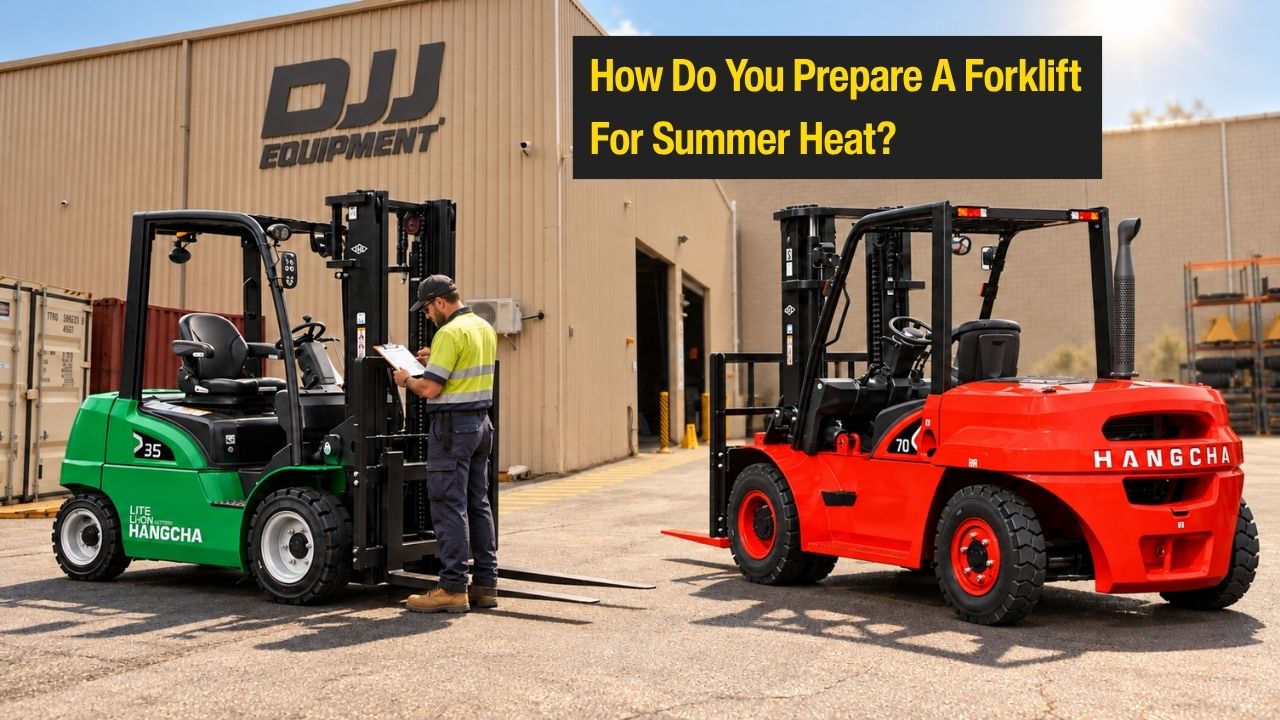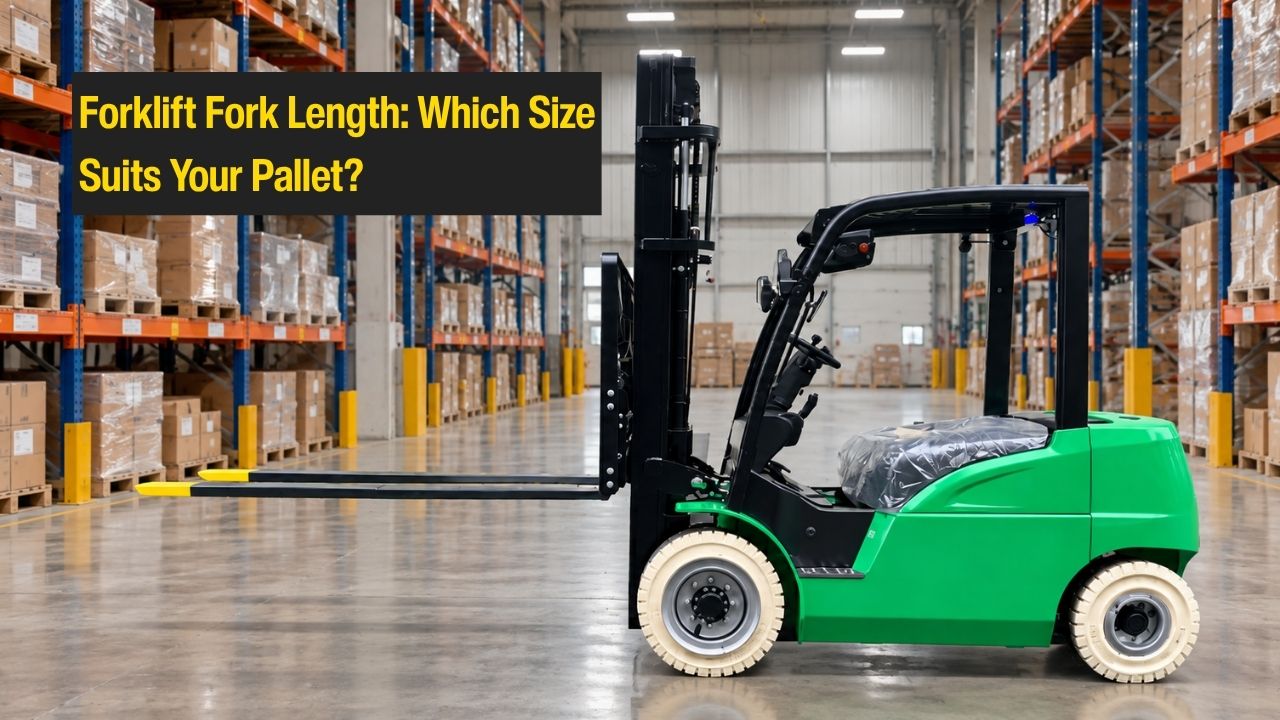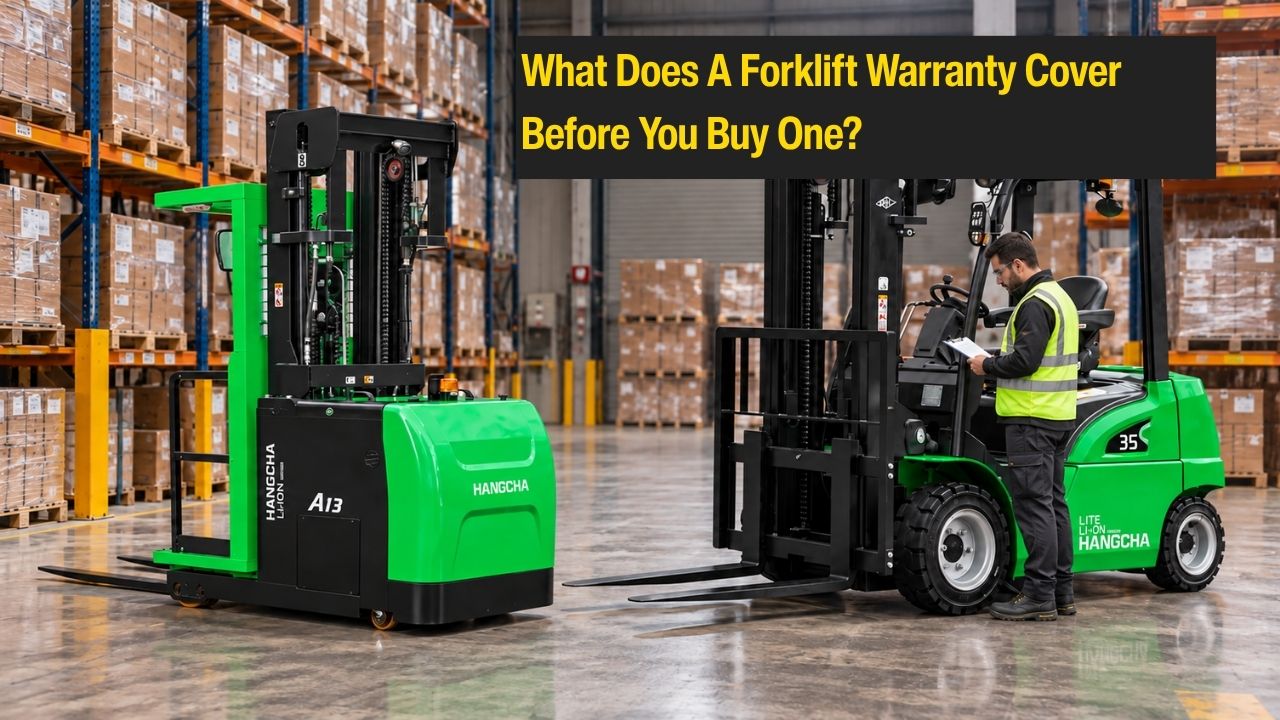
Most electric pallet jacks come with 1,150 mm forks, which suit the 1165 x 1165 mm pallets used across Australia. Measured across both forks, the spread is usually 520-700 mm. Length matters because the load wheels in the fork tips must drop into a gap between the bottom boards. It also keeps the load within the truck's rated load centre, usually 600 mm. Longer forks carry more pallets per trip but make the truck turn wider. The A Series center-control rider on 2,440 mm forks turns in 2,915 mm, while the compact A Series walkie 2 t turns in 1,532 mm.
The table lists the fork sizes on the Hangcha electric pallet jacks DJJ Equipment sells.
| Model | Standard fork length | Optional fork lengths | Width across both forks | Turning radius |
|---|---|---|---|---|
| WS Series 1.5-2 t | 1,150 mm | 1,220 mm | 520, 550 or 685 mm (CBD15-WS) | 1,353-1,426 mm |
| WD Series 1.5-2 t | 1,150 mm | 1,220 mm | 560 mm, or 680 mm as an option | 1,374 mm |
| XA Series mini 1.5-2 t | 1,150 mm | 1,220 mm | Not listed | 1,445 mm |
| A Series walkie 2 t | 1,150 mm | 1,220-2,400 mm | 540 mm, or 560-700 mm as options | 1,532-1,597 mm |
| XA Series stand-on 2 t | 1,150 mm | 2,400 mm | Not listed | 1,792-1,860 mm |
| X Series rider 2-3 t | 1,150 mm | Not listed | 540 mm | 2,052-2,120 mm |
| A Series walkie 2.7-3.6 t | 1,220 mm | 1,372-3,658 mm | Not listed | 1,840-1,955 mm |
| A Series end-control rider 2.7-3.6 t | Not listed | 2,438 or 3,658 mm | Not listed | 2,035 mm |
| A Series center-control rider 2.72-3.63 t | 2,440 mm | Not listed | Not listed | 2,915 mm |
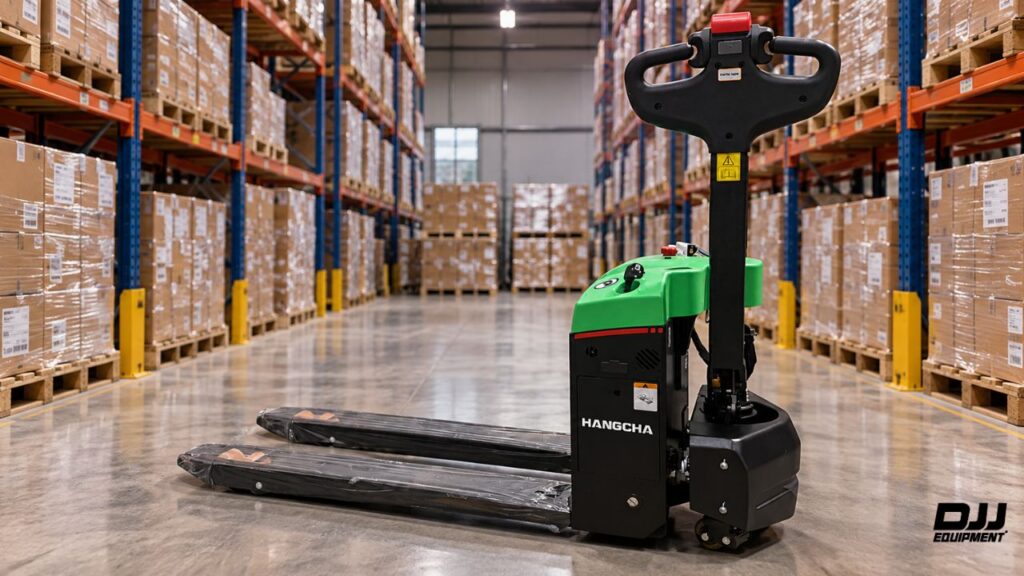
Every walk-behind model in DJJ's range of electric pallet jacks starts at 1,150 mm, or 1,220 mm on the heavier A Series walkie. The listed widths sit between 520 and 700 mm. The long forks belong to the stand-on and rider trucks built to carry several pallets, and their turning radius shows the cost of that length.
How long should pallet jack forks be for an Australian 1165 x 1165 mm pallet?
A 1,150 mm fork suits the Australian standard pallet, which the pallet pool companies CHEP and Loscam list at 1165 x 1165 x 150 mm. Pushed in until the fork heel touches the pallet face, a 1,150 mm fork reaches almost the full depth, so the tips don't stick out the far side. A 1,220 mm fork, an option on the WS and WD Series, also suits pallets about 1,200 mm deep.
Capacity is the other reason length matters. Pallet trucks are rated at a load centre, the distance from the fork face to the centre of the load. It is 600 mm on the WS Series and the XA Series stand-on, and 610 mm on the A Series walkie 2.7-3.6 t. An evenly loaded 1165 mm pallet pushed fully onto the forks has its centre about 583 mm out, inside that rating.
What happens when pallet jack forks are too long or too short?
Pallet jack forks that are too long stick out past the pallet, where the tips can catch the next pallet, a wall or the front of a trailer. They also make the whole truck longer, and a longer truck needs a wider turning circle and aisle. The center-control rider is 3,918 mm long on its 2,440 mm forks and turns in 2,915 mm.
Forks that are too short, or pushed in only part of the way, cause the opposite problems. The load overhangs the fork tips and its centre moves further out than the rating allows. The load wheels can also come to rest on a bottom board instead of the floor. When the forks lift, that board takes the load and can crack.
Push the forks fully in on every lift. Choose the length for the deepest pallet you handle day to day, not the longest load you might move once a year.
Where should a pallet jack's load wheels sit under the pallet?
A pallet jack's load wheels, the small wheels in the fork tips, should stand on the floor in a gap between the pallet's bottom boards. The way a pallet jack lifts is by pushing those wheels down. A wheel resting on a board has nowhere to go, so the board takes the weight.
The wheels also move as the forks rise. The linkage swings them back towards the fork heel. If the forks are the wrong length for the pallet, a wheel that starts in a gap can finish against a board. Test a truck on your own pallets, lowered and raised, from every side you plan to enter.
Wheel design helps on the way in. The A Series walkie 2 t has tandem load wheels as standard, and the A Series walkie 2.7-3.6 t has fork-tip guide wheels for smoother pallet entry.
How wide should electric pallet jack forks be?
Electric pallet jack forks should be wide enough to carry the pallet steadily but narrow enough to fit its entry openings. The gap between the forks also has to clear the centre bearer or blocks. A wider spread carries a wide pallet more steadily, while a narrower spread suits smaller pallets and tighter openings.
Widths vary by model and option. The WS Series pallet truck comes in 520, 550 or 685 mm. The WD Series is 560 mm with 680 mm as an option, and the A Series walkie 2 t is 540 mm with 560-700 mm options.
Measure the entry openings on your own pallets before you order, because pool, export and one-off pallets aren't all built the same way. If you handle more than one type, choose the width that fits all of them, and check the forks still clear the centre bearer on the narrowest.
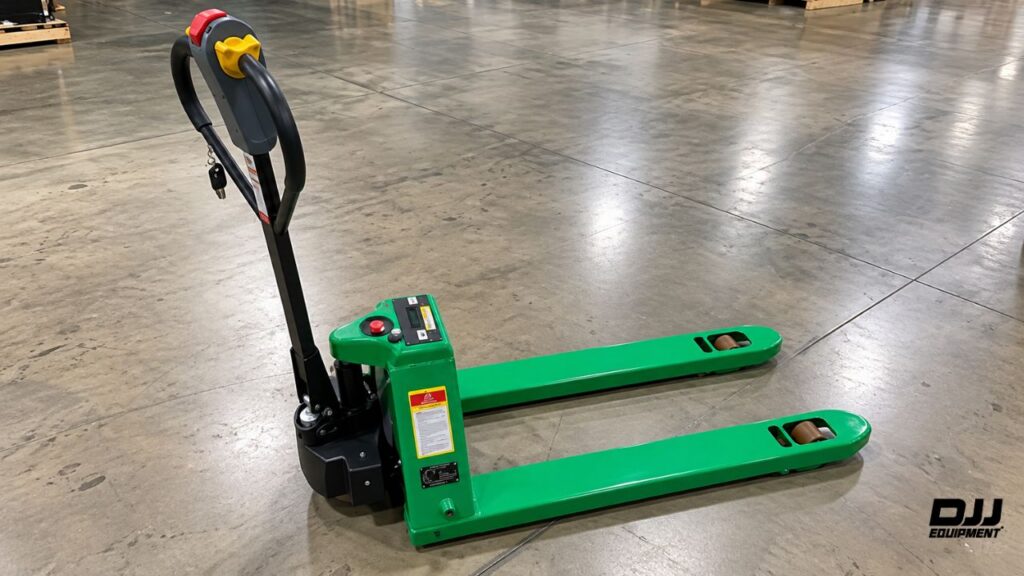
Will electric pallet jack forks fit under low pallets?
The lowered fork height decides whether the forks slide under a pallet at all. The models that list it lower to 80-85 mm. That is 80 mm on the XA Series mini, 82 mm on the WS Series, 83 mm on the center-control rider and 85 mm on the X Series rider.
For pallets with a low entry, the WS Series also comes as the CBD15-WS-65L, with forks that lower to 65 mm. Once under the pallet, the forks lift 120 mm on the XA Series mini and up to 197 mm on the WS Series.
When do you need long forks on an electric pallet jack?
You need long forks on an electric pallet jack when it should move several pallets per trip on long runs across a warehouse or dock. The XA Series stand-on and the A Series walkie 2 t take 2,400 mm forks for two pallets. The A Series end-control rider takes 2,438 or 3,658 mm forks for two or three.
The A Series center-control rider shows the trade-off. Its 2,440 mm forks carry two 1,200 mm pallets end to end, rated at 2,700 or 3,600 kg at a 1,220 mm load centre. But the truck is 3,918 mm long and turns in 2,915 mm.
That suits wide aisles and busy docks, not tight storerooms. If most of your moves are single pallets in narrow aisles, the extra length costs space on every turn.
What to measure before you order an electric pallet jack
Before you order an electric pallet jack, measure the pallets and the space it will work in, not the nominal sizes on a spec sheet:
- the depth of each type of pallet you handle, front to back
- the width and height of the entry openings, and where the bottom boards sit
- the narrowest aisle, doorway or lift the truck has to turn in
- the heaviest loaded pallet, and how far its load overhangs the pallet
- how many pallets you want to move per trip
Pool pallets are 1165 x 1165 x 150 mm, but export and one-off pallets vary. The oddest pallet on site can be the one that decides the fork width or lowered height.
Send DJJ your pallet sizes, your heaviest load and your narrowest aisle, and the team can match an electric pallet jack and fork size to them. Call 1800 355 388 or send an enquiry to your nearest branch.