The main types of telehandlers are fixed boom and rotating, and they come in sizes from compact to high reach, with diesel or electric power. A fixed boom machine always lifts straight ahead, while a rotating machine turns its boom on a turntable and works more like a small crane. Size changes the numbers most: a compact telehandler lifts 2,500 kg to 5.8 m, while a high reach model lifts 4,000 kg to 17.7 m. The chassis adds one more split, between rigid frame machines and articulated telescopic handlers that bend in the middle to steer.
Fixed boom vs rotating telehandlers: what is the difference?
A fixed boom telehandler's boom always points forward, so you move a load sideways by driving the machine, while a rotating telehandler turns its boom and cab through 360 degrees on a turntable. That one difference changes how each type sets up, what it costs and which licence applies when it works as a crane.
Fixed boom telehandlers
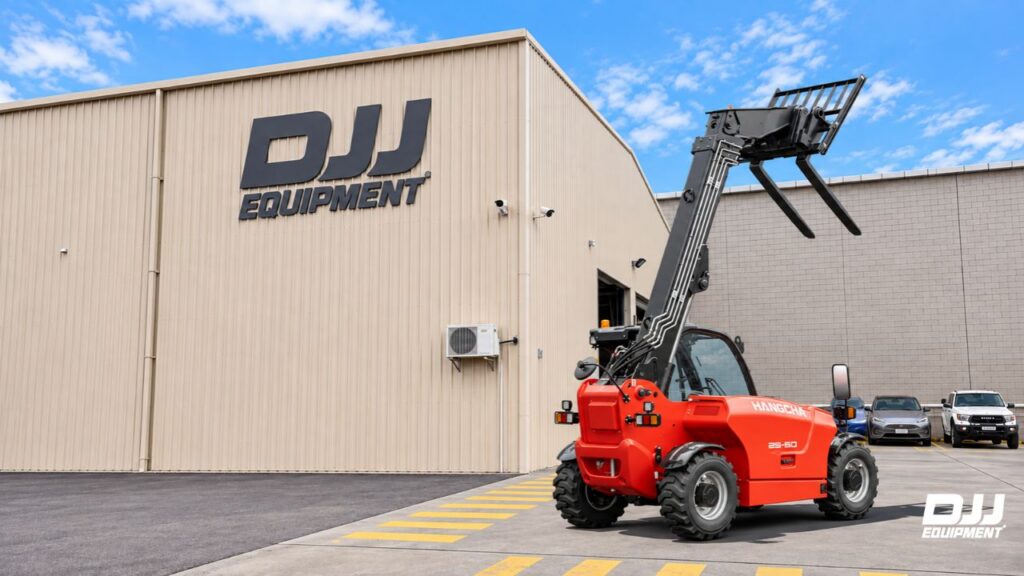
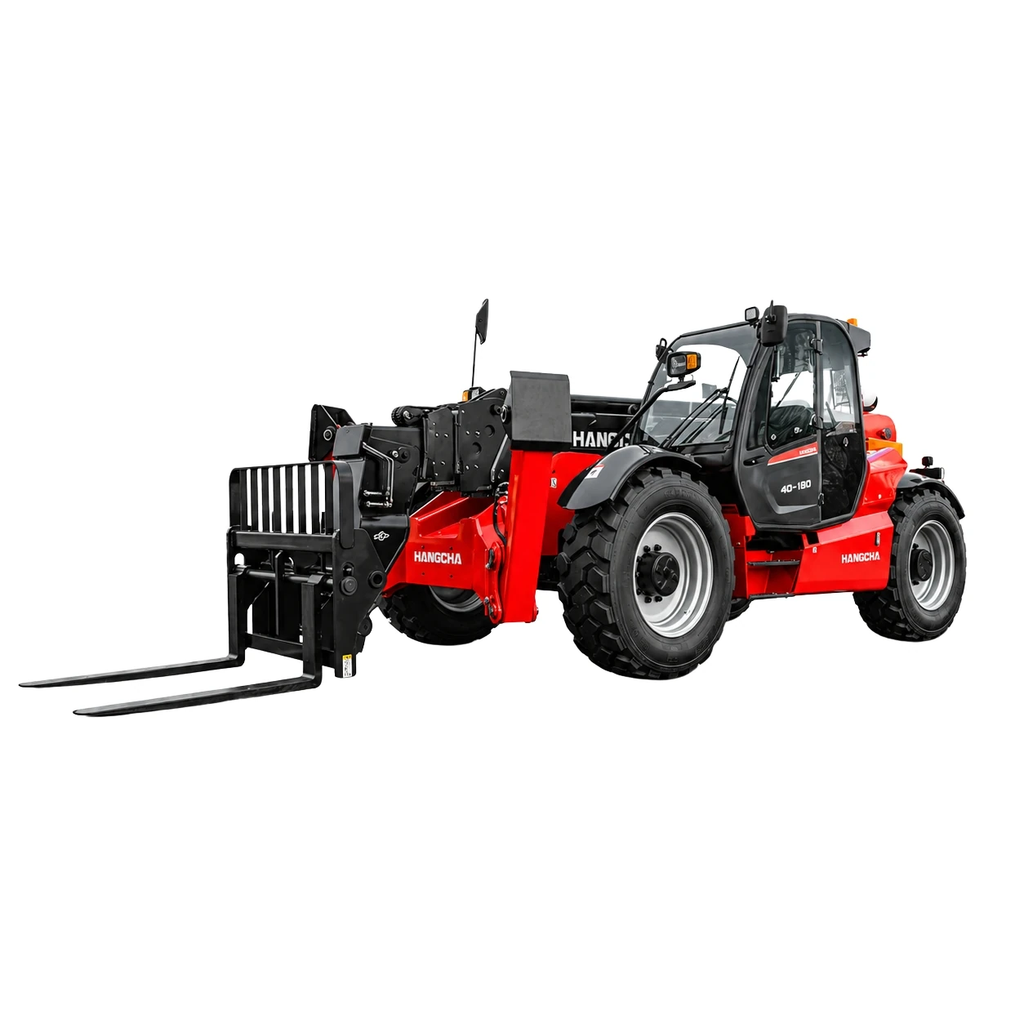
A fixed boom telehandler picks up a load, lowers the boom and carries it across the site. That suits repeated work on farms, building sites and yards, such as loading trucks or moving pallets to a work face. With no turntable or slewing counterweight, it's the simpler and lighter design, and it travels well between jobs: the Hangcha X Series telehandler drives at up to 35 km/h.
Long reach is where a fixed boom machine needs help. Front stabilisers widen its base for high or far placements. On the X Series, the load at full reach is 850 kg with the stabilisers down and 400 kg with them up, and the chart drops from 17.7 m of height to 12.72 m.
DJJ Equipment sells two fixed boom telehandlers, one diesel and one electric, and no rotating models.
Rotating telehandlers
A rotating telehandler sets up on outriggers and swings loads around itself, so one position can take material off a truck on one side and place it on a roof on the other. It suits tight city sites where moving the chassis between lifts is slow or unsafe.
The swing is also its main limit. When the boom turns to the side, the load sits over the narrowest part of the machine's base, so a rotating telehandler needs a heavy counterweight, wide outriggers and a load chart for each slew position. That makes it heavier, more complex and generally dearer than a fixed boom machine, and the operator has more of the chart to read before each lift.
What sizes do telehandlers come in?
Telehandlers come in four broad size classes: compact, mid-size, high reach and heavy lift. There's no fixed industry cut-off between them, so they're easiest to compare through real machines. This table uses the three Hangcha telehandlers DJJ sells, all rated at a 500 mm load centre.
| Size class | Model | Rated capacity | Max lift height | Max forward reach | Load at full reach | Machine weight |
|---|---|---|---|---|---|---|
| Compact | XH T25 (electric) | 2,500 kg | 5.8 m | 3.31 m | 800 kg | 5,500 kg |
| Mid-size | XH T35 (electric) | 3,500 kg | 9.8 m | 7.0 m | 500 kg | 9,600 kg |
| High reach | X Series 4 t (diesel) | 4,000 kg | 17.7 m | 13.02 m | 850 kg | 13,650-13,700 kg |
The rated capacity only applies with the boom close in. At full reach, all three telehandlers carry 500-850 kg, and a bigger machine isn't always stronger out there: the T35 lifts much higher than the T25 but carries 500 kg at its 7.0 m reach, against 800 kg at 3.31 m for the T25. Size a telehandler by your hardest lift on the load chart, not by the tonne figure in its name. The X Series figures are with its stabilisers down.
Compact telehandlers
Compact telehandlers suit sheds, narrow farm lanes and small building sites. The Hangcha XH Series T25 is 1,820 mm wide with 240 mm of ground clearance, and at 5,500 kg it's the lightest of the three to move between sites.
Mid-size telehandlers
Mid-size telehandlers suit general building and farm work. The T35 lifts to 9.8 m and adds frame levelling and 400 mm of ground clearance, but at 9,600 kg it weighs almost twice as much as the T25, which matters on soft ground and for transport.
High reach telehandlers
High reach telehandlers place loads on upper floors, roofs and scaffolding. The X Series carries 2,500 kg at its full 17.7 m height with the stabilisers down, which is more than half its 4,000 kg rating.
Heavy lift telehandlers
Heavy lift telehandlers have reinforced chassis and booms for mining, ports and large infrastructure, with capacities well above the 4 tonne class. DJJ doesn't sell this class. For loads that heavy, compare a heavy lift telehandler with a mobile crane for the job.
Diesel or electric telehandler: how do the power types differ?
A diesel telehandler suits heavier loads, higher lifts and long days away from power, while an electric telehandler suits sheds, enclosed spaces and sites where exhaust or noise is a problem. The two Hangcha series show the trade-off:
- X Series (diesel): a 90 kW Cummins F3.8 or 86 kW Cummins QSF3.8 engine, up to 35 km/h, 40% grades, and 4,000 kg to 17.7 m.
- XH Series (electric): a 310V lithium iron phosphate battery of 46 kWh (T25) or 53 kWh (T35) with permanent magnet motors, no exhaust, up to 25 km/h and 45% grades.
If the telehandler works under a roof or near people for most of the day, electric is the better fit. If you need more than the XH T35's 9.8 m of lift, or the machine works far from a charging point, diesel is the practical choice.
Rigid frame vs articulated telehandlers: how do they steer?
Most telehandlers have a rigid frame and steer with their wheels, while articulated telescopic handlers bend at a hinge in the middle of the chassis. Articulated machines are common in livestock sheds and on farms, where a short machine that turns sharply matters more than reach.
The hinge is also the weak point for stability. When an articulated machine turns hard with a raised load, the load swings toward the outside of the turn while the base on that side gets narrower. A rigid frame keeps its wheels in the same place under the boom, which is why high reach telehandlers are built that way.
Rigid frame telehandlers get their tight turns from steering modes instead. Both Hangcha series have four-wheel drive with a 2WD/4WD switch and front, crab and circle steering, and the X Series turns in 4,100 mm on 400/75-28 tyres. Frame levelling tilts the chassis so the boom stays upright on a side slope: up to 10 degrees on the X Series, also fitted to the XH T35, and not available on the T25.
Which type of telehandler suits construction, farms or yards?
The job decides the type of telehandler: building work usually needs reach, farm work needs a compact machine with buckets and clamps, and enclosed sheds point to electric.
- Building sites: if loads go onto upper floors or roofs, a high reach diesel like the X Series fits, with a crane arm as an option for slung loads. If the machine can't reposition between lifts on a tight site, look at a rotating telehandler.
- Farms: for feed, bales and bulk material, a compact or mid-size machine with a bucket or clamp fits. The XH Series offers a bale clamp and the X Series a soft bag clamp, and both take a bucket.
- Sheds and covered yards: the electric XH Series runs without exhaust, and the T25's 1,820 mm width suits tighter spaces.
If every lift goes straight up and stays close to the machine, a telehandler is the wrong type altogether. Rough terrain forklifts from 1.5 to 10 t lift up to 6 m on a mast and do that work with a simpler machine.
Does the type of telehandler change the licence you need?
In NSW, Queensland and WA, neither type of telehandler needs a high risk work licence when it's fitted with forks or a bucket, but the business must make sure operators are trained to use it safely. The type starts to matter when the telehandler works as a crane:
- Fixed boom (non-slewing): a telehandler rated over 3 tonnes needs a non-slewing mobile crane licence when it's fitted with a boom or jib and a hook.
- Rotating (slewing): a telehandler used as a crane needs a slewing mobile crane licence, with the class set by its rated capacity.
- Work platform: either type needs a WP licence when a work platform is fitted to the boom and the boom length is 11 metres or more.
The LF forklift licence doesn't apply to either type. WorkSafe WA defines a forklift truck as one with a mast, and the boom is what sets what a telehandler is apart from a forklift.
Victoria is stricter. There, a fixed boom telehandler rated over 3 tonnes needs a high risk work licence even with forks, and a rotating telehandler needs a slewing mobile crane licence based on its rated capacity. Fixed boom machines of 3 tonnes or less need no specific licence, but the employer must provide information, instruction, training and supervision. Both the X Series and the XH T35 are rated over 3 tonnes.
Queensland calls these machines multi-purpose tool carriers, and WorkSafe Queensland lists a grab alongside forks and buckets as an attachment that needs no licence. Before a telehandler lifts slung loads or people, confirm the licence for that machine and attachment with your state regulator.
The right type of telehandler comes from your hardest lift and your site: how far out and how high the load goes, whether the machine can reposition, and whether it works under a roof. DJJ sells the electric XH Series and the diesel X Series from Silverwater, Meadowbrook and Bayswater, and we also hire telehandlers. Send us the load weight, the height and reach you need and your site conditions, or call 1800 355 388, and we'll suggest the model that fits.