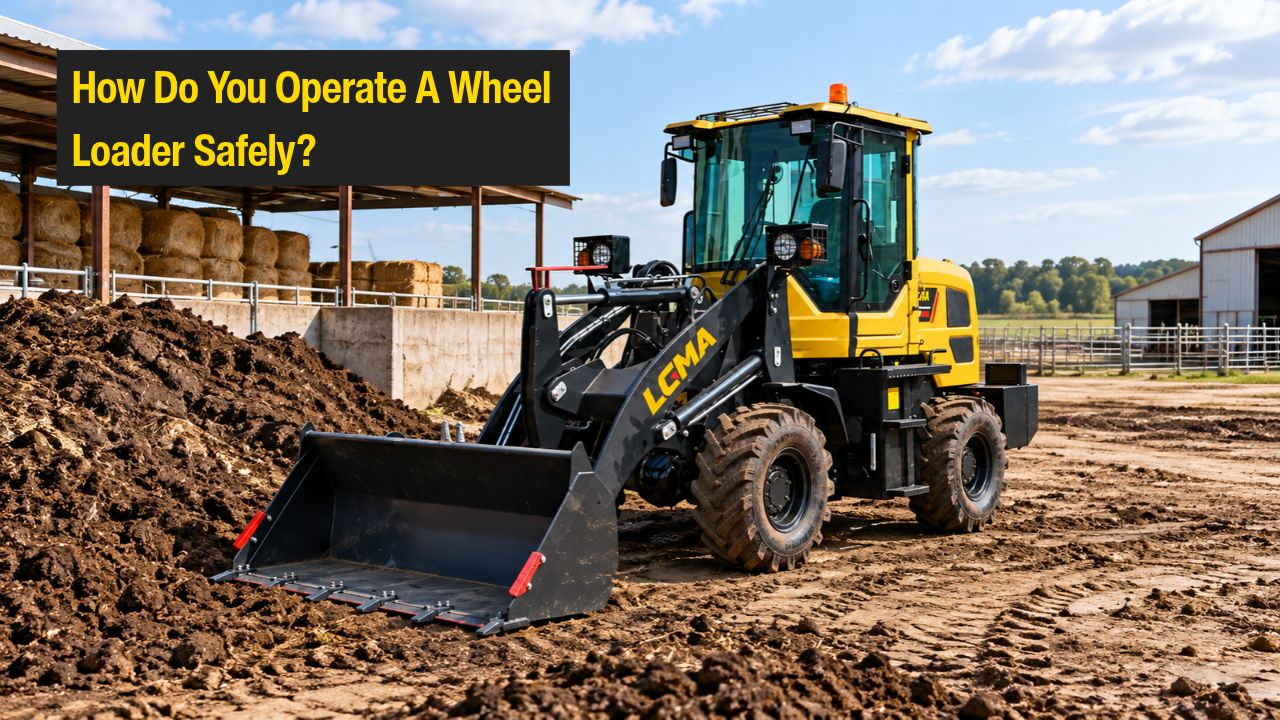
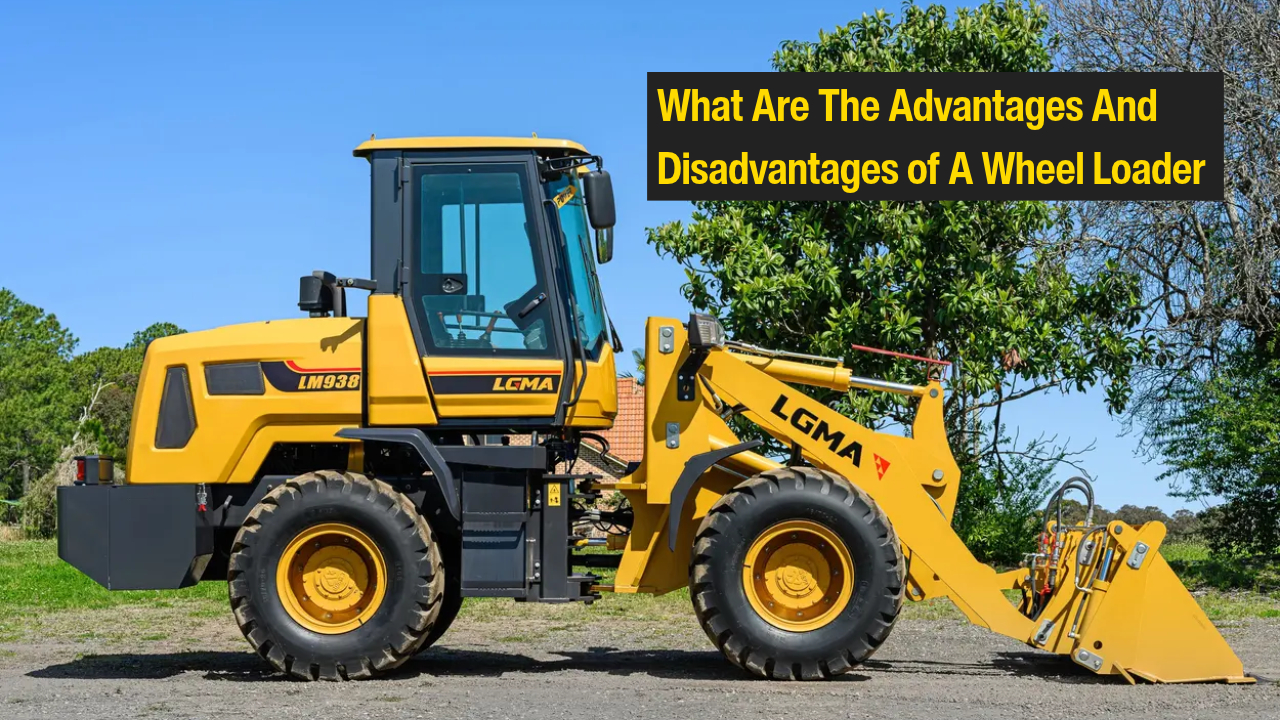
A wheel loader has seven main groups of parts. The front and rear frames meet at an articulation hinge, with the loader arms, cylinders and bucket mounted at the front. The rear frame holds the diesel engine and torque converter transmission. Two driven axles on large tyres, a hydraulic system that both lifts and steers, the brakes and the cab complete the machine. The LGMA LM938 sold by DJJ Equipment is a typical mid-size example: 5,200 kg with a 76 kW engine and a 1.0 m³ bucket rated for 2 tonnes.
How do the frames and articulation hinge of a wheel loader work?
A wheel loader is split into a front frame and a rear frame joined by an articulation hinge, and it steers by bending at that joint. The front frame carries the loader arms, bucket and front axle. The rear frame carries the engine, transmission and rear axle.
Bending in the middle lets the rear wheels follow the track of the front wheels, so the loader turns tighter than a rigid machine of the same length. The LM940 articulates 37°, and turning radii across the LM range run from 4,500 mm on the LM938 to 6,000 mm on the LM940 and LM946.
The hinge takes the whole load whenever the machine turns with a full bucket. The LM938 and LM946 use a triple-layer articulating hinge, and wheelbases run from 2,220 mm on the LM920 to 2,710 mm on the two largest models. Its pins and bushes are among the first places to check for wear, because every turn of the articulated steering loads them.
What do the loader arms, cylinders and bucket do?
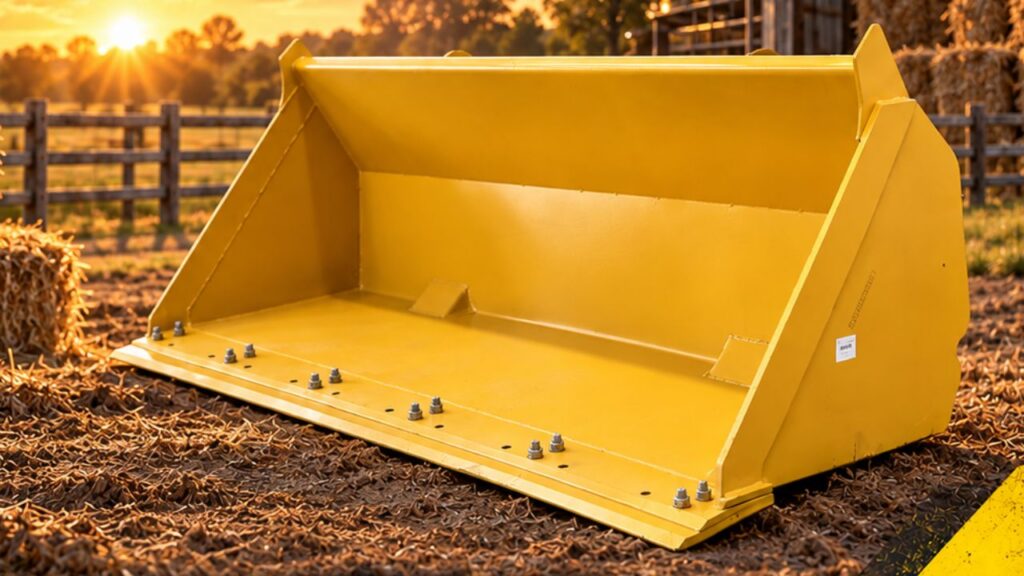
The lift cylinders raise and lower the loader arms, and the tilt cylinder curls the bucket back to hold a load and tips it forward to dump. On the LM930 and LM938 the bucket rises in 5 seconds and lowers in 4. The larger LM940 and LM946 take 6.5 and 5.5 seconds.
Linkage design shapes how the bucket behaves. A Z-bar linkage gives more breakout force at ground level for digging into a pile, while a parallel linkage keeps forks level as the arms rise, which suits pallet work. If most of your work is with forks, ask which type a loader uses.
Bucket width runs from 1,900 mm on the LM930 to 2,400 mm on the LM946, with dump heights of 3,200 to 3,800 mm. Pallet forks, a 4-in-1 bucket, a log grapple, a hay fork, a sweeper, an auger and a dozer blade all appear on the LM attachment list, and a quick hitch is optional on the LM920. Each one loads the arms differently, so wheel loader attachments have to be rated for the machine they go on.
What engine and transmission does a wheel loader use?
A diesel engine drives both the wheels and the hydraulic pump on a wheel loader. A torque converter links the engine to the transmission through oil rather than a clutch, so the engine keeps turning when the bucket hits a heavy pile instead of stalling.
The table lists the engine, axle and tyres on four LM models, taken from the LGMA brochures.
| Model | Engine | Cylinders | Rated power | Axle | Tyres |
|---|---|---|---|---|---|
| LM930 | Weichai Huafeng 4102 | 4 | 65 kW at 2,400 rpm | Small hub reduction | 20.5/70-16 |
| LM938 | Weichai Huafeng 4102T | 4 | 76 kW at 2,400 rpm | LG20 hub reduction | 16/70-20 |
| LM940 | Yuchai 4105T | 4 | 85 kW at 2,600 rpm | LG28 hub reduction | 16/70-24 |
| LM946 | Weichai Deutz WP6G125 | 6 | 92 kW at 2,200 rpm | 2.8T hub reduction | 17.5-25 |
Power and tyre size climb with weight through the range. The LM946 is the only six-cylinder model, and its 650 kg engine weighs about twice the 320 kg engine in the LM938. The entry LM920 uses a 42 kW Yunnei 490 engine, with a mechanical gear change as standard and an electronic change as an option.
The LM930, LM938, LM940 and LM946 pair the torque converter with an automatic transmission that has 4 forward and 4 reverse speeds.
What do the axles and tyres on a wheel loader do?
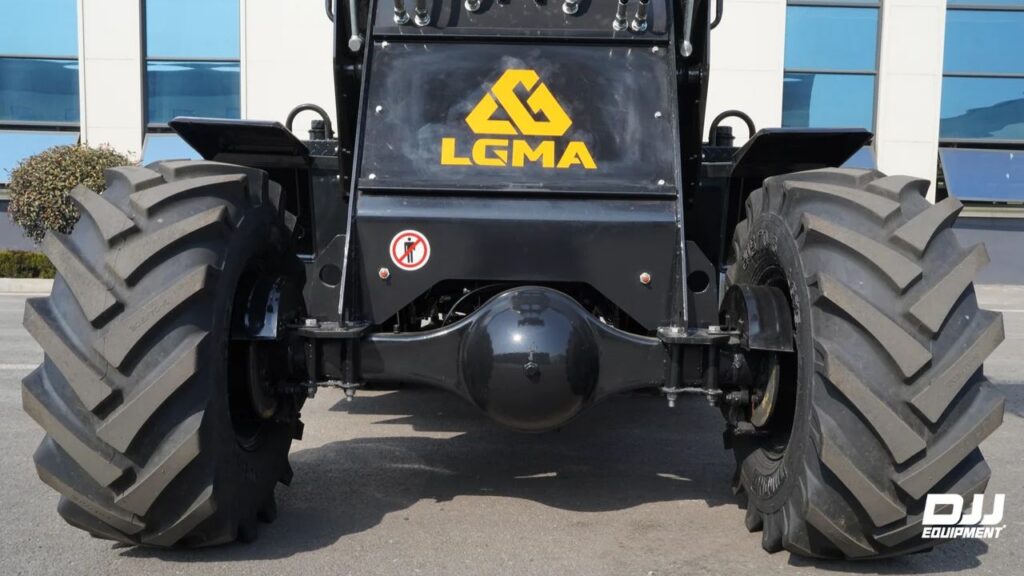
Both axles on a wheel loader are driven, and hub reduction gears at each wheel multiply torque right where it reaches the ground. Because the final reduction happens at the wheel, the axle shafts carry less torque than they would if all of it happened in the centre of the axle.
Every LM model is all-wheel drive. Wheel tracks run from 1,500 mm on the LM930 to 1,690 mm on the LM946, and a wider track spreads the machine over a broader base.
Tyres carry the machine's weight and do most of the work on rough ground. Ground clearance on the LM920 is 300 mm, and tyre size steps up through the range to 17.5-25 on the 8,200 kg LM946, the heaviest of the five.
How does the hydraulic system lift and steer a wheel loader?
An engine-driven pump supplies oil to the lift, tilt and steering cylinders of a wheel loader, and a priority valve sends oil to the steering first. That way the loader can still steer while the arms are working hard.
On the LGMA LM938, the working pump and the priority steering valve are built as one unit with no hoses between them, which removes a joint that could leak or burst. H-type fittings on the hydraulic hoses are there to stop leaks at the connections.
Hydraulic oil and filters keep the system healthy only if they are changed on schedule. Dirty oil wears pumps, valves and cylinder seals from the inside long before a leak shows.
What brakes and cab protection does a wheel loader have?
A wheel loader has service brakes for stopping and a parking brake for holding it still, and the cab is built to protect the operator in a rollover or from falling debris. The LM range uses air-over-hydraulic disc service brakes and a hand-operated parking brake.
On the LM938, two independent parallel brake lines connect to an air booster and control the front and rear axle brakes separately, so a fault in one circuit still leaves the other working. The air tank also has a quick-connect fitting for running tools during maintenance.
The LM938 cab sits in a rectangular frame for rollover and debris protection, and ROPS and FOPS certification is listed for the LM920. The electrical system runs at 24 V, and the LM930 to LM946 add an HD rear camera and a climate-controlled cab. The LM930 and LM938 also list a display with maintenance reminders.
Which wheel loader parts wear out first?
The parts that touch material and ground wear out first on a wheel loader: the cutting edge and teeth on the bucket, the tyres, and the pins and bushes in the arms and articulation hinge. On dusty sites, air filters and radiators are the first to clog.
Worn teeth make the loader push harder to fill the bucket, which costs fuel and strains the driveline, and a pin that runs short of grease wears loose quickly. The LM938 resists clogging with a dual-layer radiator, enlarged 32 mm pipes and a large-hole metal mesh on the rear engine cover.
Order wear parts by model and serial number so they match the machine. DJJ's branches at Silverwater, Meadowbrook and Bayswater keep local parts stock and workshops, so ask the parts team what is on the shelf for your model.
What should you check on a used wheel loader's parts?
On a used wheel loader, check the parts that are expensive to fix first. Look for play in the articulation hinge and arm pins, cracks in the arms and frames, leaks or scored rods on the cylinders, noise from the axles, and tyre wear and age.
Then match the service records to the hour meter. Gaps in the records make it hard to know when filters, oils and wear parts were last changed, and a wheel loader service schedule by hours gives the intervals to compare against.
DJJ sells used machines as well as new ones, and every machine it sells gets a pre-delivery inspection before it leaves.
To order parts or compare sizes, send our team the model, serial number and hours of your loader. The five wheel loaders in the LM range run from 3,800 to 8,200 kg. Call 1800 355 388 to talk through the right one.