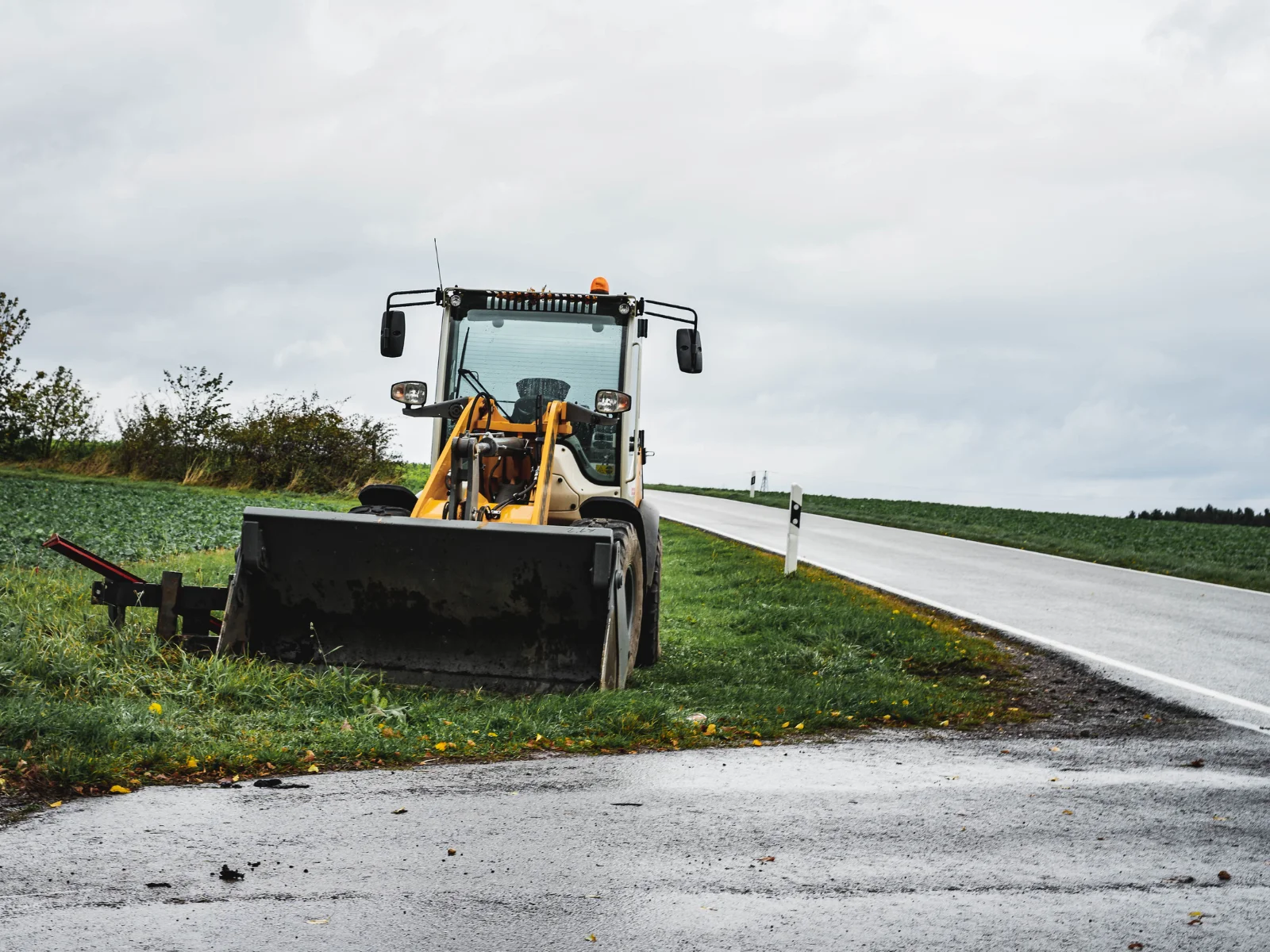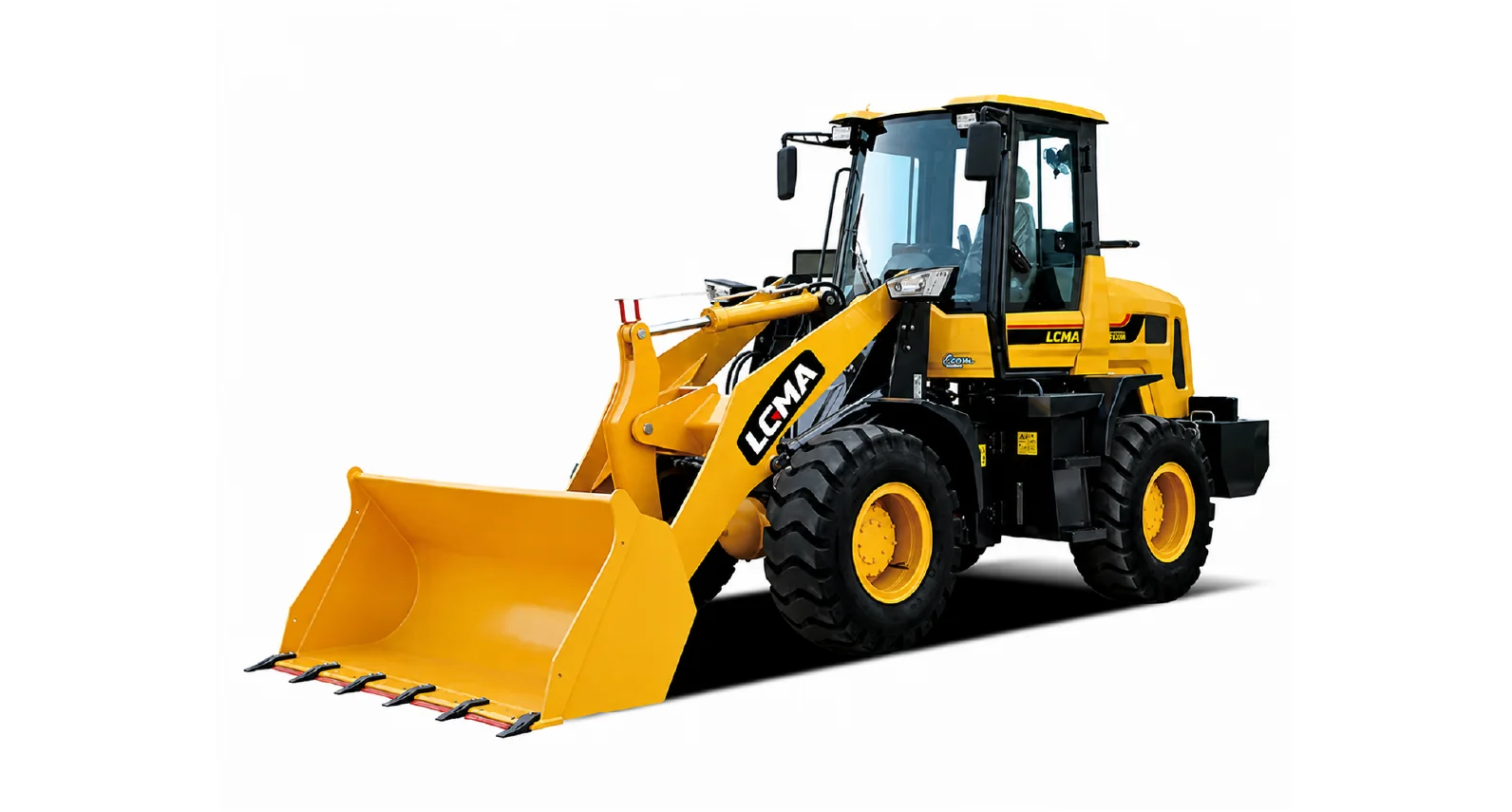
A wheel loader's main advantages are speed and volume. It fills, carries and dumps a full bucket in a short cycle on firm ground, and one machine can run many attachments. Its main disadvantages are weak traction on soft or wet ground and the room it needs to turn. It is also heavy, so it moves between sites on a truck or plant trailer. In the LGMA LM range sold by DJJ Equipment, rated loads run from 1.6 to 2.8 tonnes and buckets from 0.8 to 1.5 m³.
Why is a wheel loader quick at loading and carrying?
A wheel loader is quick because it can fill, carry and dump without help from another machine. The frame bends at a hinge in the middle, so the rear wheels follow the front ones through a turn. A torque converter lets the engine keep pushing into a pile without stalling.
On the LGMA LM940, the frame articulates 37° and the bucket rises in 6.5 seconds and lowers in 5.5 seconds, with 4 forward and 4 reverse speeds. The larger LM946 has the same cycle times. Seconds saved on each lift are repeated on every bucket of the day.
Rubber tyres make the loader kinder to sealed yards and concrete pads than a tracked machine. They also make it quicker to drive from one end of a large site to the other with a load in the bucket.
How much can a wheel loader move in one bucket?
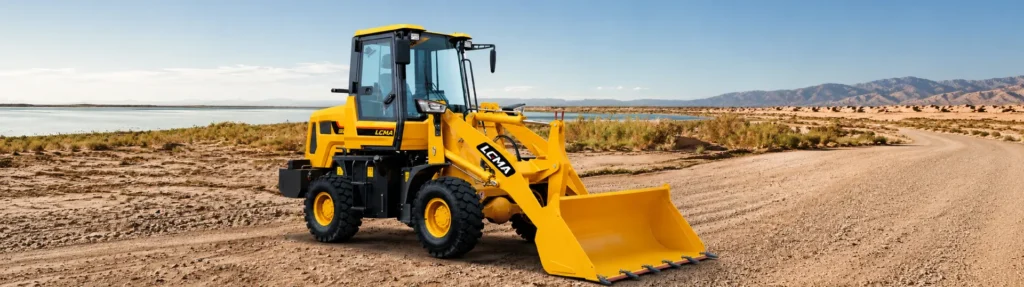
A wheel loader carries several times what a skid steer can in each bucket, and that is its biggest advantage when building stockpiles or loading trucks. The table lists the five LGMA LM models, using the figures on each product page.
| Model | Rated load | Operating weight | Bucket | Dump height | Turning radius |
|---|---|---|---|---|---|
| LM920 | 1,600 kg | 3,800 kg | 0.8 m³ | 3,200 mm | 5,000 mm |
| LM930 | 1,600 kg | 3,800 kg | 0.8 m³ | 3,200 mm | 4,900 mm |
| LM938 | 2,000 kg | 5,200 kg | 1.0 m³ | 3,600 mm | 4,500 mm |
| LM940 | 2,500 kg | 6,500 kg | 1.3 m³ | 3,800 mm | 6,000 mm |
| LM946 | 2,800 kg | 8,200 kg | 1.5 m³ | 3,800 mm | 6,000 mm |
Even the smallest model shows the gap against a compact machine. The LM920 carries 1,600 kg in a 0.8 m³ bucket, while the Yuchai S35 Pro electric skid steer has a 0.29 m³ bucket and a 350 kg rated operating capacity. The LM920 can also take a 1.6-1.7 m³ grain bucket that unloads at up to 4.5 m for light bulk material.
How many jobs can one wheel loader do with attachments?
One wheel loader can do the work of several machines once the bucket comes off. Sixteen attachments are listed for the LM920, including a 4-in-1 bucket, pallet forks, a hay fork, a slasher, grapples, an auger and a dozer blade. A quick hitch is optional.
On a farm or in a supply yard, that can mean one machine for loading trucks, moving pallets and clearing up. Each attachment has to suit the loader's coupling and hydraulics, so confirm the fit before you order one. A 4-in-1 bucket, a grapple or an auger needs an extra hydraulic circuit to work, while pallet forks and a standard bucket, the simplest wheel loader attachments, run on the loader's lift and tilt alone.
Why does a wheel loader struggle on soft or wet ground?
A wheel loader struggles on soft or wet ground because its whole weight sits on four tyre patches. Tracks spread the same weight over a much larger area, so a tracked machine sinks less where a wheel loader digs in and spins.
Ground clearance and tyre size help, but they do not change that trade-off. The LM920 has 300 mm of ground clearance on 20.5/70-16 tyres, and the LM946 runs on larger 17.5-25 tyres to carry its 8,200 kg. A full bucket also shifts weight onto the front tyres, which is when soft ground is most likely to give way.
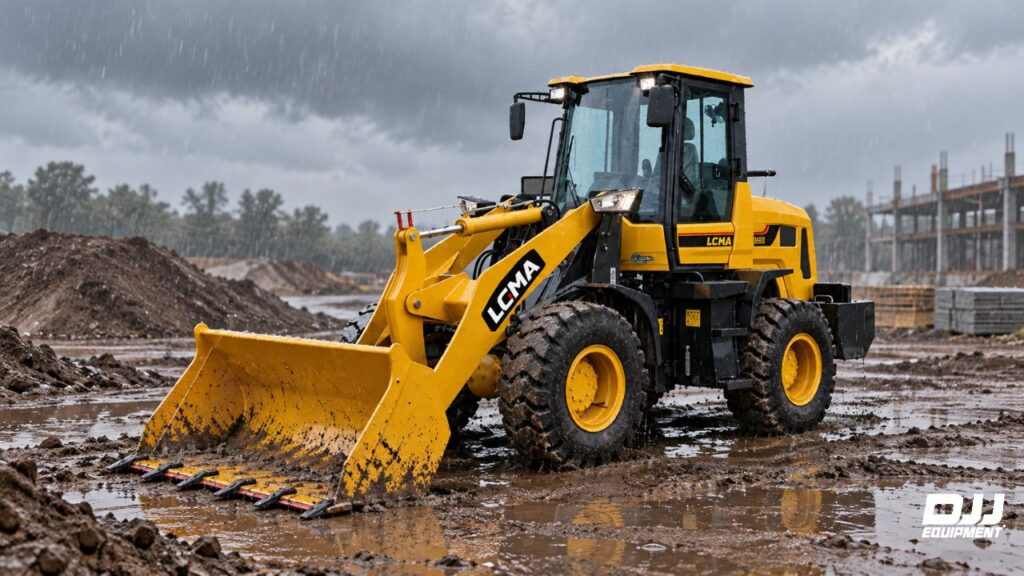
Tyres are a running cost as well. Sharp rock and scrap can puncture them, and they wear faster every time they spin. Before the wet season, read these tips for running a wheel loader in mud.
How much room does a wheel loader need to turn?
A wheel loader needs far more room to turn than a skid steer, because it steers by bending in the middle rather than turning on the spot. In the LM range, the turning radius runs from 4,500 mm on the LM938, the tightest of the five, to 6,000 mm on the LM940 and LM946.
Width matters in gates, sheds and the gaps between stockpiles. The LM920 is 1,830 mm wide, the LM930 1,850 mm and the LM938 2,020 mm, and the LM946 carries a 2,400 mm bucket, the widest in the range. Measure the narrowest gap and the tightest corner on your site before you pick a size.
Where space decides the job, a skid steer usually fits better because it turns within its own length, one of the main differences between a wheel loader and the other loader types.
What does it take to move and operate a wheel loader in Australia?
A wheel loader needs a truck or plant trailer to move between sites, and a competent operator to drive it. Operating weights in the LM range run from 3,800 kg to 8,200 kg, so even the smallest model needs a vehicle and trailer rated for that weight. Ask our team about transport options to your site.
If the loader will travel on a public road, check its registration with your state transport authority first.
There is no high risk work licence for a wheel loader. SafeWork NSW notes that these licences are no longer required for earthmoving plant such as front end loaders, which leaves the business responsible for making sure the operator is competent. Its earthmoving plant safety checklist lists the evidence a site can ask for, such as competency-based training, familiarisation on the machine and a verification of competency.
The cab helps with safety too. The LM920 is listed as ROPS and FOPS certified, and the LM930 to LM946 come with a climate-controlled cab and an HD rear camera.
What does a wheel loader cost to buy and run?
The purchase price is the largest cost of a wheel loader, followed by fuel, tyres and servicing, which all rise with the hours it works. The entry LM920 is $22,900 + GST ($25,190 inc. GST), with extra buckets and attachments quoted separately. Other LM models are priced at quotation.
The LM930, LM938 and LM946 each carry a 12 months / 2,000 hours warranty. Running costs depend on size and duty, and this breakdown of wheel loader running costs sets fuel, tyres and depreciation against loader size.
Hiring is another way to find out whether a loader suits the work. DJJ hires wheel loaders as well as selling them, so call 1800 355 388 to check which models are available.
To choose a size, send our team the material you move, the ground conditions, the tightest turn on your site and the trucks or hoppers you load. They can match that to a model in the wheel loaders range, or talk you through hiring one. Call 1800 355 388 or send an enquiry to your nearest branch.