A forklift maintenance checklist has two layers. Operators run a pre-start check at the start of each shift and whenever they switch to a different forklift, and a competent technician services the forklift at the hour-meter intervals in the manufacturer's manual, and at least once every 12 months. Any fault that affects safety takes the forklift out of service until it's fixed. Both layers are covered below, with wear limits, battery and LPG checks, and the records to keep.
Daily forklift pre-start checklist
A daily forklift pre-start check is a short look-and-test routine done before the forklift is used. Start from your manufacturer's checklist, because items differ between electric, LPG and diesel models and between attachments.
Checks with the forklift switched off
Walk around the forklift before you get on and look at:
- the floor under the forklift, hoses and fittings, for leaks
- forks and fork pins, for cracks, bends, heel wear and pins that don't lock
- the mast, lift chains and rollers, for damage and loose or uneven chains
- tyres and wheels, for cuts, missing chunks, low pressure on pneumatic tyres and loose wheel nuts
- fluid levels such as engine oil, coolant and hydraulic oil, where the manual says the operator checks them
- the battery and its connectors on an electric forklift, or the LPG cylinder, bracket and hose
- the overhead guard, load backrest and seatbelt
- the data plate or load chart, which must be readable and match any attachment fitted
Checks with the forklift running
Then start the forklift and test it before you lift a load:
- service brake and parking brake
- steering, with no excess play
- lift, lower, tilt and attachment functions through their full range
- horn, lights, reversing alarm and any warning beacon
- dashboard gauges and warning lights, including battery charge or fuel level
- unusual noises, vibration or smells
The table below is an example to adapt to your manufacturer's checklist. It isn't a complete or compliant list for every forklift.
| Item | What to look for | Take out of service if |
|---|---|---|
| Forks | Cracks, bends, worn heels, pins locking | Any crack or bend, or a pin that won't lock |
| Mast and chains | Damage, loose or uneven chains, jerky movement | A damaged chain or mast, or uneven lifting |
| Hydraulics | Leaks at hoses, fittings and cylinders | A leaking hose or cylinder, or forks drifting down |
| Tyres and wheels | Cuts, chunking, pressure, wheel nuts | A damaged tyre or a loose wheel |
| Brakes and steering | Firm pedal, parking brake holds, steering responds | A soft pedal, a slipping parking brake, or stiff or loose steering |
| Safety devices | Seatbelt, horn, lights, reversing alarm, overhead guard | A seatbelt that won't latch, a dead horn or alarm, or a damaged guard |
| Battery or LPG | Charge, cables, connectors, cylinder bracket, hose, valve | A damaged cable or connector, a gas leak or a loose cylinder |
| Data plate | Readable and right for the attachment fitted | Missing, unreadable or wrong for the attachment |
SafeWork NSW recommends recording each pre-start check. A record per shift also helps your technician spot faults that keep coming back.
What to do when a forklift fails a check
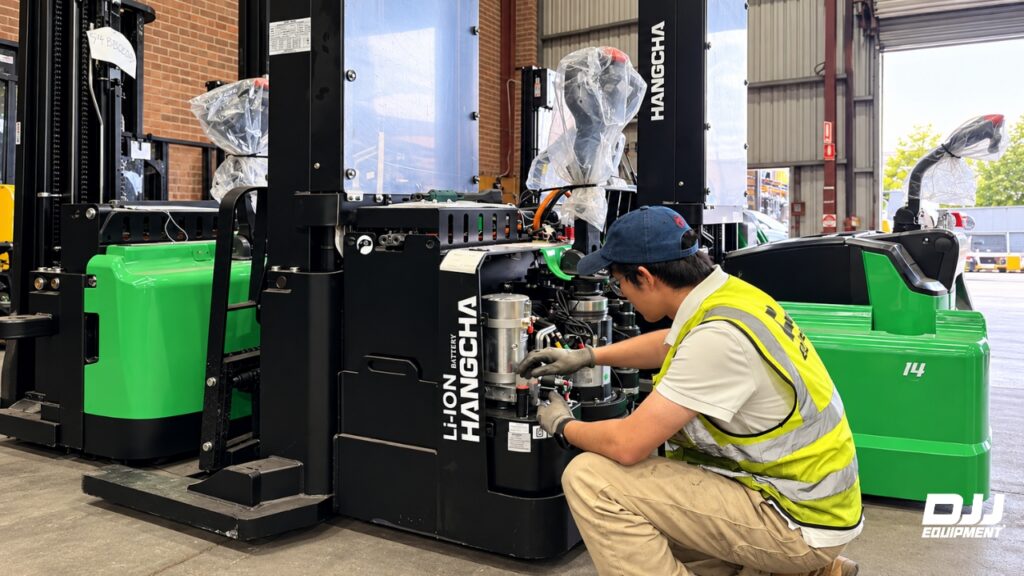
A forklift with a fault that affects safety shouldn't be used again until it's repaired. Report the fault straight away, remove the key, tag the forklift out of service and record what you found.
Only a competent person should repair the forklift and remove the tag. Operators shouldn't attempt repairs, and WorkSafe Queensland warns that a general motor mechanic may not be competent to maintain a forklift.
How often should forklifts be serviced?
Forklifts should be serviced at the hour-meter intervals in the manufacturer's manual, and Safe Work Australia's guidance is at least once every 12 months. Hours matter more than the calendar, because a forklift on double shifts reaches each service level twice as fast.
As an example, Hangcha's manual for its XE series lithium forklifts sets these service levels:
| Service level | Hour meter | Calendar guide in the manual |
|---|---|---|
| Daily | Every 8 hours | Each day |
| Weekly | Every 40 hours | Each week |
| 250-hour service | Every 250 hours | About every 1.5 months |
| 500-hour service | Every 500 hours | About every 3 months |
| 1,000-hour service | Every 1,000 hours | About every 6 months |
| 2,000-hour service | Every 2,000 hours | About once a year |
The manual treats the first 100 hours as a running-in period, with lighter loads. Engine-powered models can use different service steps, so always work from the manual for your exact model.
When to service more often
Harsh conditions shorten the intervals. WorkSafe Queensland names conditions such as cold stores as a reason to service more often, and the Hangcha XE manual cuts lift chain lubrication to every 100 hours in cold or corrosive environments. Dust, wet yards and multi-shift work also wear filters, tyres and chains faster, so ask your technician to set the schedule from your hours and site.
Forklift preventive maintenance checklist: operator vs technician
Preventive maintenance splits between what operators check every shift and what a technician inspects, adjusts and replaces at each service. A typical split looks like this:
| System | Operator, each shift | Technician, at each service |
|---|---|---|
| Forks | Look for cracks, bends and heel wear | Measure fork wear, check for cracks, replace worn forks |
| Mast and lift chains | Watch for uneven or jerky lifting | Measure chain stretch, lubricate and adjust chains, check rollers |
| Hydraulics | Look for leaks and drifting forks | Change hydraulic oil and filters at the manual's intervals, check hoses and cylinders |
| Brakes and steering | Test brakes, parking brake and steering | Inspect and adjust brake and steering components |
| Tyres and wheels | Check for damage and pressure | Replace worn tyres, check wheel nuts and bearings |
| Battery and electrics | Check charge, cables and connectors | Test the battery, charger, contactors and wiring |
| Engine and fuel (LPG, diesel) | Check fuel level and leaks | Change engine oil and filters, tune the engine, check the exhaust |
| Safety devices | Test seatbelt, horn, lights and alarms | Check the overhead guard, mounts and operator presence system |
Replacing worn parts at a scheduled service avoids a forklift going down mid-shift. DJJ keeps common forklift parts at its Sydney, Brisbane and Perth branches.
Fork and lift chain wear limits
Fork and lift chain wear limits tell a technician when a part must be replaced rather than repaired. SafeWork NSW says a fork worn more than 10% at the heel must be replaced, and forks should also get a thorough inspection at least once a year.
For lift chains, the Hangcha XE manual says to replace a chain once it has stretched more than 3% of its original length, and to replace all the chains on the same mast at once. Measuring wear takes the right tools, so it's a technician's job. Operators should report cracked or bent forks and loose, uneven or rusted chains straight away.
Electric forklift maintenance
Electric forklift maintenance has no engine oil or filters to change, but the battery and charger need regular care. The routine depends on the battery type.
Lead-acid batteries
Flooded lead-acid batteries need topping up with distilled water after charging, not before. Charge them in a ventilated area set aside for it, keep cables and connectors clean and undamaged, and let only trained staff charge or change batteries.
Lithium batteries
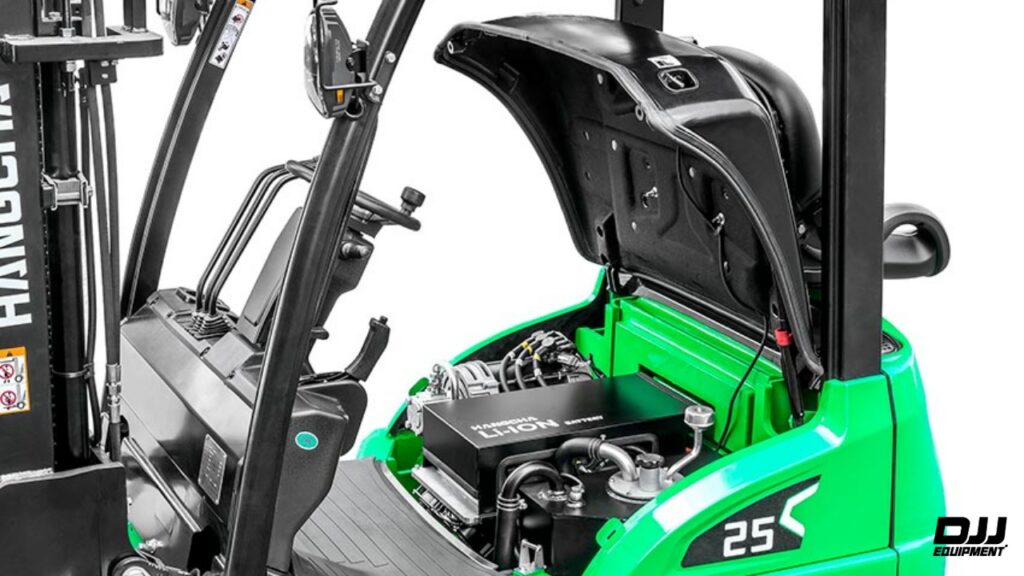
Lithium batteries don't need watering, but they still need care. The Hangcha XE manual calls for the charger the manufacturer specifies, with charging controlled by the battery management system (BMS), and a full charge once a week. Keep the charging point dry and ventilated, and don't modify the charging port.
The service intervals still apply to the rest of the forklift, from brakes and hydraulics to the mast. Our electric forklifts come with lithium batteries, and some X Series models also come with lead-acid.
LPG and diesel forklift maintenance
LPG and diesel forklifts add an engine, fuel system and exhaust to the checklist. Engine oil, filters and tuning follow the manual's intervals, and regular tuning keeps carbon monoxide (CO) in the exhaust down.
CO is the main risk indoors. Safe Work Australia's workplace exposure limit for CO is 30 ppm over eight hours, falling to 20 ppm from 1 December 2026. Diesel engines produce less CO than LPG, but diesel exhaust carries its own particulate risk, so tuning, exhaust checks and air monitoring matter for both.
LPG cylinders should be changed only by trained staff, fitted with the relief valve at the 12 o'clock position, and turned off at the valve when the forklift isn't in use. Cylinders must be requalified every 10 years, and an out-of-date cylinder can't be refilled. Repairs to the gas system are a job for a licensed gas fitter.
Each power type also has its own running cost, and electric vs LPG vs diesel forklifts differ most on fuel or charging per shift.
Attachments and the load chart
An attachment changes what a forklift can safely lift, so it changes the maintenance checklist too. Before fitting one, check with the manufacturer that it suits the model, and have the load chart updated by the manufacturer or a competent person before the forklift goes back to work.
Each attachment needs its own capacity on the data plate or load chart. Add the attachment to the pre-start check: its mounting, hoses, and wear on parts such as clamp pads or side shift slides.
Forklift maintenance records and annual inspection
Under the WHS Regulations in NSW, Queensland and WA, plant must be maintained, inspected and tested by a competent person. The work follows the manufacturer's recommendations, or a competent person's advice where there are none, and where neither is available the plant is inspected at least once a year.
Forklifts aren't registrable plant, and the regulations don't set out a daily logbook. Safe Work Australia's general guide for industrial lift trucks still recommends keeping maintenance records at or near the workplace, covering:
- the forklift's identification number
- the date and the hour meter reading
- the work done and any repairs
- who did it and their qualifications
- any changes made to the forklift
On a hired forklift, the hire agreement sets who does the servicing and who does the daily checks, as explained in what's included in forklift hire.
Forklift servicing from DJJ Equipment
A forklift maintenance checklist only works if faults get fixed and services happen on time. The DJJ Service Team services Hangcha forklifts and can work on most major brands, so check your model with the team first. Servicing and repairs are done at our Silverwater, Meadowbrook and Bayswater workshops, with on-site service in selected areas, subject to technician availability. Call 1300 646 747 or book through our forklift servicing page.