
The most common jobs for a skid steer are loading and carrying material, levelling and backfilling, moving pallets, drilling post holes and site clean-up. Four specs decide which of those jobs a machine does well: how much it carries, how high it dumps, how much oil it sends to attachments and how wide it is. The Yuchai S35 Pro electric skid steer from DJJ Equipment carries 350 kg, half its 700 kg tipping load.
Loading and carrying is the most common job for a skid steer
A skid steer spends most of its hours scooping soil, gravel, mulch or rubble and carrying it across the site. The limit on that job is weight, not bucket size. A heaped bucket of heavy material can weigh more than the machine is rated to carry.
Here's how that works on a small machine. The Yuchai S35 Pro has a 0.29 m³ bucket and a 350 kg rated operating capacity. Divide 350 kg by 0.29 m³ and you get about 1.2 tonnes per cubic metre. Any material heavier than that, and you fill the bucket only part of the way.
Ask your landscape or quarry supplier for the weight per cubic metre before you start. The S35's 8 kN bucket breakout force suits loose stockpiles, not compacted ground.
How a skid steer levels and backfills a site
A skid steer levels by back-dragging the bucket across the ground and backfills by pushing fill into trenches and around footings. Both jobs happen at ground level, where the loader arms are strongest.
A radial lift skid steer suits this work best. Its arms swing on a single pivot at the rear, which gives the most breakout force close to the ground. A vertical lift machine does the same job, but its strengths show higher up.
Wheeled skid steers have one weak spot here. They turn by running one side faster than the other, so the tyres drag sideways and scuff lawn and fresh topsoil. On finished surfaces, make long straight passes and keep turns to firm ground. On a slope, the S35's auto-hold keeps the machine in place when you stop.
Loading trucks and bins with a skid steer depends on dump height
A skid steer can only load a truck, trailer or skip bin if its dump height clears the side of that body. Measure the side height of whatever you load most often and compare it with the machine's dump height before you buy.
The S35 has a 1,850 mm dump height and a 2,410 mm hinge pin height. That suits trailers, low skip bins and site dumpers, but not a high-sided tipper truck.
Vertical lift skid steers are built for this job. Their arms rise in a near-straight line and keep the load closer to the machine at full height, so they reach further over the side of a truck. On tight residential sites, a common setup is a small skid steer loading a site dumper, which then carries the spoil to the street.
Moving pallets with skid steer forks is limited by rated operating capacity
A skid steer with pallet forks can lift only up to its rated operating capacity, whatever the forks are rated for. Under ISO 14397-1, a wheeled skid steer's rated operating capacity is 50% of its tipping load, the weight that lifts the rear wheels off the ground. Tracked machines are usually rated at 35% of tipping load.
The S35 Max has a 730 kg tipping load and the S35 Pro 700 kg. Both are rated at 350 kg. Read the weight on the pallet before you lift it. If it's over 350 kg, split the load or use a bigger machine.
Drilling post holes and trenching need the right hydraulic flow on a skid steer
Augers and trenchers run on the skid steer's auxiliary hydraulic circuit, so the machine's oil flow decides whether they work properly. Flow sets how fast the attachment turns. Too little flow and an auger bogs down in hard ground.
The S35 sends 20.5 L/min at 33.7 MPa to its attachments, which is enough for loading, sweeping and crushing work. Before you fit an auger or trencher, check its flow rating against that figure. Large augers in clay or rock need a high-flow machine. In rocky ground, a rock bit replaces the standard earth bit. Our skid steer attachments guide lists the flow each common attachment needs.
Site clean-up is where a small skid steer earns its keep
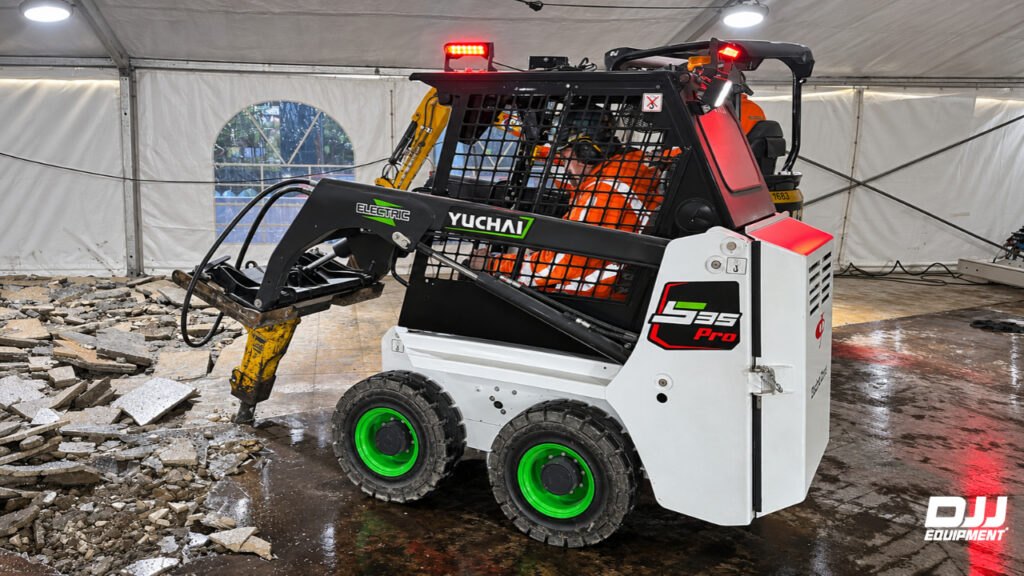
On building and demolition sites, a skid steer cleans up behind the excavator and the breaker. It loads rubble into bins and carries spoil out of buildings during strip-outs. For this job, a narrow machine that fits through doorways matters more than lifting power.
At 959 mm wide and 1,815 mm high to the cab roof, the S35 is sized for corridors, alleys and low rooms, and it turns within a 1,650 mm radius. Because it's battery-electric, it puts out no exhaust inside the building. The S35 Pro's 21.29 kWh battery runs 6-8 hours, and the S35 Max's 29.17 kWh battery runs 8-9 hours. Both charge from 30% to 80% in 1 hour, so a lunch break tops up the battery for the afternoon.
Clearing scrub and land is a job for a larger skid steer
A small skid steer can clear cut branches and building waste with a grapple. Cutting standing scrub and trees is different. Mulchers and heavy brush cutters need a high-flow hydraulic system on a large machine, usually on tracks.
If you run a high-flow mulcher on a standard-flow machine, it stalls under load. The oil then dumps through the relief valve and turns into heat. Land clearing also throws up dust and leaf litter that packs between the oil cooler and the radiator, so check and clean the gap between them every day. At 20.5 L/min, the S35 isn't the machine for this job.
Which skid steer suits each common job?
The table sets each common skid steer job against the spec that decides it and what the S35 Pro and S35 Max can do.
| Job | What decides it | S35 Pro and S35 Max |
|---|---|---|
| Loading and carrying | Material weight per m³ against rated operating capacity | Full 0.29 m³ bucket up to about 1.2 t per m³ |
| Levelling and backfilling | Breakout force at ground level | Light levelling and backfill, 8 kN breakout |
| Loading trucks and bins | Dump height against the side of the body | Bodies below 1,850 mm |
| Moving pallets | Rated operating capacity | Loads up to 350 kg |
| Post holes and trenching | Auxiliary hydraulic flow | Attachments rated for 20.5 L/min |
| Indoor and site clean-up | Width, exhaust and run time | 959 mm wide, no exhaust, 6-9 hours per charge |
| Scrub clearing with a mulcher | High-flow hydraulics and cooling | Not suited; needs a large high-flow machine |
The pattern is clear: a compact electric skid steer covers the light, tight and indoor jobs, and the heavy cutting and bulk loading jobs need a larger diesel machine. Choose the size from the job you do most weeks. Each industry mixes these jobs differently, with landscapers levelling and spreading and farms loading and cleaning sheds, so the right machine follows those skid steer uses.
Do you need a licence for skid steer jobs in Australia?
No. There's no high risk work licence for skid steers in Australia. The business still has to make sure each operator is trained and competent on the machine, and using a skid steer as a crane needs specific training on top of that. Check with your state regulator before any lifting on chains or slings.
Builders often ask for the national skid steer unit, RIIMPO318 Conduct civil construction skid steer loader operations. It replaced RIIMPO318F in September 2026, and the two are treated as equivalent.
If your work is mostly clean-up, light loading and indoor jobs, the S35 Pro and S35 Max are worth a look. DJJ sells skid steers but doesn't hire them. Both models are in our range of electric skid steers for sale, and DJJ on 1800 355 388 can match one to the jobs you do most. Have your heaviest material weights and the side height of your bin or trailer ready when you call.


