A forklift should be checked for damage before every shift and whenever the operator or the forklift changes. It needs another check straight after it hits something, tips or drops a load, and a technician's inspection at each scheduled service, which Safe Work Australia puts at least once every 12 months. Rough ground, a trip on a truck and weeks in storage can also bend or loosen parts without anyone noticing, so check after those too.
When should a forklift be checked for damage each shift?
Every forklift gets a damage check before the shift starts, and again when someone else takes it over or an operator moves to another truck. SafeWork NSW says to complete and record that check, and WorkSafe Victoria adds before first daily use. Safe Work Australia gives the reason: the previous operator may not have left the forklift in a safe condition.
The damage part is a walk-around. Look at the forks, mast, chains, tyres, overhead guard and hydraulic hoses for cracks, bends, cuts and fresh oil. Brakes, steering, horn and seatbelt are tested afterwards with the forklift running, which is the second half of the forklift pre-start checks. On a site running two shifts, that's two checks a day on every truck.
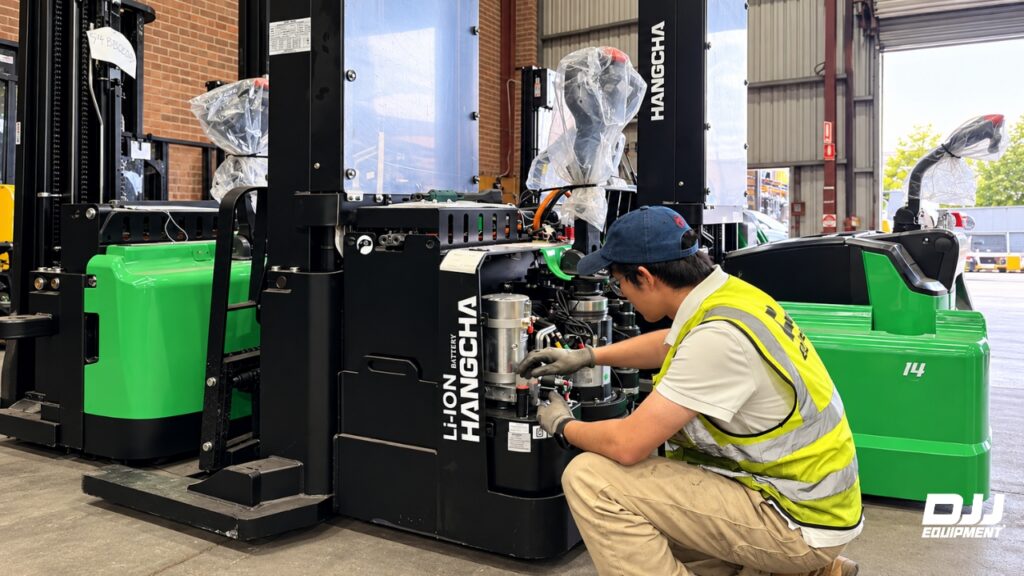
What to check after a forklift hits something
After a collision, tip-over, dropped load, serious fault or near miss, SafeWork NSW says to stop work and isolate the forklift and the area around it. That holds even when the forklift still drives normally. A cracked fork, a bent mast channel or a split hose doesn't always change how the truck feels.
A competent person then assesses three things, according to Safe Work Australia's guide for industrial lift trucks: what caused the damage, whether the forklift can be used safely as it is, and whether it can be repaired. A copy of that assessment goes into the forklift's maintenance records. Until it's done, remove the key and tag the forklift out of service, as WorkSafe Queensland advises for any damaged forklift.
Where to look depends on what was hit. A racking or dock strike usually lands on the forks, carriage and mast. A reversing knock lands on the counterweight, rear lights and steer axle, and anything overhead meets the overhead guard and the mast head first.
Container work shows how small the margins are. At DJJ Equipment, the X Series in-container diesel forklift we sell has a 2,240 mm overhead guard and a lowered mast height of about 2,180 mm. A container roof or door frame only slightly lower than the operator expected meets the guard or the mast first. After a knock like that, check for bent guard posts, cracked welds and a mast that no longer travels straight.
Does a forklift need a damage check after an overload?
Yes. A forklift that has lifted more than its load rating plate allows, or dropped a load from height, needs checking before it lifts again. The extra force goes through the forks, lift chains, mast and tilt cylinders, and the damage can sit there until the next heavy lift.
Overloading is easier than it sounds. A rated capacity is only true at the load centre and lift height stamped on the plate, and an attachment lowers it. Australian ratings commonly use a 600 mm load centre, so a long or off-centre load can overload a truck that's lifting less than its rated weight.
After an overload, look for fork tips bent down, chains sitting unevenly, fresh oil at the lift and tilt cylinders, and forks that drift down when the controls are released. Any one of those takes the forklift out of service until a technician has seen it.
Forklift damage checks on rough ground and harsh sites
Forklifts on gravel, building sites or in freezers need damage checks more often than a warehouse truck on a smooth floor. WorkSafe Queensland's maintenance checklist calls for more frequent inspections in severe operating conditions or harsh environments. Unsealed yards are exactly where rough terrain forklift trucks work, with rocks and potholes hitting the tyres and underside every shift.
Dragging the forks on concrete or gravel wears the heel. SafeWork NSW says a fork must be replaced once the heel is worn more than 10% thinner than the upright arm. That's measured at a service, not judged by eye.
On rough ground the underside takes the hits. Our 4WD rough terrain forklift in its 2.5 tonne model has 240 mm of ground clearance under the mast and 260 mm at the wheelbase centre. A rock or kerb taller than that strikes the mast base or the frame. After a day on rough ground, check under the mast, the tyres and the rims for cuts and dents, and look for leaks around the axles.
Checking a forklift for damage after transport or storage
Check a forklift for damage when it comes off a truck and before its first shift after storage. Tie-down chains, a load that shifts or a rough trip can crack a light, pinch a hose or damage a tyre. Under our standard hire terms, the hirer is responsible for damage in transport, so photograph anything you find before the truck leaves.
A forklift parked for weeks needs a full walk-around before it lifts again, because tyres, hoses and battery cables can deteriorate while nobody is looking. Good forklift long term storage starts with a service before the forklift is parked, which is also the easiest time to find and fix damage.
Damage checks on a hired forklift
A hired forklift should be checked for damage when it arrives, after any incident and before it goes back, because the hire terms decide who pays. Under our standard terms, the machine goes back in the condition it was dispatched in, reasonable wear and tear excepted. The hirer pays for damage from improper use or abuse, and for tyres as we assess them.
Accidents and faults on a hired machine must be reported to us straight away, and only our authorised staff may repair, modify or adjust it. The optional Equipment Waiver costs 10% of the weekly hire cost, isn't insurance and excludes overhead strikes. It won't cover a mast or guard damaged under a roller door. Photos when the forklift arrives and when it goes back, with the hour meter reading, settle most questions about when a dent appeared.
Who inspects forklift damage, and how often?
The operator finds forklift damage, but a competent forklift technician decides whether the truck is safe and repairs it. Safe Work Australia's guide says industrial lift trucks should be serviced and maintained regularly or at least once every 12 months, following the manufacturer's instructions.
Not every mechanic qualifies. WorkSafe Queensland warns that car and truck mechanics usually aren't competent to work on forklifts. LPG system parts are for a licensed gas fitter only, and pneumatic tyres should be changed by a qualified tyre fitter.
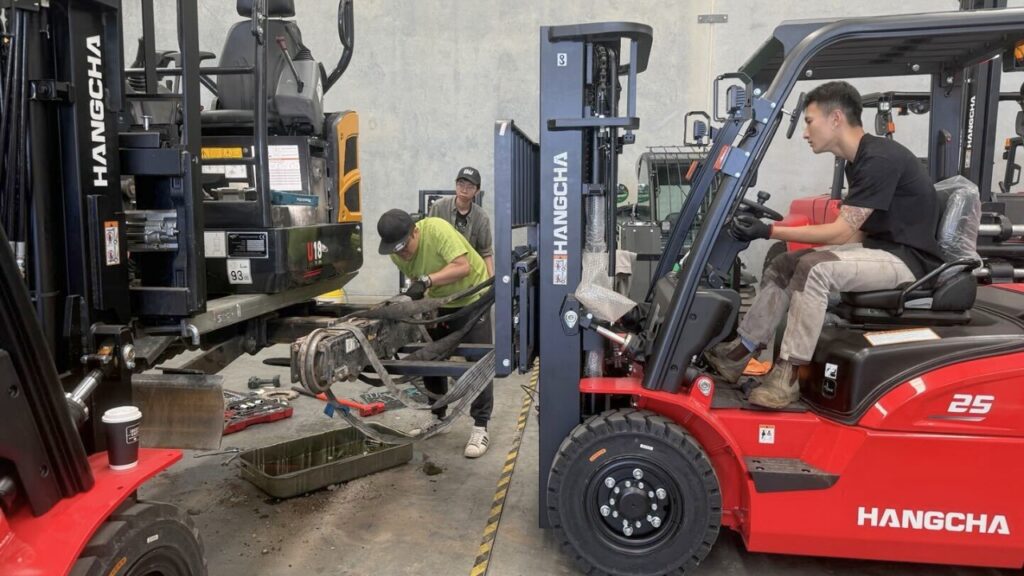
A scheduled service is where the measured checks happen, such as fork heel wear, chain stretch and mast wear. Forklift servicing and repairs are done on site within 50 km of our Silverwater, Meadowbrook and Bayswater branches, or in the branch workshop. DJJ services and repairs all forklift brands.
Keep the damage assessment, the repair and the sign-off together. WorkSafe Victoria says inspection and maintenance records should show what was inspected, any defects found and the work done to fix them.
If a forklift has hit something, dropped a load or come back from a rough job, tag it out and have it looked at before the next shift. Call the DJJ Service Team on 1300 646 747 with the model, serial number, hour meter reading and what happened.