The main downsides of leasing a forklift are that you pay for a machine you never own, you're committed to the full term even if your work drops off, and the agreement caps your hours and charges for damage when the truck goes back. Over a long term, lease payments usually add up to more than buying the same forklift, and at the end you have no machine to sell or trade in. Leasing still works when you need a truck for a set period, can't spare the capital, or don't know what your workload will look like in two years.
What leasing a forklift means in Australia
Leasing a forklift means someone else owns the truck and you pay to use it for an agreed term. In Australia the word covers a few different agreements, and the downsides depend on which one you sign.
The question to ask of each one is who owns the forklift and what happens on the last day:
| Agreement | Who owns the forklift | At the end of the term |
|---|---|---|
| Finance lease | The finance company | Pay the residual and keep it, refinance, or hand it back |
| Long-term hire (operating lease) | The dealer or hire company | The forklift goes back to the owner |
| Rent to own | The dealer or financier until the last payment | Ownership passes to you after the last payment, for example after 60 months |
| Chattel mortgage (buying on finance) | You, from the day you take delivery | You already own it |
Only the first two are leases in the strict sense, and they are where the downsides below apply. Rent to own and a chattel mortgage both end with you owning the truck, which removes the biggest one.
Leasing a forklift usually costs more over the long run
Leasing a forklift usually costs more than buying it if you keep the truck working for most of its life. Each payment covers the owner's finance cost, their margin and the value the forklift loses while you use it, and none of it builds equity for you.
When you buy a forklift, the payments stop once the loan is paid off and the truck keeps working. A forklift you own also has resale or trade-in value at the end, which a leased truck never gives you.
On a finance lease, the residual is a real payment due on the last day if you want to keep the machine. Get that figure in writing before you sign, because it decides what keeping the truck really costs.
The break-even point in forklift hire vs buying depends mainly on how many months you need the truck and how many hours a year it runs. The longer and harder it works, the stronger the case for owning it.
Can you get out of a forklift lease early?
Getting out of a forklift lease early usually means paying out the rest of the term. You commit to the full agreement on the day you sign, and the owner prices the lease on that basis.
DJJ Equipment's own hire terms work this way. The hirer commits to the full agreed term, and if a forklift is off-hired before the term ends, the hirer pays out the remaining value of the agreement. A finance lease is normally just as fixed, because the lender has already paid for the machine.
That's the real risk for a business whose work can change quickly. Say you lease three trucks on a 60-month agreement for a distribution contract, and the contract ends after 24 months. That leaves 36 months of payments on forklifts that sit idle in the corner.
Hour limits on a forklift lease and what overtime costs
Most forklift leases and long-term hire agreements set a maximum number of operating hours per period, read off the hour meter. Hours above that limit are charged at an overtime rate.
The limit is easy to break once you add a shift. One 8-hour shift, five days a week for 48 weeks, puts 1,920 hours on the meter in a year. A second shift doubles that to 3,840 hours, and every hour over the agreed limit is billed separately.
Under our hire terms, hours above the maximum for the period are charged at the hourly overtime rate in the agreement, based on the hour meter. If your volumes are growing or seasonal, ask for an hour allowance that matches your busiest months, not your average week.
Keeping the truck past the end date costs extra too. If a hired forklift isn't returned when the term expires, our terms extend the hire day by day at the daily rate until it comes back. Hire rates are also subject to an annual CPI increase, so the weekly cost in year three is higher than in year one.
What do you pay for when a leased forklift goes back?
When a leased forklift goes back, you pay for anything beyond fair wear and tear. The truck has to be returned in the condition it was delivered in, with only reasonable wear and tear excepted.
The trouble is that wear and tear is judged at the end, often years after delivery. Damage from improper use or abuse is the hirer's cost under our terms, and so are tyres, as we assess them. A fork bent by an overweight load, a mast scraped on a roller door or a tyre chunked on a rough yard all count as damage, not wear.
Forks are a common sticking point. SafeWork NSW sets the wear limit at 10%: the heel of a fork must not be more than 10% thinner than its upright section. A worn fork past that limit has to be replaced, and on a returned truck the hirer can end up paying for it if the wear came from dragging loads or pushing pallets along the floor.
Protect yourself on day one. Photograph the forklift from every side at delivery, record the hour meter, note existing marks on the handover sheet and have both sides sign it.
Who pays for repairs on a leased forklift?
Who pays for repairs on a leased forklift depends on the agreement. On a long-term hire the owner usually services the truck. On a finance lease, maintenance and repairs are normally your cost, just as if you owned it.
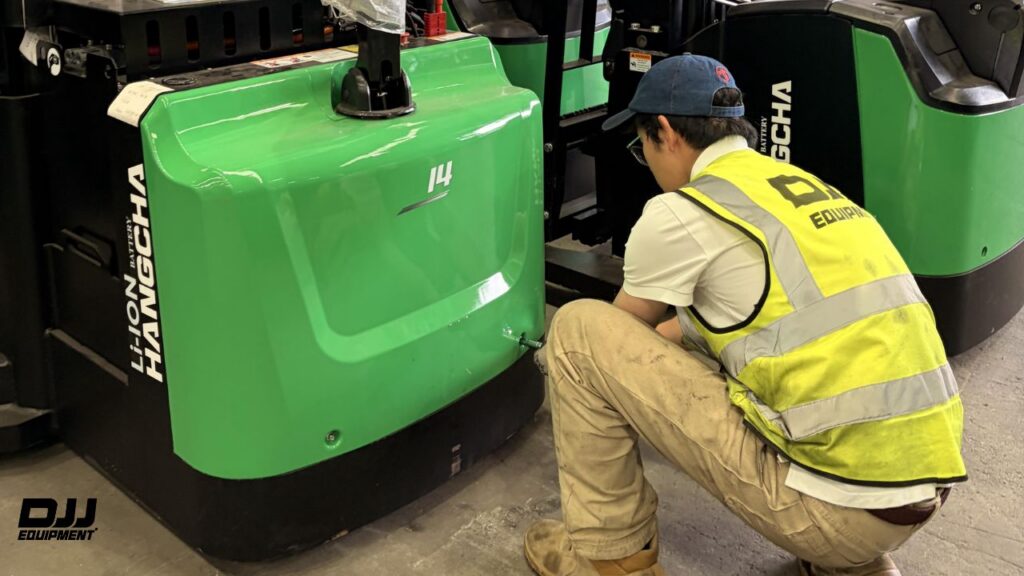
That matters most after the warranty runs out. Our Hangcha XA Series 2-3.8 t lithium forklift, for example, carries a 24 month / 2,000 hour warranty. Say you take one on a five-year finance lease: you're paying lease instalments and covering repairs yourself for the last three years, on a truck you still don't own.
On DJJ's long-term hire, servicing and maintenance are part of the standard terms, carried out during business hours, Monday to Friday, 8am to 5pm. Service outside those hours is at the hirer's cost if we agree to it. The hirer still does the daily checks, supplies fuel, oil and water and recharges the batteries.
Insurance and the equipment waiver on a leased forklift
A leased forklift still needs your insurance. Our hire terms require the hirer to carry public liability insurance for the truck and its use.
Damage to the forklift itself is a separate risk. DJJ offers an optional Equipment Waiver at 10% of the weekly hire cost, which caps your liability if the truck is stolen, lost or written off. The waiver is not an insurance policy, and it falls away in excluded cases such as unlicensed operators, wilful damage or a truck left outside a locked compound.
How a forklift lease affects tax and the balance sheet
A forklift lease gives up the tax deductions that come with owning the machine. Under ATO rules, only the holder of a depreciating asset can claim its decline in value, and in most cases that's the legal owner, which on a lease is the lessor.
That rules out the instant asset write-off as well. Small businesses with aggregated turnover under $10 million can immediately deduct eligible assets costing less than $20,000 each, but only when they hold the asset. Lease payments are usually claimed as a running expense instead, so check how your agreement is treated with your accountant.
The old balance sheet advantage is mostly gone too. Businesses reporting under Australian Accounting Standards (AASB 16) bring most leases onto the balance sheet as a right-of-use asset and a lease liability. Only short leases of 12 months or less, with no purchase option, can be left off.
When leasing a forklift still makes sense
Leasing a forklift still makes sense when you know you'll only need the truck for a fixed period, or when spending capital on a forklift would starve the rest of the business. It also suits a site that's still working out its volumes and wants to try a machine before committing to it.
For a seasonal peak or a project, forklift hire means the truck goes back when the busy months end, so you aren't paying for it all year. DJJ's standard minimum hire period is 3 months, with shorter project hire on selected equipment, subject to availability and approval.
Rent to own sits between leasing and buying. You pay weekly, subject to finance approval, and the forklift becomes yours at the end of the term, which is 60 months on our current Brisbane offer. You don't hand back a truck you've spent years paying for, so the biggest downside of leasing falls away.
If the forklift will work most days for years, owning it usually costs less. Equipment finance spreads the cost of buying the truck, and pre-approval with our finance partner costs nothing and doesn't commit you.
The right choice comes down to how many hours a year the truck will run and how sure you are about the work it's needed for. Tell us your load weights, lift height, shifts and how long you'll need the truck, and we'll compare leasing, hire and buying for your site. Call 1800 355 388 or send an enquiry and our team will come back to you.